




What is the product of the reaction of nitrous acid with aliphatic primary amine in the cold?
(A) A diazonium salt
(B) An alcohol
(C) A nitrite
(D) A dye
Answer
 Verified
233.4k+ views
Hint: Amines are the compounds that contain an $N{{H}_{2}}$functional group in their structure. These are basic in nature as they contain nitrogen with a lone pair of electrons. These compounds are sensitive to pyrolysis when the $N{{H}_{2}}$ group is present.
Complete Step by Step Solution:
Reaction of $HN{{O}_{2}}$ with aliphatic amines, also known as the nitrous acid test, is an important test for distinguishing primary, secondary, and tertiary amines. When nitrous acid $HN{{O}_{2}}$ ) reacts with aliphatic primary amine in the cold, it first processes a diazonium salt, which is unstable. The diazonium salt then decomposes to alcohol along with the evolution of nitrogen gas (${{N}_{2}}$ ) and water.
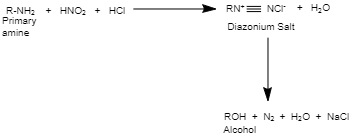
Correct option: (B) An alcohol.
Additional information: At room temperature, primary amines are liquid, whereas secondary and tertiary amines are solid. Treatment of nitrous acid ($HN{{O}_{2}}$ ) with secondary amines gives an insoluble oil layer of nitrosamine; with tertiary amines, it gives a clear solution of quaternary ammonium salts.
Note: The nitrous acid test is used as a test for amines in organic chemistry to identify whether the compound has an amino functional group present or not. The primary amine can further be identified with the carbylamine test, in which amines are treated with chloroform in the presence of alkali. An alkyl isocyanide ($RNC$ ) is formed in this process. Both aliphatic and aromatic amines can give this test.
Complete Step by Step Solution:
Reaction of $HN{{O}_{2}}$ with aliphatic amines, also known as the nitrous acid test, is an important test for distinguishing primary, secondary, and tertiary amines. When nitrous acid $HN{{O}_{2}}$ ) reacts with aliphatic primary amine in the cold, it first processes a diazonium salt, which is unstable. The diazonium salt then decomposes to alcohol along with the evolution of nitrogen gas (${{N}_{2}}$ ) and water.
Correct option: (B) An alcohol.
Additional information: At room temperature, primary amines are liquid, whereas secondary and tertiary amines are solid. Treatment of nitrous acid ($HN{{O}_{2}}$ ) with secondary amines gives an insoluble oil layer of nitrosamine; with tertiary amines, it gives a clear solution of quaternary ammonium salts.
Note: The nitrous acid test is used as a test for amines in organic chemistry to identify whether the compound has an amino functional group present or not. The primary amine can further be identified with the carbylamine test, in which amines are treated with chloroform in the presence of alkali. An alkyl isocyanide ($RNC$ ) is formed in this process. Both aliphatic and aromatic amines can give this test.
Recently Updated Pages
JEE Main 2023 April 6 Shift 1 Question Paper with Answer Key

JEE Main 2023 April 6 Shift 2 Question Paper with Answer Key
JEE Main 2023 (January 31 Evening Shift) Question Paper with Solutions [PDF]
JEE Main 2023 January 30 Shift 2 Question Paper with Answer Key
JEE Main 2023 January 25 Shift 1 Question Paper with Answer Key
JEE Main 2023 January 24 Shift 2 Question Paper with Answer Key
Trending doubts
JEE Main 2026: Session 2 Registration Open, City Intimation Slip, Exam Dates, Syllabus & Eligibility
JEE Main 2026 Application Login: Direct Link, Registration, Form Fill, and Steps
Understanding the Angle of Deviation in a Prism
Hybridisation in Chemistry – Concept, Types & Applications
How to Convert a Galvanometer into an Ammeter or Voltmeter
Understanding the Electric Field of a Uniformly Charged Ring
Other Pages
JEE Advanced Marks vs Ranks 2025: Understanding Category-wise Qualifying Marks and Previous Year Cut-offs
NCERT Solutions For Class 12 Chemistry Chapter 1 Solutions (2025-26)
Solutions Class 12 Chemistry Chapter 1 CBSE Notes - 2025-26
NCERT Solutions For Class 12 Chemistry Chapter 4 The d and f Block Elements (2025-26)
Biomolecules Class 12 Chemistry Chapter 10 CBSE Notes - 2025-26
NCERT Solutions For Class 12 Chemistry Chapter 10 Biomolecules (2025-26)