




How is Nylon 6,6 obtained. Give reaction
Answer
 Verified
654k+ views
Hint:Nylon 6,6 is a type of polyamide or nylon. It is made up of two monomers each containing 6 carbon atoms, hexamethylenediamine and adipic acid.
Complete step by step answer:
Nylon,6,6 is synthesized by polycondensation of hexamethylenediamine and adipic acid.
Equivalent amounts of hexamethylenediamine and adipic acid are combined with water in a reactor. This is crystallized to make nylon salt, an ammonium/ carbonate mixture and thus molten nylon,6,6 is formed.
To prepare Nylon 6,6 adipic acid and hexamethylenediamine are heated at 553 K under pressure.
This reaction is a shown:
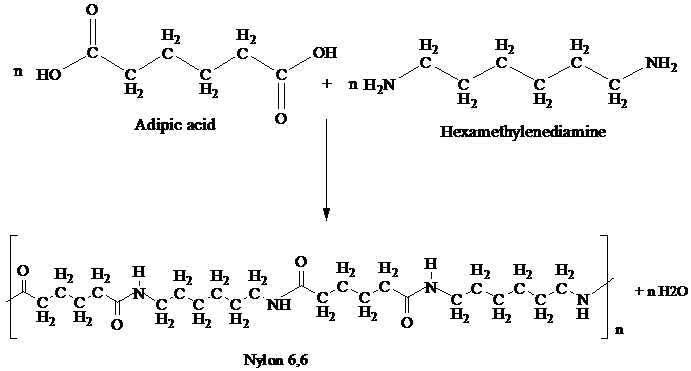
The resulting polymer is extruded into a wide range of fiber types. The fibers are drawn, or sketched in a process that increases their length and reorients the materials molecules parallel to one another to produce a strong, elastic filament.
Note:
Nylon 6,6 has long molecular chains resulting in more hydrogen bonds, creating chemical springs and making it very resilient. It is an amorphous solid so it has a large elastic property and is slightly soluble in boiling water and is very stable in nature. It is very difficult to dye, but one it is dyed it has a high colorfastness and is less susceptible to fading.
Complete step by step answer:
Nylon,6,6 is synthesized by polycondensation of hexamethylenediamine and adipic acid.
Equivalent amounts of hexamethylenediamine and adipic acid are combined with water in a reactor. This is crystallized to make nylon salt, an ammonium/ carbonate mixture and thus molten nylon,6,6 is formed.
To prepare Nylon 6,6 adipic acid and hexamethylenediamine are heated at 553 K under pressure.
This reaction is a shown:
The resulting polymer is extruded into a wide range of fiber types. The fibers are drawn, or sketched in a process that increases their length and reorients the materials molecules parallel to one another to produce a strong, elastic filament.
Note:
Nylon 6,6 has long molecular chains resulting in more hydrogen bonds, creating chemical springs and making it very resilient. It is an amorphous solid so it has a large elastic property and is slightly soluble in boiling water and is very stable in nature. It is very difficult to dye, but one it is dyed it has a high colorfastness and is less susceptible to fading.
Recently Updated Pages
Explain the structure of megasporangium class 12 biology CBSE

Why is chloroform kept in dark coloured bottles class 12 chemistry CBSE
Derive the balancing condition of a Wheatstone bri class 12 physics CBSE
Draw VI characteristics of a pn junction diode Explain class 12 physics CBSE
Is it possible to carry pride in ones language too class 12 english CBSE
In a population at Hardy Weinberg equilibrium the allele class 12 biology CBSE
Trending doubts
Draw a labelled sketch of the human eye class 12 physics CBSE
Which are the Top 10 Largest Countries of the World?
Draw ray diagrams each showing i myopic eye and ii class 12 physics CBSE
Which is the correct genotypic ratio of mendel dihybrid class 12 biology CBSE
Differentiate between homogeneous and heterogeneous class 12 chemistry CBSE
Which animal never drinks water in its entire life class 12 biology CBSE