




What is nucleosome? Explain the packaging of the DNA helix. Draw the labeled diagram of the nucleosome.
Answer
 Verified
591k+ views
Hint: The basic structural unit of the DNA is called the nucleosome. DNA is a molecule that contains two polynucleotide chains that run antiparallel to each other and form the DNA helix.
Complete answer:
The basic structural and fundamental unit of the DNA of a eukaryotic chromosome is called the nucleosome. It is formed by a section of DNA molecules and proteins. The proteins involved are the- highly basic histone proteins that form the core of the nucleosome. The residues of amino acids- lysine and arginine form the basic protein- Histone. They help in the condensation of chromatin by wrapping the DNA tightly and compactly around itself. This condensation helps the DNA to fit inside the nucleus of a cell. The center of a nucleosome core- is formed by the histone octamer. Histone octamer is a complex protein molecule formed by the two copies of- H2A, H2B, H3, and H4 histone proteins. The H3 and H4 proteins are sandwiched between the H2A and H2B proteins. A small segment of the DNA chain binds around this octamer complex, approximately 1.65 times. The structure of the nucleosome is completed by the H1 protein. It binds to the nucleosome core at the entry or exit of the DNA and keeps the structure of DNA intact. They also help to bind the nucleosomes together.
Nucleosomes are the repeating unit in the eukaryotic chromatin and give the appearance of beads on a string. A single nucleosome has around 150 base pairs of DNA.
The eukaryotic cells undergo DNA packaging to accommodate the- large lengths of the DNA molecules into the nucleus of each cell. The DNA forms the double helix structure by wounding two strands of DNA molecules in an antiparallel manner. The helix is right winded and has 10-10.5 pairs of bases in its every turn. Its backbone is made by the sugar molecules and phosphate group and has nitrogenous bases attached to them. A sequence of nucleotides on DNA forms a gene- the functional unit of heredity and inheritance. The information of DNA is stored in genes. The long-stranded DNA molecules are twisted, condensed, and packed to form chromosomes in a cell.
The DNA is packed 1.65 times around the histone to form a nucleosome. The negatively charged DNA coils around eight positively charged histone proteins to form a nucleosome. The strand of nucleosomes folds up to form chromatin fiber. The nucleosome looks like- beads on a string on the chromatin fiber. Chromatin fibers are tightly packed to form chromosomes. Chromosomes are thread-like structures made up of DNA and proteins that are present inside the nucleus of a cell and carry genetic information from one generation to another. They also play an important role in heredity and variation, mutation, cell division, etc.
DNA packaging helps to adjust the 6 feet long DNA into the nucleus of each eukaryotic cell.
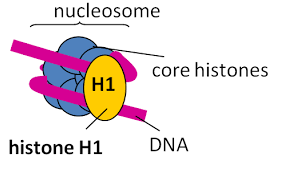
Note: Roger Kornberg was the first scientist to- study and give the structure of nucleosomes. The double helix structure of DNA was studied by Watson and Crick through X-ray crystallography.
Complete answer:
The basic structural and fundamental unit of the DNA of a eukaryotic chromosome is called the nucleosome. It is formed by a section of DNA molecules and proteins. The proteins involved are the- highly basic histone proteins that form the core of the nucleosome. The residues of amino acids- lysine and arginine form the basic protein- Histone. They help in the condensation of chromatin by wrapping the DNA tightly and compactly around itself. This condensation helps the DNA to fit inside the nucleus of a cell. The center of a nucleosome core- is formed by the histone octamer. Histone octamer is a complex protein molecule formed by the two copies of- H2A, H2B, H3, and H4 histone proteins. The H3 and H4 proteins are sandwiched between the H2A and H2B proteins. A small segment of the DNA chain binds around this octamer complex, approximately 1.65 times. The structure of the nucleosome is completed by the H1 protein. It binds to the nucleosome core at the entry or exit of the DNA and keeps the structure of DNA intact. They also help to bind the nucleosomes together.
Nucleosomes are the repeating unit in the eukaryotic chromatin and give the appearance of beads on a string. A single nucleosome has around 150 base pairs of DNA.
The eukaryotic cells undergo DNA packaging to accommodate the- large lengths of the DNA molecules into the nucleus of each cell. The DNA forms the double helix structure by wounding two strands of DNA molecules in an antiparallel manner. The helix is right winded and has 10-10.5 pairs of bases in its every turn. Its backbone is made by the sugar molecules and phosphate group and has nitrogenous bases attached to them. A sequence of nucleotides on DNA forms a gene- the functional unit of heredity and inheritance. The information of DNA is stored in genes. The long-stranded DNA molecules are twisted, condensed, and packed to form chromosomes in a cell.
The DNA is packed 1.65 times around the histone to form a nucleosome. The negatively charged DNA coils around eight positively charged histone proteins to form a nucleosome. The strand of nucleosomes folds up to form chromatin fiber. The nucleosome looks like- beads on a string on the chromatin fiber. Chromatin fibers are tightly packed to form chromosomes. Chromosomes are thread-like structures made up of DNA and proteins that are present inside the nucleus of a cell and carry genetic information from one generation to another. They also play an important role in heredity and variation, mutation, cell division, etc.
DNA packaging helps to adjust the 6 feet long DNA into the nucleus of each eukaryotic cell.
Note: Roger Kornberg was the first scientist to- study and give the structure of nucleosomes. The double helix structure of DNA was studied by Watson and Crick through X-ray crystallography.
Recently Updated Pages
Master Class 12 Business Studies: Engaging Questions & Answers for Success

Master Class 12 Chemistry: Engaging Questions & Answers for Success
Master Class 12 Biology: Engaging Questions & Answers for Success
Class 12 Question and Answer - Your Ultimate Solutions Guide
Master Class 11 English: Engaging Questions & Answers for Success
Master Class 11 Social Science: Engaging Questions & Answers for Success
Trending doubts
Which are the Top 10 Largest Countries of the World?
Draw a labelled sketch of the human eye class 12 physics CBSE
The end of compass needle which points towards north class 12 physics CBSE
Differentiate between homogeneous and heterogeneous class 12 chemistry CBSE
Why is the cell called the structural and functional class 12 biology CBSE
When was the first election held in India a 194748 class 12 sst CBSE