




Name two commonly used vectors in genetic engineering.
Answer
 Verified
603.9k+ views
Hint: Vectors have the ability to replicate within bacterial cells independent of the control of chromosomal DNA.
Complete answer:
Two types of vectors that are most commonly used are plasmids and bacteriophage.

Plasmids are circular DNA molecules which are present independently inside the bacterial cell, and it has one or more genes. These genes have an important role in the host bacterium. The plasmids contain a specific DNA sequence called the origin of replication which helps plasmids to replicate independently. Some plasmids often use host cell enzymes for replication while some can code for their own special type of enzymes for replication.
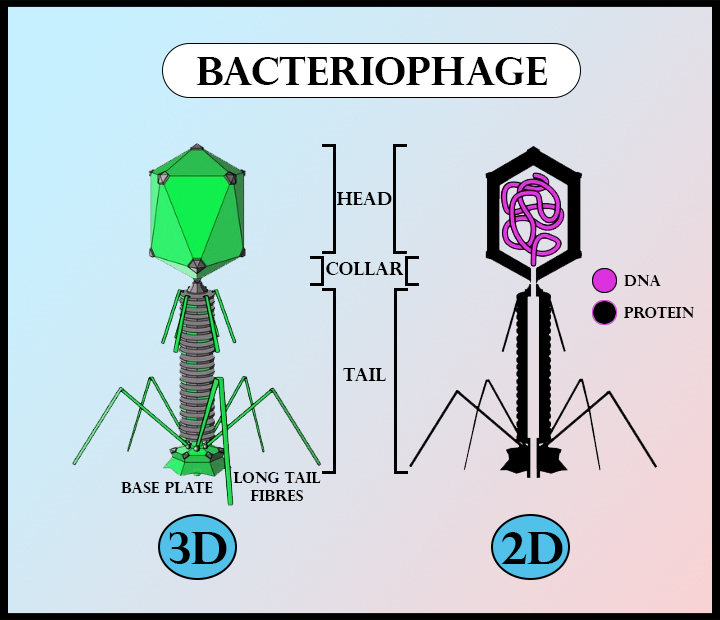
Bacteriophages are a group of viruses that use bacterial cells as hosts and reproduce in it by infecting the bacterial cells. Bacteriophages also contain a protein coat that provides protection to the genome. Most of the phages are DNA viruses that code for several genes responsible for virus replication. A major problem of using plasmids as a cloning vector is the size of the gene of interest is small. However, bacteriophages help to overcome this problem, as larger genes can be transferred by using bacteriophage as a cloning vector.
Note: In molecular biology, a vector refers to a DNA molecule that transfers genetic material into another cell and the genetic material gets incorporated into the cell genome and expressed. The foreign DNA carried by the vector is referred to as recombinant DNA. The vectors are generally characterized by three factors such as the origin of replication, multi cloning site, and a selective marker.
Complete answer:
Two types of vectors that are most commonly used are plasmids and bacteriophage.
Plasmids are circular DNA molecules which are present independently inside the bacterial cell, and it has one or more genes. These genes have an important role in the host bacterium. The plasmids contain a specific DNA sequence called the origin of replication which helps plasmids to replicate independently. Some plasmids often use host cell enzymes for replication while some can code for their own special type of enzymes for replication.
Bacteriophages are a group of viruses that use bacterial cells as hosts and reproduce in it by infecting the bacterial cells. Bacteriophages also contain a protein coat that provides protection to the genome. Most of the phages are DNA viruses that code for several genes responsible for virus replication. A major problem of using plasmids as a cloning vector is the size of the gene of interest is small. However, bacteriophages help to overcome this problem, as larger genes can be transferred by using bacteriophage as a cloning vector.
Note: In molecular biology, a vector refers to a DNA molecule that transfers genetic material into another cell and the genetic material gets incorporated into the cell genome and expressed. The foreign DNA carried by the vector is referred to as recombinant DNA. The vectors are generally characterized by three factors such as the origin of replication, multi cloning site, and a selective marker.
Recently Updated Pages
Master Class 12 Business Studies: Engaging Questions & Answers for Success

Master Class 12 Chemistry: Engaging Questions & Answers for Success
Master Class 12 Biology: Engaging Questions & Answers for Success
Class 12 Question and Answer - Your Ultimate Solutions Guide
Master Class 11 English: Engaging Questions & Answers for Success
Master Class 11 Social Science: Engaging Questions & Answers for Success
Trending doubts
Which are the Top 10 Largest Countries of the World?
Draw a labelled sketch of the human eye class 12 physics CBSE
The end of compass needle which points towards north class 12 physics CBSE
Differentiate between homogeneous and heterogeneous class 12 chemistry CBSE
In order to find out the different types of gametes class 12 biology NEET_UG
Why is the cell called the structural and functional class 12 biology CBSE