




Label the figure given below, as directed below in (i) to (iv) and give the name of each type of teeth.
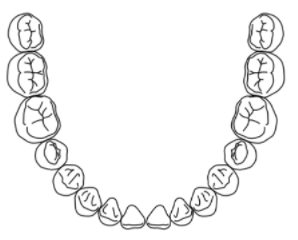
(i) The cutting and biting teeth as ‘A’
(ii) The piercing and tearing teeth as ‘B’
(iii) The grinding and chewing teeth as ‘C’
(iv) The grinding teeth present only in adult as ‘D’
Answer
 Verified
528.6k+ views
Hint: The figure represents one set of teeth present in the human adult. One set of teeth contains 16 teeth present in the upper and lower jaw. The teeth are of four types- incisors, canine, molar, premolars.
Complete answer:
Humans have 20 milk teeth and 32 permanent teeth. The teeth are classified as incisors, canines, premolars and molars. The teeth basically serve the function of processing the food so that that can be broken down easily and better enzymatic action for digestion can take place.
Let us discuss the types of teeth in detail.
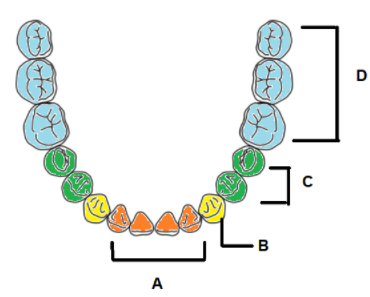
Incisors are the cutting and biting teeth. They are a total of 8 in number (4 each in both the jaws). They are the front teeth whose main function is to cut the food. Two in the middle are called central incisors and the two at the adjacent are lateral incisors. (Represented as A in the figure below)
Canines: They are the four in number, two on each jaw. They are placed adjacent to the incisors. They are relatively long and pointed. They are also known as dog teeth. The main function of these teeth is piercing and tearing food. This tooth is well developed in carnivores. (Represented as B in the figure below.)
Premolars: These are permanent teeth located after the canines. They are 8 in total, 4 in each jaw. They are the largest teeth. They have a flat biting surface. The function of premolars is grinding and chewing of food. (Represented as C in the figure below)
Molars: Molars are the last teeth in our mouth. They are large flat teeth that are located beyond the premolars. They are 12 in number, 6 in each jaw. They are the grinding teeth. (Represented as D in the figure below)
Note: The molars are the set of permanent teeth. They emerge at the later ages. The first molar arises at the age of 6-7 years. The second molars arise at the age of 12-13 years. The last molar is also known as wisdom teeth. They arise at the age of 17-21 years.
Complete answer:
Humans have 20 milk teeth and 32 permanent teeth. The teeth are classified as incisors, canines, premolars and molars. The teeth basically serve the function of processing the food so that that can be broken down easily and better enzymatic action for digestion can take place.
Let us discuss the types of teeth in detail.
Incisors are the cutting and biting teeth. They are a total of 8 in number (4 each in both the jaws). They are the front teeth whose main function is to cut the food. Two in the middle are called central incisors and the two at the adjacent are lateral incisors. (Represented as A in the figure below)
Canines: They are the four in number, two on each jaw. They are placed adjacent to the incisors. They are relatively long and pointed. They are also known as dog teeth. The main function of these teeth is piercing and tearing food. This tooth is well developed in carnivores. (Represented as B in the figure below.)
Premolars: These are permanent teeth located after the canines. They are 8 in total, 4 in each jaw. They are the largest teeth. They have a flat biting surface. The function of premolars is grinding and chewing of food. (Represented as C in the figure below)
Molars: Molars are the last teeth in our mouth. They are large flat teeth that are located beyond the premolars. They are 12 in number, 6 in each jaw. They are the grinding teeth. (Represented as D in the figure below)
Note: The molars are the set of permanent teeth. They emerge at the later ages. The first molar arises at the age of 6-7 years. The second molars arise at the age of 12-13 years. The last molar is also known as wisdom teeth. They arise at the age of 17-21 years.
Recently Updated Pages
Three beakers labelled as A B and C each containing 25 mL of water were taken A small amount of NaOH anhydrous CuSO4 and NaCl were added to the beakers A B and C respectively It was observed that there was an increase in the temperature of the solutions contained in beakers A and B whereas in case of beaker C the temperature of the solution falls Which one of the following statements isarecorrect i In beakers A and B exothermic process has occurred ii In beakers A and B endothermic process has occurred iii In beaker C exothermic process has occurred iv In beaker C endothermic process has occurred

Master Class 8 Social Science: Engaging Questions & Answers for Success
Master Class 8 Science: Engaging Questions & Answers for Success
Master Class 8 Maths: Engaging Questions & Answers for Success
Class 8 Question and Answer - Your Ultimate Solutions Guide
Master Class 9 Social Science: Engaging Questions & Answers for Success
Three beakers labelled as A B and C each containing 25 mL of water were taken A small amount of NaOH anhydrous CuSO4 and NaCl were added to the beakers A B and C respectively It was observed that there was an increase in the temperature of the solutions contained in beakers A and B whereas in case of beaker C the temperature of the solution falls Which one of the following statements isarecorrect i In beakers A and B exothermic process has occurred ii In beakers A and B endothermic process has occurred iii In beaker C exothermic process has occurred iv In beaker C endothermic process has occurred
Master Class 8 Social Science: Engaging Questions & Answers for Success
Master Class 8 Science: Engaging Questions & Answers for Success
Trending doubts
What is BLO What is the full form of BLO class 8 social science CBSE
What are the 12 elements of nature class 8 chemistry CBSE
Give me the opposite gender of Duck class 8 english CBSE
Name the states through which the Tropic of Cancer class 8 social science CBSE
Citizens of India can vote at the age of A 18 years class 8 social science CBSE
Advantages and disadvantages of science