




In the circuit shown in the figure, what is the value of ${{I}_{1}}$ just after pressing the key K?
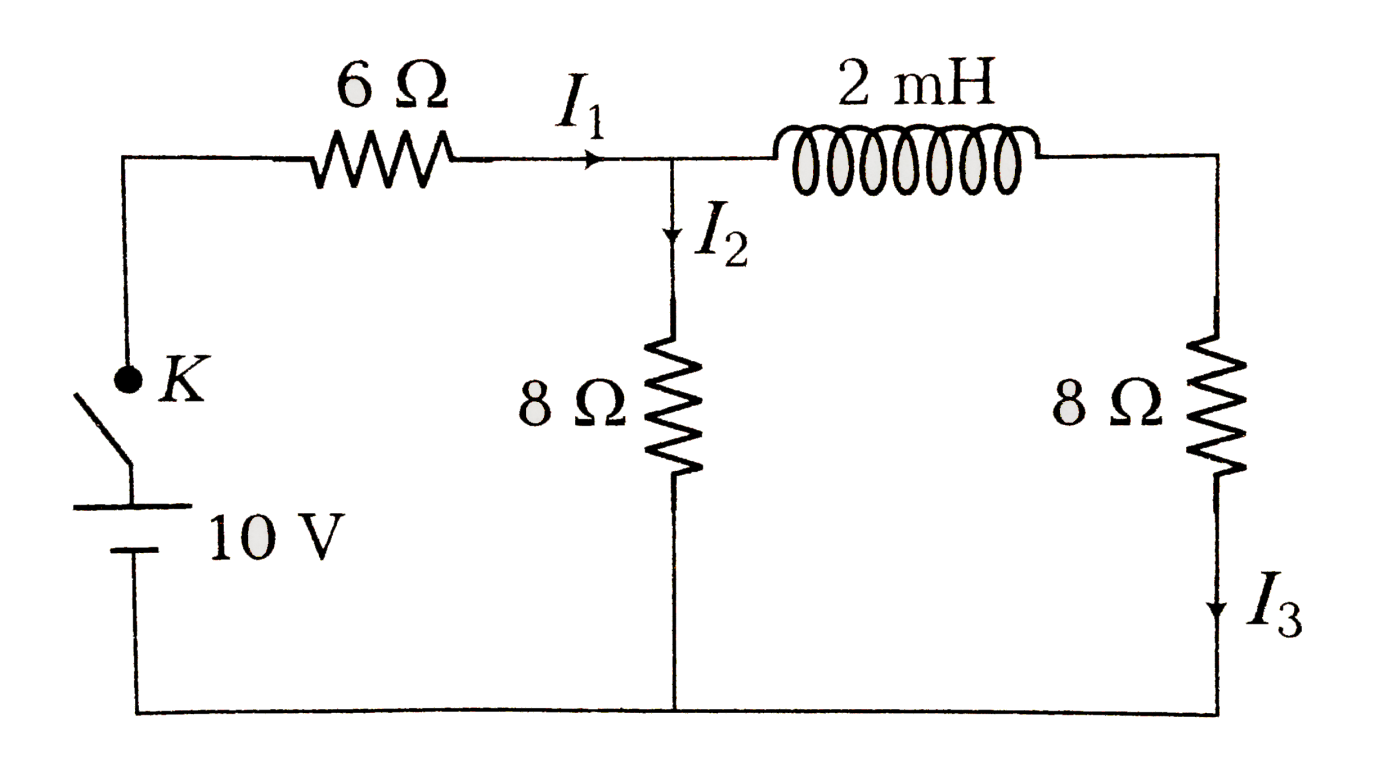
5/7 A
5/11 A
1 A
None of these
Answer
 Verified
662.7k+ views
Hint: First trace the path through which the current is going to pass, now after tracing the path find the equivalent resistance or capacitance if required. Then calculate the value of current flowing through the circuit.
Complete step by step answer:
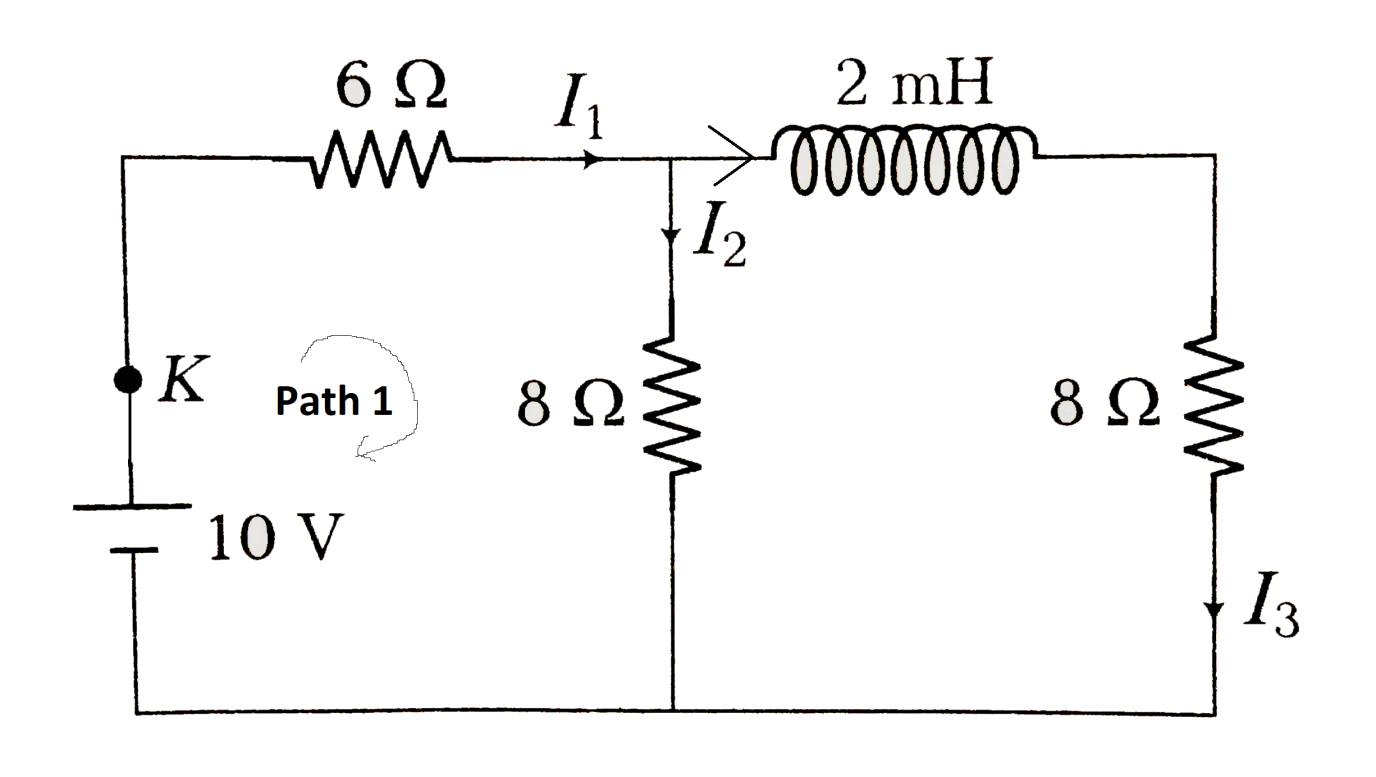
In the above diagram when the key K is closed, we see that a potential difference of 10V and a current has been induced in the circuit, now when the current tries to pass through the 2mH inductor, it could not pass because of its excessively high resistance, so the current takes the path 1, shown in the diagram.
Now in path 1,
Equivalent resistance,
${{R}_{eq}}=\left( 6+8 \right)\Omega $ ,
${{R}_{eq}}=14\Omega $,
So the value of current ${{I}_{1}}$ flowing through the circuit is,
${{I}_{1}}=\dfrac{V}{{{R}_{eq}}}$,
${{I}_{1}}=\dfrac{10}{14}$,
${{I}_{1}}=\dfrac{5}{7}A$,
Therefore the correct option is, option A which is (5/7 A).
Additional Information
Resistance is a device that is used in the electrical circuit to stop the flow of current inside the circuit sometimes partially and sometimes fully.
The difference between the current at two points of an electrical circuit is known as potential difference.
We can show the potential difference by a simple law known as ohm’s law, which states that the voltage or potential difference of a circuit is proportional to the amount of current flowing through the circuit and the resistance offered.
Note:
Inductor is an electrical component that has a very high resistance and its work is to oppose the flow of current through the circuit. Hence the current is passing through a loop named path 1.
Complete step by step answer:
In the above diagram when the key K is closed, we see that a potential difference of 10V and a current has been induced in the circuit, now when the current tries to pass through the 2mH inductor, it could not pass because of its excessively high resistance, so the current takes the path 1, shown in the diagram.
Now in path 1,
Equivalent resistance,
${{R}_{eq}}=\left( 6+8 \right)\Omega $ ,
${{R}_{eq}}=14\Omega $,
So the value of current ${{I}_{1}}$ flowing through the circuit is,
${{I}_{1}}=\dfrac{V}{{{R}_{eq}}}$,
${{I}_{1}}=\dfrac{10}{14}$,
${{I}_{1}}=\dfrac{5}{7}A$,
Therefore the correct option is, option A which is (5/7 A).
Additional Information
Resistance is a device that is used in the electrical circuit to stop the flow of current inside the circuit sometimes partially and sometimes fully.
The difference between the current at two points of an electrical circuit is known as potential difference.
We can show the potential difference by a simple law known as ohm’s law, which states that the voltage or potential difference of a circuit is proportional to the amount of current flowing through the circuit and the resistance offered.
Note:
Inductor is an electrical component that has a very high resistance and its work is to oppose the flow of current through the circuit. Hence the current is passing through a loop named path 1.
Recently Updated Pages
Which of the following graphs shows the variation of class 12 physics CBSE

Draw a labelled diagram of the human male reproductive class 12 biology CBSE
Describe the experiment to compare the emf of two cells class 12 physics CBSE
What is standard hydrogen electrode
What is conventional current and electric current class 12 physics CBSE
2Bromopentane is treated with an alcoholic KOH solution class 12 chemistry CBSE
Trending doubts
Draw a labelled sketch of the human eye class 12 physics CBSE
Which are the Top 10 Largest Countries of the World?
Differentiate between homogeneous and heterogeneous class 12 chemistry CBSE
Draw ray diagrams each showing i myopic eye and ii class 12 physics CBSE
Which is the correct genotypic ratio of mendel dihybrid class 12 biology CBSE
What is the Full Form of PVC, PET, HDPE, LDPE, PP and PS ?