




Explain the structure and functions of cholesterol.
Answer
 Verified
631.8k+ views
Hint: The molecular formula of cholesterol is \[{{C}_{27}}{{H}_{46}}O\]. Cholesterol contains 4 rings in its structure, one double bond, one hydroxyl group and one hydrocarbon chain. Cholesterol is also known as a "sterol" because it contains alcohol and a steroid moiety in its structure.
Complete answer:
Structure of cholesterol:
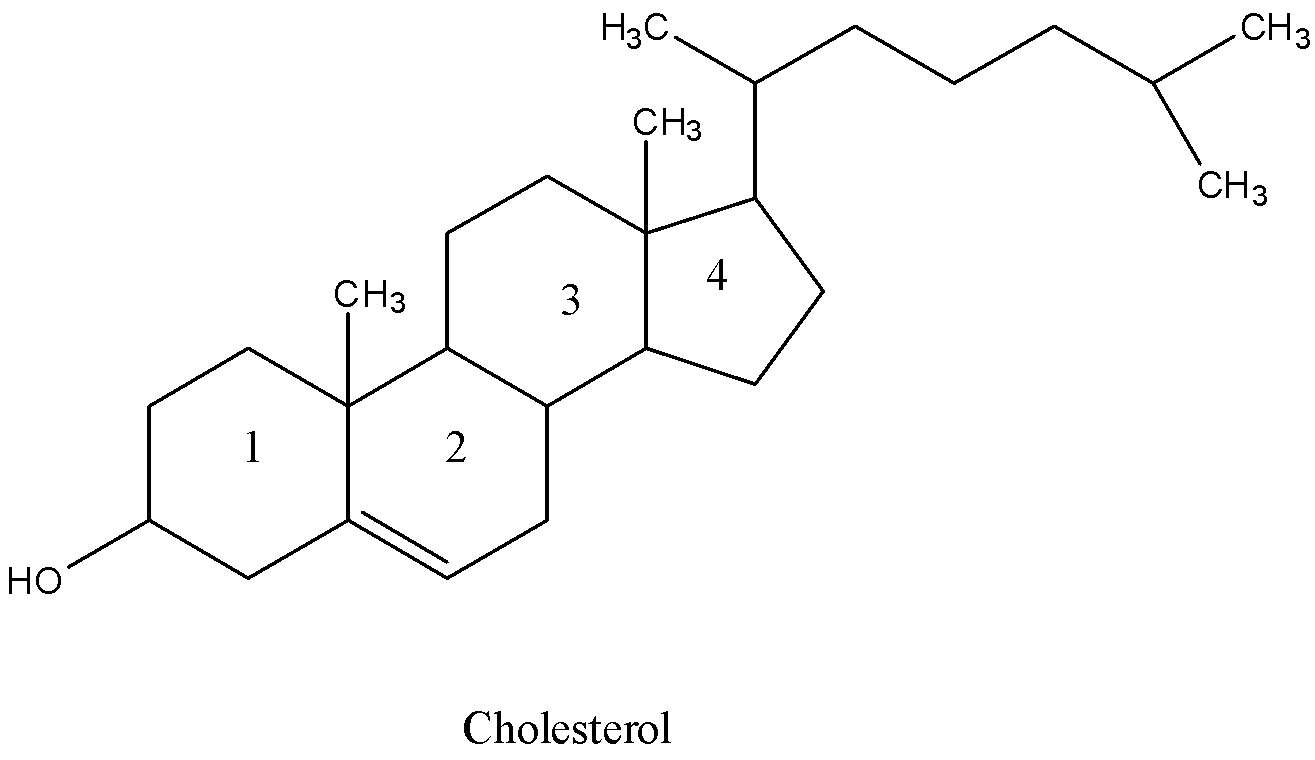
We know that Cholesterol is a lipid having a structure consisting of four hydrocarbon rings forming the bulky steroid structure and they are labeled with numbers 1, 2, 3 and 4. We can see the numbering in the below structure.
There is a hydrocarbon chain containing eight carbon atoms linked to five membered rings of the steroid.
There is a double bond in the ring-2 of the cholesterol.
Cholesterol contains a hydroxyl group linked to the first six membered rings in the structure.
The hydroxyl group of cholesterol is capable of forming hydrogen bonds with the nearby oxygen of the carbonyl group of phospholipid.
Functions of cholesterol:
Cholesterol is a vital constituent of the cell membrane.
Cholesterol is going to maintain proper membrane permeability and fluidity of the cells.
Cholesterol is going to involve the synthesis of Steroid Hormones, Vitamin-D and Bile Acids in the cells.
Note: Cholesterol is not present in prokaryotes like bacteria and archaea. Because prokaryotes do not contain a proper cell wall in their structure. By using sunlight cholesterol present in the skin of eukaryotes prepares vitamin-D which is useful to absorb calcium from the intestine.
Complete answer:
Structure of cholesterol:
We know that Cholesterol is a lipid having a structure consisting of four hydrocarbon rings forming the bulky steroid structure and they are labeled with numbers 1, 2, 3 and 4. We can see the numbering in the below structure.
There is a hydrocarbon chain containing eight carbon atoms linked to five membered rings of the steroid.
There is a double bond in the ring-2 of the cholesterol.
Cholesterol contains a hydroxyl group linked to the first six membered rings in the structure.
The hydroxyl group of cholesterol is capable of forming hydrogen bonds with the nearby oxygen of the carbonyl group of phospholipid.
Functions of cholesterol:
Cholesterol is a vital constituent of the cell membrane.
Cholesterol is going to maintain proper membrane permeability and fluidity of the cells.
Cholesterol is going to involve the synthesis of Steroid Hormones, Vitamin-D and Bile Acids in the cells.
Note: Cholesterol is not present in prokaryotes like bacteria and archaea. Because prokaryotes do not contain a proper cell wall in their structure. By using sunlight cholesterol present in the skin of eukaryotes prepares vitamin-D which is useful to absorb calcium from the intestine.
Recently Updated Pages
Master Class 12 Business Studies: Engaging Questions & Answers for Success

Master Class 12 Chemistry: Engaging Questions & Answers for Success
Master Class 12 Biology: Engaging Questions & Answers for Success
Class 12 Question and Answer - Your Ultimate Solutions Guide
Master Class 11 English: Engaging Questions & Answers for Success
Master Class 11 Social Science: Engaging Questions & Answers for Success
Trending doubts
The end of compass needle which points towards north class 12 physics CBSE
When was the first election held in India a 194748 class 12 sst CBSE
Hormone responsible for the secretion of milk after class 12 biology CBSE
Yeast reproduces by A Spore formation B Multiple fission class 12 biology CBSE
Draw a well labelled diagram of LS of the human ki class 12 biology CBSE
Draw a diagram of a flower and name the parts class 12 biology ICSE