




Explain the process of fertilisation in plants.
Answer
 Verified
645.6k+ views
Hint: Fertilisation is the most vital event of sexual reproduction. It is defined as fusion of gametes. This process is also called syngamy. The pollen grain formed by another gets transferred to stigma and fuses there. This process is called the fertilisation process in plants.
Complete answer:
The pollen grain germinates on stigma to produce a pollen tube through one of the germ pores. The content of pollen grain moves into the pollen tube. Pollen tube grows through the tissue of stigma and style and reaches the ovary . The generative cell divides and forms two male gametes during growth of the pollen tube in the stigma.
The pollen tube enters the embryo sac at the micropylar end. A typical embryo sac has two synergids, and one egg cell and together they are called egg apparatus at micropylar end three nuclei get organised as antipodal cells at chalaza end. Two nuclei in the centre are called polar nuclei.
The polar nuclei fuses before fertilisation to form a secondary nucleus. After entering the micropylar end that is at synergids the pollen tube releases two male gametes into the cytoplasm of synergids .
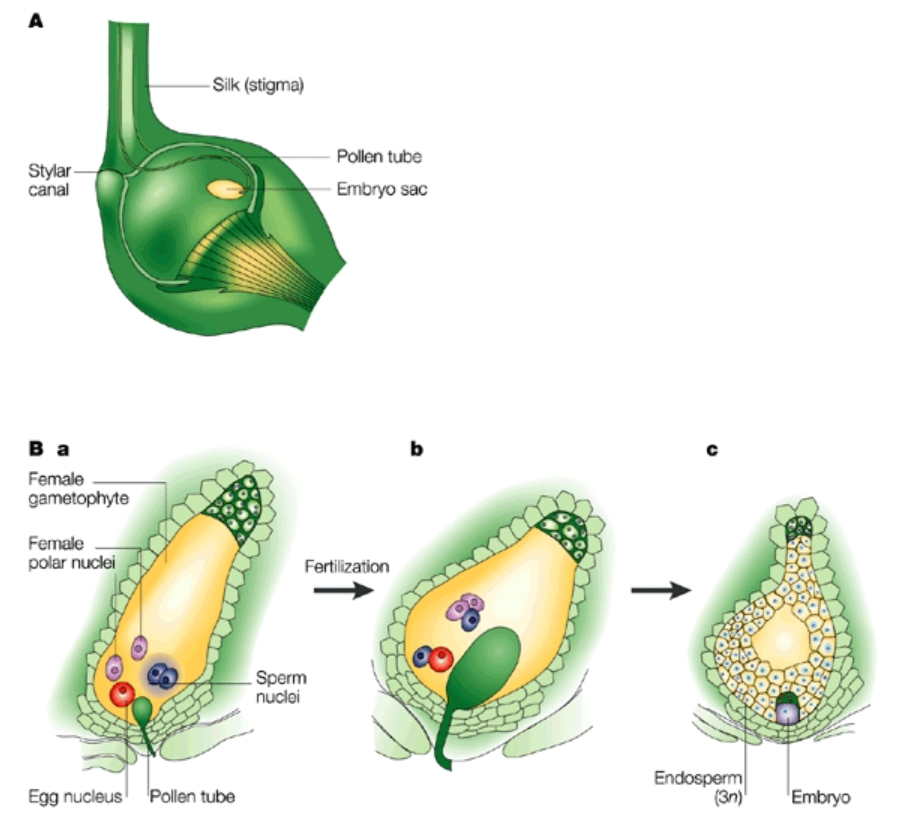
FIGURE: SHOWING DOUBLE FERTILIZATION
Syngamy: male gamete moves towards the egg cell and fuses with its nucleus . Thus, resulting in formation of a diploid cell , the zygote.
Triple Fusion: The other male gamete moves towards the polar nuclei located in central cell and fuses with them to produce triploid endosperm nucleus (PEN)
The two types of fusion that is syngamy and triple fusion occur in embryo sac , it is termed as double fertilization.
Note: Pollen grain or microspore divides mitotically into two cells:-
Vegetative Cell :- Bigger in size , having abundant food reserve and a large irregularly shaped nucleus.
Generative Cell :- small and floats in the cytoplasm of vegetative cells. It is spindle shape with dense cytoplasm and nucleus.
Complete answer:
The pollen grain germinates on stigma to produce a pollen tube through one of the germ pores. The content of pollen grain moves into the pollen tube. Pollen tube grows through the tissue of stigma and style and reaches the ovary . The generative cell divides and forms two male gametes during growth of the pollen tube in the stigma.
The pollen tube enters the embryo sac at the micropylar end. A typical embryo sac has two synergids, and one egg cell and together they are called egg apparatus at micropylar end three nuclei get organised as antipodal cells at chalaza end. Two nuclei in the centre are called polar nuclei.
The polar nuclei fuses before fertilisation to form a secondary nucleus. After entering the micropylar end that is at synergids the pollen tube releases two male gametes into the cytoplasm of synergids .
FIGURE: SHOWING DOUBLE FERTILIZATION
Syngamy: male gamete moves towards the egg cell and fuses with its nucleus . Thus, resulting in formation of a diploid cell , the zygote.
Triple Fusion: The other male gamete moves towards the polar nuclei located in central cell and fuses with them to produce triploid endosperm nucleus (PEN)
The two types of fusion that is syngamy and triple fusion occur in embryo sac , it is termed as double fertilization.
Note: Pollen grain or microspore divides mitotically into two cells:-
Vegetative Cell :- Bigger in size , having abundant food reserve and a large irregularly shaped nucleus.
Generative Cell :- small and floats in the cytoplasm of vegetative cells. It is spindle shape with dense cytoplasm and nucleus.
Recently Updated Pages
Basicity of sulphurous acid and sulphuric acid are

Master Class 12 Economics: Engaging Questions & Answers for Success
Master Class 12 Biology: Engaging Questions & Answers for Success
Master Class 11 English: Engaging Questions & Answers for Success
Master Class 11 Physics: Engaging Questions & Answers for Success
Master Class 11 Computer Science: Engaging Questions & Answers for Success
Trending doubts
Draw a labelled sketch of the human eye class 12 physics CBSE
The chemical formula of tear gas is A CO Cl 2 B C 10 class 12 chemistry CBSE
Draw ray diagrams each showing i myopic eye and ii class 12 physics CBSE
Which are the Top 10 Largest Countries of the World?
Differentiate between homogeneous and heterogeneous class 12 chemistry CBSE
Which is the correct genotypic ratio of mendel dihybrid class 12 biology CBSE