




When ethylene bromide is treated with \[Zn\] we get
(a) Alkane
(b) Alkene
(c) Alkyne
(d) All
Answer
 Verified
233.1k+ views
Hint: When two atoms or substituents which are connected to two neighboring carbon atoms undergo elimination via a one or two-step reaction pathway. Such reactions are recognized as elimination reactions.
Complete Step by Step Answer:
The given question represents the reaction of \[Zn\]with ethylene bromide.
The structure of ethylene bromide contains two bromine atoms which are seated on two adjacent carbon atoms. The structure of ethylene bromide can be represented below.
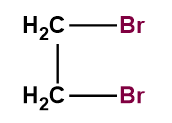
Figure: Structure of ethylene bromide.
When the alcoholic solution of ethylene bromide is treated with \[Zn\], the formation of ethylene molecules is observed with the formation of \[ZnB{r_2}\]salt.
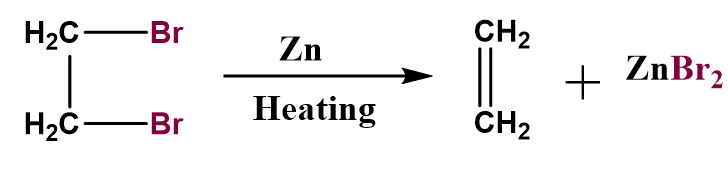
Figure: Reaction of ethylene bromide with zinc.
In the above reaction the \[Zn\] behave as a de-halogenating or eliminating agent i.e., it causes the removal of adjacent bromine atoms on neighboring carbon atoms.
The question contains options such as an alkane, alkene, and alkyne. Hence, from the above explanation, it is clear that when ethylene bromide is heated with zinc the formation of ethylene (alkene) occurs. There is no alkane and alkyne formation observed.
Therefore, the option which contained alkane (a), alkyne (c) and mixture (d) is wrong.
Therefore, from the above discussion, it is quite clear that, option (b) will be the correct answer.
Note: The alkane, alkene and alkyne are saturated (alkane) and unsaturated (alkene and alkyne) hydrocarbons. Alkane is a saturated hydrocarbon, in which the carbon atoms contain the single bonds Alkene and alkyne belong to the family of unsaturated hydrocarbons in which the double and triple bond is present between the carbon atoms.
Complete Step by Step Answer:
The given question represents the reaction of \[Zn\]with ethylene bromide.
The structure of ethylene bromide contains two bromine atoms which are seated on two adjacent carbon atoms. The structure of ethylene bromide can be represented below.
Figure: Structure of ethylene bromide.
When the alcoholic solution of ethylene bromide is treated with \[Zn\], the formation of ethylene molecules is observed with the formation of \[ZnB{r_2}\]salt.
Figure: Reaction of ethylene bromide with zinc.
In the above reaction the \[Zn\] behave as a de-halogenating or eliminating agent i.e., it causes the removal of adjacent bromine atoms on neighboring carbon atoms.
The question contains options such as an alkane, alkene, and alkyne. Hence, from the above explanation, it is clear that when ethylene bromide is heated with zinc the formation of ethylene (alkene) occurs. There is no alkane and alkyne formation observed.
Therefore, the option which contained alkane (a), alkyne (c) and mixture (d) is wrong.
Therefore, from the above discussion, it is quite clear that, option (b) will be the correct answer.
Note: The alkane, alkene and alkyne are saturated (alkane) and unsaturated (alkene and alkyne) hydrocarbons. Alkane is a saturated hydrocarbon, in which the carbon atoms contain the single bonds Alkene and alkyne belong to the family of unsaturated hydrocarbons in which the double and triple bond is present between the carbon atoms.
Recently Updated Pages
JEE Main 2023 April 6 Shift 1 Question Paper with Answer Key

JEE Main 2023 April 6 Shift 2 Question Paper with Answer Key
JEE Main 2023 (January 31 Evening Shift) Question Paper with Solutions [PDF]
JEE Main 2023 January 30 Shift 2 Question Paper with Answer Key
JEE Main 2023 January 25 Shift 1 Question Paper with Answer Key
JEE Main 2023 January 24 Shift 2 Question Paper with Answer Key
Trending doubts
JEE Main 2026: Session 2 Registration Open, City Intimation Slip, Exam Dates, Syllabus & Eligibility
JEE Main 2026 Application Login: Direct Link, Registration, Form Fill, and Steps
Understanding the Angle of Deviation in a Prism
Hybridisation in Chemistry – Concept, Types & Applications
How to Convert a Galvanometer into an Ammeter or Voltmeter
Understanding the Electric Field of a Uniformly Charged Ring
Other Pages
JEE Advanced Marks vs Ranks 2025: Understanding Category-wise Qualifying Marks and Previous Year Cut-offs
NCERT Solutions For Class 12 Chemistry Chapter 1 Solutions (2025-26)
Solutions Class 12 Chemistry Chapter 1 CBSE Notes - 2025-26
NCERT Solutions For Class 12 Chemistry Chapter 4 The d and f Block Elements (2025-26)
Biomolecules Class 12 Chemistry Chapter 10 CBSE Notes - 2025-26
NCERT Solutions For Class 12 Chemistry Chapter 10 Biomolecules (2025-26)