




Dress material Terylene is essentially:
A) A nylon product
B) Acrylic product
C) Polyester product
D) Rayon product
Answer
 Verified
573.3k+ views
Hint:Terylene is an artificial synthetic fiber extensively used in the textile industry to make hard wear clothes like sarees, tapestry, and dress material. It is mixed with natural fiber (like wool and cotton) to make huge varieties of clothes.
Complete step by step answer:1) Dress material terylene is essentially a polyester product; made by condensation polymerization ethylene glycol \[\left( {{\text{ethane - 1,2 - diol}}} \right)\]and terephthalic acid \[\left( {{\text{benzene - 1,4 - dicarboxylic acid}}} \right)\]at \[\left( {{\text{benzene - 1,4 - dicarboxylic acid}}} \right)\], which is obtained from petroleum. Since, it is obtained by condensation polymerization, in which the molecular mass of a polymer is not a whole number of monomers due to loss of water molecules, that’s why it is also called step-growth polymer.
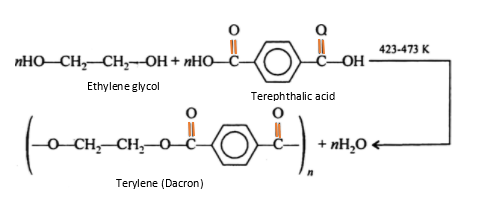
2) Terylene possesses qualities such as lightness, toughness, resistance to scraping and to sunlight, and durability (particularly in the form of staple fiber). It was discovered by J. R. Whinfield and J. T. Dickson, in March \[{\text{1941}}\].
3) It is not affected by acidic substances, neither bleaches nor dry cleaning agents can destroy it and crease resist too. So, it is also used to prepare the seat belt, sails, and tire cords.
Hence, option (C) is the correct choice.
Note:
Terylene is the first polyester fabric ever produced. It may also be known by the brand names Dacron in the US, Lavan in Russia and the former Soviet Union, and Terylene in the UK. It can be easy in the wash and dries quickly, so it is used for the manufacture of wash and wear fabrics and mixed with cotton and wool to increase their resistance to wear and tear.
Complete step by step answer:1) Dress material terylene is essentially a polyester product; made by condensation polymerization ethylene glycol \[\left( {{\text{ethane - 1,2 - diol}}} \right)\]and terephthalic acid \[\left( {{\text{benzene - 1,4 - dicarboxylic acid}}} \right)\]at \[\left( {{\text{benzene - 1,4 - dicarboxylic acid}}} \right)\], which is obtained from petroleum. Since, it is obtained by condensation polymerization, in which the molecular mass of a polymer is not a whole number of monomers due to loss of water molecules, that’s why it is also called step-growth polymer.
2) Terylene possesses qualities such as lightness, toughness, resistance to scraping and to sunlight, and durability (particularly in the form of staple fiber). It was discovered by J. R. Whinfield and J. T. Dickson, in March \[{\text{1941}}\].
3) It is not affected by acidic substances, neither bleaches nor dry cleaning agents can destroy it and crease resist too. So, it is also used to prepare the seat belt, sails, and tire cords.
Hence, option (C) is the correct choice.
Note:
Terylene is the first polyester fabric ever produced. It may also be known by the brand names Dacron in the US, Lavan in Russia and the former Soviet Union, and Terylene in the UK. It can be easy in the wash and dries quickly, so it is used for the manufacture of wash and wear fabrics and mixed with cotton and wool to increase their resistance to wear and tear.
Recently Updated Pages
Three beakers labelled as A B and C each containing 25 mL of water were taken A small amount of NaOH anhydrous CuSO4 and NaCl were added to the beakers A B and C respectively It was observed that there was an increase in the temperature of the solutions contained in beakers A and B whereas in case of beaker C the temperature of the solution falls Which one of the following statements isarecorrect i In beakers A and B exothermic process has occurred ii In beakers A and B endothermic process has occurred iii In beaker C exothermic process has occurred iv In beaker C endothermic process has occurred

Master Class 12 Social Science: Engaging Questions & Answers for Success
Master Class 12 Physics: Engaging Questions & Answers for Success
Master Class 12 Maths: Engaging Questions & Answers for Success
Master Class 12 Economics: Engaging Questions & Answers for Success
Master Class 12 Chemistry: Engaging Questions & Answers for Success
Three beakers labelled as A B and C each containing 25 mL of water were taken A small amount of NaOH anhydrous CuSO4 and NaCl were added to the beakers A B and C respectively It was observed that there was an increase in the temperature of the solutions contained in beakers A and B whereas in case of beaker C the temperature of the solution falls Which one of the following statements isarecorrect i In beakers A and B exothermic process has occurred ii In beakers A and B endothermic process has occurred iii In beaker C exothermic process has occurred iv In beaker C endothermic process has occurred
Master Class 12 Social Science: Engaging Questions & Answers for Success
Master Class 12 Physics: Engaging Questions & Answers for Success
Trending doubts
Which are the Top 10 Largest Countries of the World?
Draw a labelled sketch of the human eye class 12 physics CBSE
Differentiate between homogeneous and heterogeneous class 12 chemistry CBSE
What are the major means of transport Explain each class 12 social science CBSE
Sulphuric acid is known as the king of acids State class 12 chemistry CBSE
Why should a magnesium ribbon be cleaned before burning class 12 chemistry CBSE