




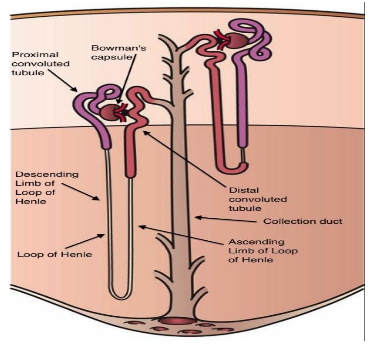
Draw a well-labeled diagram of human nephron and define hemodialysis.
Answer
 Verified
605.4k+ views
Hint: Kidney performs two functions namely excretion of nitrogenous wastes and osmoregulation. Hemodialysis is the phenomenon that is related to kidney failure. The apparatus used in such a condition is called an artificial kidney. This occurs due to the accumulation of excess urea.
Complete answer:
Accumulation of excess urea in blood is called Uremia which is highly harmful and conditions may cause kidney failure in humans.
In the condition of kidney failure, the excess of urea is removed with the help of a process known as hemodialysis and the person is said to be put on dialysis.
The apparatus used in such a condition consists of a dialyzing unit also called a dialyzer which contains a coiled cellophane tube surrounded by a solution having the exact composition as that of plasma.
Blood is drained from a convenient artery into which there is an addition of heparin, an anticoagulant. This blood is pumped into the dialyzer in which the tube removes the nitrogenous wastes and thus cleaning the blood. The blood which was cleaned and heparin is added into it is then pumped back to the body.
Also,
Nephron: nephron is also called as the functional unit of the kidney. Each kidney is composed of a large number of nephrons.
A nephron consists of a glomerulus and renal tubule. Each nephron starts with a renal corpuscle which is the combination of a glomerulus and Bowman's capsule.
It is then followed by the secretory tubule which consists of the proximal convoluted tubule(PCT), the loop of Henle, distal convoluted tubule(DCT).
The DCT opens into a collecting tubule(CT).
Note: The process of hemodialysis the substitute of the kidneys. An important point that when there is an occurrence of kidney failure then to eliminate extra nitrogenous wastes from the blood Hemodialysis is used as a replacement of the original kidney.
Complete answer:
Accumulation of excess urea in blood is called Uremia which is highly harmful and conditions may cause kidney failure in humans.
In the condition of kidney failure, the excess of urea is removed with the help of a process known as hemodialysis and the person is said to be put on dialysis.
The apparatus used in such a condition consists of a dialyzing unit also called a dialyzer which contains a coiled cellophane tube surrounded by a solution having the exact composition as that of plasma.
Blood is drained from a convenient artery into which there is an addition of heparin, an anticoagulant. This blood is pumped into the dialyzer in which the tube removes the nitrogenous wastes and thus cleaning the blood. The blood which was cleaned and heparin is added into it is then pumped back to the body.
Also,
Nephron: nephron is also called as the functional unit of the kidney. Each kidney is composed of a large number of nephrons.
A nephron consists of a glomerulus and renal tubule. Each nephron starts with a renal corpuscle which is the combination of a glomerulus and Bowman's capsule.
It is then followed by the secretory tubule which consists of the proximal convoluted tubule(PCT), the loop of Henle, distal convoluted tubule(DCT).
The DCT opens into a collecting tubule(CT).
Note: The process of hemodialysis the substitute of the kidneys. An important point that when there is an occurrence of kidney failure then to eliminate extra nitrogenous wastes from the blood Hemodialysis is used as a replacement of the original kidney.
Recently Updated Pages
Master Class 10 Computer Science: Engaging Questions & Answers for Success

Master Class 10 General Knowledge: Engaging Questions & Answers for Success
Master Class 10 English: Engaging Questions & Answers for Success
Master Class 10 Social Science: Engaging Questions & Answers for Success
Master Class 10 Maths: Engaging Questions & Answers for Success
Master Class 10 Science: Engaging Questions & Answers for Success
Trending doubts
Which is more stable and why class 12 chemistry CBSE
Which are the Top 10 Largest Countries of the World?
Draw a labelled sketch of the human eye class 12 physics CBSE
Differentiate between homogeneous and heterogeneous class 12 chemistry CBSE
What are the major means of transport Explain each class 12 social science CBSE
Sulphuric acid is known as the king of acids State class 12 chemistry CBSE