




How many donor atoms are present in EDTA?
Answer
 Verified
661.8k+ views
Hint:
We know that, the full name of EDTA is ethylenediaminetetraacetic acid and its molecular formula is \[{{\rm{C}}_{{\rm{10}}}}{{\rm{H}}_{{\rm{16}}}}{{\rm{N}}_{\rm{2}}}{{\rm{O}}_{\rm{8}}}\]. It has pH value between \[ - {\rm{0}}{\rm{.8}}\;{\rm{to}}\;{\rm{12}}\]. EDTA is versatile in nature. It can be used in the medical area and industrial area. It behaves as an acid, aminopolycarboxylic acid. It shows many side effects.
Complete step by step solution
Now, let’s discuss EDTA (ethylenediaminetetraacetic acid) in detail.
As we know that EDTA is a chelating agent, which is used in the separation of dye and other substances from heavy metals.it is a type of compound which can be used in household and industrial areas. In European inland, it has the highest concentration that is why it is named as an anthropogenic compound. Studies have detected poor biodegradability in the natural ecosystem. The structure of EDTA is shown below.
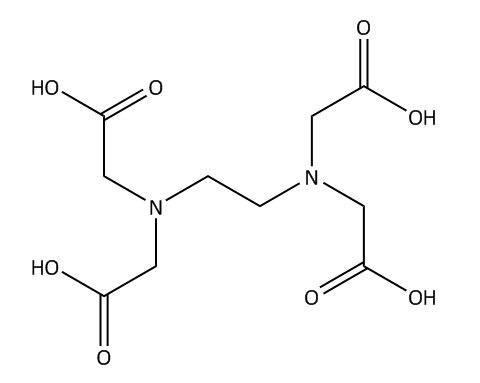
It is a hexadentate ligand, which means it has \[6\] lone pair of electrons that participate in coordination bonding. When a metal reacts with one molecule of EDTA, it can form \[6\] valent coordination complex. Metal ions have \[4\]bonds on oxygen atoms that are negatively charged and \[2\] bonds to a single electron pair on the nitrogen atom.
Therefore, EDTA has six donor atoms.
Notes:
EDTA is used as an anticoagulant for blood as it forms chelate with the calcium ions present in the blood responsible for the coagulation of blood. It is concluded that EDTA acts in the environment as a persistent substance and that its contribution to bioavailability and remobilization of heavy metals.
We know that, the full name of EDTA is ethylenediaminetetraacetic acid and its molecular formula is \[{{\rm{C}}_{{\rm{10}}}}{{\rm{H}}_{{\rm{16}}}}{{\rm{N}}_{\rm{2}}}{{\rm{O}}_{\rm{8}}}\]. It has pH value between \[ - {\rm{0}}{\rm{.8}}\;{\rm{to}}\;{\rm{12}}\]. EDTA is versatile in nature. It can be used in the medical area and industrial area. It behaves as an acid, aminopolycarboxylic acid. It shows many side effects.
Complete step by step solution
Now, let’s discuss EDTA (ethylenediaminetetraacetic acid) in detail.
As we know that EDTA is a chelating agent, which is used in the separation of dye and other substances from heavy metals.it is a type of compound which can be used in household and industrial areas. In European inland, it has the highest concentration that is why it is named as an anthropogenic compound. Studies have detected poor biodegradability in the natural ecosystem. The structure of EDTA is shown below.
It is a hexadentate ligand, which means it has \[6\] lone pair of electrons that participate in coordination bonding. When a metal reacts with one molecule of EDTA, it can form \[6\] valent coordination complex. Metal ions have \[4\]bonds on oxygen atoms that are negatively charged and \[2\] bonds to a single electron pair on the nitrogen atom.
Therefore, EDTA has six donor atoms.
Notes:
EDTA is used as an anticoagulant for blood as it forms chelate with the calcium ions present in the blood responsible for the coagulation of blood. It is concluded that EDTA acts in the environment as a persistent substance and that its contribution to bioavailability and remobilization of heavy metals.
Recently Updated Pages
Explain the structure of megasporangium class 12 biology CBSE

Why is chloroform kept in dark coloured bottles class 12 chemistry CBSE
Derive the balancing condition of a Wheatstone bri class 12 physics CBSE
Draw VI characteristics of a pn junction diode Explain class 12 physics CBSE
Is it possible to carry pride in ones language too class 12 english CBSE
In a population at Hardy Weinberg equilibrium the allele class 12 biology CBSE
Trending doubts
Draw a labelled sketch of the human eye class 12 physics CBSE
Which are the Top 10 Largest Countries of the World?
Draw ray diagrams each showing i myopic eye and ii class 12 physics CBSE
One megawatt is equal to how many units of electri class 12 physics CBSE
Which is the correct genotypic ratio of mendel dihybrid class 12 biology CBSE
Give 10 examples of unisexual and bisexual flowers