



How will you convert Benzene to acetophenone?
Answer
 Verified
557.1k+ views
Hint: Acetophenone is a carbonyl compound in which the ketone group is attached to the benzene ring. The catalyst used in the production of acetophenone is anhydrous aluminium chloride. The reaction is a type of electrophilic substitution reaction.
Complete answer:
Benzene (having chemical formula ${{C}_{6}}{{H}_{6}}$) can be converted to acetophenone (has chemical formula ${{C}_{6}}{{H}_{5}}COC{{H}_{3}}$), which is a methylphenyl ketone by Friedel-Crafts acylation reaction.
There are two primary types of Friedel-Crafts reaction, which are alkylation and acylation reactions. Friedel-Crafts acylation is one of the most convenient and widely used methods for the preparation of aromatic ketone, in which the ketonic group is directly attached to at least one aromatic ring. The reaction involves the treatment of an aromatic hydrocarbon with an acid halide in the presence of a Lewis acid such as aluminium chloride.
Here, when benzene is reacted with an acyl halide in the presence of anhydrous aluminium chloride, it will give an acyl benzene as a product. This reaction is a type of electrophilic substitution reaction. Firstly, ethanoyl chloride reacts with aluminium chloride and produces an electrophile. Then this electrophile reacts with benzene which will actually undergo the electrophilic substitution reaction to form acetophenone. Following is the reaction shown for the production of acetophenone:
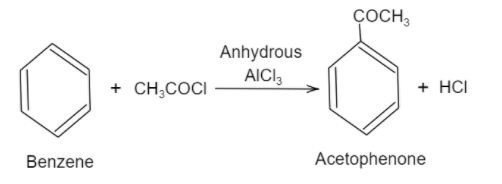
Hence, from the above discussion, it can be seen that benzene is converted into acetophenone by Friedel-Craft acylation reaction.
Note: Possibly you may get confused with Friedel-Craft alkylation but Friedel-Craft alkylation reaction involves reaction of benzene with alkyl halides in the presence of a Lewis acid catalyst like anhydrous aluminium chloride to form alkyl benzene (otherwise called an arenes).
Complete answer:
Benzene (having chemical formula ${{C}_{6}}{{H}_{6}}$) can be converted to acetophenone (has chemical formula ${{C}_{6}}{{H}_{5}}COC{{H}_{3}}$), which is a methylphenyl ketone by Friedel-Crafts acylation reaction.
There are two primary types of Friedel-Crafts reaction, which are alkylation and acylation reactions. Friedel-Crafts acylation is one of the most convenient and widely used methods for the preparation of aromatic ketone, in which the ketonic group is directly attached to at least one aromatic ring. The reaction involves the treatment of an aromatic hydrocarbon with an acid halide in the presence of a Lewis acid such as aluminium chloride.
Here, when benzene is reacted with an acyl halide in the presence of anhydrous aluminium chloride, it will give an acyl benzene as a product. This reaction is a type of electrophilic substitution reaction. Firstly, ethanoyl chloride reacts with aluminium chloride and produces an electrophile. Then this electrophile reacts with benzene which will actually undergo the electrophilic substitution reaction to form acetophenone. Following is the reaction shown for the production of acetophenone:
Hence, from the above discussion, it can be seen that benzene is converted into acetophenone by Friedel-Craft acylation reaction.
Note: Possibly you may get confused with Friedel-Craft alkylation but Friedel-Craft alkylation reaction involves reaction of benzene with alkyl halides in the presence of a Lewis acid catalyst like anhydrous aluminium chloride to form alkyl benzene (otherwise called an arenes).
Recently Updated Pages
Master Class 12 Business Studies: Engaging Questions & Answers for Success

Master Class 12 Chemistry: Engaging Questions & Answers for Success
Master Class 12 Biology: Engaging Questions & Answers for Success
Class 12 Question and Answer - Your Ultimate Solutions Guide
Master Class 11 English: Engaging Questions & Answers for Success
Master Class 11 Social Science: Engaging Questions & Answers for Success
Trending doubts
Which are the Top 10 Largest Countries of the World?
Draw a labelled sketch of the human eye class 12 physics CBSE
Differentiate between homogeneous and heterogeneous class 12 chemistry CBSE
Why is the cell called the structural and functional class 12 biology CBSE
Draw ray diagrams each showing i myopic eye and ii class 12 physics CBSE
Which is the correct genotypic ratio of mendel dihybrid class 12 biology CBSE