




Among the following, the most reactive towards alcoholic KOH is :
A. \[C{H_2} = CHBr\]
B. \[C{H_3}COC{H_2}C{H_2}Br\]
C. \[C{H_3}C{H_2}Br\]
D. \[C{H_3}C{H_2}C{H_2}Br\]
Answer
 Verified
232.8k+ views
Hint: Halide organic compounds react with alcoholic $KOH$ to undergo nucleophilic elimination reaction of order 2 and it is represented as ${{E}_{2}}$. It is a bimolecular reaction where several atoms either in pairs or groups are removed from the reactant molecule in presence of a strong base.
Complete step-by-step answer:Generally ${{E}_{2}}$ is a single-step reaction and in one step carbon-hydrogen bond and carbon-halogen bond mostly break off to form a new double bond. In basic medium, a strong base, ${{C}_{2}}{{H}_{5}}{{O}^{-}}$ is formed.

Option A: Br is attached to a \[s{p^2}\] hybridized carbon atom and the carbon-halogen bond gets a double bond character due to the delocalization of lone pairs of bromine atom, hence the bond strength increases. So Bromine ion cannot leave easily, thus the compound does not react with alcoholic $KOH$.

Options B, C, and D have halide attached to \[s{p^3}\]carbon atom and the carbon is a primary carbon as it is attached to further only one carbon.
But option B is incorrect because the electronegative oxygen atom in the $C=O$ group pulls the electron density from carbon making it more electrophilic. Thus incoming base abstracts proton and thereby negative charge undergo resonance with the $C=O$ group and the rate of elimination decreases.

As we know the polarity between carbon-bromine bonds increases by increasing the +I effect which can be increased by increasing the alkyl group. Therefore between options C and D, a higher number of alkyl groups are present in compound D, propyl bromide than compound C. In the presence of strong base ${{C}_{2}}{{H}_{5}}{{O}^{-}}$, propyl bromide formed propene by ${{E}_{2}}$ reaction.
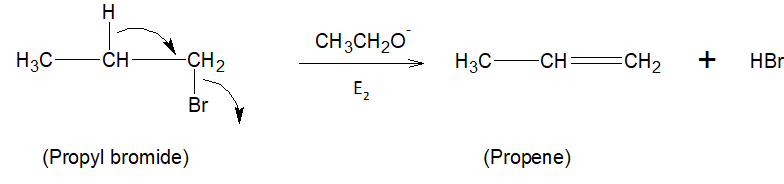
Option ‘D’ is correct
Note: In ${{E}_{2}}$ reaction an anti-coplanar orientation of the base and the leaving group must be required since both the electron-rich base and leaving group electrostatically repel each other forcing them to occupy the anti-coplanar position.
Complete step-by-step answer:Generally ${{E}_{2}}$ is a single-step reaction and in one step carbon-hydrogen bond and carbon-halogen bond mostly break off to form a new double bond. In basic medium, a strong base, ${{C}_{2}}{{H}_{5}}{{O}^{-}}$ is formed.
Option A: Br is attached to a \[s{p^2}\] hybridized carbon atom and the carbon-halogen bond gets a double bond character due to the delocalization of lone pairs of bromine atom, hence the bond strength increases. So Bromine ion cannot leave easily, thus the compound does not react with alcoholic $KOH$.
Options B, C, and D have halide attached to \[s{p^3}\]carbon atom and the carbon is a primary carbon as it is attached to further only one carbon.
But option B is incorrect because the electronegative oxygen atom in the $C=O$ group pulls the electron density from carbon making it more electrophilic. Thus incoming base abstracts proton and thereby negative charge undergo resonance with the $C=O$ group and the rate of elimination decreases.
As we know the polarity between carbon-bromine bonds increases by increasing the +I effect which can be increased by increasing the alkyl group. Therefore between options C and D, a higher number of alkyl groups are present in compound D, propyl bromide than compound C. In the presence of strong base ${{C}_{2}}{{H}_{5}}{{O}^{-}}$, propyl bromide formed propene by ${{E}_{2}}$ reaction.
Option ‘D’ is correct
Note: In ${{E}_{2}}$ reaction an anti-coplanar orientation of the base and the leaving group must be required since both the electron-rich base and leaving group electrostatically repel each other forcing them to occupy the anti-coplanar position.
Recently Updated Pages
Types of Solutions in Chemistry: Explained Simply

JEE General Topics in Chemistry Important Concepts and Tips
JEE Extractive Metallurgy Important Concepts and Tips for Exam Preparation
JEE Amino Acids and Peptides Important Concepts and Tips for Exam Preparation
JEE Atomic Structure and Chemical Bonding important Concepts and Tips
Electricity and Magnetism Explained: Key Concepts & Applications
Trending doubts
JEE Main 2026: Session 2 Registration Open, City Intimation Slip, Exam Dates, Syllabus & Eligibility
JEE Main 2026 Application Login: Direct Link, Registration, Form Fill, and Steps
JEE Main Marking Scheme 2026- Paper-Wise Marks Distribution and Negative Marking Details
Understanding the Angle of Deviation in a Prism
Hybridisation in Chemistry – Concept, Types & Applications
How to Convert a Galvanometer into an Ammeter or Voltmeter
Other Pages
JEE Advanced Marks vs Ranks 2025: Understanding Category-wise Qualifying Marks and Previous Year Cut-offs
NCERT Solutions For Class 12 Chemistry Chapter 1 Solutions (2025-26)
Solutions Class 12 Chemistry Chapter 1 CBSE Notes - 2025-26
NCERT Solutions For Class 12 Chemistry Chapter 4 The d and f Block Elements (2025-26)
Biomolecules Class 12 Chemistry Chapter 10 CBSE Notes - 2025-26
NCERT Solutions For Class 12 Chemistry Chapter 10 Biomolecules (2025-26)