




Alkyl cyanides when react with Grignard reagent, the product on hydrolysis found is
A. Aldehyde
B. Ketone
C. Alcohol
D. Acid
Answer
 Verified
233.1k+ views
Hint: Toluene is a transparent, colourless liquid that, when heated to room temperature, turns into a vapour. Toluene is a naturally occurring component of crude oil and is used in the production of paints, lacquers, explosives (TNT), and glues, in addition to oil refining. Toluene exposure can lead to a variety of symptoms, including irritation of the eyes and nose, exhaustion, headache, dilated pupils, tears, anxiety, muscle fatigue, sleeplessness, and nerve damage.
Complete Step by Step Answer:
Grignard reagent has two parts. In the Grignard reagent the alkyl part acts as a nucleophile that is electron efficient species and wants to donate its electrons. In this reaction in the first step the alkyl part of the Grignard reagent attacks the carbon atom of the alkyl cyanide and the metal part of the Grignard reagent that is magnesium part connects with the nitrogen atom of cyanide.
In the next step water attacks the carbon atom and makes ketone along with ammonia as a side product. The reaction can be given as follows:
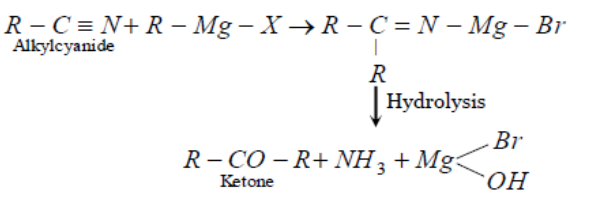
Thus we can write that Alkyl cyanides when react with Grignard reagent, the product on hydrolysis found is ketone.
Thus the correct option is B.
Note: Grignard reagent is alkyl or aryl magnesium halide type of compound. In Grignard reagent the alkyl or aryl part acts as a nucleophile and the metal part gets positive charge. Grignard reagents can convert aldehyde and ketone to alcohol. It can also convert acid to alcohol. In these Grignard reagents the metal that is magnesium acts as a hard species.
Complete Step by Step Answer:
Grignard reagent has two parts. In the Grignard reagent the alkyl part acts as a nucleophile that is electron efficient species and wants to donate its electrons. In this reaction in the first step the alkyl part of the Grignard reagent attacks the carbon atom of the alkyl cyanide and the metal part of the Grignard reagent that is magnesium part connects with the nitrogen atom of cyanide.
In the next step water attacks the carbon atom and makes ketone along with ammonia as a side product. The reaction can be given as follows:
Thus we can write that Alkyl cyanides when react with Grignard reagent, the product on hydrolysis found is ketone.
Thus the correct option is B.
Note: Grignard reagent is alkyl or aryl magnesium halide type of compound. In Grignard reagent the alkyl or aryl part acts as a nucleophile and the metal part gets positive charge. Grignard reagents can convert aldehyde and ketone to alcohol. It can also convert acid to alcohol. In these Grignard reagents the metal that is magnesium acts as a hard species.
Recently Updated Pages
JEE Main 2023 April 6 Shift 1 Question Paper with Answer Key

JEE Main 2023 April 6 Shift 2 Question Paper with Answer Key
JEE Main 2023 (January 31 Evening Shift) Question Paper with Solutions [PDF]
JEE Main 2023 January 30 Shift 2 Question Paper with Answer Key
JEE Main 2023 January 25 Shift 1 Question Paper with Answer Key
JEE Main 2023 January 24 Shift 2 Question Paper with Answer Key
Trending doubts
JEE Main 2026: Session 2 Registration Open, City Intimation Slip, Exam Dates, Syllabus & Eligibility
JEE Main 2026 Application Login: Direct Link, Registration, Form Fill, and Steps
Understanding the Angle of Deviation in a Prism
Hybridisation in Chemistry – Concept, Types & Applications
How to Convert a Galvanometer into an Ammeter or Voltmeter
Understanding the Electric Field of a Uniformly Charged Ring
Other Pages
JEE Advanced Marks vs Ranks 2025: Understanding Category-wise Qualifying Marks and Previous Year Cut-offs
NCERT Solutions For Class 12 Chemistry Chapter 1 Solutions (2025-26)
Solutions Class 12 Chemistry Chapter 1 CBSE Notes - 2025-26
NCERT Solutions For Class 12 Chemistry Chapter 4 The d and f Block Elements (2025-26)
Biomolecules Class 12 Chemistry Chapter 10 CBSE Notes - 2025-26
NCERT Solutions For Class 12 Chemistry Chapter 10 Biomolecules (2025-26)