




A wire mesh consisting of very small squares is viewed at a distance of 8 cm through a magnifying converging lens of focal length 10 cm, kept close to the eye. The magnification produced by the lens is:
A. 5
B. 8
C. 10
D. 20
Answer
 Verified
624.3k+ views
Hint: In this question distance of an object from a lens is given, and also its focal length is given, so we need to find the distance of the image formed, after which the magnification of the lens will be calculated. Magnification of a lens is the ratio of the distance of the object from the axis of the lens to the image distance given by the formula \[m = \dfrac{v}{u}\]
Complete step by step answer:
The focal length of the converging lens \[f = 10cm\]
The distance of the object from the converging lens \[u = - 8cm\]
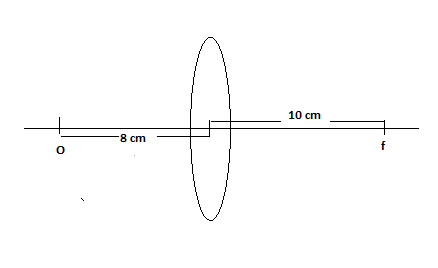
The focal length of a converging lens is given as
\[\dfrac{1}{f} = \dfrac{1}{v} - \dfrac{1}{u} - - (i)\]
Here \[v\]is the distance of the image from the lens.
As we know the magnification of a lens is the ratio of the distance of the image formed from the axis of the lens to the distance of the object from the axis of the lens, given by the formula
\[m = \dfrac{v}{u} - - (ii)\]
Since the distance of the object is given, so we need to find the distance of the image formed from the axis by using equation (i)
\[
\dfrac{1}{f} = \dfrac{1}{v} - \dfrac{1}{u} \\
\dfrac{1}{v} = \dfrac{1}{f} + \dfrac{1}{u} \\
= \dfrac{1}{{10}} + \dfrac{1}{{\left( { - 8} \right)}} \\
= \dfrac{{8 - 10}}{{80}} \\
= - \dfrac{2}{{80}} \\
\dfrac{1}{v} = - \dfrac{1}{{40}} \\
\]
Hence the distance of the object from the lens \[v = - 40cm\]
Now find the magnification produced by the lens by using equation (ii)
\[
m = \dfrac{v}{u} \\
= \dfrac{{ - 40}}{{ - 8}} \\
= 5 \\
\]
Hence magnification produced by the lens \[m = 5\]
Option A is correct.
Note:Students must note that if the image and objects are on the same side of the lens then the image distance is negative and the image formed is virtual, in the converging lens the focal length is positive.
Complete step by step answer:
The focal length of the converging lens \[f = 10cm\]
The distance of the object from the converging lens \[u = - 8cm\]
The focal length of a converging lens is given as
\[\dfrac{1}{f} = \dfrac{1}{v} - \dfrac{1}{u} - - (i)\]
Here \[v\]is the distance of the image from the lens.
As we know the magnification of a lens is the ratio of the distance of the image formed from the axis of the lens to the distance of the object from the axis of the lens, given by the formula
\[m = \dfrac{v}{u} - - (ii)\]
Since the distance of the object is given, so we need to find the distance of the image formed from the axis by using equation (i)
\[
\dfrac{1}{f} = \dfrac{1}{v} - \dfrac{1}{u} \\
\dfrac{1}{v} = \dfrac{1}{f} + \dfrac{1}{u} \\
= \dfrac{1}{{10}} + \dfrac{1}{{\left( { - 8} \right)}} \\
= \dfrac{{8 - 10}}{{80}} \\
= - \dfrac{2}{{80}} \\
\dfrac{1}{v} = - \dfrac{1}{{40}} \\
\]
Hence the distance of the object from the lens \[v = - 40cm\]
Now find the magnification produced by the lens by using equation (ii)
\[
m = \dfrac{v}{u} \\
= \dfrac{{ - 40}}{{ - 8}} \\
= 5 \\
\]
Hence magnification produced by the lens \[m = 5\]
Option A is correct.
Note:Students must note that if the image and objects are on the same side of the lens then the image distance is negative and the image formed is virtual, in the converging lens the focal length is positive.
Recently Updated Pages
Master Class 12 Business Studies: Engaging Questions & Answers for Success

Master Class 12 Chemistry: Engaging Questions & Answers for Success
Master Class 12 Biology: Engaging Questions & Answers for Success
Class 12 Question and Answer - Your Ultimate Solutions Guide
Master Class 11 English: Engaging Questions & Answers for Success
Master Class 11 Social Science: Engaging Questions & Answers for Success
Trending doubts
Which are the Top 10 Largest Countries of the World?
Draw a labelled sketch of the human eye class 12 physics CBSE
Differentiate between homogeneous and heterogeneous class 12 chemistry CBSE
Differentiate between Pyramid of energy and pyramid class 12 biology CBSE
Why is the cell called the structural and functional class 12 biology CBSE
Draw the diagram of the pyramid of energy Explain In class 12 biology CBSE