




A number $x$ is chosen at random from the set $\{ 1,2,3,4,...........,100\} .$ Define the event:
$A = $ the chosen number $x$ satisfies $\dfrac{{(x - 10)(x - 50)}}{{(x - 30)}} \geqslant 0.$ Then $P(A)$is :
Answer
 Verified
696k+ views
Hint-Wavy curve method defined as the limit of x from the given equation. And probability is the ratio of favorable number of outcomes to the total number of outcomes. With the help of these definitions we will solve the question.
Given that:
$ \Rightarrow \dfrac{{(x - 10)(x - 50)}}{{(x - 30)}} \geqslant 0$
We will use the wavy curve method to find the solution of the above equation.
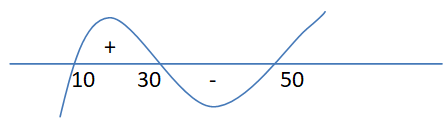
By wavy curve method, the solution is
$\{ 10,11,12,..........29\} U\{ 50,51,......100\} $
The value of $x = 30$ is neglected because it does not satisfy the above equation, therefore
$
n(A) = 20 + 51 \\
= 71 \\
$
The probability of chosen no satisfies the given equation is
$
P(A) = \dfrac{{n(A)}}{{n(Givenset)}} \\
= \dfrac{{71}}{{100}} = 0.71 \\
$
Hence probability of the event is 0.71
Note- This problem combines the concept of both probability and solutions of polynomial equations. For this problem the sample space is a solution of the polynomial equation which we found using a wavy curve method. In probability problems first we have to define the event and then sample space. After this we proceed further to solve the problem.
Given that:
$ \Rightarrow \dfrac{{(x - 10)(x - 50)}}{{(x - 30)}} \geqslant 0$
We will use the wavy curve method to find the solution of the above equation.
By wavy curve method, the solution is
$\{ 10,11,12,..........29\} U\{ 50,51,......100\} $
The value of $x = 30$ is neglected because it does not satisfy the above equation, therefore
$
n(A) = 20 + 51 \\
= 71 \\
$
The probability of chosen no satisfies the given equation is
$
P(A) = \dfrac{{n(A)}}{{n(Givenset)}} \\
= \dfrac{{71}}{{100}} = 0.71 \\
$
Hence probability of the event is 0.71
Note- This problem combines the concept of both probability and solutions of polynomial equations. For this problem the sample space is a solution of the polynomial equation which we found using a wavy curve method. In probability problems first we have to define the event and then sample space. After this we proceed further to solve the problem.
Recently Updated Pages
Which of the following graphs shows the variation of class 12 physics CBSE

Draw a labelled diagram of the human male reproductive class 12 biology CBSE
Describe the experiment to compare the emf of two cells class 12 physics CBSE
What is standard hydrogen electrode
What is conventional current and electric current class 12 physics CBSE
2Bromopentane is treated with an alcoholic KOH solution class 12 chemistry CBSE
Trending doubts
Draw a labelled sketch of the human eye class 12 physics CBSE
Which are the Top 10 Largest Countries of the World?
Draw ray diagrams each showing i myopic eye and ii class 12 physics CBSE
Materials which do not allow an electric current to class 12 physics CBSE
Which is the correct genotypic ratio of mendel dihybrid class 12 biology CBSE
Which is the strongest oxidising agent out of the following class 12 chemistry CBSE