




A motor cyclist is riding North in still air at 36 km/h. The wind starts blowing Westward with a velocity 18 km/h. The direction of apparent velocity is:
A. ${{\tan }^{-1}}(\dfrac{1}{2})$ West of North
B. ${{\tan }^{-1}}(\dfrac{1}{2})$ North of West
C. ${{\tan }^{-1}}(\dfrac{1}{2})$ East of North
D. ${{\tan }^{-1}}(\dfrac{1}{2})$ North of East
Answer
 Verified
232.8k+ views
Hint: The discussion of relative motion in one or more dimensions is where the idea of reference frames was originally introduced. When we state that an object has a given velocity, we mean that this velocity is relative to the so-called reference frame. In daily life, the ground or the earth is assumed to be the reference frame when measuring an object's velocity.
Complete step by step solution:
Two-dimensional relative motion will be able to solve this problem. If you need to determine how fast A is moving relative to B, assume that B is at rest and provide A B's speed in the opposite direction.
Let's take into consideration two objects A and B that are travelling at speeds $V_a$ and $V_b$, respectively, according to some common frame of reference, such as the ground or the earth. Assuming B is at rest, we must determine the velocity of A with respect to B before applying the velocity of B to A in the opposite direction.
${{V}_{ab}}={{v}_{a}}-{{v}_{b}}$
Similar to this, to get the velocity of object B relative to object A, suppose that A is at rest and apply the opposite direction of A's velocity to B's velocity.
${{V}_{ba}}={{v}_{b}}-{{v}_{a}}$
Given: Velocity of cyclist in North $({{V}_{c}})$= 36Km/h and Velocity of wind in west $({{V}_{w}})$= 18Km/h
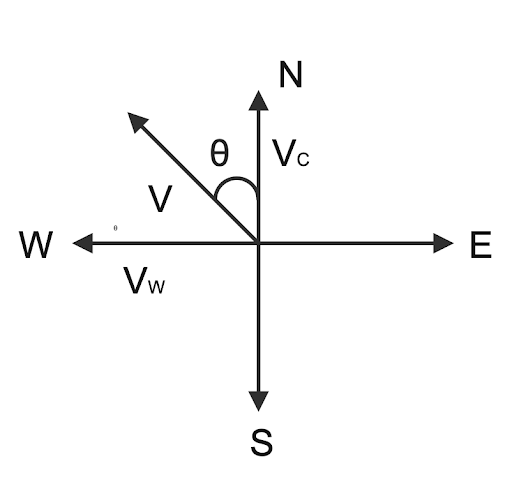
Direction of motion = tanθ
∴ tanθ = $\dfrac{{{V}_{w}}}{{{V}_{C}}}$=$\dfrac{18}{36}$
tanθ = $\dfrac{18}{36}$
∴ θ= ${{\tan }^{-1}}(\dfrac{1}{2})$
From fig. direction of apparent velocity is,
θ= ${{\tan }^{-1}}(\dfrac{1}{2})$ in West of North
Hence, option A is correct.
Note: There is a chance that students may get confused between the concepts of velocity and relative velocity. Velocity is measured with respect to a reference point which is relative to a different point whereas relative velocity is measured with reference to a frame where an object is either moving or at rest with respect to the absolute frame. When viewed from a fixed point of observation, the item is said to be moving absolutely (there is no change in the position of an observer). Relative motion refers to the movement of an object when there is no fixed point of view (the position of the observer changes with respect to time).
Complete step by step solution:
Two-dimensional relative motion will be able to solve this problem. If you need to determine how fast A is moving relative to B, assume that B is at rest and provide A B's speed in the opposite direction.
Let's take into consideration two objects A and B that are travelling at speeds $V_a$ and $V_b$, respectively, according to some common frame of reference, such as the ground or the earth. Assuming B is at rest, we must determine the velocity of A with respect to B before applying the velocity of B to A in the opposite direction.
${{V}_{ab}}={{v}_{a}}-{{v}_{b}}$
Similar to this, to get the velocity of object B relative to object A, suppose that A is at rest and apply the opposite direction of A's velocity to B's velocity.
${{V}_{ba}}={{v}_{b}}-{{v}_{a}}$
Given: Velocity of cyclist in North $({{V}_{c}})$= 36Km/h and Velocity of wind in west $({{V}_{w}})$= 18Km/h
Direction of motion = tanθ
∴ tanθ = $\dfrac{{{V}_{w}}}{{{V}_{C}}}$=$\dfrac{18}{36}$
tanθ = $\dfrac{18}{36}$
∴ θ= ${{\tan }^{-1}}(\dfrac{1}{2})$
From fig. direction of apparent velocity is,
θ= ${{\tan }^{-1}}(\dfrac{1}{2})$ in West of North
Hence, option A is correct.
Note: There is a chance that students may get confused between the concepts of velocity and relative velocity. Velocity is measured with respect to a reference point which is relative to a different point whereas relative velocity is measured with reference to a frame where an object is either moving or at rest with respect to the absolute frame. When viewed from a fixed point of observation, the item is said to be moving absolutely (there is no change in the position of an observer). Relative motion refers to the movement of an object when there is no fixed point of view (the position of the observer changes with respect to time).
Recently Updated Pages
Dimensions of Charge: Dimensional Formula, Derivation, SI Units & Examples

How to Calculate Moment of Inertia: Step-by-Step Guide & Formulas
Circuit Switching vs Packet Switching: Key Differences Explained
Dimensions of Pressure in Physics: Formula, Derivation & SI Unit
JEE General Topics in Chemistry Important Concepts and Tips
JEE Extractive Metallurgy Important Concepts and Tips for Exam Preparation
Trending doubts
JEE Main 2026: Session 2 Registration Open, City Intimation Slip, Exam Dates, Syllabus & Eligibility
JEE Main 2026 Application Login: Direct Link, Registration, Form Fill, and Steps
JEE Main Marking Scheme 2026- Paper-Wise Marks Distribution and Negative Marking Details
Understanding the Angle of Deviation in a Prism
Hybridisation in Chemistry – Concept, Types & Applications
How to Convert a Galvanometer into an Ammeter or Voltmeter
Other Pages
JEE Advanced Marks vs Ranks 2025: Understanding Category-wise Qualifying Marks and Previous Year Cut-offs
Laws of Motion Class 11 Physics Chapter 4 CBSE Notes - 2025-26
Waves Class 11 Physics Chapter 14 CBSE Notes - 2025-26
Mechanical Properties of Fluids Class 11 Physics Chapter 9 CBSE Notes - 2025-26
Thermodynamics Class 11 Physics Chapter 11 CBSE Notes - 2025-26
Units And Measurements Class 11 Physics Chapter 1 CBSE Notes - 2025-26