




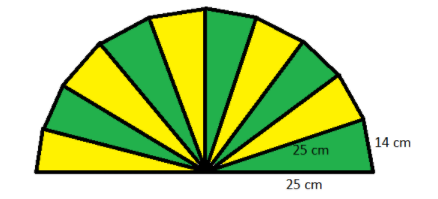
A hand fan is made by stitching 10 equal size triangular strips of two different types of paper as shown in the figure. The dimensions of equal strips are 25cm, 25cm, and 14 cm. Find the area of each type of paper needed to make the hand fan.
$\left( a \right)280{\text{ c}}{{\text{m}}^2}$
$\left( b \right)420{\text{ c}}{{\text{m}}^2}$
$\left( c \right)840{\text{ c}}{{\text{m}}^2}$
$\left( d \right)384{\text{ c}}{{\text{m}}^2}$
Answer
 Verified
608.7k+ views
Hint: In this particular question use the concept that if all the sides of the triangle are given then the area (A) of the triangle is given as, $A = \sqrt {s\left( {s - a} \right)\left( {s - b} \right)\left( {s - c} \right)} $, so use this concept to reach the solution of the question.
Complete step-by-step answer:
Given data:
The sides of the triangle are 25cm, 25cm, and 14cm, as shown in the given figure.
Now we have to find out the area of each type of paper needed to make the hand fan.
Now as we see that there are two types of paper used in the given figure each type has 5 similar triangles.
As there are a total 10 triangles in a hand fan.
So the area $\left( {{A_1}} \right)$ of one type of paper = area $\left( {{A_2}} \right)$ of other types of paper = 5 times the area (A) of any one triangle.
Let, a = 25cm, b = 25cm, and c = 14cm.
Now as we know that if all the sides of the triangle are given then the area (A) of the triangle is given as,
$ \Rightarrow A = \sqrt {s\left( {s - a} \right)\left( {s - b} \right)\left( {s - c} \right)} $................. (1), where s is the half of the perimeter and a, b and c are the length of the sides of the triangle.
Now as we know that the perimeter is the sum of all the sides.
So, the perimeter of the triangle = a + b + c = 25 + 25 + 14 = 64cm.
So, \[s = \dfrac{{a + b + c}}{2} = \dfrac{{64}}{2} = 32\] cm.
Now substitute all the values in equation (1) we have,
$ \Rightarrow A = \sqrt {32\left( {32 - 25} \right)\left( {32 - 25} \right)\left( {32 - 14} \right)} $
Now simplify this we have,
$ \Rightarrow A = \sqrt {32\left( 7 \right)\left( 7 \right)\left( {18} \right)} $
\[ \Rightarrow A = \sqrt {{7^2}\left( {16} \right)\left( {36} \right)} \]
\[ \Rightarrow A = \sqrt {\left( {{7^2}} \right)\left( {{4^2}} \right)\left( {{6^2}} \right)} \]
\[ \Rightarrow A = 7\left( 4 \right)\left( 6 \right) = 168\] Sq. cm.
So the area of each type of paper needed to make the hand fan is 5 times the above calculated area.
$ \Rightarrow {A_1} = {A_2} = 5\left( A \right) = 5\left( {168} \right) = 840{\text{ c}}{{\text{m}}^2}$
Hence option (c) is the correct answer.
Note:Whenever we face such types of questions the key concept we have to remember is that the perimeter of any shape is the sum of all the sides, so the perimeter of triangle is the sum of all the sides, so calculate it, so s is equal to half of the perimeter so calculate it then simply substitute the values in the area formula as above and simplify we will get the required answer.
Complete step-by-step answer:
Given data:
The sides of the triangle are 25cm, 25cm, and 14cm, as shown in the given figure.
Now we have to find out the area of each type of paper needed to make the hand fan.
Now as we see that there are two types of paper used in the given figure each type has 5 similar triangles.
As there are a total 10 triangles in a hand fan.
So the area $\left( {{A_1}} \right)$ of one type of paper = area $\left( {{A_2}} \right)$ of other types of paper = 5 times the area (A) of any one triangle.
Let, a = 25cm, b = 25cm, and c = 14cm.
Now as we know that if all the sides of the triangle are given then the area (A) of the triangle is given as,
$ \Rightarrow A = \sqrt {s\left( {s - a} \right)\left( {s - b} \right)\left( {s - c} \right)} $................. (1), where s is the half of the perimeter and a, b and c are the length of the sides of the triangle.
Now as we know that the perimeter is the sum of all the sides.
So, the perimeter of the triangle = a + b + c = 25 + 25 + 14 = 64cm.
So, \[s = \dfrac{{a + b + c}}{2} = \dfrac{{64}}{2} = 32\] cm.
Now substitute all the values in equation (1) we have,
$ \Rightarrow A = \sqrt {32\left( {32 - 25} \right)\left( {32 - 25} \right)\left( {32 - 14} \right)} $
Now simplify this we have,
$ \Rightarrow A = \sqrt {32\left( 7 \right)\left( 7 \right)\left( {18} \right)} $
\[ \Rightarrow A = \sqrt {{7^2}\left( {16} \right)\left( {36} \right)} \]
\[ \Rightarrow A = \sqrt {\left( {{7^2}} \right)\left( {{4^2}} \right)\left( {{6^2}} \right)} \]
\[ \Rightarrow A = 7\left( 4 \right)\left( 6 \right) = 168\] Sq. cm.
So the area of each type of paper needed to make the hand fan is 5 times the above calculated area.
$ \Rightarrow {A_1} = {A_2} = 5\left( A \right) = 5\left( {168} \right) = 840{\text{ c}}{{\text{m}}^2}$
Hence option (c) is the correct answer.
Note:Whenever we face such types of questions the key concept we have to remember is that the perimeter of any shape is the sum of all the sides, so the perimeter of triangle is the sum of all the sides, so calculate it, so s is equal to half of the perimeter so calculate it then simply substitute the values in the area formula as above and simplify we will get the required answer.
Recently Updated Pages
Master Class 12 Social Science: Engaging Questions & Answers for Success

Master Class 12 Physics: Engaging Questions & Answers for Success
Master Class 12 Maths: Engaging Questions & Answers for Success
Master Class 12 Economics: Engaging Questions & Answers for Success
Master Class 12 Chemistry: Engaging Questions & Answers for Success
Master Class 12 Business Studies: Engaging Questions & Answers for Success
Trending doubts
Draw a labelled sketch of the human eye class 12 physics CBSE
What are the major means of transport Explain each class 12 social science CBSE
How many 176Omega resistors in parallel are required class 12 physics CBSE
What are the advantages of vegetative propagation class 12 biology CBSE
What is corrosion Explain its advantages and disad class 12 chemistry CBSE
When was the first election held in India a 194748 class 12 sst CBSE