




A galvanometer of resistance $100\Omega $ gives full scale deflection with $5mA$current. To convert it into a $5$ volt range voltmeter, the value of resistance connected in series is:
(A) $900\Omega $
(B) $9999\Omega $
(C) $10000\Omega $
(D) $1M\Omega $
Answer
 Verified
232.8k+ views
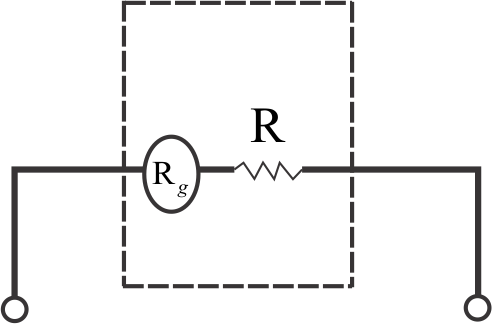
Hint: In order to convert a galvanometer into a voltmeter, a high resistance R is connected in series. Let V be the voltage drop across the circuit. Firstly, we will calculate the ${R_{eq}}$ i.e., the equivalent resistance of the circuit, since the range as well as full scale deflection current is given hence using Ohm’s law, we will calculate the required resistance.
Complete step by step answer
Given:
$V = 5V$
full scale deflection current $ = I = 5mA$
and, ${R_g} = 100\Omega $
Firstly, we will find ${R_{eq}}$
Since both the resistances are in series therefore, we have
$
{R_{eq}} = R + {R_g} \\
{R_{eq}} = 100 + R......(1) \\
$
Given the range of voltmeter and the full-scale deflection current.
Hence, from Ohm’s law, we have
$
V = I{R_{eq}}......(2) \\
\\
$
Using above values in equation (1) and (2), we get
$5 = 5mA(R + 100)......(3)$
On solving above equation, we get
$
5 = 5 \times {10^{ - 3}}(R + 100) \\
1000 = R + 100 \\
R = 900\Omega \\
$
Hence the required resistance connected in series is $R = 900\Omega $ .
Option (A) is correct.
Note When the voltmeter is used in a circuit, its resistance ${R_{eq}}$ is connected in parallel to some element of the circuit. This changes the overall current in the circuit and hence, the potential difference to be measured is also changed. To minimize the error due to this, the equivalent resistance ${R_{eq}}$ should be large. (when a large resistance is connected in parallel to a small resistance, the equivalent resistance is only slightly less than the smaller one.) That is why, a large resistance R is added in series with the coil of a voltmeter.
Complete step by step answer
Given:
$V = 5V$
full scale deflection current $ = I = 5mA$
and, ${R_g} = 100\Omega $
Firstly, we will find ${R_{eq}}$
Since both the resistances are in series therefore, we have
$
{R_{eq}} = R + {R_g} \\
{R_{eq}} = 100 + R......(1) \\
$
Given the range of voltmeter and the full-scale deflection current.
Hence, from Ohm’s law, we have
$
V = I{R_{eq}}......(2) \\
\\
$
Using above values in equation (1) and (2), we get
$5 = 5mA(R + 100)......(3)$
On solving above equation, we get
$
5 = 5 \times {10^{ - 3}}(R + 100) \\
1000 = R + 100 \\
R = 900\Omega \\
$
Hence the required resistance connected in series is $R = 900\Omega $ .
Option (A) is correct.
Note When the voltmeter is used in a circuit, its resistance ${R_{eq}}$ is connected in parallel to some element of the circuit. This changes the overall current in the circuit and hence, the potential difference to be measured is also changed. To minimize the error due to this, the equivalent resistance ${R_{eq}}$ should be large. (when a large resistance is connected in parallel to a small resistance, the equivalent resistance is only slightly less than the smaller one.) That is why, a large resistance R is added in series with the coil of a voltmeter.
Recently Updated Pages
JEE Main Mock Test 2025-26: Optics Chapter Practice Online

JEE Main 2025-26 Mock Test: Properties of Solids and Liquids
JEE Main Mock Test 2025-26: Electromagnetic Induction & Alternating Currents
JEE Main 2025-26 Electromagnetic Waves Mock Test with Solutions
JEE Main 2025-26 Mock Test: Electronic Devices Chapter Practice
JEE Main 2025-26 Mock Test: Magnetic Effects of Current & Magnetism
Trending doubts
JEE Main 2026: Admit Card Out, City Intimation Slip, Exam Dates, Syllabus & Eligibility
JEE Main 2026 Application Login: Direct Link, Registration, Form Fill, and Steps
JEE Main Marking Scheme 2026- Paper-Wise Marks Distribution and Negative Marking Details
Understanding the Angle of Deviation in a Prism
Hybridisation in Chemistry – Concept, Types & Applications
How to Convert a Galvanometer into an Ammeter or Voltmeter
Other Pages
JEE Advanced Marks vs Ranks 2025: Understanding Category-wise Qualifying Marks and Previous Year Cut-offs
Understanding Uniform Acceleration in Physics
Dual Nature of Radiation and Matter Class 12 Physics Chapter 11 CBSE Notes - 2025-26
Understanding the Electric Field of a Uniformly Charged Ring
Derivation of Equation of Trajectory Explained for Students
Understanding Electromagnetic Waves and Their Importance