




5% of the power of a 200W bulb is converted into visible radiation. The average intensity of visible radiation at a distance of 1 m from the bulb is:
$\eqalign{
& {\text{A}}{\text{. }}0.5W/{m^2} \cr
& {\text{B}}{\text{. }}0.8W/{m^2} \cr
& {\text{C}}{\text{. }}0.4W/{m^2} \cr
& {\text{D}}{\text{. }}2W/{m^2} \cr} $
Answer
 Verified
596.7k+ views
Hint:The intensity of light is mathematically defined as the ratio of power per unit area. Firstly, calculate the effective power of the bulb, then substitute its value in the mathematical expression for intensity of light using the distance as 1 meter, to find the required answer.
Formula Used:
Intensity of light, $I = \dfrac{{{\text{Power}}}}{{{\text{Area}}}} = \dfrac{I}{A}$
Complete step by step solution:
The intensity of light refers to its strength. For radiating energy, its intensity is the power transferred per unit area. The concerned area is measured on the plane perpendicular to the direction of propagation of the energy. In other words, it is the energy per unit area per unit time. It is denoted by $I$.
Mathematically,
$\eqalign{
& I = \dfrac{{{\text{Power}}}}{{{\text{Area}}}} \cr
& \Rightarrow I = \dfrac{P}{A} \cdots \cdots \cdots \left( 1 \right) \cr} $
Given:
The power of the light bulb, ${P_ \circ } = 200W$
Effective power of the light bulb, $P = 5\% {\text{ of }}200W$
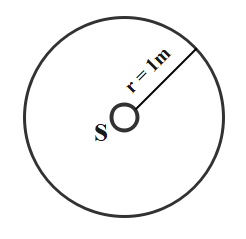
Distance for average intensity of visible radiation, $r = 1m$
Now, as the energy source will be a point source, let that be represented by S and its energy will thus be radiated with a spherical wave fronts of radius r, as shown below:
We know that the area for a spherical surface is given by $4\pi {r^2}$, substituting its value in equation (1), we get:
$ \Rightarrow I = \dfrac{P}{{4\pi {r^2}}} \cdots \cdots \cdots \left( 2 \right)$
Now, because only 5% of the power of 200W is converted into visible radiation, i.e.:
$\eqalign{
& 5\% {\text{ of }}200W = \dfrac{5}{{100}} \times 200W \cr
& 5\% {\text{ of }}200W = 10W \cr} $
This gives us the value for effective power. So, substituting its value in equation (2), we get:
$\eqalign{
& I = \dfrac{{10}}{{4\pi {r^2}}}{\text{ }}\left[ {\because P = 10W} \right] \cr
& \Rightarrow I = \dfrac{{10}}{{4\pi {{\left( 1 \right)}^2}}} \cr
& \Rightarrow I = \dfrac{{10}}{{4 \times 3.14}} \cr
& \Rightarrow I = \dfrac{{10}}{{12.56}} \cr
& \Rightarrow I = 0.796 \cr
& \therefore I \approx 0.8W/{m^2} \cr} $
Therefore, the correct option is B. i.e., the average intensity of visible radiation at a distance of 1 m from the bulb is $0.8W/{m^2}$.
Note: Students can wrongly substitute the value of power as 200W in the equation. Avoid such errors by properly understanding the question before solving it. Additionally, the intensity of light is better known as its Luminous intensity and is measured in the standard candle, or candela, one lumen per steradian.
Formula Used:
Intensity of light, $I = \dfrac{{{\text{Power}}}}{{{\text{Area}}}} = \dfrac{I}{A}$
Complete step by step solution:
The intensity of light refers to its strength. For radiating energy, its intensity is the power transferred per unit area. The concerned area is measured on the plane perpendicular to the direction of propagation of the energy. In other words, it is the energy per unit area per unit time. It is denoted by $I$.
Mathematically,
$\eqalign{
& I = \dfrac{{{\text{Power}}}}{{{\text{Area}}}} \cr
& \Rightarrow I = \dfrac{P}{A} \cdots \cdots \cdots \left( 1 \right) \cr} $
Given:
The power of the light bulb, ${P_ \circ } = 200W$
Effective power of the light bulb, $P = 5\% {\text{ of }}200W$
Distance for average intensity of visible radiation, $r = 1m$
Now, as the energy source will be a point source, let that be represented by S and its energy will thus be radiated with a spherical wave fronts of radius r, as shown below:
We know that the area for a spherical surface is given by $4\pi {r^2}$, substituting its value in equation (1), we get:
$ \Rightarrow I = \dfrac{P}{{4\pi {r^2}}} \cdots \cdots \cdots \left( 2 \right)$
Now, because only 5% of the power of 200W is converted into visible radiation, i.e.:
$\eqalign{
& 5\% {\text{ of }}200W = \dfrac{5}{{100}} \times 200W \cr
& 5\% {\text{ of }}200W = 10W \cr} $
This gives us the value for effective power. So, substituting its value in equation (2), we get:
$\eqalign{
& I = \dfrac{{10}}{{4\pi {r^2}}}{\text{ }}\left[ {\because P = 10W} \right] \cr
& \Rightarrow I = \dfrac{{10}}{{4\pi {{\left( 1 \right)}^2}}} \cr
& \Rightarrow I = \dfrac{{10}}{{4 \times 3.14}} \cr
& \Rightarrow I = \dfrac{{10}}{{12.56}} \cr
& \Rightarrow I = 0.796 \cr
& \therefore I \approx 0.8W/{m^2} \cr} $
Therefore, the correct option is B. i.e., the average intensity of visible radiation at a distance of 1 m from the bulb is $0.8W/{m^2}$.
Note: Students can wrongly substitute the value of power as 200W in the equation. Avoid such errors by properly understanding the question before solving it. Additionally, the intensity of light is better known as its Luminous intensity and is measured in the standard candle, or candela, one lumen per steradian.
Recently Updated Pages
Master Class 12 Economics: Engaging Questions & Answers for Success

Master Class 12 Physics: Engaging Questions & Answers for Success
Master Class 12 English: Engaging Questions & Answers for Success
Master Class 12 Social Science: Engaging Questions & Answers for Success
Master Class 12 Maths: Engaging Questions & Answers for Success
Master Class 12 Business Studies: Engaging Questions & Answers for Success
Trending doubts
Which are the Top 10 Largest Countries of the World?
What are the major means of transport Explain each class 12 social science CBSE
Draw a labelled sketch of the human eye class 12 physics CBSE
Why cannot DNA pass through cell membranes class 12 biology CBSE
Differentiate between insitu conservation and exsitu class 12 biology CBSE
Draw a neat and well labeled diagram of TS of ovary class 12 biology CBSE