


A Closer Look at Class 9 Maths Chapter 5 Exercise 5.4


Question 1.
Use the Baudhayana-Pythagoras theorem to show why Theorem 6 must be true.
Solution:
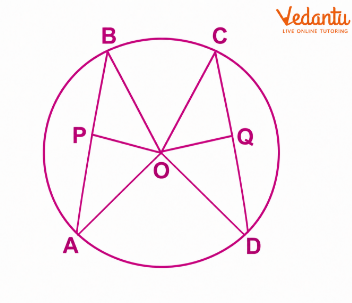
Given: AB and CD are two equal chords of a circle with centre O. OP and OQ are perpendicular to AB and CD, respectively.
Therefore:
OP ⊥ AB and OQ ⊥ CD
To prove:
OP = OQ
Proof:
A perpendicular drawn from the centre of a circle to a chord bisects the chord.
Therefore:
AP = AB/2
CQ = CD/2
Since AB = CD, we get:
AP = CQ
Also, OA and OC are radii of the same circle.
OA = OC = r
In right-angled ∆OPA, using the Baudhayana-Pythagoras theorem:
OA² = OP² + AP²
r² = OP² + AP² …(i)
In right-angled ∆OQC:
OC² = OQ² + CQ²
r² = OQ² + CQ² …(ii)
From equations (i) and (ii):
OP² + AP² = OQ² + CQ²
Since AP = CQ:
OP² = OQ²
Therefore:
OP = OQ
Hence, equal chords of a circle are equidistant from its centre.
Question 2.
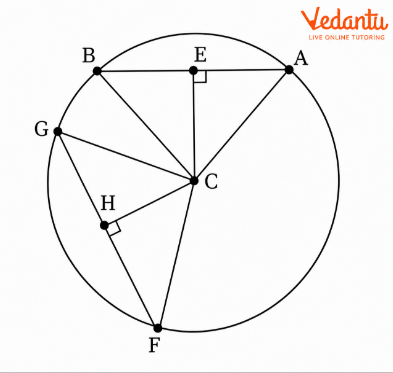
Consider Fig. 5.15. If CE is perpendicular to AB, CH is perpendicular to GH, and CE = CH, show that AB = GF.
Solution:
Given: AB and GF are chords of a circle with centre C.
CE ⊥ AB
CH ⊥ GF
CE = CH
To prove:
AB = GF
Proof:
A perpendicular drawn from the centre of a circle to a chord bisects the chord.
Therefore:
AE = EB
and
GH = HF
Consider right-angled ∆CEA and ∆CHG.
CA = CG, as they are radii of the same circle.
CE = CH, as given.
∠CEA = ∠CHG = 90°
Therefore, by the RHS congruence criterion:
∆CEA ≅ ∆CHG
Hence, by CPCT:
AE = GH
Now:
AB = 2AE
and
GF = 2GH
Since AE = GH:
AB = GF
Therefore, the two chords are equal.
Question 3.
Solve the previous question using the Baudhayana-Pythagoras theorem.
Solution:
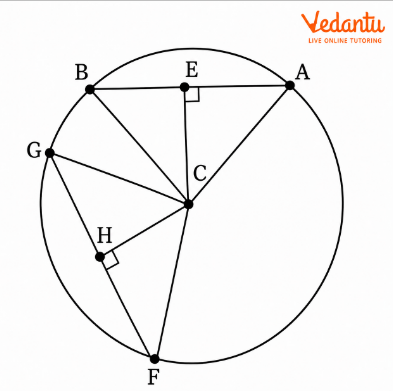
Given: AB and GF are chords of a circle with centre C.
CE ⊥ AB
CH ⊥ GF
CE = CH
To prove:
AB = GF
Proof:
Let:
CA = CG = r
because they are radii of the same circle.
Also, let:
CE = CH = d
In right-angled ∆CEA, using the Baudhayana-Pythagoras theorem:
CA² = CE² + AE²
AE² = CA² - CE²
AE² = r² - d² …(i)
In right-angled ∆CHG:
CG² = CH² + GH²
GH² = CG² - CH²
GH² = r² - d² …(ii)
From equations (i) and (ii):
AE² = GH²
Therefore:
AE = GH
A perpendicular drawn from the centre of a circle to a chord bisects the chord.
So:
AB = 2AE
and
GF = 2GH
Since AE = GH:
AB = GF
Hence proved.
How to Use Class 9 Maths Chapter 5 Exercise 5.4 Solutions
Try before checking: Solve each construction, proof, or numerical problem yourself before referring to the solution.
Focus on the reason: Pay attention to why a theorem, congruence rule, or Baudhayana-Pythagoras theorem is used in each step.
Revise difficult steps: If a proof feels confusing, go back to the corresponding figure and identify the given measurements and equal quantities.
Use the PDF for revision: Students looking for Class 9 Maths Chapter 5 Exercise 5.4 solutions PDF can use the solution material for quick revision and practice.
Practise beyond the exercise: The Class 9 Maths Chapter 5 Exercise 5.4 solutions worksheets can help you apply the same circle properties to similar questions.
Keep the chapter connected: These solutions are part of Maths Class 9 Chapter 5 Exercise 5.4, so revise related circle concepts from the full chapter as needed.
Access Exercise Wise NCERT Solutions for Chapter 5 Maths Class 9
CBSE Class 9 Maths Chapter 5 Other Study Materials
Chapter-Specific NCERT Solutions for Class 9 Maths
Additional Study Materials for Class 9 Maths
FAQs on NCERT Solutions for Class 9 Maths Chapter 5 Exercise 5.4 (2026-27)
1. What does Class 9 Maths Chapter 5 Exercise 5.4 cover?
Exercise 5.4 focuses on circle properties, equal chords, their distances from the centre, and applications of the Baudhayana-Pythagoras theorem.
2. Where can I find Class 9 Maths Chapter 5 Exercise 5.4 solutions?
This page provides complete solutions, with reasoning and calculations explained question by question.
3. What is the main theorem used in Exercise 5.4?
The exercise uses the relationship between equal chords and their distances from the centre, along with the perpendicular-to-chord property.
4. How is the Baudhayana-Pythagoras theorem used in Exercise 5.4?
It relates the radius, the perpendicular distance from the centre, and half a chord to establish the required result.
5. Are Class 9 Maths Chapter 5 Exercise 5.4 solutions useful for proof questions?
Yes. They show how to arrange the given information and apply the appropriate theorem or congruence criterion to complete a proof.
6. How can I revise Maths Class 9 Chapter 5 Exercise 5.4 quickly?
Review the circle properties first, then practise the three exercise questions and compare your reasoning with the solved steps.
7. Can I get Class 9 Maths Chapter 5 Exercise 5.4 solutions in PDF format?
Yes, a PDF of the Class 9 Maths Chapter 5 Exercise 5.4 solutions from Vedantu can be a convenient revision resource.
8. What should I remember while solving Exercise 5.4?
Check which quantities are radii, identify perpendiculars to the chords, and determine whether Pythagoras or triangle congruence is the better approach.
9. Why does a perpendicular from the centre matter in Exercise 5.4?
It bisects the chord, so you can relate the full chord to its half-length and make distance calculations easier.
10. How can I practise more questions from Class 9 Maths Chapter 5 Exercise 5.4?
After completing the textbook questions, use Class 9 Maths Chapter 5 Exercise 5.4 solutions worksheets to practise similar applications.
11. Is Exercise 5.4 part of the Ganita Manjari Class 9 Maths syllabus?
Yes. It belongs to Chapter 5, "I’m Up and Down, and Round and Round," in the Ganita Manjari Class 9 Maths book.
12. What is the difference between the approaches used in Exercise 5.4?
Some questions can be solved through triangle congruence, while others specifically ask you to apply the Baudhayana-Pythagoras theorem.
13. Are these solutions helpful for CBSE Class 9 Maths preparation?
Yes. The Class 9 Maths Chapter 5 Exercise 5.4 solutions help students revise concepts and practise logical, proof-based questions.
14. What is the easiest way to approach Exercise 5.4 questions?
Start with the figure, list the given facts, identify the relevant circle property, and then work towards the required result step by step.
15. Can I use Exercise 5.4 solutions while preparing notes?
Yes. You can use the solutions to understand the reasoning, record important theorems, and create concise revision notes for Chapter 5.