



Exploring Algebraic Identities Class 9 Maths NCERT Solutions - FREE PDF Download
Think and Reflect (NCERT Textbook Page No. 69)
Try and find other patterns like this one. For example, you could consider 4 consecutive squares and see if you can find a pattern.
Solution: Students can try this activity on their own by choosing four consecutive square numbers and observing the relation between them. By testing different sets, they may find useful number patterns.
Think and Reflect (NCERT Textbook Page No. 71)
Question 1. What can you say about a and b if (a + b)2 < a2 + b2?
Solution:
Given,
(a + b)² < a² + b²
We know that,
(a + b)² = a² + 2ab + b²
So,
a² + 2ab + b² < a² + b²
Subtracting a² + b² from both sides, we get:
2ab < 0
This means ab is negative. So, a and b must have opposite signs.
Therefore, (a + b)² < a² + b² when a and b have opposite signs.
Question 2. What can you say about a and b if (a + b)2 > a2 + b2?
Solution:
Given,
(a + b)² > a² + b²
We know that,
(a + b)² = a² + 2ab + b²
So,
a² + 2ab + b² > a² + b²
Subtracting a² + b² from both sides, we get:
2ab > 0
This means ab is positive. So, a and b must have the same sign.
Therefore, (a + b)² > a² + b² when both a and b are positive or both are negative.
Question 3. When will (a + b)2 be equal to a2 + b2?
Solution:
Given,
(a + b)² = a² + b²
We know that,
(a + b)² = a² + 2ab + b²
So,
a² + 2ab + b² = a² + b²
Subtracting a² + b² from both sides, we get:
2ab = 0
This is possible when either a = 0 or b = 0.
Therefore, (a + b)² = a² + b² when one of the numbers, a or b, is zero.
Did you observe that (a + b)2 and a2 + b2 are both positive? What term will decide which is larger? Use the expansion of (a + b)2 to decide.
Solution:
Yes, both (a + b)² and a² + b² are non-negative because they involve squares.
Using the identity,
(a + b)² = a² + 2ab + b²
We can see that the term 2ab decides which expression is larger.
If 2ab is positive, then (a + b)² is greater than a² + b².
If 2ab is negative, then (a + b)² is smaller than a² + b².
If 2ab = 0, then both expressions are equal.
Exploring Algebraic Identities Class 9 Solutions Maths Ganita Manjari Chapter 4
Think and Reflect (NCERT Textbook Page No. 73)
What if we replace b by -b in (a + b)2 = a2 + 2ab + b2
Solution:
If we replace b by -b in the identity,
(a + b)² = a² + 2ab + b²
we get:
(a - b)² = a² - 2ab + b²
This is also an important algebraic identity. It is used to expand and simplify expressions involving the square of a difference.
Think and Reflect (NCERT Textbook Page No. 76)
Label the squares and rectangles in Fig. 4.4 so that it represents the identity
(a + b + c)2 = a2 + b2 + c2 + 2ab + 2bc + 2ca.
Solution:
To represent the identity,
(a + b + c)² = a² + b² + c² + 2ab + 2bc + 2ca
label the large square as having side (a + b + c).
Inside it:
Label the square of side a as a².
Label the square of side b as b².
Label the square of side c as c².
Label the two rectangles with sides a and b as ab and ab.
Label the two rectangles with sides b and c as bc and bc.
Label the two rectangles with sides c and a as ca and ca.
Adding all these parts gives:
a² + b² + c² + ab + ab + bc + bc + ca + ca
= a² + b² + c² + 2ab + 2bc + 2ca
Hence, the diagram represents the identity correctly.
Think and Reflect (NCERT Textbook Page No. 78)
Question 1. Try to evaluate the following using a suitable identity:
(i) 352
(ii) 652
(iii) 852
(iv) 1052
Do you observe any interesting pattern?
Solution:
We can use the identity:
a² = (a + b)(a - b) + b²
Here, for numbers ending in 5, we take b = 5.
(i) 35²
35² = (35 + 5)(35 - 5) + 5²
= 40 × 30 + 25
= 1200 + 25
= 1225
(ii) 65²
65² = (65 + 5)(65 - 5) + 5²
= 70 × 60 + 25
= 4200 + 25
= 4225
(iii) 85²
85² = (85 + 5)(85 - 5) + 5²
= 90 × 80 + 25
= 7200 + 25
= 7225
(iv) 105²
105² = (105 + 5)(105 - 5) + 5²
= 110 × 100 + 25
= 11000 + 25
= 11025
Interesting pattern:
To square a number ending in 5, multiply the number formed by the digits before 5 by its next number and write 25 at the end.
Question 2. Observe the two rows of figures below. They represent an algebraic identity. Try to identify it.
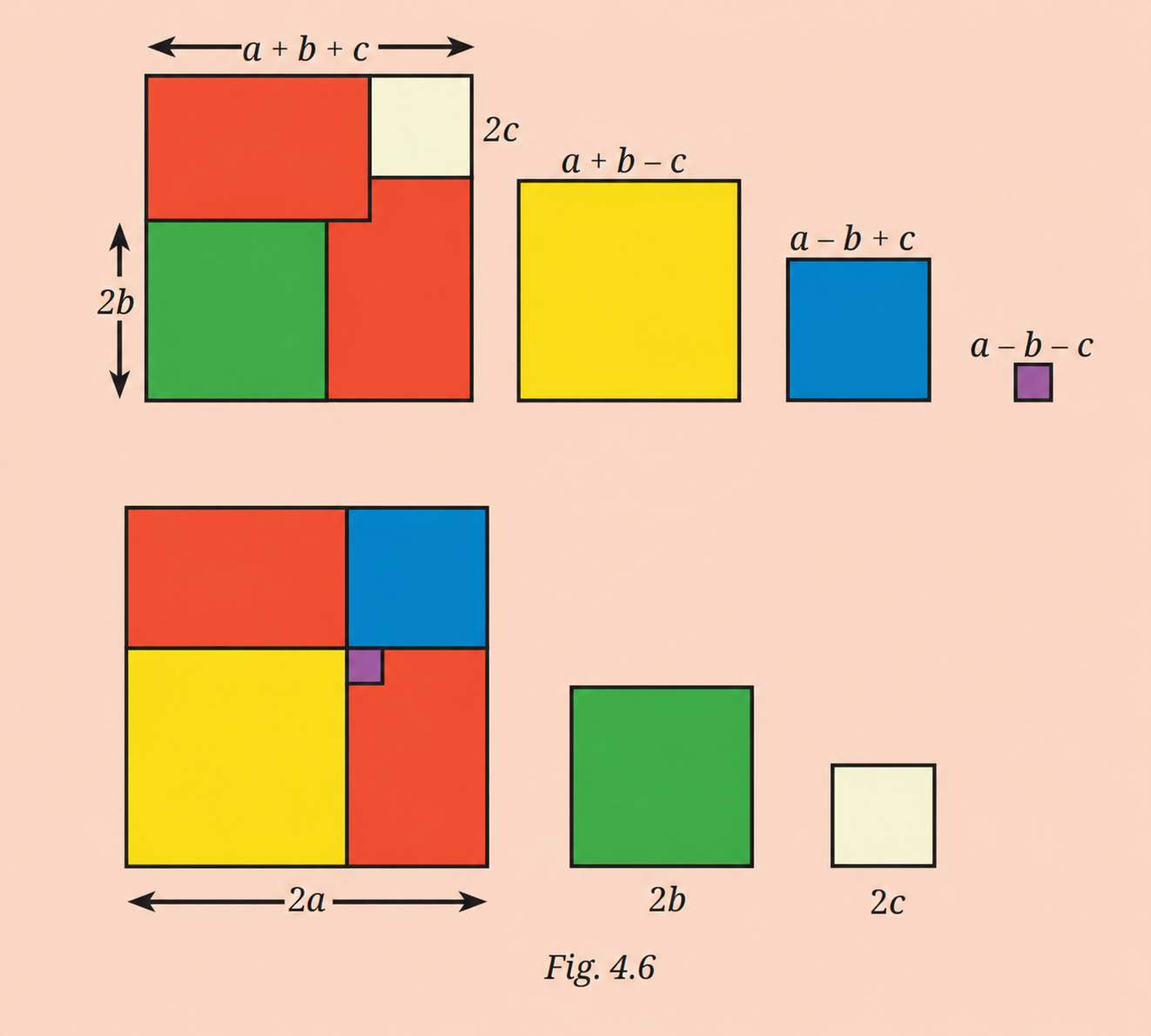
Solution:
The top row represents the squares of the following expressions:
(a + b + c), (a + b - c), (a - b + c), and (a - b - c)
So, the total area in the top row is:
(a + b + c)² + (a + b - c)² + (a - b + c)² + (a - b - c)²
The bottom row rearranges the same areas into three squares with sides:
2a, 2b, and 2c
So, the total area in the bottom row is:
(2a)² + (2b)² + (2c)²
= 4a² + 4b² + 4c²
= 4(a² + b² + c²)
Therefore, the identity represented by the figures is:
(a + b + c)² + (a + b - c)² + (a - b + c)² + (a - b - c)² = 4(a² + b² + c²)
Think and Reflect (NCERT Textbook Page No. 79)
Suppose 7x is split as 2x + 5x; can a similar rectangular arrangement be formed? Consider other possibilities and check.
Solution:
Students can try this activity by splitting 7x in different ways, such as 1x + 6x, 2x + 5x, or 3x + 4x. Then, they can check whether the tiles can be arranged to form a proper rectangle.
Think and Reflect (NCERT Textbook Page No. 79)
Question 1. Figure out the product of x + 2 and x + 3 using algebra tiles.
Solution:
We need to find:
(x + 2)(x + 3)
Using algebra tiles, we form a rectangle with length (x + 2) and breadth (x + 3).
The rectangle contains:
1 tile of x²
5 tiles of x
6 unit tiles
So, the total area is:
x² + 5x + 6
Therefore,
(x + 2)(x + 3) = x² + 5x + 6
Question 2. Lay out algebra tiles for x2 + 11x + 30 in such a way that you will see its factors.
Solution:
We need to arrange the tiles for:
x² + 11x + 30
This means we need:
1 tile of x²
11 tiles of x
30 unit tiles
Now, arrange these tiles to form a rectangle.
The rectangle can be formed with sides:
(x + 5) and (x + 6)
So,
x² + 11x + 30 = (x + 5)(x + 6)
Therefore, the factors of x² + 11x + 30 are (x + 5) and (x + 6).
Think and Reflect (NCERT Textbook Page No. 80)
We have seen that (x + 3)(x + 4) = x2 + 7x + 12.
Also (x + 6)(x + 7) = x2 + 13x + 42.
Generalise the pattern to get an expression for (x + a)(x + b).
Solution:
Let us expand the given expressions.
(x + 3)(x + 4)
= x² + 3x + 4x + 12
= x² + (3 + 4)x + 12
= x² + 7x + 12
Similarly,
(x + 6)(x + 7)
= x² + 6x + 7x + 42
= x² + (6 + 7)x + 42
= x² + 13x + 42
From this pattern, we can generalise:
(x + a)(x + b) = x² + ax + bx + ab
= x² + (a + b)x + ab
Therefore,
(x + a)(x + b) = x² + (a + b)x + ab
Think and Reflect (NCERT Textbook Page No. 82)
James and Reshma were talking about algebraic identities they leamt in school.
James: (a – b)2 (a + b) = (a2 – 2ab + b2)(a + b)
Reshma: I have a different idea, (a – b)2 (a + b) = (a – b) [(a-b) (a + b)] = (a-b)(a2 – b2)
I will find this product to get the answer.
According to you, who is correct and why?
Try to combine more such identities and find new results.
Solution:
Both James and Reshma are correct because they are using valid algebraic identities.
James first expands (a - b)² as:
(a - b)² = a² - 2ab + b²
So,
(a - b)²(a + b) = (a² - 2ab + b²)(a + b)
Reshma groups the terms differently:
(a - b)²(a + b) = (a - b)[(a - b)(a + b)]
Using the identity,
(a - b)(a + b) = a² - b²
she gets:
(a - b)(a² - b²)
Both methods give the same final result:
a³ - a²b - ab² + b³
Therefore, both are correct. They only used different identities to simplify the same expression.
Think and Reflect (NCERT Textbook Page No. 85)
We already know that x2 – y2 = (x – y)(x + y)
Further, we have verified that x3 – y3 = (x -y)(x2 + xy + y2) Observe that x – y is a common factor of x2 – y2 and x3 – y3. Do you think x-y is also a factor of x4 – y4?
Note that x4 – y4 = (x2)2 – (y2)2 = (x2 – y2) (x2 + y2).
Can you see how x – y is a factor of x4 – y4?
How about x5 – y5? Does this also have x – y as a factor?
Solution:
Yes, x - y is also a factor of x⁴ - y⁴.
We know that:
x⁴ - y⁴ = (x²)² - (y²)²
Using the identity a² - b² = (a - b)(a + b), we get:
x⁴ - y⁴ = (x² - y²)(x² + y²)
Also,
x² - y² = (x - y)(x + y)
So,
x⁴ - y⁴ = (x - y)(x + y)(x² + y²)
Hence, x - y is a factor of x⁴ - y⁴.
Similarly, x - y is also a factor of x⁵ - y⁵.
In fact,
x⁵ - y⁵ = (x - y)(x⁴ + x³y + x²y² + xy³ + y⁴)
Therefore, x - y is a factor of x² - y², x³ - y³, x⁴ - y⁴, x⁵ - y⁵, and so on.
Think and Reflect (NCERT Textbook Page No. 87)
Try to simplify the following rational expression:

Solution:
We need to simplify:
(36s² - 12st + t²) / (t² + 2ts - 48s²)
First, factor the numerator.
36s² - 12st + t²
= (6s)² - 2(6s)(t) + t²
= (6s - t)²
Now, factor the denominator.
t² + 2ts - 48s²
We need two terms whose product is -48s² and whose sum is 2s.
These terms are 8s and -6s.
So,
t² + 2ts - 48s²
= t² + 8st - 6st - 48s²
= t(t + 8s) - 6s(t + 8s)
= (t - 6s)(t + 8s)
Now,
(36s² - 12st + t²) / (t² + 2ts - 48s²)
= (6s - t)² / [(t - 6s)(t + 8s)]
Since t - 6s = -(6s - t), we get:
= (6s - t)² / [-(6s - t)(t + 8s)]
Cancel the common factor (6s - t):
= -(6s - t) / (t + 8s)
= (t - 6s) / (t + 8s)
Therefore,
(36s² - 12st + t²) / (t² + 2ts - 48s²) = (t - 6s) / (t + 8s)
Exercise Set 4.1 Class 9 Maths Detailed Solutions
Question 1. Using the identity (a + b)² = a² + 2ab + b², expand the following:
(i) (7x + 4y)²
Solution:
Using the identity,
(a + b)² = a² + 2ab + b²
Here, a = 7x and b = 4y.
(7x + 4y)²
= (7x)² + 2(7x)(4y) + (4y)²
= 49x² + 56xy + 16y²
Therefore,
(7x + 4y)² = 49x² + 56xy + 16y²
(ii) ((7/5)x + (3/2)y)²
Solution:
Using the identity,
(a + b)² = a² + 2ab + b²
Here, a = (7/5)x and b = (3/2)y.
((7/5)x + (3/2)y)²
= ((7/5)x)² + 2((7/5)x)((3/2)y) + ((3/2)y)²
= (49/25)x² + (21/5)xy + (9/4)y²
Therefore,
((7/5)x + (3/2)y)² = (49/25)x² + (21/5)xy + (9/4)y²
(iii) (2.5p + 1.5q)²
Solution:
Using the identity,
(a + b)² = a² + 2ab + b²
Here, a = 2.5p and b = 1.5q.
(2.5p + 1.5q)²
= (2.5p)² + 2(2.5p)(1.5q) + (1.5q)²
= 6.25p² + 7.5pq + 2.25q²
Therefore,
(2.5p + 1.5q)² = 6.25p² + 7.5pq + 2.25q²
(iv) ((3/4)s + 8t)²
Solution:
Using the identity,
(a + b)² = a² + 2ab + b²
Here, a = (3/4)s and b = 8t.
((3/4)s + 8t)²
= ((3/4)s)² + 2((3/4)s)(8t) + (8t)²
= (9/16)s² + 12st + 64t²
Therefore,
((3/4)s + 8t)² = (9/16)s² + 12st + 64t²
(v) (x + (1/2)y)²
Solution:
Using the identity,
(a + b)² = a² + 2ab + b²
Here, a = x and b = (1/2)y.
(x + (1/2)y)²
= x² + 2(x)((1/2)y) + ((1/2)y)²
= x² + xy + (1/4)y²
Therefore,
(x + (1/2)y)² = x² + xy + (1/4)y²
(vi) (1/x + 1/y)²
Solution:
Using the identity,
(a + b)² = a² + 2ab + b²
Here, a = 1/x and b = 1/y.
(1/x + 1/y)²
= (1/x)² + 2(1/x)(1/y) + (1/y)²
= 1/x² + 2/xy + 1/y²
Therefore,
(1/x + 1/y)² = 1/x² + 2/xy + 1/y²
Question 2. Using the same identity, find the values of the following:
(i) (64)²
Solution:
Using the identity,
(a + b)² = a² + 2ab + b²
Write 64 as 60 + 4.
64² = (60 + 4)²
= 60² + 2(60)(4) + 4²
= 3600 + 480 + 16
= 4096
Therefore,
64² = 4096
(ii) (105)²
Solution:
Using the identity,
(a + b)² = a² + 2ab + b²
Write 105 as 100 + 5.
105² = (100 + 5)²
= 100² + 2(100)(5) + 5²
= 10000 + 1000 + 25
= 11025
Therefore,
105² = 11025
(iii) (205)²
Solution:
Using the identity,
(a + b)² = a² + 2ab + b²
Write 205 as 200 + 5.
205² = (200 + 5)²
= 200² + 2(200)(5) + 5²
= 40000 + 2000 + 25
= 42025
Therefore,
205² = 42025
Exercise Set 4.2 Class 9 Maths Detailed Solutions
Question 1. Factor completely:
(i) 9x² + 24xy + 16y²
Solution:
Using the identity,
(a + b)² = a² + 2ab + b²
We can write:
9x² + 24xy + 16y²
= (3x)² + 2(3x)(4y) + (4y)²
= (3x + 4y)²
Therefore,
9x² + 24xy + 16y² = (3x + 4y)²
(ii) 4s² + 20st + 25t²
Solution:
Using the identity,
(a + b)² = a² + 2ab + b²
We can write:
4s² + 20st + 25t²
= (2s)² + 2(2s)(5t) + (5t)²
= (2s + 5t)²
Therefore,
4s² + 20st + 25t² = (2s + 5t)²
(iii) 49x² + 28xy + 4y²
Solution:
Using the identity,
(a + b)² = a² + 2ab + b²
We can write:
49x² + 28xy + 4y²
= (7x)² + 2(7x)(2y) + (2y)²
= (7x + 2y)²
Therefore,
49x² + 28xy + 4y² = (7x + 2y)²
(iv) 64p² + (32/3)pq + (4/9)q²
Solution:
Using the identity,
(a + b)² = a² + 2ab + b²
We can write:
64p² + (32/3)pq + (4/9)q²
= (8p)² + 2(8p)((2/3)q) + ((2/3)q)²
= (8p + (2/3)q)²
Therefore,
64p² + (32/3)pq + (4/9)q² = (8p + (2/3)q)²
(v) 3a² + 4ab + (4/3)b²
Solution:
Using the identity,
(a + b)² = a² + 2ab + b²
We can write:
3a² + 4ab + (4/3)b²
= (√3a)² + 2(√3a)((2/√3)b) + ((2/√3)b)²
= (√3a + (2/√3)b)²
Therefore,
3a² + 4ab + (4/3)b² = (√3a + (2/√3)b)²
(vi) (9/5)s² + 6sv + 5v²
Solution:
Using the identity,
(a + b)² = a² + 2ab + b²
We can write:
(9/5)s² + 6sv + 5v²
= ((3/√5)s)² + 2((3/√5)s)(√5v) + (√5v)²
= ((3/√5)s + √5v)²
Therefore,
(9/5)s² + 6sv + 5v² = ((3/√5)s + √5v)²
Question 2. Find the values of the following using the identity (a – b)² = a² – 2ab + b².
(i) (79)²
Solution:
Write 79 as 80 - 1.
Using the identity,
(a - b)² = a² - 2ab + b²
79² = (80 - 1)²
= 80² - 2(80)(1) + 1²
= 6400 - 160 + 1
= 6241
Therefore,
79² = 6241
(ii) (193)²
Solution:
Write 193 as 200 - 7.
Using the identity,
(a - b)² = a² - 2ab + b²
193² = (200 - 7)²
= 200² - 2(200)(7) + 7²
= 40000 - 2800 + 49
= 37249
Therefore,
193² = 37249
(iii) (299)²
Solution:
Write 299 as 300 - 1.
Using the identity,
(a - b)² = a² - 2ab + b²
299² = (300 - 1)²
= 300² - 2(300)(1) + 1²
= 90000 - 600 + 1
= 89401
Therefore,
299² = 89401
Exercise Set 4.3 Class 9 Maths Detailed Solutions
Question 1. Find the following squares using one of the above identities to make these calculations easier.
(i) 117²
Solution:
Write 117 as 100 + 10 + 7.
Using the identity,
(a + b + c)² = a² + b² + c² + 2ab + 2bc + 2ca
117² = (100 + 10 + 7)²
= 100² + 10² + 7² + 2(100)(10) + 2(10)(7) + 2(7)(100)
= 10000 + 100 + 49 + 2000 + 140 + 1400
= 13689
Therefore,
117² = 13689
(ii) 78²
Solution:
Write 78 as 80 - 2.
Using the identity,
(a - b)² = a² - 2ab + b²
78² = (80 - 2)²
= 80² - 2(80)(2) + 2²
= 6400 - 320 + 4
= 6084
Therefore,
78² = 6084
(iii) 198²
Solution:
Write 198 as 200 - 2.
Using the identity,
(a - b)² = a² - 2ab + b²
198² = (200 - 2)²
= 200² - 2(200)(2) + 2²
= 40000 - 800 + 4
= 39204
Therefore,
198² = 39204
(iv) 214²
Solution:
Write 214 as 200 + 10 + 4.
Using the identity,
(a + b + c)² = a² + b² + c² + 2ab + 2bc + 2ca
214² = (200 + 10 + 4)²
= 200² + 10² + 4² + 2(200)(10) + 2(10)(4) + 2(4)(200)
= 40000 + 100 + 16 + 4000 + 80 + 1600
= 45796
Therefore,
214² = 45796
(v) 1104²
Solution:
Write 1104 as 1000 + 100 + 4.
Using the identity,
(a + b + c)² = a² + b² + c² + 2ab + 2bc + 2ca
1104² = (1000 + 100 + 4)²
= 1000² + 100² + 4² + 2(1000)(100) + 2(100)(4) + 2(4)(1000)
= 1000000 + 10000 + 16 + 200000 + 800 + 8000
= 1218816
Therefore,
1104² = 1218816
(vi) 1120²
Solution:
Write 1120 as 1000 + 100 + 20.
Using the identity,
(a + b + c)² = a² + b² + c² + 2ab + 2bc + 2ca
1120² = (1000 + 100 + 20)²
= 1000² + 100² + 20² + 2(1000)(100) + 2(100)(20) + 2(20)(1000)
= 1000000 + 10000 + 400 + 200000 + 4000 + 40000
= 1254400
Therefore,
1120² = 1254400
Question 2: Factor using suitable identities:
(i) 16y² - 24y + 9
Solution:
Using the identity,
(a - b)² = a² - 2ab + b²
16y² - 24y + 9
= (4y)² - 2(4y)(3) + 3²
= (4y - 3)²
Therefore,
16y² - 24y + 9 = (4y - 3)²
(ii) (9/4)s² + 6st + 4t²
Solution:
Using the identity,
(a + b)² = a² + 2ab + b²
(9/4)s² + 6st + 4t²
= ((3/2)s)² + 2((3/2)s)(2t) + (2t)²
= ((3/2)s + 2t)²
Therefore,
(9/4)s² + 6st + 4t² = ((3/2)s + 2t)²
(iii) m²/9 + mk/3 + k²/4 + 2mn + 3nk + 9n²
Solution:
Using the identity,
(a + b + c)² = a² + b² + c² + 2ab + 2bc + 2ca
m²/9 + mk/3 + k²/4 + 2mn + 3nk + 9n²
= (m/3)² + (k/2)² + (3n)² + 2(m/3)(k/2) + 2(k/2)(3n) + 2(m/3)(3n)
= (m/3 + k/2 + 3n)²
Therefore,
m²/9 + mk/3 + k²/4 + 2mn + 3nk + 9n² = (m/3 + k/2 + 3n)²
(iv) p²/16 - 2 + 16/p²
Solution:
Using the identity,
(a - b)² = a² - 2ab + b²
p²/16 - 2 + 16/p²
= (p/4)² - 2(p/4)(4/p) + (4/p)²
= (p/4 - 4/p)²
Therefore,
p²/16 - 2 + 16/p² = (p/4 - 4/p)²
(v) 9a² + 4b² + c² - 12ab + 6ac - 4bc
Solution:
Using the identity,
(a + b + c)² = a² + b² + c² + 2ab + 2bc + 2ca
9a² + 4b² + c² - 12ab + 6ac - 4bc
= (3a)² + (-2b)² + c² + 2(3a)(-2b) + 2(3a)(c) + 2(-2b)(c)
= (3a - 2b + c)²
Therefore,
9a² + 4b² + c² - 12ab + 6ac - 4bc = (3a - 2b + c)²
Question 3. Expand the following using the identity
(a + b + c)² = a² + b² + c² + 2ab + 2bc + 2ca:
(i) (p + 3q + 7r)²
Solution:
Using the identity,
(a + b + c)² = a² + b² + c² + 2ab + 2bc + 2ca
(p + 3q + 7r)²
= p² + (3q)² + (7r)² + 2(p)(3q) + 2(3q)(7r) + 2(7r)(p)
= p² + 9q² + 49r² + 6pq + 42qr + 14pr
Therefore,
(p + 3q + 7r)² = p² + 9q² + 49r² + 6pq + 42qr + 14pr
(ii) (3x - 2y + 4z)²
Solution:
Using the identity,
(a + b + c)² = a² + b² + c² + 2ab + 2bc + 2ca
Here, a = 3x, b = -2y, and c = 4z.
(3x - 2y + 4z)²
= (3x)² + (-2y)² + (4z)² + 2(3x)(-2y) + 2(-2y)(4z) + 2(4z)(3x)
= 9x² + 4y² + 16z² - 12xy - 16yz + 24xz
Therefore,
(3x - 2y + 4z)² = 9x² + 4y² + 16z² - 12xy - 16yz + 24xz
Question 4. Is this an identity?
(a + b – c)² + (a – b + c)² + (a – b – c)² = 2a² + 2b² + 2c².
Solution:
No, the given statement is not an identity.
Let us expand the left-hand side.
(a + b - c)² = a² + b² + c² + 2ab - 2ac - 2bc
(a - b + c)² = a² + b² + c² - 2ab + 2ac - 2bc
(a - b - c)² = a² + b² + c² - 2ab - 2ac + 2bc
Now, add all three expressions:
(a + b - c)² + (a - b + c)² + (a - b - c)²
= 3a² + 3b² + 3c² - 2ab - 2ac - 2bc
This is not equal to 2a² + 2b² + 2c².
Therefore, the given equation is not an identity.
Exercise Set 4.4 Class 9 Maths Detailed Solutions
Question 1. Fill in the blanks to complete the following identities:
(i) s² – 11s + 24 = ()()
Solution:
We need to factor:
s² - 11s + 24
Compare it with:
x² + (a + b)x + ab = (x + a)(x + b)
Here, we need two numbers whose sum is -11 and product is 24.
The required numbers are -8 and -3 because:
-8 + (-3) = -11
and
(-8)(-3) = 24
So,
s² - 11s + 24 = s² - 8s - 3s + 24
= s(s - 8) - 3(s - 8)
= (s - 8)(s - 3)
Therefore,
s² - 11s + 24 = (s - 8)(s - 3)
(ii) (__________) (x + 1) = (3x² – 4x – 7)
Solution:
We need to factor:
3x² - 4x - 7
Multiply the coefficient of x² and the constant term:
3 × (-7) = -21
Now, find two numbers whose product is -21 and sum is -4.
The numbers are -7 and 3 because:
-7 × 3 = -21
and
-7 + 3 = -4
So,
3x² - 4x - 7 = 3x² - 7x + 3x - 7
= x(3x - 7) + 1(3x - 7)
= (3x - 7)(x + 1)
Therefore,
(3x - 7)(x + 1) = 3x² - 4x - 7
(iii) 10x² – 11x – 6 = (2x – ) ( + 2)
Solution:
We need to factor:
10x² - 11x - 6
Multiply the coefficient of x² and the constant term:
10 × (-6) = -60
Now, find two numbers whose product is -60 and sum is -11.
The numbers are -15 and 4 because:
-15 × 4 = -60
and
-15 + 4 = -11
So,
10x² - 11x - 6 = 10x² - 15x + 4x - 6
= 5x(2x - 3) + 2(2x - 3)
= (2x - 3)(5x + 2)
Therefore,
10x² - 11x - 6 = (2x - 3)(5x + 2)
(iv) 6x² + 7x + 2 = ()()
Solution:
We need to factor:
6x² + 7x + 2
Multiply the coefficient of x² and the constant term:
6 × 2 = 12
Now, find two numbers whose product is 12 and sum is 7.
The numbers are 3 and 4 because:
3 × 4 = 12
and
3 + 4 = 7
So,
6x² + 7x + 2 = 6x² + 3x + 4x + 2
= 3x(2x + 1) + 2(2x + 1)
= (3x + 2)(2x + 1)
Therefore,
6x² + 7x + 2 = (3x + 2)(2x + 1)
Question 2. Select and use the identity that will help you to find the following products without multiplying directly:
(i) (41)²
Solution:
Write 41 as 40 + 1.
Using the identity,
(a + b)² = a² + 2ab + b²
41² = (40 + 1)²
= 40² + 2(40)(1) + 1²
= 1600 + 80 + 1
= 1681
Therefore,
41² = 1681
(ii) (27)²
Solution:
Write 27 as 30 - 3.
Using the identity,
(a - b)² = a² - 2ab + b²
27² = (30 - 3)²
= 30² - 2(30)(3) + 3²
= 900 - 180 + 9
= 729
Therefore,
27² = 729
(iii) (23 × 17)
Solution:
Write 23 as 20 + 3 and 17 as 20 - 3.
Using the identity,
(a + b)(a - b) = a² - b²
23 × 17 = (20 + 3)(20 - 3)
= 20² - 3²
= 400 - 9
= 391
Therefore,
23 × 17 = 391
(iv) (135)²
Solution:
Write 135 as 140 - 5.
Using the identity,
(a - b)² = a² - 2ab + b²
135² = (140 - 5)²
= 140² - 2(140)(5) + 5²
= 19600 - 1400 + 25
= 18225
Therefore,
135² = 18225
(v) (97)²
Solution:
Write 97 as 100 - 3.
Using the identity,
(a - b)² = a² - 2ab + b²
97² = (100 - 3)²
= 100² - 2(100)(3) + 3²
= 10000 - 600 + 9
= 9409
Therefore,
97² = 9409
(vi) (18 × 29)
Solution:
Write 18 as 20 - 2 and 29 as 20 + 9.
Using the identity,
(x + a)(x + b) = x² + (a + b)x + ab
18 × 29 = (20 - 2)(20 + 9)
= 20² + (-2 + 9)20 + (-2)(9)
= 400 + 7(20) - 18
= 400 + 140 - 18
= 522
Therefore,
18 × 29 = 522
(vii) (34 × 43)
Solution:
Write 34 as 40 - 6 and 43 as 40 + 3.
Using the identity,
(x + a)(x + b) = x² + (a + b)x + ab
34 × 43 = (40 - 6)(40 + 3)
= 40² + (-6 + 3)40 + (-6)(3)
= 1600 - 120 - 18
= 1462
Therefore,
34 × 43 = 1462
(viii) (205)²
Solution:
Write 205 as 200 + 5.
Using the identity,
(a + b)² = a² + 2ab + b²
205² = (200 + 5)²
= 200² + 2(200)(5) + 5²
= 40000 + 2000 + 25
= 42025
Therefore,
205² = 42025
Question 3. Factor the following:
(i) 9a² + b² + 4c² – 6ab + 12ac – 4bc
Solution:
Using the identity,
(a + b + c)² = a² + b² + c² + 2ab + 2bc + 2ca
We can write:
9a² + b² + 4c² - 6ab + 12ac - 4bc
= (3a)² + (-b)² + (2c)² + 2(3a)(-b) + 2(3a)(2c) + 2(-b)(2c)
= (3a - b + 2c)²
Therefore,
9a² + b² + 4c² - 6ab + 12ac - 4bc = (3a - b + 2c)²
(ii) 16s² + 25t² – 40st
Solution:
Using the identity,
(a - b)² = a² - 2ab + b²
We can write:
16s² + 25t² - 40st
= (4s)² + (5t)² - 2(4s)(5t)
= (4s - 5t)²
Therefore,
16s² + 25t² - 40st = (4s - 5t)²
(iii) r² – r – 42
Solution:
We need to factor:
r² - r - 42
Find two numbers whose product is -42 and sum is -1.
The numbers are -7 and 6 because:
-7 × 6 = -42
and
-7 + 6 = -1
So,
r² - r - 42 = r² - 7r + 6r - 42
= r(r - 7) + 6(r - 7)
= (r - 7)(r + 6)
Therefore,
r² - r - 42 = (r - 7)(r + 6)
(iv) 49g² + 14gb + b²
Solution:
Using the identity,
(a + b)² = a² + 2ab + b²
We can write:
49g² + 14gb + b²
= (7g)² + 2(7g)(b) + b²
= (7g + b)²
Therefore,
49g² + 14gb + b² = (7g + b)²
(v) 64u² + 121v² + 4w² – 176uv – 32uw + 44vw
Solution:
Using the identity,
(a + b + c)² = a² + b² + c² + 2ab + 2bc + 2ca
We can write:
64u² + 121v² + 4w² - 176uv - 32uw + 44vw
= (-8u)² + (11v)² + (2w)² + 2(-8u)(11v) + 2(-8u)(2w) + 2(11v)(2w)
= (-8u + 11v + 2w)²
This can also be written as:
(11v + 2w - 8u)²
Therefore,
64u² + 121v² + 4w² - 176uv - 32uw + 44vw = (11v + 2w - 8u)²
Exercise Set 4.5 Class 9 Maths Detailed Solutions
Question 1. Simplify the following rational expressions assuming that the expressions in the denominators are not equal to zero:
(i) (3p² - 3pq - 18q²) / (p² + 3pq - 10q²)
Solution:
We need to simplify:
(3p² - 3pq - 18q²) / (p² + 3pq - 10q²)
First, factor the numerator.
3p² - 3pq - 18q²
= 3(p² - pq - 6q²)
Now, factor p² - pq - 6q².
We need two terms whose product is -6q² and whose sum is -q.
The terms are -3q and 2q.
So,
p² - pq - 6q²
= p² - 3pq + 2pq - 6q²
= p(p - 3q) + 2q(p - 3q)
= (p + 2q)(p - 3q)
Therefore,
3p² - 3pq - 18q² = 3(p + 2q)(p - 3q)
Now, factor the denominator.
p² + 3pq - 10q²
We need two terms whose product is -10q² and whose sum is 3q.
The terms are 5q and -2q.
So,
p² + 3pq - 10q²
= p² + 5pq - 2pq - 10q²
= p(p + 5q) - 2q(p + 5q)
= (p - 2q)(p + 5q)
Hence,
(3p² - 3pq - 18q²) / (p² + 3pq - 10q²)
= 3(p + 2q)(p - 3q) / [(p - 2q)(p + 5q)]
Therefore,
(3p² - 3pq - 18q²) / (p² + 3pq - 10q²) = 3(p + 2q)(p - 3q) / [(p - 2q)(p + 5q)]
(ii) (n³ - 3n²m + 3nm² - m³) / (5m² - 10mn + 5n²)
Solution:
We need to simplify:
(n³ - 3n²m + 3nm² - m³) / (5m² - 10mn + 5n²)
The numerator is in the form:
a³ - 3a²b + 3ab² - b³ = (a - b)³
So,
n³ - 3n²m + 3nm² - m³ = (n - m)³
Now, factor the denominator.
5m² - 10mn + 5n²
= 5(m² - 2mn + n²)
= 5(m - n)²
Since (m - n)² = (n - m)², we can write:
5(m - n)² = 5(n - m)²
Now,
(n³ - 3n²m + 3nm² - m³) / (5m² - 10mn + 5n²)
= (n - m)³ / [5(n - m)²]
= (n - m) / 5
Therefore,
(n³ - 3n²m + 3nm² - m³) / (5m² - 10mn + 5n²) = (n - m) / 5
(iii) (w³ - v³ + x³ + 3wvx) / (w² + v² + x² - 2wv - 2vx + 2wx)
Solution:
We need to simplify:
(w³ - v³ + x³ + 3wvx) / (w² + v² + x² - 2wv - 2vx + 2wx)
First, factor the numerator.
The numerator can be written using the identity:
a³ + b³ + c³ - 3abc = (a + b + c)(a² + b² + c² - ab - bc - ca)
Here, take:
a = w, b = -v, and c = x
Then,
w³ - v³ + x³ + 3wvx
= (w - v + x)(w² + v² + x² + wv + vx - wx)
Now, factor the denominator.
w² + v² + x² - 2wv - 2vx + 2wx
= (w - v + x)²
So,
(w³ - v³ + x³ + 3wvx) / (w² + v² + x² - 2wv - 2vx + 2wx)
= [(w - v + x)(w² + v² + x² + wv + vx - wx)] / (w - v + x)²
Cancel the common factor (w - v + x).
= (w² + v² + x² + wv + vx - wx) / (w - v + x)
Therefore,
(w³ - v³ + x³ + 3wvx) / (w² + v² + x² - 2wv - 2vx + 2wx)
= (w² + v² + x² + wv + vx - wx) / (w - v + x)
(iv) (4y² - 20yz + 25z²) / (25z² - 4y²)
Solution:
We need to simplify:
(4y² - 20yz + 25z²) / (25z² - 4y²)
First, factor the numerator.
4y² - 20yz + 25z²
= (2y)² - 2(2y)(5z) + (5z)²
= (2y - 5z)²
Now, factor the denominator.
25z² - 4y²
= (5z)² - (2y)²
= (5z - 2y)(5z + 2y)
Since 2y - 5z = -(5z - 2y), we have:
(2y - 5z)² = (5z - 2y)²
So,
(4y² - 20yz + 25z²) / (25z² - 4y²)
= (5z - 2y)² / [(5z - 2y)(5z + 2y)]
Cancel the common factor (5z - 2y).
= (5z - 2y) / (5z + 2y)
Therefore,
(4y² - 20yz + 25z²) / (25z² - 4y²) = (5z - 2y) / (5z + 2y)
(v) [(x² + x - 6)(x² - 7x + 12)] / [(x² - 6x + 8)(x² - 9)]
Solution:
We need to simplify:
[(x² + x - 6)(x² - 7x + 12)] / [(x² - 6x + 8)(x² - 9)]
First, factor each expression.
x² + x - 6
= x² + 3x - 2x - 6
= x(x + 3) - 2(x + 3)
= (x - 2)(x + 3)
x² - 7x + 12
= x² - 3x - 4x + 12
= x(x - 3) - 4(x - 3)
= (x - 3)(x - 4)
x² - 6x + 8
= x² - 2x - 4x + 8
= x(x - 2) - 4(x - 2)
= (x - 2)(x - 4)
x² - 9
= x² - 3²
= (x - 3)(x + 3)
Now substitute these factors.
[(x² + x - 6)(x² - 7x + 12)] / [(x² - 6x + 8)(x² - 9)]
= [(x - 2)(x + 3)(x - 3)(x - 4)] / [(x - 2)(x - 4)(x - 3)(x + 3)]
All factors cancel.
= 1
Therefore,
[(x² + x - 6)(x² - 7x + 12)] / [(x² - 6x + 8)(x² - 9)] = 1
(vi) (p⁴ - 16) / (p² - 4p + 4)
Solution:
We need to simplify:
(p⁴ - 16) / (p² - 4p + 4)
First, factor the numerator.
p⁴ - 16
= (p²)² - 4²
Using the identity,
a² - b² = (a - b)(a + b)
we get:
p⁴ - 16 = (p² - 4)(p² + 4)
Now,
p² - 4 = p² - 2²
= (p - 2)(p + 2)
So,
p⁴ - 16 = (p - 2)(p + 2)(p² + 4)
Now, factor the denominator.
p² - 4p + 4
= p² - 2(p)(2) + 2²
= (p - 2)²
Therefore,
(p⁴ - 16) / (p² - 4p + 4)
= [(p - 2)(p + 2)(p² + 4)] / (p - 2)²
Cancel one common factor (p - 2).
= [(p + 2)(p² + 4)] / (p - 2)
Therefore,
(p⁴ - 16) / (p² - 4p + 4) = [(p + 2)(p² + 4)] / (p - 2)
Algebraic Identities End of Chapter Exercises Solutions
Question 1. Use suitable identities to find the following products:
(i) (-3x + 4)²
Solution:
Using the identity,
(a + b)² = a² + 2ab + b²
Here, a = -3x and b = 4.
(-3x + 4)²
= (-3x)² + 2(-3x)(4) + 4²
= 9x² - 24x + 16
Therefore,
(-3x + 4)² = 9x² - 24x + 16
(ii) (2s + 7)(2s – 7)
Solution:
Using the identity,
(a + b)(a - b) = a² - b²
Here, a = 2s and b = 7.
(2s + 7)(2s - 7)
= (2s)² - 7²
= 4s² - 49
Therefore,
(2s + 7)(2s - 7) = 4s² - 49
(iii) (p² + 12)(p² – 12)
Solution:
Using the identity,
(a + b)(a - b) = a² - b²
Here, a = p² and b = 12.
(p² + 12)(p² - 12)
= (p²)² - 12²
= p⁴ - 144
Therefore,
(p² + 12)(p² - 12) = p⁴ - 144
(iv) (2n + 7)(2n – 7)
Solution:
Using the identity,
(a + b)(a - b) = a² - b²
Here, a = 2n and b = 7.
(2n + 7)(2n - 7)
= (2n)² - 7²
= 4n² - 49
Therefore,
(2n + 7)(2n - 7) = 4n² - 49
(v) (s – 2t)(s² + 2st + 4t²)
Solution:
Using the identity,
(x - y)(x² + xy + y²) = x³ - y³
Here, x = s and y = 2t.
(s - 2t)(s² + 2st + 4t²)
= s³ - (2t)³
= s³ - 8t³
Therefore,
(s - 2t)(s² + 2st + 4t²) = s³ - 8t³
(vi) (r/2 – 4/r)²
Solution:
Using the identity,
(a - b)² = a² - 2ab + b²
Here, a = r/2 and b = 4/r.
(r/2 - 4/r)²
= (r/2)² - 2(r/2)(4/r) + (4/r)²
= r²/4 - 4 + 16/r²
Therefore,
(r/2 - 4/r)² = r²/4 - 4 + 16/r²
(vii) (-3m + 4k – l)²
Solution:
Using the identity,
(a + b + c)² = a² + b² + c² + 2ab + 2bc + 2ca
Here, a = -3m, b = 4k, and c = -l.
(-3m + 4k - l)²
= (-3m)² + (4k)² + (-l)² + 2(-3m)(4k) + 2(4k)(-l) + 2(-l)(-3m)
= 9m² + 16k² + l² - 24mk - 8kl + 6ml
Therefore,
(-3m + 4k - l)² = 9m² + 16k² + l² - 24mk + 6ml - 8kl
(viii) (x – y/3)³
Solution:
Using the identity,
(a - b)³ = a³ - 3a²b + 3ab² - b³
Here, a = x and b = y/3.
(x - y/3)³
= x³ - 3x²(y/3) + 3x(y/3)² - (y/3)³
= x³ - x²y + xy²/3 - y³/27
Therefore,
(x - y/3)³ = x³ - x²y + xy²/3 - y³/27
(ix) ((7/2)k – (2/3)m)³
Solution:
Using the identity,
(a - b)³ = a³ - 3a²b + 3ab² - b³
Here, a = (7/2)k and b = (2/3)m.
((7/2)k - (2/3)m)³
= ((7/2)k)³ - 3((7/2)k)²((2/3)m) + 3((7/2)k)((2/3)m)² - ((2/3)m)³
= (343/8)k³ - (49/2)k²m + (14/3)km² - (8/27)m³
Therefore,
((7/2)k - (2/3)m)³ = (343/8)k³ - (49/2)k²m + (14/3)km² - (8/27)m³
Question 2. Find the values using suitable identities:
(i) 17 × 21
Solution:
Write 17 as 20 - 3 and 21 as 20 + 1.
Using the identity,
(x + a)(x + b) = x² + (a + b)x + ab
17 × 21
= (20 - 3)(20 + 1)
= 20² + (-3 + 1)20 + (-3)(1)
= 400 - 40 - 3
= 357
Therefore,
17 × 21 = 357
(ii) 104 × 96
Solution:
Write 104 as 100 + 4 and 96 as 100 - 4.
Using the identity,
(a + b)(a - b) = a² - b²
104 × 96
= (100 + 4)(100 - 4)
= 100² - 4²
= 10000 - 16
= 9984
Therefore,
104 × 96 = 9984
(iii) 24 × 16
Solution:
Write 24 as 20 + 4 and 16 as 20 - 4.
Using the identity,
(a + b)(a - b) = a² - b²
24 × 16
= (20 + 4)(20 - 4)
= 20² - 4²
= 400 - 16
= 384
Therefore,
24 × 16 = 384
(iv) 147³
Solution:
Write 147 as 150 - 3.
Using the identity,
(a - b)³ = a³ - 3a²b + 3ab² - b³
147³
= (150 - 3)³
= 150³ - 3(150)²(3) + 3(150)(3)² - 3³
= 3375000 - 202500 + 4050 - 27
= 3176523
Therefore,
147³ = 3176523
(v) 199³
Solution:
Write 199 as 200 - 1.
Using the identity,
(a - b)³ = a³ - 3a²b + 3ab² - b³
199³
= (200 - 1)³
= 200³ - 3(200)²(1) + 3(200)(1)² - 1³
= 8000000 - 120000 + 600 - 1
= 7880599
Therefore,
199³ = 7880599
(vi) 127³
Solution:
Write 127 as 130 - 3.
Using the identity,
(a - b)³ = a³ - 3a²b + 3ab² - b³
127³
= (130 - 3)³
= 130³ - 3(130)²(3) + 3(130)(3)² - 3³
= 2197000 - 152100 + 3510 - 27
= 2048383
Therefore,
127³ = 2048383
(vii) (-107)³
Solution:
Write -107 as -100 - 7.
Using the identity,
(a - b)³ = a³ - 3a²b + 3ab² - b³
(-107)³
= (-100 - 7)³
= (-100)³ - 3(-100)²(7) + 3(-100)(7)² - 7³
= -1000000 - 210000 - 14700 - 343
= -1225043
Therefore,
(-107)³ = -1225043
(viii) (-299)³
Solution:
Write -299 as -300 + 1.
Using the identity,
(a + b)³ = a³ + 3a²b + 3ab² + b³
(-299)³
= (-300 + 1)³
= (-300)³ + 3(-300)²(1) + 3(-300)(1)² + 1³
= -27000000 + 270000 - 900 + 1
= -26730899
Therefore,
(-299)³ = -26730899
Question 3. Factor the following algebraic expressions:
(i) 4y² + 1 + 1/(16y²)
Solution:
Using the identity,
(a + b)² = a² + 2ab + b²
We can write:
4y² + 1 + 1/(16y²)
= (2y)² + 2(2y)(1/4y) + (1/4y)²
= (2y + 1/4y)²
Therefore,
4y² + 1 + 1/(16y²) = (2y + 1/4y)²
(ii) 9m² – n²/25
Solution:
Using the identity,
a² - b² = (a + b)(a - b)
We can write:
9m² - n²/25
= (3m)² - (n/5)²
= (3m + n/5)(3m - n/5)
Therefore,
9m² - n²/25 = (3m + n/5)(3m - n/5)
(iii) 27b³ – 1/(64b³)
Solution:
Using the identity,
a³ - b³ = (a - b)(a² + ab + b²)
We can write:
27b³ - 1/(64b³)
= (3b)³ - (1/4b)³
= (3b - 1/4b)[(3b)² + (3b)(1/4b) + (1/4b)²]
= (3b - 1/4b)(9b² + 3/4 + 1/16b²)
Therefore,
27b³ - 1/(64b³) = (3b - 1/4b)(9b² + 3/4 + 1/16b²)
(iv) x² + 5x/6 + 1/6
Solution:
We need to factor:
x² + 5x/6 + 1/6
Find two terms whose product is 1/6 and whose sum is 5/6.
The required terms are 1/2 and 1/3.
So,
x² + 5x/6 + 1/6
= x² + x/2 + x/3 + 1/6
= x(x + 1/2) + 1/3(x + 1/2)
= (x + 1/2)(x + 1/3)
Therefore,
x² + 5x/6 + 1/6 = (x + 1/2)(x + 1/3)
(v) 27u³ – 27u²/5 + 9u/25 – 1/125
Solution:
Using the identity,
(a - b)³ = a³ - 3a²b + 3ab² - b³
Here, a = 3u and b = 1/5.
27u³ - 27u²/5 + 9u/25 - 1/125
= (3u)³ - 3(3u)²(1/5) + 3(3u)(1/5)² - (1/5)³
= (3u - 1/5)³
Therefore,
27u³ - 27u²/5 + 9u/25 - 1/125 = (3u - 1/5)³
(vi) 64y³ – z³/125
Solution:
Using the identity,
a³ - b³ = (a - b)(a² + ab + b²)
We can write:
64y³ - z³/125
= (4y)³ - (z/5)³
= (4y - z/5)[(4y)² + (4y)(z/5) + (z/5)²]
= (4y - z/5)(16y² + 4yz/5 + z²/25)
Therefore,
64y³ - z³/125 = (4y - z/5)(16y² + 4yz/5 + z²/25)
(vii) p³ + 27q³ + r³ – 9pqr
Solution:
Using the identity,
a³ + b³ + c³ - 3abc = (a + b + c)(a² + b² + c² - ab - bc - ca)
Here, a = p, b = 3q, and c = r.
p³ + 27q³ + r³ - 9pqr
= p³ + (3q)³ + r³ - 3(p)(3q)(r)
= (p + 3q + r)(p² + 9q² + r² - 3pq - 3qr - pr)
Therefore,
p³ + 27q³ + r³ - 9pqr = (p + 3q + r)(p² + 9q² + r² - 3pq - 3qr - pr)
(viii) 9m² – 12m + 4
Solution:
Using the identity,
(a - b)² = a² - 2ab + b²
We can write:
9m² - 12m + 4
= (3m)² - 2(3m)(2) + 2²
= (3m - 2)²
Therefore,
9m² - 12m + 4 = (3m - 2)²
(ix) 9x³ – (8/3)y³ + z³/3 + 6xyz
Solution:
First, take 1/3 common:
9x³ - (8/3)y³ + z³/3 + 6xyz
= 1/3[27x³ - 8y³ + z³ + 18xyz]
Now,
27x³ - 8y³ + z³ + 18xyz
= (3x)³ + (-2y)³ + z³ - 3(3x)(-2y)(z)
Using the identity,
a³ + b³ + c³ - 3abc = (a + b + c)(a² + b² + c² - ab - bc - ca)
we get:
= (3x - 2y + z)(9x² + 4y² + z² + 6xy + 2yz - 3xz)
Therefore,
9x³ - (8/3)y³ + z³/3 + 6xyz
= 1/3(3x - 2y + z)(9x² + 4y² + z² + 6xy + 2yz - 3xz)
(x) 4x² + 9y² + 36z² + 12xz + 36yz + 24xy
Solution:
Using the identity,
(a + b + c)² = a² + b² + c² + 2ab + 2bc + 2ca
We can write:
4x² + 9y² + 36z² + 24xy + 36yz + 12xz
= (2x)² + (3y)² + (6z)² + 2(2x)(3y) + 2(3y)(6z) + 2(2x)(6z)
= (2x + 3y + 6z)²
Therefore,
4x² + 9y² + 36z² + 12xz + 36yz + 24xy = (2x + 3y + 6z)²
(xi) 27u³ – 9u²/2 + u/4 – 1/216
Solution:
Using the identity,
(a - b)³ = a³ - 3a²b + 3ab² - b³
Here, a = 3u and b = 1/6.
27u³ - 9u²/2 + u/4 - 1/216
= (3u)³ - 3(3u)²(1/6) + 3(3u)(1/6)² - (1/6)³
= (3u - 1/6)³
Therefore,
27u³ - 9u²/2 + u/4 - 1/216 = (3u - 1/6)³
Question 4. Simplify the following:
(i) (4x² + 4x + 1) / (4x² - 1)
Solution:
We need to simplify:
(4x² + 4x + 1) / (4x² - 1)
Factor the numerator:
4x² + 4x + 1
= (2x + 1)²
Factor the denominator:
4x² - 1
= (2x)² - 1²
= (2x - 1)(2x + 1)
So,
(4x² + 4x + 1) / (4x² - 1)
= (2x + 1)² / [(2x - 1)(2x + 1)]
Cancel the common factor (2x + 1).
= (2x + 1)/(2x - 1)
Therefore,
(4x² + 4x + 1) / (4x² - 1) = (2x + 1)/(2x - 1)
(ii) 9(3a³ – 24b³) / (9a² – 36b²)
Solution:
We need to simplify:
9(3a³ - 24b³) / (9a² - 36b²)
First, factor the numerator:
9(3a³ - 24b³)
= 27(a³ - 8b³)
= 27(a³ - (2b)³)
Using the identity,
a³ - b³ = (a - b)(a² + ab + b²)
we get:
27(a³ - 8b³)
= 27(a - 2b)(a² + 2ab + 4b²)
Now, factor the denominator:
9a² - 36b²
= 9(a² - 4b²)
= 9(a - 2b)(a + 2b)
So,
9(3a³ - 24b³) / (9a² - 36b²)
= 27(a - 2b)(a² + 2ab + 4b²) / [9(a - 2b)(a + 2b)]
Cancel the common factor 9(a - 2b).
= 3(a² + 2ab + 4b²)/(a + 2b)
Therefore,
9(3a³ - 24b³) / (9a² - 36b²) = 3(a² + 2ab + 4b²)/(a + 2b)
(iii) (s³ + 125t³) / (s² – 2st – 35t²)
Solution:
We need to simplify:
(s³ + 125t³) / (s² - 2st - 35t²)
Factor the numerator:
s³ + 125t³
= s³ + (5t)³
Using the identity,
a³ + b³ = (a + b)(a² - ab + b²)
we get:
s³ + 125t³
= (s + 5t)(s² - 5st + 25t²)
Now, factor the denominator:
s² - 2st - 35t²
We need two terms whose product is -35t² and whose sum is -2t.
The terms are 5t and -7t.
So,
s² - 2st - 35t²
= s² + 5st - 7st - 35t²
= s(s + 5t) - 7t(s + 5t)
= (s - 7t)(s + 5t)
Now,
(s³ + 125t³) / (s² - 2st - 35t²)
= (s + 5t)(s² - 5st + 25t²) / [(s - 7t)(s + 5t)]
Cancel the common factor (s + 5t).
= (s² - 5st + 25t²)/(s - 7t)
Therefore,
(s³ + 125t³) / (s² - 2st - 35t²) = (s² - 5st + 25t²)/(s - 7t)
Note: Assume that the denominators are not equal to 0.
Question 5. Find possible expressions for the length and breadth of each of the following rectangles whose areas are given by the following expressions in square units.
(i) 25a² – 30ab + 9b²
Solution:
Using the identity,
(a - b)² = a² - 2ab + b²
We can write:
25a² - 30ab + 9b²
= (5a)² - 2(5a)(3b) + (3b)²
= (5a - 3b)²
= (5a - 3b)(5a - 3b)
Area of a rectangle = length × breadth
So, possible dimensions are:
Length = (5a - 3b) units
Breadth = (5a - 3b) units
(ii) 36s² – 49t²
Solution:
Using the identity,
a² - b² = (a + b)(a - b)
We can write:
36s² - 49t²
= (6s)² - (7t)²
= (6s + 7t)(6s - 7t)
Area of a rectangle = length × breadth
So, possible dimensions are:
Length = (6s + 7t) units
Breadth = (6s - 7t) units
Question 6. Find possible expressions for the length, breadth, and heights of each of the following cuboids whose volumes are given by the following expressions in cubic units.
(i) 6a² – 24b²
Solution:
First, factor the given expression:
6a² - 24b²
= 6(a² - 4b²)
= 6[a² - (2b)²]
Using the identity,
a² - b² = (a + b)(a - b)
we get:
6[a² - (2b)²]
= 6(a + 2b)(a - 2b)
Volume of a cuboid = length × breadth × height
So, possible dimensions are:
Length = 6 units
Breadth = (a + 2b) units
Height = (a - 2b) units
(ii) 3ps² – 15ps + 12p
Solution:
First, factor the given expression:
3ps² - 15ps + 12p
= 3p(s² - 5s + 4)
Now, factor s² - 5s + 4.
We need two numbers whose product is 4 and whose sum is -5.
The numbers are -1 and -4.
So,
s² - 5s + 4
= s² - s - 4s + 4
= s(s - 1) - 4(s - 1)
= (s - 1)(s - 4)
Therefore,
3ps² - 15ps + 12p = 3p(s - 1)(s - 4)
Volume of a cuboid = length × breadth × height
So, possible dimensions are:
Length = 3p units
Breadth = (s - 1) units
Height = (s - 4) units
Question 7. The village playground is shaped as a square of side 40 metres. A path of width s metres is created around the playground for people to walk. Find an expression for the area of the path in terms of s.
Solution:
Side of the square playground = 40 m
Area of the playground = 40 × 40 = 40² m²
A path of width s metres is made around the playground. So, the side of the larger square becomes:
40 + 2s
Area of the larger square = (40 + 2s)² m²
Area of the path = Area of larger square - Area of playground
= (40 + 2s)² - 40²
Using the identity,
a² - b² = (a + b)(a - b)
we get:
(40 + 2s)² - 40²
= [(40 + 2s) + 40][(40 + 2s) - 40]
= (80 + 2s)(2s)
= 160s + 4s²
Therefore, the area of the path is:
(4s² + 160s) m²
Question 8. If a number plus its reciprocal equals 10/3, find the number.
Solution:
Let the number be x.
Then, its reciprocal is 1/x.
According to the question:
x + 1/x = 10/3
Multiplying both sides by 3x, we get:
3x² + 3 = 10x
So,
3x² - 10x + 3 = 0
Now, factor the quadratic expression:
3x² - 10x + 3
= 3x² - 9x - x + 3
= 3x(x - 3) - 1(x - 3)
= (3x - 1)(x - 3)
So,
(3x - 1)(x - 3) = 0
Therefore,
3x - 1 = 0 or x - 3 = 0
x = 1/3 or x = 3
Hence, the number is 1/3 or 3.
Question 9. A rectangular pool has area 2x² + 7x + 3 square hastas. If its width is 2x + 1 hastas, find its length. Hasta was a unit used to measure length.
Solution:
Area of the rectangular pool = 2x² + 7x + 3
Factor the area expression:
2x² + 7x + 3
= 2x² + 6x + x + 3
= 2x(x + 3) + 1(x + 3)
= (2x + 1)(x + 3)
Area of a rectangle = length × width
Given width = 2x + 1 hastas
So,
Length = x + 3 hastas
Therefore, the length of the rectangular pool is (x + 3) hastas.
Question 10. If both x – 2 and x – 1/2 are factors of px² + 5x + r, show that p = r.
Solution:
Let the polynomial be:
px² + 5x + r
Since x - 2 is a factor, x = 2 is a zero of the polynomial.
Substitute x = 2:
p(2)² + 5(2) + r = 0
4p + 10 + r = 0 …(1)
Since x - 1/2 is also a factor, x = 1/2 is a zero of the polynomial.
Substitute x = 1/2:
p(1/2)² + 5(1/2) + r = 0
p/4 + 5/2 + r = 0 …(2)
Now, multiply equation (2) by 4:
p + 10 + 4r = 0 …(3)
From equation (1):
4p + 10 + r = 0 …(1)
Subtract equation (3) from equation (1):
(4p + 10 + r) - (p + 10 + 4r) = 0
3p - 3r = 0
p = r
Hence proved.
Question 11. If a + b + c = 5 and ab + bc + ca = 10, then prove that a³ + b³ + c³ – 3abc = –25.
Solution:
We know the identity:
a³ + b³ + c³ - 3abc
= (a + b + c)(a² + b² + c² - ab - bc - ca)
Given,
a + b + c = 5
and
ab + bc + ca = 10
Now,
a³ + b³ + c³ - 3abc
= 5(a² + b² + c² - 10) …(1)
Next, square a + b + c = 5.
(a + b + c)² = 5²
a² + b² + c² + 2(ab + bc + ca) = 25
Substitute ab + bc + ca = 10:
a² + b² + c² + 2(10) = 25
a² + b² + c² + 20 = 25
a² + b² + c² = 5
Now, substitute this in equation (1):
a³ + b³ + c³ - 3abc
= 5(5 - 10)
= 5(-5)
= -25
Therefore,
a³ + b³ + c³ - 3abc = -25
Hence proved.
Question 12. By factoring the expression, check that n³ – n is always divisible by 6 for all natural numbers n. Give reasons.
Solution:
We have:
n³ - n
Take n common:
n³ - n = n(n² - 1)
Using the identity,
a² - b² = (a + b)(a - b)
we get:
n² - 1 = (n - 1)(n + 1)
So,
n³ - n = n(n - 1)(n + 1)
This is the product of three consecutive natural numbers:
(n - 1), n, and (n + 1)
Among any three consecutive natural numbers:
One number is divisible by 3.
At least one number is even, so it is divisible by 2.
Therefore, their product is divisible by 2 × 3 = 6.
Hence, n³ - n is always divisible by 6 for all natural numbers n.
Question 13. Find the value of
(i) x³ + y³ – 12xy + 64, when x + y = –4
Solution:
We know that:
(x + y)³ = x³ + y³ + 3xy(x + y)
Given,
x + y = -4
So,
(-4)³ = x³ + y³ + 3xy(-4)
-64 = x³ + y³ - 12xy
Now, add 64 to both sides:
x³ + y³ - 12xy + 64 = 0
Therefore,
x³ + y³ - 12xy + 64 = 0
(ii) x³ – 8y³ – 36xy – 216, when x = 2y + 6
Solution:
Given,
x = 2y + 6
So,
x - 2y = 6
Now, use the identity:
(a - b)³ = a³ - b³ - 3ab(a - b)
Here, a = x and b = 2y.
(x - 2y)³
= x³ - (2y)³ - 3(x)(2y)(x - 2y)
Since x - 2y = 6,
6³ = x³ - 8y³ - 6xy(6)
216 = x³ - 8y³ - 36xy
Now, subtract 216 from both sides:
x³ - 8y³ - 36xy - 216 = 0
Therefore,
x³ - 8y³ - 36xy - 216 = 0
Key Algebraic Identities Used in Class 9 Maths Chapter 4
Every question in this chapter applies one of a handful of identities: (a + b)², (a − b)², (a + b)(a − b) = a² − b², (x + a)(x + b), the three-term square (a + b + c)², the cubes (a ± b)³, and a³ + b³ + c³ − 3abc. The fastest way to master them is to practise mental squaring — like 97² or 205² — using these identities daily. Then attempt Vedantu's Chapter 4 Important Questions to test whether you can pick the right identity without hints.
Why Exploring Algebraic Identities Matters Beyond Class 9?
The identities in this chapter power almost everything ahead: factorising polynomials in Class 10, simplifying rational expressions, and solving quadratic equations all depend on them. Even the mental-maths trick for squaring numbers ending in 5 comes from (x + a)(x + b). After completing these solutions, solve Vedantu's Chapter 4 Important Questions and move ahead to the next chapter of Ganita Manjari.
Access Exercise Wise NCERT Solutions for Chapter 4 Maths Class 9
CBSE Class 9 Maths Chapter 4 Exploring Algebraic Identities Other Study Materials
Chapter-Specific NCERT Solutions for Class 9 Maths
Given below are the chapter-wise NCERT Solutions for Class 9 Maths. Go through these chapter-wise solutions to be thoroughly familiar with the concepts.
Additional Study Materials for Class 9 Maths
FAQs on NCERT Solutions for Class 9 Maths Ganita Manjari Chapter 4 Exploring Algebraic Identities - 2026-27 Free PDF Download (Login Required)
1. What is Chapter 4, Exploring Algebraic Identities in Class 9 Maths Ganita Manjari about?
Chapter 4 Exploring Algebraic Identities of the NCERT Class 9 Maths book Ganita Manjari teaches standard identities like (a + b)², (a − b)², a² − b², (a + b + c)², and the cube identities. Students learn to expand, factorise, and simplify expressions, and to compute large squares and products mentally.
2. What are the important identities covered in NCERT Class 9 Maths Chapter 4?
The key identities in Chapter 4 are: (a + b)² = a² + 2ab + b², (a − b)² = a² − 2ab + b², (a + b)(a − b) = a² − b², (x + a)(x + b) = x² + (a + b)x + ab, (a + b + c)², (a ± b)³, and a³ + b³ + c³ − 3abc.
3. What is the difference between an algebraic identity and an equation in Class 9 Maths?
An identity is true for every value of the variables — for example, (a + b)² = a² + 2ab + b² holds for all a and b. An equation is true only for particular values, like x + 3 = 7, which holds only when x = 4. Chapter 4 focuses on identities.
4. How do you find the square of a number using identities in Chapter 4?
Split the number around a convenient base and apply (a + b)² or (a − b)². For example, 105² = (100 + 5)² = 10000 + 1000 + 25 = 11025, and 97² = (100 − 3)² = 10000 − 600 + 9 = 9409. This method from Chapter 4 makes mental squaring fast and accurate.
5. What is the trick to square numbers ending in 5 in Class 9 Chapter 4?
Multiply the digits before the 5 by their next number, then write 25 at the end. For example, for 85², take 8 × 9 = 72 and append 25 to get 7225. This pattern, explored in Chapter 4 of Ganita Manjari, follows from the identity (x + a)(x + b).
6. How many exercise sets are there in NCERT Class 9 Maths Chapter 4 Exploring Algebraic Identities?
Chapter 4 has five exercise sets (4.1 to 4.5) plus End of Chapter Exercises, along with several Think and Reflect activities. The exercises cover expansion using identities, factorisation, evaluating squares and cubes of numbers, simplifying rational expressions, and application problems on areas and volumes.
7. How do you factorise expressions like x² + (a + b)x + ab in Chapter 4?
Find two numbers whose product equals the constant term and whose sum equals the coefficient of x, then split the middle term. For example, in s² − 11s + 24, the numbers −8 and −3 give the factors (s − 8)(s − 3). This splitting method is used throughout Exercise Set 4.4.
8. Is Chapter 4 Exploring Algebraic Identities important for Class 9 exams?
Yes. Algebraic identities is among the highest-weightage algebra chapters in Class 9 Maths, with questions ranging from one-mark direct expansions to proof-based problems like showing n³ − n is divisible by 6. It also builds the base for polynomials and quadratic equations in Class 10.
