



Stepwise Answers and Important Definitions for Class 8 Science Chapter 11
Keeping Time with the Skies Class 8 Question Answer (InText)
Question 1. Have you ever seen the Moon during the day? Why do you think it is sometimes possible when the Sun is up? (Page 170)
Answer: Yes, the Moon is often visible during the daytime, particularly during its waxing and waning phases. It appears because it reflects sunlight, and at certain points in its orbit, it is positioned high in the sky while the Sun is also above the horizon, allowing us to see it clearly even in daylight.
Question 2. Imagine you lived on the Moon instead of Earth. What would you mean by a day, a month, or a year? (Page 170)
Answer:
A single day on the Moon—from one sunrise to the next—lasts about 29.5 Earth days.
A lunar month could be defined as one full orbit of the Moon around Earth, which takes about 27.3 Earth days.
A year, based on Earth’s orbit around the Sun, would still be observed from the Moon as roughly 365 Earth days.
Question 3. What would happen if Earth had two moons instead of one? How would that change the night sky? (Page 170)
Answer: If Earth had two moons:
Nights would be brighter, with a constantly changing sky.
Eclipses could occur more often.
The combined gravitational pull could alter tides and might even influence weather patterns.
The moons’ orbits might occasionally bring them close to each other, creating striking views and, over long periods, a potential risk of collision
Question 4. If we didn’t have clocks or calendars, how else could we measure time? (Page 170)
Answer:
Time could be measured by:
Watching the Sun’s movement—sunrise, midday, and sunset.
Using the changing phases of the Moon to mark months.
Noting the seasonal appearance and position of stars and constellations.
Observing natural cues, such as when plants bloom or how animals behave, to track longer intervals of time.
Keep the Curiosity Alive (Pages 187-189)
Question 1. State whether the following statements are True or False.
(i) We can only see that part of the Moon which reflects sunlight towards us.
(ii) The shadow of Earth blocks sunlight from reaching the Moon, causing phases.
(iii) Calendars are based on various astronomical cycles which repeat predictably.
(iv) The Moon can only be seen at night.
Answer:
(i) True: We see only the portion of the Moon that reflects sunlight toward Earth.
(ii) False: The Moon’s phases are not caused by Earth’s shadow; only lunar eclipses occur due to Earth’s shadow.
(iii) True: Calendars are built on recurring astronomical patterns such as the day–night cycle, lunar phases, and seasonal changes.
(iv) False: The Moon is sometimes visible during the day, depending on its phase and location in the sky.
Question 2. Amol was born on the 6th of May on a full Moon day. Does his birthday fall on the full Moon day every year? Explain your answer.
Answer: No, Amol’s birthday will not always coincide with a full Moon day. The Moon’s phases repeat every 29.5 days, while the calendar year is based on a 365-day solar cycle. As a result, the full Moon date shifts each year in the Gregorian calendar.
Question 3. Name two things that are incorrect in the Figure.

Answer:
Two incorrect things are:
Stars are shown near the Moon during the daytime, which is incorrect because stars are not visible in the daytime sky.
The Moon’s dark part is shaded incorrectly to show a phase. The shadow in the figure suggests it’s caused by Earth’s shadow, which is not true for regular Moon phases; they are caused by the Moon’s position relative to the Earth and Sun, not a shadow.
Question 4. Look at the pictures of the Moon in the figure, and answer the following questions.

(i) Write the correct panel number corresponding to the phases of the Moon shown in the pictures above.
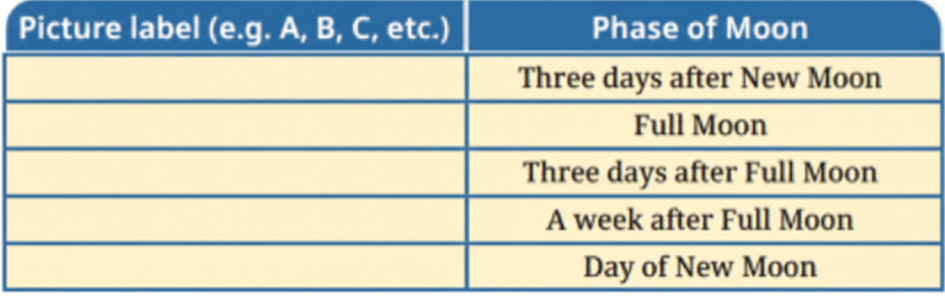
(ii) List the picture labels of the phases of the Moon that are never seen from Earth.
[Hint: You can use your observations from Activity Fig. as a reference.]
Answer:
(i)
(ii) Picture B, which shows the New Moon phase, is never visible from Earth because the lit side of the Moon faces away from us.
Question 5. Malini saw the Moon overhead in the sky at sunset.
(i) Draw the phase of the Moon that Malini saw.
(ii) Is the Moon in the waxing or the waning phase?
Answer:
(i) At sunset, the Moon is directly overhead only during the first quarter phase, which occurs about a week after the New Moon. In this phase, the right half of the Moon is lit. Therefore, the correct drawing should show the right half illuminated and the left half in shadow.
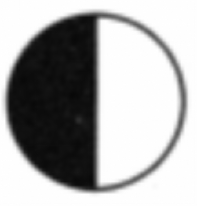
(ii) The Moon is in its waxing phase, as this comes after the New Moon and the illuminated portion is growing.
Question 6. Ravi said, “I saw a crescent Moon, and it was rising in the East when the Sun was setting.” Kaushalya said, “Once I saw the gibbous Moon during the afternoon in the East.” Who out of the two is telling the truth?
Answer: Kaushalya is correct because gibbous Moons can indeed be seen in the eastern sky during the afternoon. Ravi is wrong since crescent Moons do not rise in the east at sunset. A waxing crescent appears shortly after sunset in the western sky, while a waning crescent rises just before sunrise—neither occurs at sunset in the east.
Question 7. Scientific studies show that the Moon is getting farther away from the Earth and slower in its revolution. Will luni-solar calendars need an intercalary month more often or less often?
Answer: As the Moon gradually moves farther away and its orbital speed decreases, it takes longer to complete a cycle. This makes the lunar year even shorter than the solar year, causing luni-solar calendars to require an extra, intercalary month more frequently.
Question 8. A total of 37 full Moons happen during 3 years in a solar calendar. Show that at least two of the 37 full moons must happen during the same month of the solar calendar.
Answer: Yes, there must be at least two full Moons in the same solar month.
In three years, a solar calendar has 36 months, but there are 37 full Moons in this period. Since 37 full Moons cannot fit into 36 separate months, at least one month will contain two full Moons.
Question 9. On a particular night, Vaishali saw the Moon in the sky from sunset to sunrise. What phase of the Moon would she have noticed?
Answer: Since the Moon remains visible throughout the entire night only during the Full Moon phase, it must be a Full Moon.
Question 10. If we stopped having leap years, in approximately how many years would the Indian Independence Day happen in winter?
Answer:
A leap year adds about one extra day every four years.
Without these leap years, the calendar would drift by one day every four years.
There are about 183 days between 15 August (monsoon season) and mid-February (winter).
183 days × 4 ≈ 732 years.
So, in roughly 730–732 years, 15 August would shift into the winter season.
Question 11. What is the purpose of launching artificial satellites?
Answer:
Artificial satellites are used for:
Communication
Navigation
Weather forecasting
Scientific studies
Disaster management
Observing and monitoring Earth
Question 12. On which periodic phenomenon are the following measures of time based:
(i) day
(ii) month
(iii) year?
Answer:
(i) Day → Earth’s rotation
(ii) Month → Moon’s revolution (phases of the Moon)
(iii) Year → Earth’s revolution around the Sun.
Activity 11.1: Let us Explore (Pages 171-172)
Documenting Changes in the Moon’s Appearance
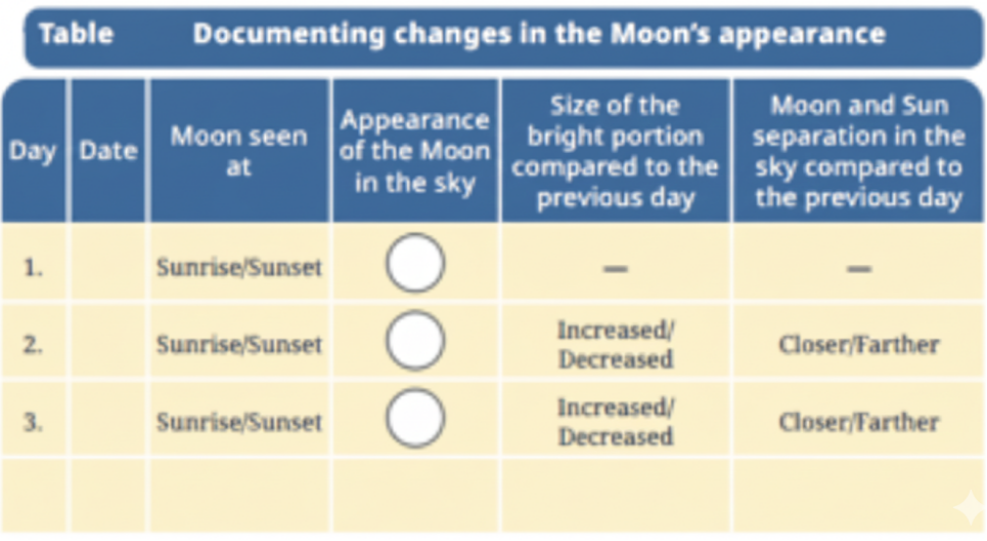
Analysis Questions:
Question 1. Did the Moon appear different each day?
Answer: Yes, its appearance or phase changed from day to day.
Question 2. Was the Moon visible on all days?
Answer: Yes, on those three days, it could be seen at sunrise.
Question 3. Did the Moon appear at the same position in the sky as on the previous day?
Answer: No, each day it appeared nearer to the Sun and lower in the sky.
Activity 11.2: Let us Measure a Day! (Pages 178-179)
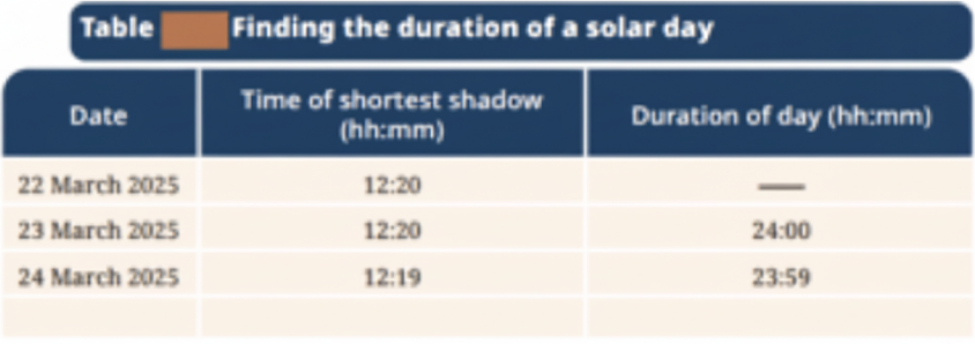
Find the average duration of the day. Is it nearly equal to 24 hours?
Answer:
o find the average of 24:00 and 23:59:
Convert both to minutes:
24:00 = 1440 minutes
23:59 = 1439 minutes
Add them: 1440 + 1439 = 2879 minutes
Divide by 2: 2879 ÷ 2 = 1439.5 minutes
Convert back to hours:
1439.5 minutes = 23 hours 59 minutes 30 seconds
So, the average length of the day is 23 hours 59 minutes 30 seconds, which is almost exactly 24 hours.
NCERT Solutions for Class 8 Science Chapter 11: Keeping Time with the Skies (2026-27)
Understanding phases of the Moon, the origin of calendars, and the role of artificial satellites is essential for Class 8 Science Chapter 11. With structured learning, you can master these key astronomical concepts for exams and real-life observations.
This chapter builds your foundation in understanding time, months, and years through natural phenomena. Regular practice of Class 8 Science NCERT solutions helps you clarify doubts and boost your confidence for the Science 2026-27 exam.
Review important sections like lunar phases and calendar systems to improve your retention. Consistent revision using exercise-based learning will enhance your performance in school assessments and deepen your scientific understanding.
FAQs on NCERT Solutions For Class 8 Science Chapter 11 Keeping Time With The Skies - 2026-27 Free PDF Download (Login Required)
1. What is covered in NCERT Solutions for Class 8 Science Chapter 11: Keeping Time with the Skies?
NCERT Solutions for Class 8 Science Chapter 11 provide stepwise answers to all textbook questions and cover key concepts about measuring time using celestial objects.
These solutions include:
- Detailed explanations of intext and back exercise questions
- Important definitions and concepts related to time, celestial bodies, and their movement
- Diagram-based solutions and labelling tips
- Practice for CBSE board marking scheme
2. How should I write NCERT answers to score full marks in Class 8 Science Chapter 11?
To score full marks in Class 8 Science Chapter 11, structure your answers stepwise, use correct keywords, and include diagrams where needed.
Follow these tips:
- Start with a clear definition or main point (keywords)
- Write answers step-by-step as required in marking schemes
- Label all diagrams neatly if asked
- Underline or highlight important terms
- Maintain exam-oriented clarity and presentation
3. Which questions are important from Class 8 Science Chapter 11 for school exams?
Important questions from Chapter 11: Keeping Time with the Skies often include definitions, explanations of time measurement, and diagram-based questions.
Common exam topics:
- Definitions like sundial, apparent motion, constellations
- Short notes on how ancient people measured time
- Diagram labelling questions (e.g., phases of the Moon, sundial working)
- Comparison between solar and lunar calendars
4. Are diagrams or definitions mandatory in the answers for Class 8 Science Chapter 11?
Including diagrams and definitions is highly recommended in answers for full marks, especially when the question demands it.
Keep in mind:
- Definitions for key terms should be concise and accurate
- Diagrams should be neat, labeled, and relevant
- Supporting diagrams often fetch step/figure marks as per CBSE marking scheme
5. How do I structure long answers for better marks in Class 8 Science Chapter 11?
For long answers in Class 8 Science Chapter 11, use an organized structure with headings, points, and diagrams.
Steps to improve long answers:
- Write a brief introduction or definition
- Use clear, numbered or bulleted points for explanation
- Include labeled diagrams if relevant
- End with a short conclusion or summary statement
6. Where can I download the free PDF for Class 8 Science Chapter 11 NCERT Solutions?
You can download the free PDF of NCERT Solutions for Class 8 Science Chapter 11 on trusted educational platforms providing chapter-wise solutions.
Benefits of downloading:
- Offline study and quick revision
- Printable for exam preparation
- Contains all stepwise, exercise-wise answers
7. What are the key definitions and formulae to remember from Class 8 Science Chapter 11?
Key definitions and formulae from Chapter 11: Keeping Time with the Skies include important terms related to time measurement and celestial events.
Some must-know terms:
- Sundial: An instrument using the position of the Sun's shadow to tell time
- Celestial bodies: Objects like the Sun, Moon, and stars
- Constellation: A group of stars forming a recognizable pattern
- Apparent motion: The observed movement of celestial objects due to Earth's rotation
8. How can I revise Class 8 Science Chapter 11 quickly before exams?
To revise Chapter 11 quickly, use flash notes, focus on key concepts, and solve previous year questions.
Effective revision tips:
- Review summary notes and important diagrams
- Memorize keywords and definitions
- Practice all exercise and exemplar questions
- Use a 1-day or 3-day revision planner for time management
9. How are diagrams/maps marked in CBSE Class 8 Science exams for this chapter?
Diagrams and maps in Class 8 Science are marked for neatness, correct labeling, and accuracy according to the CBSE marking scheme.
Tips for scoring marks:
- Draw with a sharp pencil
- Label all parts clearly
- Follow CBSE diagram conventions
- Show required celestial positions accurately
10. Are NCERT Solutions enough for Class 8 Science exams?
NCERT Solutions are sufficient for scoring well in Class 8 Science as they follow the textbook and CBSE syllabus.
However, for best results:
- Practice NCERT Exemplar and important questions
- Revise conceptual topics, diagrams, and definitions
- Attempt previous year papers for exam pattern familiarity
11. How to present long answers to match CBSE marking?
Present long answers by structuring them with an introduction, bullet points, diagrams, and a conclusion, as per the CBSE marking pattern.
Recommended format:
- Begin with the main point or definition
- List details in logical order (using points/steps)
- Add clear, relevant diagrams
- End with a summary statement
12. Where to get chapterwise solutions PDF for offline study?
You can find chapterwise NCERT solutions PDFs for Class 8 Science on reliable educational sites, downloadable for free and useful for offline revision.
13. How to learn diagrams/maps for this chapter?
Practice drawing diagrams/maps regularly, use labeling checklists, and revise from NCERT textbook illustrations for Chapter 11.
Best approaches:
- Redraw important diagrams as shown in the chapter
- Label every part as per CBSE norms
- Review previous year diagram questions
14. What are the most important topics from this chapter?
Key topics in Keeping Time with the Skies include measurement of time, role of celestial bodies, description of sundials and calendars, and the history of timekeeping methods. Focus on:
- Apparent motion of Sun, Moon, and stars
- Types and use of sundials
- Working of different calendars (solar vs. lunar)
15. Do examiners award partial marks for correct steps even if the final answer is wrong?
Yes, CBSE examiners often give partial marks for correct intermediate steps or relevant diagrams, even if the final answer is incorrect. Always show all your workings and reasoning clearly.
16. Are references to textbook page numbers useful during revision?
Referring to textbook page numbers during revision helps quickly locate key definitions, diagrams, and solved examples. It improves efficiency and accuracy in exam preparation.
