



How to Answer Light: Mirrors and Lenses Questions for Full Marks
Light: Mirrors and Lenses Class 8 Question Answer (InText)
Question 1. Can we make mirrors that can give enlarged or diminished images? (Page 152)
Answer: Yes, it is possible to create mirrors that show either enlarged or reduced images. Concave mirrors can produce both magnified and diminished images depending on how far the object is from the mirror, whereas convex mirrors always form smaller, diminished images.
Question 2. On the side-view mirrors of vehicles, there is a warning that says “Objects in mirror are closer than they appear”. Why is this warning written there? (Page 152)
Answer: The message “Objects in mirror are closer than they appear” is placed on vehicle side-view mirrors because they are usually convex mirrors. Convex mirrors make objects look smaller and therefore farther away than their actual distance. The warning helps drivers avoid misjudging how close other vehicles really are, reducing the risk of accidents.
Question 3. Why is there a curved line on some reading glasses? (Page 152)
Answer: The curved line seen on reading glasses comes from the convex design of the lenses. These lenses are shaped so they are thicker at the center and thinner at the edges, which causes incoming light rays to bend inward and helps people with presbyopia see nearby objects clearly. This curved structure is necessary to direct light correctly onto the retina and improve near vision.
Question 4. How can we distinguish between concave and convex mirrors? (Page 155)
Answer: To tell concave and convex mirrors apart, look at their shape and the type of images they produce. A concave mirror curves inward, bringing parallel rays together at a focal point, and can create both real and virtual images. A convex mirror curves outward, spreads parallel rays apart, and always produces virtual, smaller images.
Question 5. We have observed images formed by three types of mirrors – plane, concave, and convex. But are there any laws that govern the image formation? (Page 157)
Answer: Yes, certain principles guide how images are formed in plane, concave, and convex mirrors. These principles follow the laws of reflection, which state that the angle at which light strikes the mirror (angle of incidence) is equal to the angle at which it reflects (angle of reflection). Moreover, the incident ray, the reflected ray, and the normal—an imaginary line perpendicular to the mirror at the point of incidence—are all in the same plane.
Question 6. Are the laws of reflection applicable to spherical mirrors also?
Answer: Yes, spherical mirrors also follow the laws of reflection. According to these laws, the angle of incidence equals the angle of reflection, and the incident ray, reflected ray, and normal all lie in the same plane. These rules apply to all reflecting surfaces, including concave and convex spherical mirrors.
Question 7. What changes can be seen in the objects when viewed through lenses? (Page 163)
Answer: When you look at an object through a lens, its image may differ in size, orientation, and whether it is real or virtual. In particular, a concave lens generally forms images that are smaller than the object, upright, and virtual.
Question 8. Do lenses also converge or diverge the light beam? (Page 163)
Answer: Yes, lenses can either concentrate or disperse light rays. A convex lens brings light rays together, while a concave lens spreads them apart.
Question 9. Since a convex lens converges a light beam, can it also burn a paper? (Page 164)
Answer: Yes. A convex lens works like a magnifying glass by concentrating sunlight onto a small point. This focused light produces intense heat, which can be strong enough to ignite materials such as paper.
Question 10. Where are all the lenses used? (Page 165)
Answer: Lenses are widely used in everyday objects and scientific tools. They are found in eyeglasses, cameras, microscopes, telescopes, projectors, magnifying glasses, and even door spyholes.
Keep the Curiosity Alive (Pages 166-169)
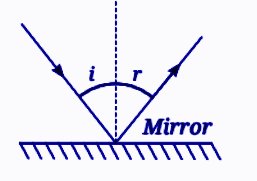
Question 1. A light ray is incident on a mirror and gets reflected by it (Figure). The angle made by the incident ray with the normal to the mirror is 40°. What is the angle made by the reflected ray with the mirror?
(i) 40°
(ii) 50°
(iii) 45°
(iv) 60°
Answer:
(ii) If the incident ray makes a 40° angle with the normal, then:
Angle of incidence (i) = 40°
According to the law of reflection,
Angle of reflection (r) = Angle of incidence (i) = 40°
Now, Angle between reflected ray and mirror = 90° – angle of reflection
= 90° – 40°
= 50°
Question 2. The figure shows three different situations where a light ray falls on a mirror:
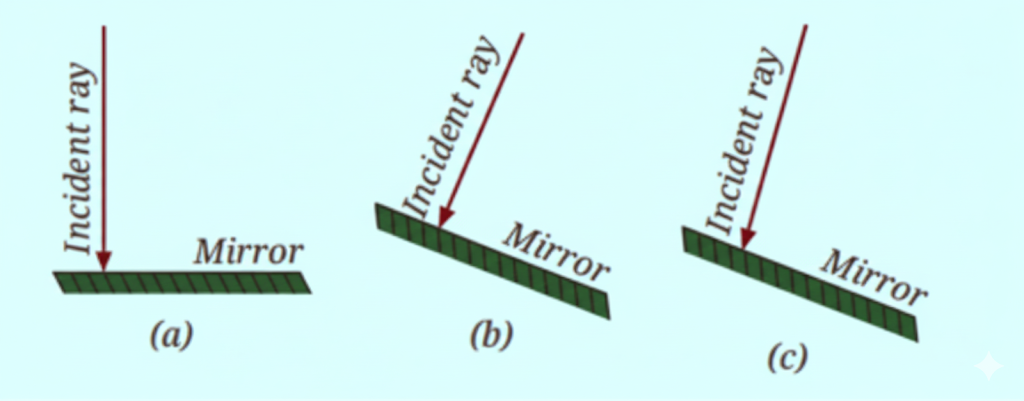
(i) The light ray falls along the normal.
(ii) The mirror is tilted, but the light ray still falls along the normal to the tilted surface.
(iii) The mirror is tilted, and the light ray falls at an angle of 20° from the normal.
Draw the reflected ray in each case (Use a ruler and protractor for accurate drawing). What is the angle of reflection in each case?
Answer:
(i) Light ray falls along the normal
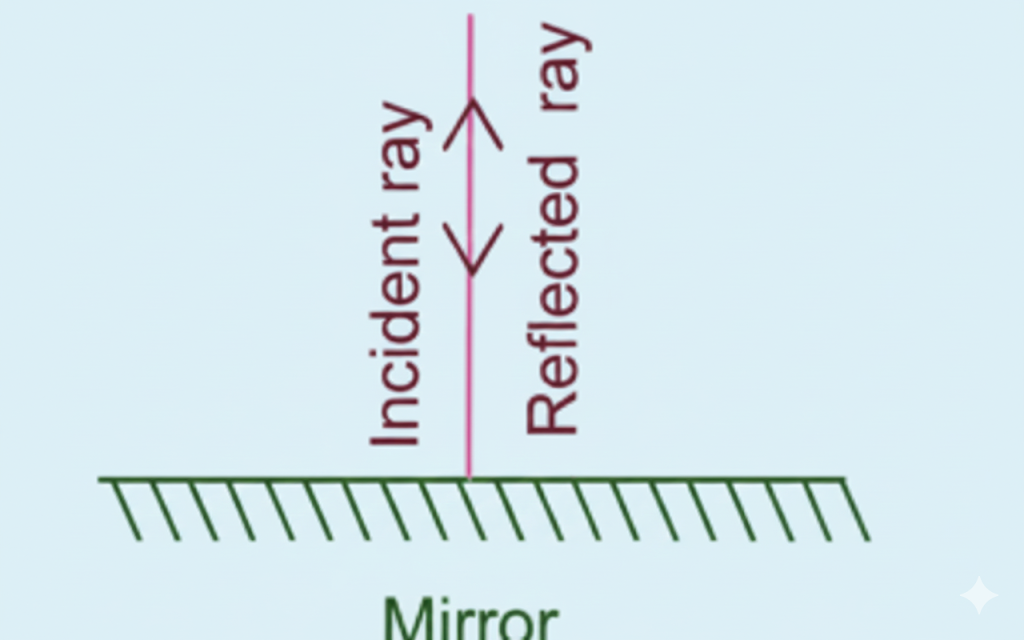
Angle of incidence = 0°
Angle of reflection = 0°
The ray retraces its path. It reflects straight back along the same line.
(ii) The mirror is tilted, but the light ray still falls along the normal to the tilted surface
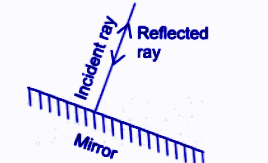
Even though the mirror is tilted, the ray is still perpendicular to the surface.
Angle of incidence = 0°
Angle of reflection = 0°
The ray again retraces its path — the tilt doesn’t affect the reflection if the ray is normal to the surface.
(iii) The mirror is tilted, and the light ray falls at 20° from the normal
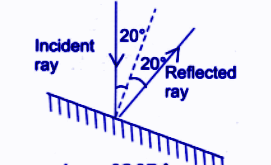
Angle of incidence = 20°
By the law of reflection:
Angle of reflection = 20°
The reflected ray will make a 20° angle with the normal, on the opposite side.
Question 3. In the Figure, the cap of a sketch pen is placed in front of three types of mirrors.
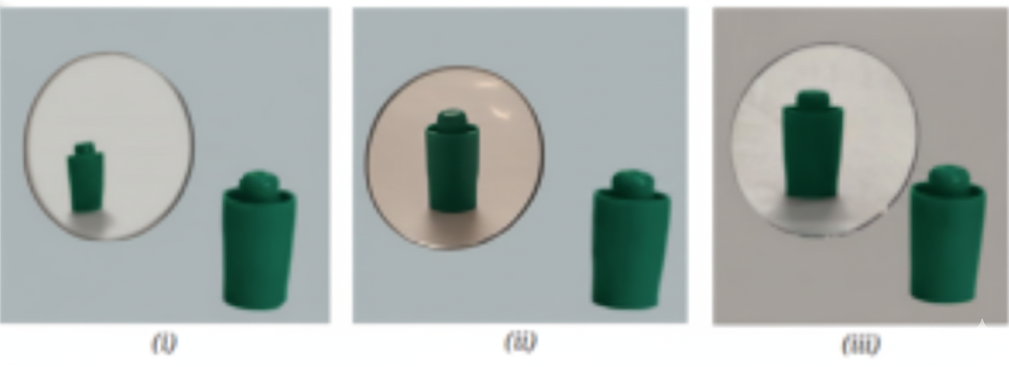
Match each image with the correct mirror.

Answer:
Question 4. In the Figure, the cap of a sketch pen is placed behind a convex lens, a concave lens, and a flat transparent glass piece —all at the same distance.
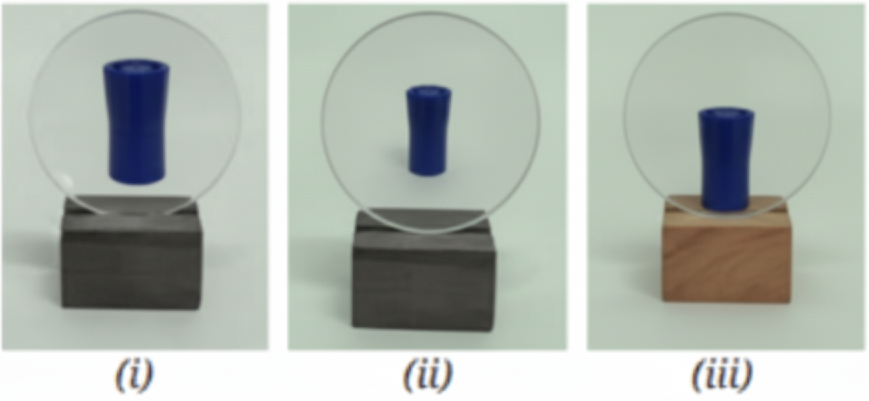
Match each image with the correct type of lens or glass.
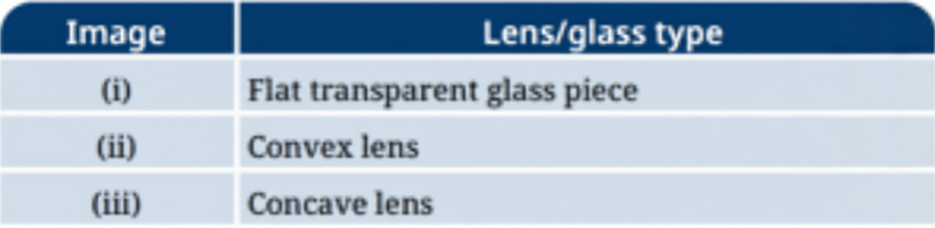
Answer:
Question 5. When the light is incident along the normal on the mirror, which of the following statements is true:
(i) Angle of incidence is 90°
(ii) Angle of incidence is 0°
(iii) Angle of reflection is 90°
(iv) No reflection of light takes place in this case
Answer:
(ii) When light strikes a surface at a 90° angle, it is said to be incident normally.
According to the law of reflection, the angle of incidence equals the angle of reflection. Since the light is hitting the mirror straight on (at 0°), it will reflect back along the same path, also at 0°.
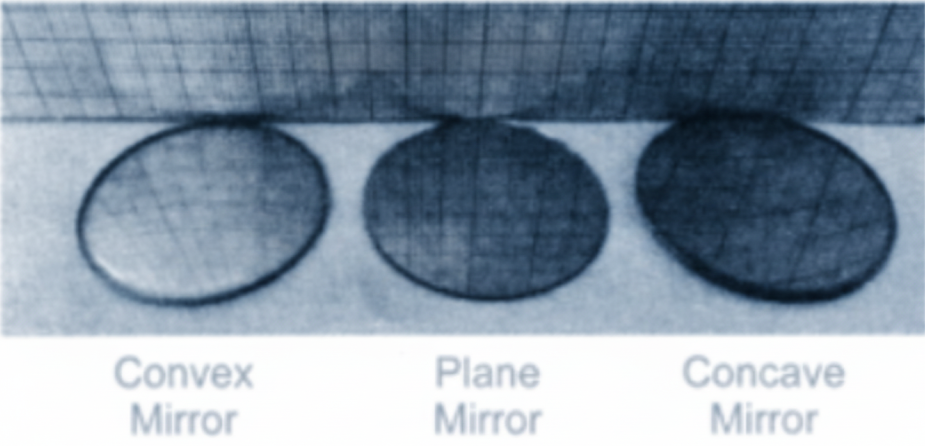
Question 6. Three mirrors-plane, concave, and convex, are placed in the Figure. Based on the images of the graph sheet formed in the mirrors, identify the mirrors and write their names above the mirrors.
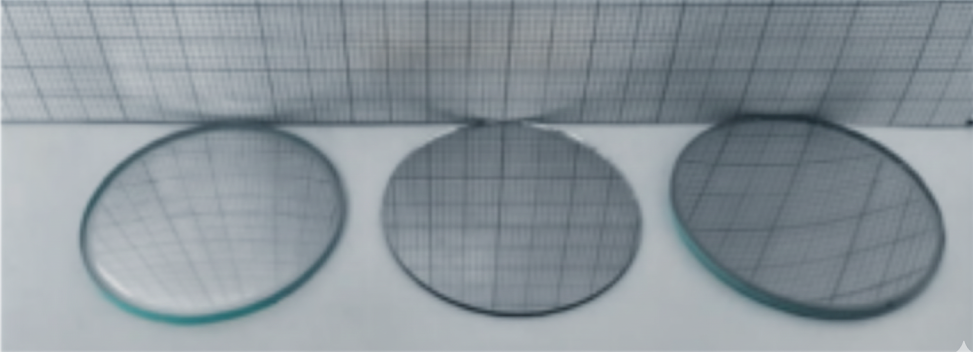
Answer:
Question 7. In a museum, a woman walks towards a large convex mirror (Figure). She will see that:
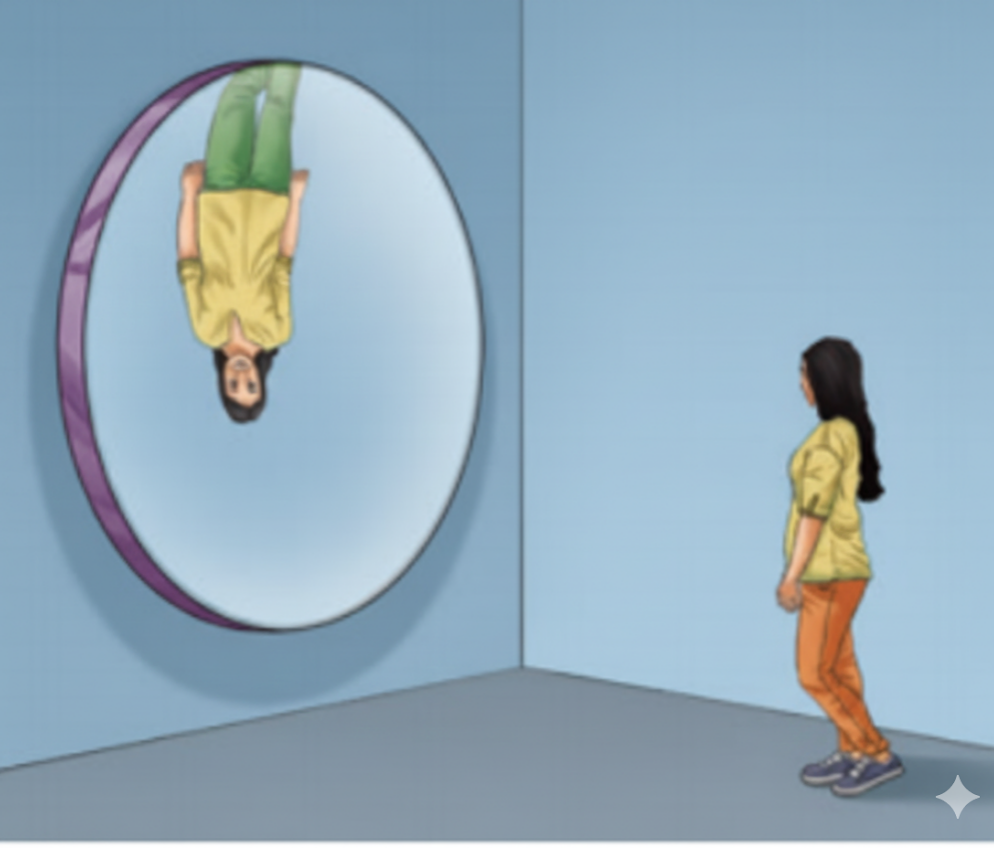
(i) Her erect image keeps decreasing in size.
(ii) her inverted image keeps decreasing in size.
(iii) her inverted image keeps increasing in size, and eventually it becomes erect and magnified.
(iv) Her erect image keeps increasing in size.
Answer: The correct answer is (i) her upright image becomes smaller. This is because a convex mirror always produces a virtual, erect, and reduced image.
Question 8. Hold a magnifying glass over the text and identify the distance at which you can see the text bigger than they are written. Now move it away from the text. What do you notice? Which type of lens is a magnifying glass?
Answer: A magnifying glass contains a convex lens that enlarges text. When you hold it close to the text and gradually move it away, the image first becomes bigger and clearer, then continues to enlarge but becomes blurry, and eventually flips upside down and appears smaller.
Question 9. Match the entries in Column I with those in Column II.
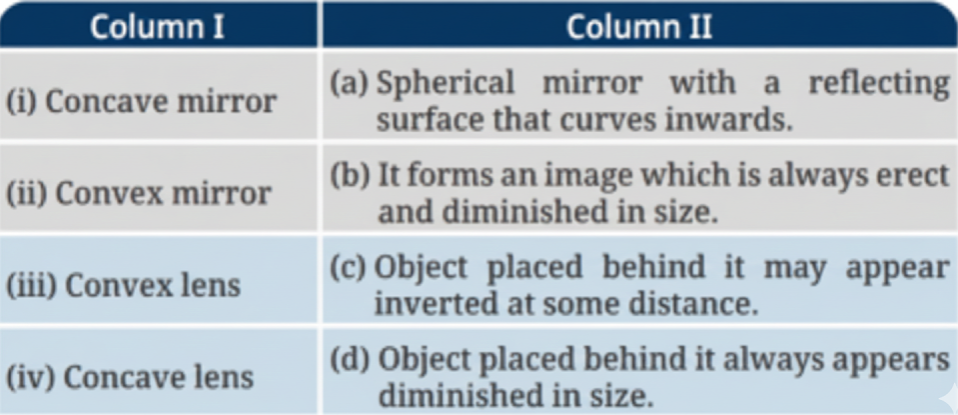
Answer:
Question 10. The following question is based on Assertion/Reason.
Assertion: Convex mirrors are preferred for observing the traffic behind us.
Reason: Convex mirrors provide a significantly larger view area than plane mirrors.
Choose the correct option:
(i) Both Assertion and Reason are correct, and Reason is the correct explanation for Assertion.
(ii) Both Assertion and Reason are correct, but Reason is not the correct explanation for
Assertion.
(iii) Assertion is correct, but Reason is incorrect.
(iv) Both Assertion and Reason are incorrect.
Answer:
(i) Both Assertion and Reason are correct, and Reason is the correct explanation for Assertion.
Question 11. In the Figure, note that O stands for object, M for mirror, and I for image.
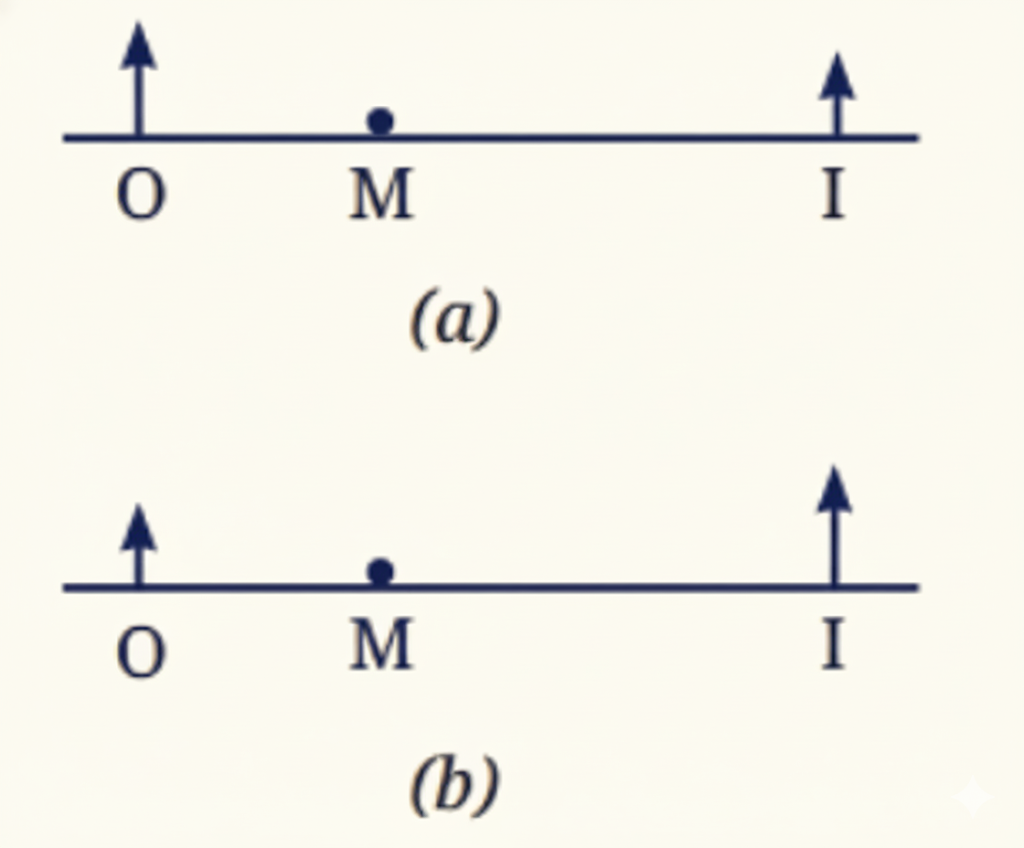
Which of the following statements is true?
(i) Figure (a) indicates a plane mirror, and Figure (b) indicates a concave mirror.
(ii) Figure (a) indicates a convex mirror and Figure (b) indicates a concave mirror.
(iii) Figure (a) indicates a concave mirror and Figure (b) indicates a convex mirror.
(iv) Figure (a) indicates a plane mirror, and Figure (b) indicates a convex mirror.
Answer:
(ii) Figure (a) indicates a convex mirror and Figure (b) indicates a concave mirror.
Question 12. Place a pencil behind a transparent glass tumbler (Figure a). Now fill the tumbler halfway with water (Figure b). How does the pencil appear when mewed through the water? Explain why its shape appears changed.
Answer: When a pencil is placed behind a transparent glass and the glass is half-filled with water, the pencil appears bent or broken at the point where it enters the water. The part of the pencil under the water may also look wider or shifted from its real position. This effect is known as refraction of light.
Why This Happens
Change of medium:
Light travels at different speeds in different substances. It moves faster in air (a rarer medium) and slower in water (a denser medium).
Refraction — bending of light:
As light from the submerged part of the pencil moves from water (denser) into air (rarer), its speed changes, causing the light rays to bend away from the normal. This bending shifts the path of the rays before they reach our eyes.
Apparent position:
Our brain always assumes that light travels in straight lines. Because the rays bend at the water–air boundary, we see the underwater part of the pencil at a different position than where it really is. This creates the illusion that the pencil is bent or broken.
If we look straight down from above, the light rays enter at 90°, so refraction is minimal and the pencil won’t appear bent.
NCERT Solutions for Class 8 Science Chapter 10: Light: Mirrors and Lenses (2026-27)
Master the fundamentals of Light: Mirrors and Lenses with concise, stepwise NCERT solutions. Quickly review key differences between concave and convex mirrors and lenses to boost your understanding for exams.
Learning how different mirrors and lenses form images helps you answer questions confidently. Using these NCERT Class 8 Science solutions (2026-27), you'll strengthen your conceptual clarity and score well in tests.
Practice drawing diagrams and remember the laws of reflection. Regularly revise definitions and uses of spherical mirrors and lenses for higher marks and better exam strategies.
FAQs on NCERT Solutions For Class 8 Science Chapter 10 Light Mirrors And Lenses - 2026-27 Free PDF Download (Login Required)
1. What are NCERT Solutions for Class 8 Science Chapter 10: Light: Mirrors and Lenses?
NCERT Solutions for Class 8 Science Chapter 10 provide step-by-step answers, definitions, and diagrams for all textbook exercises related to Light: Mirrors and Lenses. Key features include:
- Chapter 10 question answers covering intext and back exercises
- Important diagrams for mirrors and lenses
- Clear and concise definitions and formulae
- Exam-aligned answers for CBSE Class 8 Science 2026-27
- Free PDF download for offline revision
2. How can I write stepwise NCERT answers for Class 8 Science Chapter 10 to score full marks?
To score full marks in Chapter 10 of Class 8 Science, present your NCERT answers in clear, stepwise points:
- Begin with a direct answer to the question
- Include key definitions and formulae when required
- Draw neat labelled diagrams for mirrors/lenses as needed
- Underline or highlight important terms
- Number steps if the answer has a process
3. Are diagrams or definitions mandatory in answers for Light: Mirrors and Lenses?
Yes, diagrams and definitions are essential in answers for Chapter 10 Light: Mirrors and Lenses. To score well:
- Always add labelled diagrams of mirrors, lenses, and ray diagrams when asked
- Write precise definitions for key terms like 'concave', 'convex', 'real image', etc.
- Use correct conventions (arrows, labels) in the diagrams for full marks
4. Which topics and questions are most important from Class 8 Science Chapter 10 for CBSE exams?
The most important topics from Chapter 10 Light: Mirrors and Lenses include:
- Types of mirrors and lenses
- Ray diagrams for formation of images
- Uses of concave and convex mirrors/lenses
- Definitions (real & virtual image, principal axis, focal length)
- Differentiating between real and virtual images
5. How do I prepare and label diagrams for Class 8 Science Light Mirrors and Lenses?
To draw and label diagrams correctly in Chapter 10:
- Use sharp pencils and a ruler for straight lines
- Draw principal axis, mirror/lens, focal points (F, 2F)
- Label incident ray, reflected/refracted ray, object, and image clearly
- Keep the diagram neat and uncluttered
- Practice the standard diagrams given in NCERT and worksheets for accurate labelling
6. Where can I download the NCERT Solutions PDF for Class 8 Science Chapter 10?
You can download the NCERT Solutions PDF for Class 8 Science Chapter 10: Light: Mirrors and Lenses free from trusted educational websites. This helps you study offline, revise stepwise answers, and practice diagram questions easily for CBSE 2026-27 exams.
7. What is the best way to revise Class 8 Science Chapter 10: Light Mirrors and Lenses before an exam?
The best revision strategy for Chapter 10 includes:
- Reviewing key definitions and important formulae
- Practicing all standard diagrams (mirrors, lenses, images)
- Solving intext and back exercise questions stepwise
- Attempting extra questions and MCQs for better practice
- Using a 1-day or 3-day quick revision plan before exams
8. Do examiners award partial marks for correct steps if the final answer is wrong in CBSE Science exams?
Yes, partial marks are often awarded in CBSE Science exams if you show correct steps or logic, even if the final answer is incorrect. To maximize step marks:
- Write clear intermediate steps and process
- Use correct scientific terms and diagram conventions
- Attempt every part of the question, even if unsure of the last step
9. How should long answers in Class 8 Science Chapter 10 be structured to match the CBSE marking scheme?
For long answers in Chapter 10, follow these guidelines:
- Start with an introduction or definition
- Break the answer into clear sub-points or steps
- Include labelled diagrams where relevant
- Conclude with a summary or application
- Highlight key words and main concepts
10. Are NCERT Solutions alone enough for scoring well in Class 8 Science Chapter 10?
NCERT Solutions provide a strong foundation for scoring well in Chapter 10, but for top marks:
- Practice extra questions and worksheets for Light: Mirrors and Lenses
- Revise exemplar problems and previous year questions
- Review diagrams and short notes regularly
