



Difference Between Elements, Compounds, and Mixtures: Class 8 Science Explained
NCERT Probe and Ponder Questions (Page 116)
Question 1. Which of the entities in the picture below consists of matter, and which of them do not?
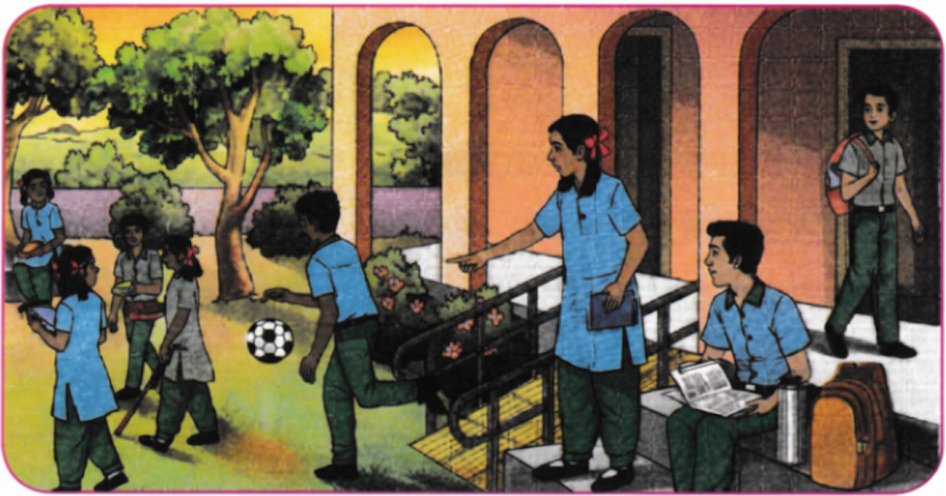
Answer: Objects like school buildings, students, trees, metal railings, footballs, bags, books, water bottles, lunch boxes, and clothes are all made of matter.
Things such as light, sound, and heat are not made of matter.
Question 2. How can elements be combined to form a compound?
Answer: A compound is a distinct substance formed when two or more elements join together through a chemical reaction. In a compound, the elements are linked by chemical bonds.
Question 3. How could the discovery of a compound that absorbs carbon dioxide from the air contribute to solving environmental challenges?
Answer: A compound that can efficiently absorb carbon dioxide (CO₂) from the air would greatly help address climate change and related environmental issues. By removing CO₂—one of the main greenhouse gases—from the atmosphere, it could help reduce global warming, ocean acidification, and other negative impacts caused by high CO₂ levels.
Keep the Curiosity Alive (Pages 131-132)
Question 1. Consider the following reaction where two substances, A and B, combine to form a product C:
A + B → C
Assume that A and B cannot be broken down into simpler substances by chemical reactions. Based on this information, which of the following statements is correct?
(i) A, B, and C are all compounds, and only C has a fixed composition.
(ii) C is a compound, and A and B have a fixed composition.
(iii) A and B are compounds, and C has a fixed composition.
(iv) A and B are elements, C is a compound, and has a fixed composition.
Answer: A and B are elements, C is a compound, and has a fixed composition.
(iv) Since A and B cannot be broken down into simpler substances by chemical means, they must be elements, as elements are pure substances made of only one type of atom. When A and B chemically combine to produce C, the product formed is a compound. Compounds are created when two or more elements join together in a fixed ratio. Therefore, A and B are elements, and C is a compound with a definite composition.
Question 2. Assertion: Air is a mixture.
Reason: A mixture is formed when two or more substances are mixed, without undergoing any chemical change.
(i) Both Assertion and Reason are true and Reason is the correct explanation for Assertion.
(ii) Both Assertion and Reason are true, but Reason is not the correct explanation for Assertion.
(iii) Assertion is true, but Reason is false.
(iv) Assertion is false, but Reason is true.
Answer:
(i) Both Assertion and Reason are true and Reason is the correct explanation for assertion.
Air is considered a mixture because it contains several gases—such as nitrogen, oxygen, and carbon dioxide—that are combined without undergoing any chemical reaction. Each gas keeps its own properties within the mixture.
Question 3. Water, a compound, has different properties compared to those of the elements oxygen and hydrogen from which it is formed. Justify this statement.
Answer: Water has completely different properties from hydrogen and oxygen. For example, water is a liquid, while both hydrogen (H) and oxygen (O) are gases. This happens because the properties of a compound depend on its molecular structure, which is different from the properties of the elements that form it.
Question 4. In which of the following cases are all the examples correctly matched? Give reasons in support of your answers.
(i) Elements – water, nitrogen, iron, air.
(ii) Uniform mixtures – minerals, seawater, bronze, air.
(iii) Pure substances – carbon dioxide, iron, oxygen, sugar.
(iv) Non-uniform mixtures – air, sand, brass, muddy water.
Answer:
(iii) Pure substances – Carbon dioxide, iron, oxygen, and sugar are all pure substances. (Correctly matched).
A pure substance contains only one kind of particle. Carbon dioxide, iron, and oxygen are considered pure because each is made of a single type of atom or molecule. Sugar, although a compound, also qualifies as a pure substance since it is made up of only one kind of molecule.
Question 5. Iron reacts with moist air to form iron oxide, and magnesium burns in oxygen to form magnesium oxide. Classify all the substances involved in the above reactions as elements, compounds, or mixtures, with justification.
Answer:
Iron reacts with moist air to produce iron oxide.
Iron (Fe) + Oxygen (O₂) + Water (H₂O) → Iron Oxide (Fe₂O₃)Magnesium burns in oxygen to produce magnesium oxide.
Magnesium (Mg) + Oxygen (O₂) → Magnesium Oxide (MgO)
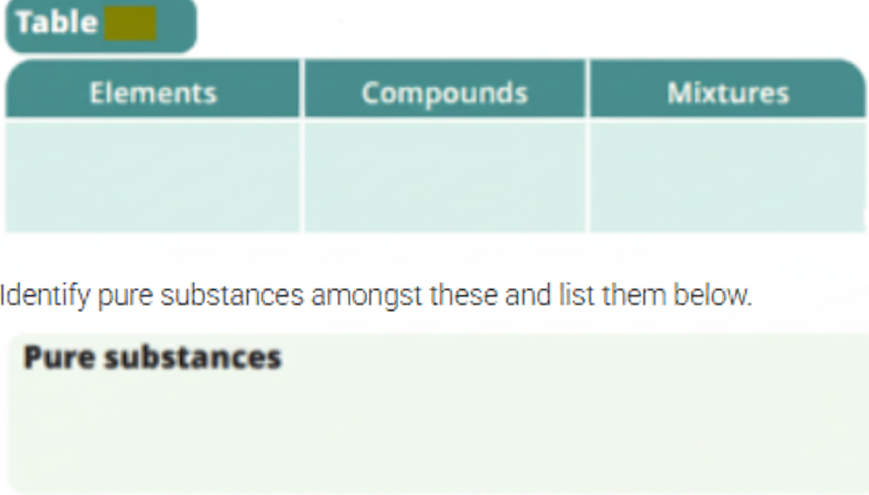
Question 6. Classify the following as elements, compounds, or mixtures in the Table.
Carbon dioxide, sand, seawater, magnesium oxide, muddy water, aluminum, gold, oxygen, rust, iron sulfide, glucose, air, water, fruit juice, nitrogen, sodium chloride, sulfur, hydrogen, and baking soda.
Answer:
Pure substances include aluminium, gold, oxygen, nitrogen, sulfur, hydrogen, carbon dioxide, magnesium oxide, iron sulfide, glucose, water, sodium chloride, and baking soda.
Question 7. What new substance is formed when a mixture of iron filings and sulfur powder is heated, and how is it different from the original mixture? Also, write the word equation for the reaction.
Answer: When iron filings and sulfur powder are heated, they undergo a chemical reaction to form a new substance called ferrous sulfide (FeS), or iron sulfide. This compound has properties that are completely different from those of iron and sulfur. The reaction can be written as:
Iron + Sulfur → Ferrous Sulfide.
Original Mixture
When iron filings and sulfur powder are simply mixed, each retains its own properties. They can be separated easily—for example, a magnet can pull out the iron.
Ferrous Sulfide (FeS)
When this mixture is heated, a chemical reaction occurs. Iron and sulfur combine to form ferrous sulfide, a compound in which the atoms are chemically bonded.
Difference in Properties
Ferrous sulfide has properties that are completely different from those of iron and sulfur. It appears as a black solid, unlike the gray iron or yellow sulfur, and it is not attracted to magnets as iron is.
Word Equation
Iron + Sulfur → Ferrous Sulfide
Question 8. Is it possible for a substance to be classified as both an element and a compound? Explain why or why not.
Answer: No, a substance cannot be both an element and a compound. Elements are pure substances made of only one kind of atom and cannot be broken down chemically. Compounds, on the other hand, are formed when two or more different elements join together through chemical bonding. Since an element contains only one type of atom and a compound contains multiple types, a substance cannot be both at the same time.
Question 9. How would our daily lives be changed if water were not a compound but a mixture of hydrogen and oxygen?
Answer: Water supports life and natural processes because it is a compound with fixed, stable properties. If water were merely a mixture, it would be unsafe and unusable, and life could not exist in its present form.
Effects on Daily Life
No safe drinking water → Life would not survive.
No water for farming → Crops would fail to grow.
No reliable water for cooking or cleaning → Everyday activities would become hazardous.
No aquatic ecosystems → Fish and other water-dwelling organisms would die.
Higher risk of fires → A mixture of hydrogen and oxygen would be explosive.
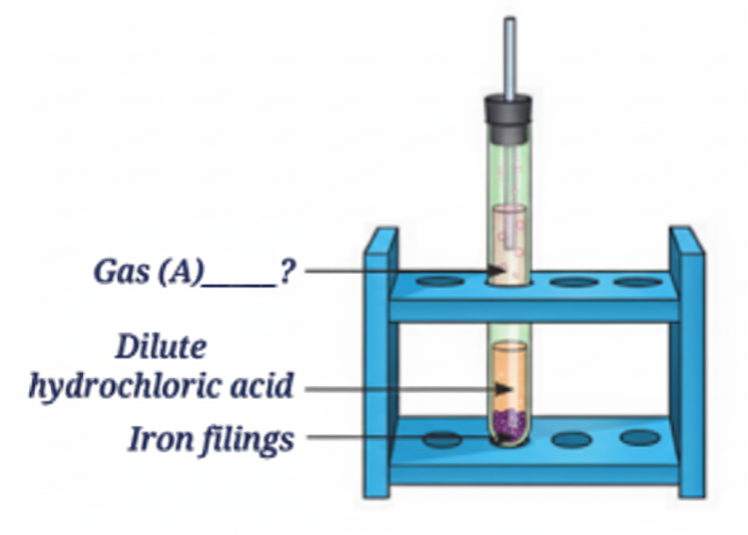
Question 10. Analyse the figure. Identify Gas A. Also, write the word equation of the chemical reaction.
Answer:
By analysing the figure, it is found that there will be a chemical reaction inside the test tube between dilute HCl and Fe.
2HCl + Fe → FeCl2 + H2 ↑
So the reaction forms Iron Chloride (FeCl2) and the gas above will be Hydrogen (H2).
Hydrochloric Acid + Iron filing → Iron Chloride + Hydrogen (g)
Thus, Gas A = Hydorgen
Question 11. Write the names of any two compounds made only from non-metals, and also mention two uses of each of them.
Answer:
Carbon Dioxide (CO₂)
Composition: Carbon and oxygen (both non-metals)
Uses:
Used in fire extinguishers to help put out fires.
Taken in by plants during photosynthesis to produce food.
Sulfur Dioxide (SO₂)
Composition: Sulfur and oxygen (both non-metals)
Uses:
Acts as a preservative in dried fruits and wines.
Used to produce sulfuric acid, a key industrial chemical.
Question 12. How can gold be classified as both a mineral and a metal?
Answer: A mineral is a naturally occurring substance with a fixed chemical composition. Gold occurs in nature in its pure form, usually found in rocks or river deposits. It is obtained through mining, which makes it a metallic mineral. Such minerals, including gold, are created through natural geological processes.
Gold as a Metal
Once extracted, gold is refined and used as a metal. It is a pure element (symbol: Au) and exhibits typical metallic characteristics:
Shiny (lustrous)
Easily shaped (malleable)
Can be drawn into thin wires (ductile)
Conducts electricity well
Gold is widely used in jewelry, electronics, and as a form of currency.
Understanding Elements, Compounds, and Mixtures – Class 8 Science NCERT Solutions 2026-27
Master the basics of matter—elements, compounds, and mixtures—with structured NCERT Class 8 Science Chapter 8 solutions for 2026-27. Knowing how substances combine and separate is fundamental for acing your exams.
Practice concept-driven questions and real-life examples to clarify distinctions between pure substances and mixtures. Regular revision of these NCERT exercise questions will sharpen your understanding and boost your confidence in Science.
Stay ahead with chapter-wise NCERT solutions and exam tips for elements, compounds, and mixtures. Focus on key definitions, practice the short and long answer questions, and review tables for quick learning and strong exam preparation.
FAQs on NCERT Solutions For Class 8 Science Chapter 8 Nature Of Matter Elements Compounds And Mixtures - 2026-27 Free PDF Download (Login Required)
1. What is the nature of matter as explained in Class 8 Science Chapter 8?
The nature of matter in Class 8 Science Chapter 8 describes how all substances are made up of tiny particles and differ as elements, compounds, and mixtures. Key points include:
- Elements: Pure substances made of one kind of atom.
- Compounds: Substances formed when two or more elements combine chemically in fixed proportions.
- Mixtures: Physical combinations of two or more substances that retain their individual properties.
2. What are elements, compounds, and mixtures? Give definitions with examples.
Elements, compounds, and mixtures are key types of matter as per Class 8 Science Chapter 8:
- Element: A pure substance that cannot be broken down into simpler substances by chemical means. Example: Oxygen (O2), Iron (Fe).
- Compound: A substance formed when two or more elements chemically combine in fixed ratios. Example: Water (H2O), Carbon dioxide (CO2).
- Mixture: A combination of two or more substances that are physically mixed but not chemically combined. Example: Air, Salt water.
3. How are NCERT Solutions for Class 8 Science Chapter 8 helpful for CBSE exam preparation?
NCERT Solutions for Class 8 Science Chapter 8 help students prepare for CBSE exams by providing:
- Step-by-step answers for all textbook exercises.
- Accurate definitions as per CBSE marking scheme.
- Diagrammatic solutions where needed.
- Practice for important questions and MCQs.
- An understanding of key concepts such as elements, compounds, and mixtures.
4. Is it necessary to draw diagrams or write definitions in answers for Class 8 Science Chapter 8?
Including diagrams and accurate definitions in your answers for Class 8 Science Chapter 8 is strongly recommended for full marks.
- Diagrams help in visually explaining the difference between elements, compounds, and mixtures.
- Definitions must be precise and exam-aligned.
- Both should be labeled neatly to maximize CBSE scores.
5. What is the marking scheme for long and short answers in Class 8 Science Chapter 8?
The marking scheme for Class 8 Science Chapter 8 follows CBSE guidelines:
- Short answers (1–2 marks): Direct definitions, 2–3 sentences.
- Long answers (3–5 marks): Require stepwise explanation, inclusion of diagrams, and correct use of keywords.
- Marks are given for each correct step and explanation.
6. Where can I download the NCERT Solutions for Class 8 Science Chapter 8 in PDF format?
You can download free PDF solutions for Class 8 Science Chapter 8 from trusted educational websites.
- Check the 'Free PDF Download' section on the page.
- These PDFs provide step-by-step NCERT answers for all exercises and important questions.
- Use them for offline revision and exam practice.
7. What is Table 8.1 in Class 8 Science Chapter 8 about and why is it important?
Table 8.1 in Class 8 Science Chapter 8 classifies everyday substances as elements, compounds, or mixtures.
- It helps students practically identify and differentiate substances.
- Questions from Table 8.1 often appear in CBSE exams (give examples or conversions).
8. How should I revise Class 8 Science Chapter 8 effectively for exams?
To revise Class 8 Science Chapter 8 quickly and thoroughly:
- Review all key definitions and diagrams.
- Solve exercise questions and extra questions from NCERT Solutions.
- Refer to Table 8.1 and practice classification of substances.
- Take online MCQs and sample tests for assessment.
- Use a 1-day, 3-day, and 7-day revision plan for best retention.
9. Are NCERT Solutions enough to score full marks in Class 8 Science Chapter 8?
NCERT Solutions for Class 8 Science Chapter 8 are usually sufficient to score high marks, especially if you:
- Write stepwise, detailed answers as seen in the solutions.
- Practice all diagrams and definitions.
- Attempt extra questions and MCQs for revision.
10. What are the most important topics to focus on in Class 8 Science Chapter 8 for the CBSE exam?
The most important topics in Class 8 Science Chapter 8 include:
- Definitions and differences between elements, compounds, and mixtures.
- Examples and types of each (as shown in Table 8.1).
- Properties and separation methods for mixtures.
- Diagram-based questions.
- Differences between physical and chemical changes.
