



Stepwise Answers & Key Tips for NCERT Class 5 Maths Chapter 5
NCERT Textbook Page 57
Let Us Find
Identify the appropriate units for measuring each of the following.
Solution:
NCERT Textbook Pages 57-58
Different Units but Same Measure
Shikha and Sonu are measuring the lengths of saris and stoles in the village weaving centre. Find which measures represent the same sari or stole. You can take help of the double number line below.
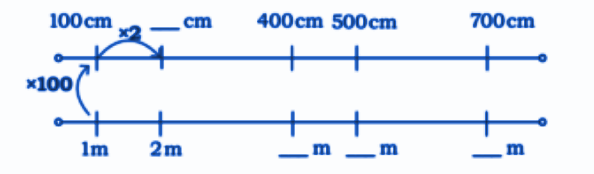
Solution:
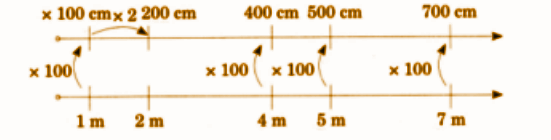
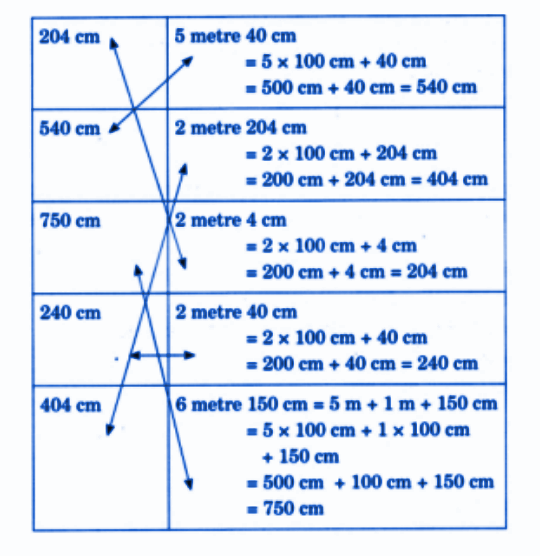
NCERT Textbook Page 58
Let Us Compare
Question 1.
Ritika is comparing the lengths of different rods. Compare them using <, =, > signs.
(a) 456 cm ____ 5 m
Solution:
456 cm remains 456 cm.
And, 5 m = 5 × 100 = 500 cm.
Since 456 cm is less than 500 cm,
therefore, 456 cm < 5 m.
(b) 55 cm + 200 cm ____ 200 cm + 54 cm
Solution:
First, add 55 cm and 200 cm to get 255 cm.
Next, add 200 cm and 54 cm to get 254 cm.
Since 255 cm is greater than 254 cm,
therefore, 55 cm + 200 cm is greater than 200 cm + 54 cm.
(c) 6 m 5 cm ____ 6 m 50 cm
Solution:
First, convert 6 m 5 cm into centimetres:
6 × 100 cm + 5 cm = 600 cm + 5 cm = 605 cm.
Now, convert 6 m 50 cm into centimetres:
6 × 100 cm + 50 cm = 600 cm + 50 cm = 650 cm.
Since 605 cm is less than 650 cm,
therefore, 6 m 5 cm < 6 m 50 cm.
(d) 2 m 150 cm ____ 3 m 50 cm
Solution:
2 × 100 cm + 150 cm = 200 cm + 150 cm = 350 cm.
Convert 3 m 50 cm into centimetres:
3 × 100 cm + 50 cm = 300 cm + 50 cm = 350 cm.
Both measurements are equal to 350 cm,
therefore, 2 m 150 cm = 3 m 50 cm.
(e) 238 cm ____ 138 cm + 1 m
Solution:
First, convert 1 m into centimetres:
1 m = 100 cm.
Now add the lengths:
138 cm + 100 cm = 238 cm.
Since both values are 238 cm,
therefore, 138 cm + 1 m = 238 cm.
Question 2.
World’s tallest statue
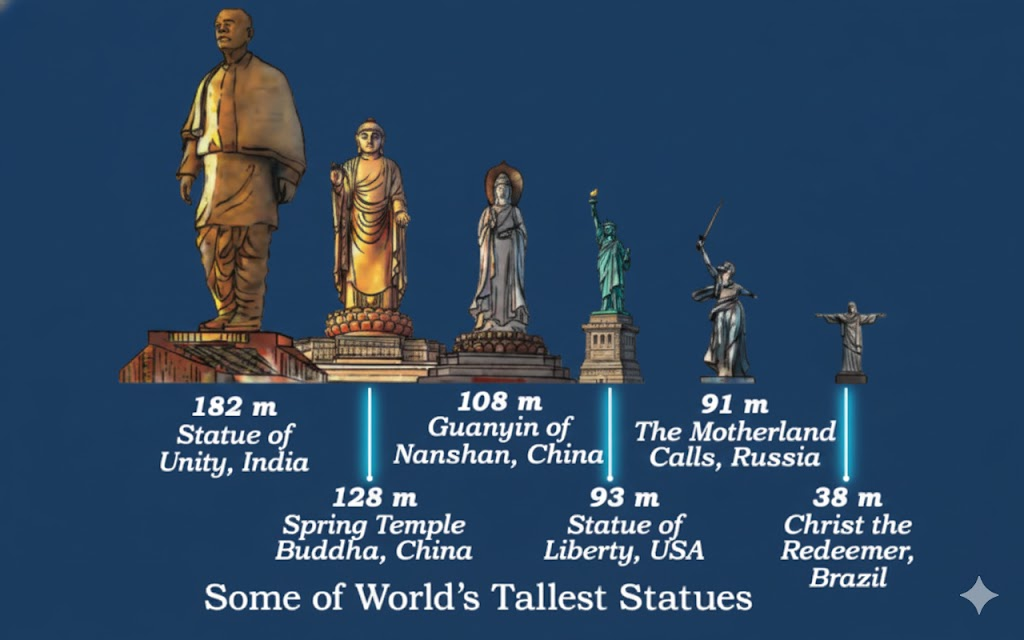
(a) What’is the difference between the height of the tallest statue in the world and the Statue of Liberty?
(b) Identify the statues whose heights have the least difference.
(c) Identify the statues whose heights have the largest difference.
(d) The height of which statue will be equal to the height of the Statue of Unity, if it is doubled?
Solution:
(a)
The height of the Statue of Unity is 182 m, while the height of the Statue of Liberty is 93 m.
The difference in their heights is:
182 m − 93 m = 89 m.
(b)
Now, find the height difference between each pair of consecutive statues:
Statue of Unity (182 m) and Spring Temple Buddha (128 m): 54 m
Spring Temple Buddha (128 m) and Guanyin of Nanshan (108 m): 20 m
Guanyin of Nanshan (108 m) and Statue of Liberty (93 m): 15 m
Statue of Liberty (93 m) and The Motherland Calls (91 m): 2 m
The Motherland Calls (91 m) and Christ the Redeemer (38 m): 53 m
Among all these, the smallest difference is 2 m, which is between the Statue of Liberty and The Motherland Calls.
(c)
The greatest difference in height occurs between the tallest statue and the shortest statue.
These are the Statue of Unity and Christ the Redeemer.
(d)
The height of the Statue of Unity is 182 m.
Half of this height is:
182 m ÷ 2 = 91 m, which is exactly the height of The Motherland Calls.
Therefore, the height of the Statue of Unity is twice the height of The Motherland Calls.
NCERT Textbook Page 59
Let Us Do
Measure 100 m and 200 m on your school playground, or any other place in and around your school, using a Long Tape. Mark these points and draw a straight line. Walk on the lines and count the number of steps. Use this relationship between the number of steps taken and distance walked to find distances around you for at least 3 locations. Wherever possible, walk and find the number of steps. Otherwise, find the distance and estimate the number of steps.
(a) Identify and write the locations that are the nearest and the farthest
from your home.
Nearest location _______________________________________________________.
Farthest location ______________________________________________________.
(b) Write the distances obtained above in increasing order.
_______________, _________________, _________________, __________________.
(c) Name a location that is equal to or more than 1,000 m from your home
(а) Identify and write the locations that are the nearest and the farthest from your home.
Nearest location Farthest location
(b) Write the distances obtained above in increasing order.
(c) Name a location that is equal to or more than 1.000 m from your home.
Solution:
Students should do it by themselves.
Let Us Explore
When we walk 1,000 m, we say we have walked 1 km.
1,000 m = 1 km
Kilo stands for thousand. This unit is used to measure long distances.
Solution:
NCERT Textbook Page 60
Kilometre Race
Sheena and Jennifer are helping to organise a 3-km race. Help them with the arrangements for the race.
Question 1.
Water stations are to be installed at intervals of 500 m.
Solution:
The total distance is 3 km, which is equal to 3 × 1000 m = 3000 m.
The number of water stations required is 3000 ÷ 500 = 6.
Therefore, the water stations will be located at 500 m, 1000 m, 1500 m, 2000 m, 2500 m, and 3000 m from the starting point.
Question 2.
Children need to stand at an interval of 300 m to direct the runners. How many children are needed? At what positions from the starting point will the children be standing?
Solution:
The total distance is 3 km, which is equal to 3000 m.
The distance between two children is 300 m.
So, the number of children required is 3000 ÷ 300 = 10.
Hence, the children will be positioned at 300 m, 600 m, 900 m, 1200 m, 1500 m, 1800 m, 2100 m, 2400 m, 2700 m, and 3000 m from the starting point.
Question 3.
Red and blue flags are to be placed alternately at every 50 m. How many red and blue flags are needed till the finish line?
Solution:
The distance between two consecutive flags is 50 m.
The total number of flags required is 3000 ÷ 50 = 60.
Since the flags are arranged alternately, beginning with a red flag, the pattern will be red, blue, red, blue, …
As the total number of flags is 60, which is an even number, the flags will be equally distributed.
Therefore, 30 red flags and 30 blue flags are required.
NCERT Textbook Pages 60-61
Let Us Do
Longest Train Journey
The longest train journey in India is by The Vivek Express which runs from Dibrugarh in Assam to Kanniyakumari in Tamil Nadu. Look at the stations on the route shown in the table below and answer the questions.
1. The total length of the route from Dibrugarh to Kanniyakumari is _______________ km.
Solution:
4,187 km
2. The distance between Vijayawada and Jalpaiguri road is _______________.
Solution:
2,800 km – 983 km = 1817 km
3. Distance between Vijayawada and Visakhapatnam is _______________.
Solution:
2,800 km – 2,450 km = 350 km
4. Which two stations are farther apart—Guwahati and Dimapur or Bhubaneswar and Jalpaiguri Road?
Solution:
The distance between Guwahati and Dimapur is calculated as:
556 km − 306 km = 250 km.
The distance between Bhubaneswar and Jalpaiguri Road is:
2007 km − 987 km = 1,020 km.
Since 1,020 km is greater than 250 km,
Bhubaneswar and Jalpaiguri Road are farther apart than Guwahati and Dimapur.
5. What is the distance between Guwahati and Coimbatore JN?
Solution:
3,675 km – 556 km = 3,119 km
NCERT Textbook Page 61
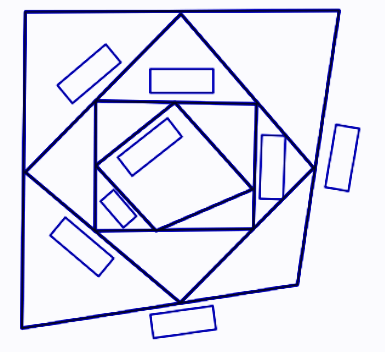
Let Us Measure
Measure the lines in the design and write their measurements in cm and mm.
Solution:
Students should do it by themselves.
NCERT Textbook Page 62
Let Us Do
Soak some seeds of whole moong or black or white chana overnight. Next morning, take them out and wrap them in a moist cloth to sprout them. Over the next 4 days, take out one seed each day and measure the length of sprout. For ease of measurement, you can either place the seed on a paper and mark the length of the sprout, or use a thread to find its length.
Solution:
Students should do it by themselves.
Let Us Draw
Draw lines of the following lengths in your notebook using a scale.
1. 5 mm 5 mm
2. 3 cm 6 mm
3. 8 mm 3 mm
4. 36 mm
5. 67 mm
How did you draw lines of lengths 36 mm and 67 mm? Share your thoughts in class.
Solution:
Students should do it by themselves.
NCERT Textbook Pages 63-64
Let Us Do
Question 1.
Fill in the blanks appropriately in the double number lines given below:
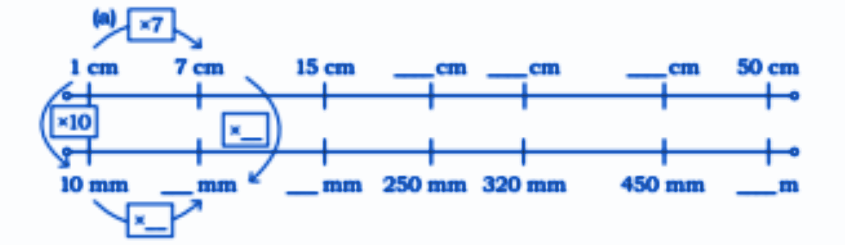
Solution:
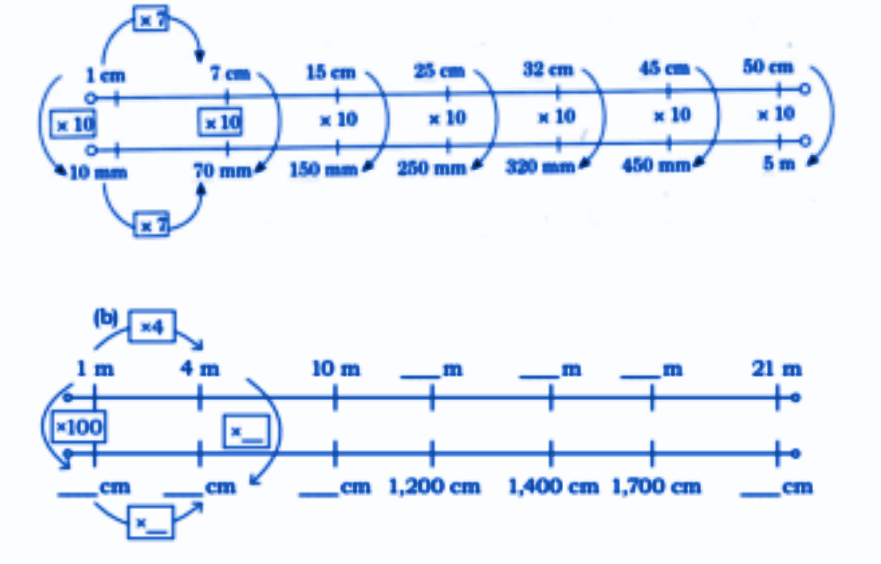
Solution:
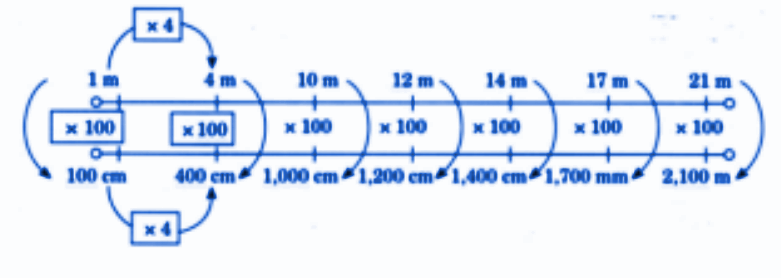
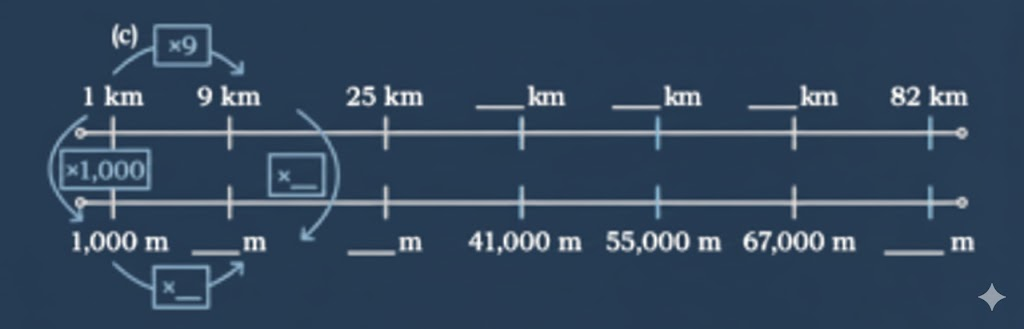
Solution:
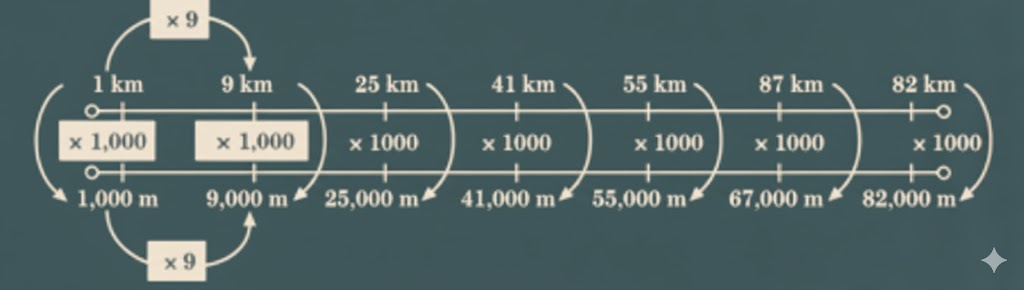
Question 2.
Use your understanding from above to fill in the blanks appropriately.
Use your understanding from above to fill in the blanks appropriately.
(a) 4 cm 5 mm = ______ mm
Solution:
4 cm 5 mm = 4 × 10 mm + 5 mm
[As 1 m = 10 mm]
= 40 mm 5 mm
= 45 mm
(b) 89 mm = ____ cm ____ mm
Solution:
89 mm = 80 mm + 9 mm
= 8 cm 9 mm
(c) 234 cm = ____ mm
Solution:
234 cm = 234 × 10 mm
= 2340 mm
(d) 514 mm = ____ cm ____ mm
Solution:
514 mm = 510 mm + 4 mm
= 51 cm 4 mm
(e) 6 m 34 cm = ____ cm
Solution:
6 m 34 cm = 6 × 100 cm + 34 cm
[As, 1 m = 100 cm] = 600 cm + 34 cm
= 634 cm
(f) 20 m 12 cm = ____ cm
Solution:
20 m 12 cm = 20 × 100 cm + 12 cm
= 2,000 cm + 12 cm
= 2,012 cm
(g) 397 m = ______ cm
Solution:
397 m = 397 × 100 cm
= 39,700 cm
(h) 5,792 cm = ______m ______ cm
Solution:
5792 cm = 5700 cm + 92 cm
= 57 m 92 cm
(i) 9,108 cm = ______ m ______ cm
Solution:
9108 cm = 9100 cm + 8 cm
= 91 m 8 cm
(j) 34 km = _______ m
Solution:
34 km = 34 × 1000 m
= 34000 m
(k) 6,870 m = ____ km ____ m
Solution:
6,870 m = 6000 m + 870 m
= 6 km 870 m
(l) 10,552 m = ____ km ___ m
Solution:
10,552 m = 10000 m + 552 m
= 10 km 552 m
(m) 29 km 30 m = ____ m
Solution:
29 km 30 m = 29 × 1000 m + 30 m
= 29000 m + 30 m
= 29030 m
(n) 32 km 359 m = ____ m
Solution:
32 km 359 m = 32 × 1000 m + 359 m
= 32000 m + 359 m
= 32359 m
NCERT Textbook Page 66
Let Us Do
Question 1.
Rani has two red-coloured ribbon rolls, one of length 3 m 75 cm and another 2 m 25 cm long. How much ribbon does she have?
Solution:
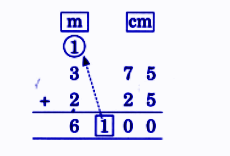
Therefore, Rani has a ribbon that is 6 m long.
Question 2.
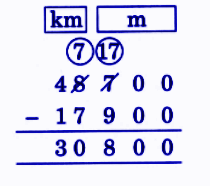
The distance from Bhopal to Sanchi is 48 km 700 m. Bhadbhada Ghat waterfall is on the way, and 17 km 900 m away from Bhopal. How far is Sanchi from the waterfall?
Solution:
The distance from Bhopal to Sanchi is 48 km 700 m, and the distance from Bhopal to Bhadbhada Ghat waterfall is 17 km 900 m.
Therefore, the distance between Sanchi and the waterfall is 30 km 800 m.
Question 3.
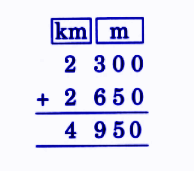
Gulmarg Gondola in Gulmarg, Kashmir is the second longest and second highest cable car in the world. It is divided into two sections. The first section covers 2 km 300 m and the second section covers 2 km 650 m. What is the total distance covered by the cable car?
Solution:
The cable car travels 2 km 300 m in the first section and 2 km 650 m in the second section.
Adding these distances:
2 km 300 m + 2 km 650 m = 4 km 950 m.
Hence, the total distance covered by the cable car in the two sections is 4 km 950 m.
Question 4.
Circle the bigger length and find the difference.
(a) 11 mm and 1 cm Difference— ________________
(b) 26 mm and 2 cm Difference— ________________
(c) 20 cm and 201 mm Difference— ________________
(d) 1,020 mm and 1m Difference— ________________
(e) 2 m and 245 cm Difference— ________________
(f) 5,678 m and 6 km Difference— ________________
(g) 6 km 1,480m and 7 km 479m Difference— ________________
Solution:
(a) 1 cm = 1 × 10 mm = 10 mm 11 mm > 10 mm So, 11 mm > 1 cm
Difference = 11 mm – 10 mm = 1 mm
(b) 2 cm = 20 mm 26 mm > 20 mm Difference – 26 mm – 2 cm
= 26 mm – 20 mm = 6 mm
(c) 20 cm = 200 mm 200 mm < 201 mm So, 20 mm < 201 mm
Difference = 201 mm – 200 mm = 1 mm
(d) 1 m = 100 cm = 1000 mm 1020 mm > 1000 mm
Difference = 1020 mm -1000 mm = 20 mm
(e) 2 m = 200 cm
200 cm < 245 cm
So, 2 m < 245 cm
Difference = 245 cm – 200 cm = 45 cm
(f) 6 km = 6 × 1000 m = 6000 m
5678 m < 6000 m
Difference = 6000 m 5678 m = 322 m
(g) 6 km 1480 m = 6000 m + 1480 m
= 7480 m 7 km 479 m
= 7000 m + 479 m
= 7479 m
So,7480 m > 7479 m
So, 6 km 1480 > 7 km 479 m
So, difference = 7480 m – 7479 m = 1 m
NCERT Textbook Pages 66-67
Multiplying and Dividing Lengths
Question 1.
We need a 1 m 80 cm cloth to make a shirt for a 10-year old child. How much cloth will be needed to make shirts for 20 such children?
Solution:
To find 20 × 1 m 80 cm, first split the measure into metres and centimetres:
20 × 1 m = 20 m
20 × 80 cm = 1600 cm
Convert 1600 cm into metres:
1600 cm = 16 m
Now add the results:
20 m + 16 m = 36 m
This shows how lengths can be multiplied by separating metres and centimetres or by converting everything into a single unit before multiplying.
Question 2.
A shop sells cloth for making bags at ₹ 100 for 5 m. How much money is needed to buy a 1 m cloth?

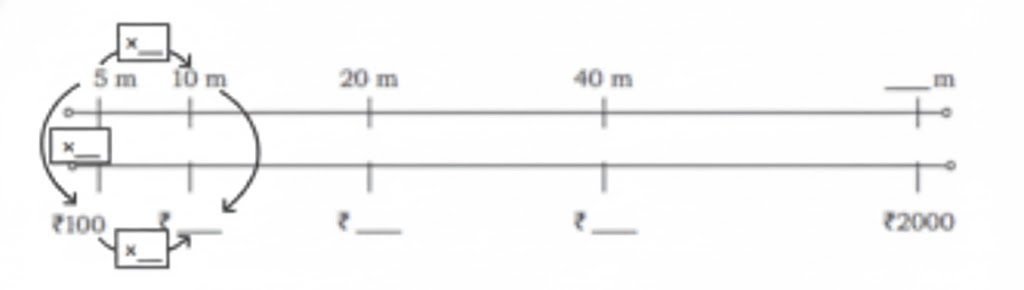
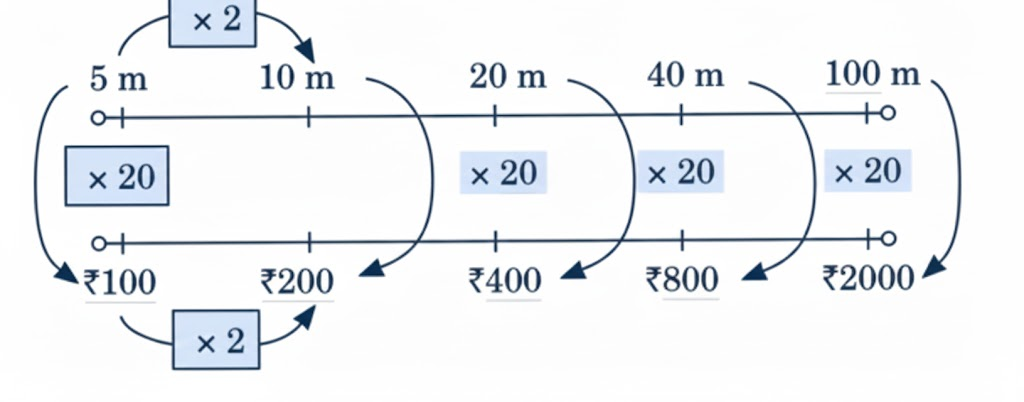
If 5 m cloth costs ₹ 100, then a 1 m cloth costs 100 ÷ 5 = ₹ 20.
Now, use the double number line to find the cost of the cloth or the length of cloth that we can buy at a particular cost.
Solution:
Question 3.
Anita is making an embroidery on the border of a sari. She needs aim long thread to embroider a 50 cm sari. How much thread would she need for a 5 m sari border?
A 1 m long thread costs ?50. How much money will be needed to by the thread?

Solution:
The length of the sari is 5 m, which is equal to 500 cm.
For every 50 cm of sari, 1 m of thread is required.
The number of 50 cm parts in 500 cm is:
500 ÷ 50 = 10.
Therefore, Anita needs 10 m of thread.
The cost of 1 m of thread is ₹50.
So, the total cost for 10 m of thread is:
₹50 × 10 = ₹500.
Hence, Anita requires 10 metres of thread, costing ₹500.
Question 4.
A road 12 km 600 m long is being laid in a town. The workers lay an equal length of road each day, and complete the work in 6 days. How much road-laying work is done on each day?
Solution:
The total length of the road is 12 km 600 m, which is equal to 12,600 m.
The work is to be completed in 6 days.
So, the length of road laid each day is:
12,600 m ÷ 6 = 2,100 m, that is 2 km 100 m per day.
NCERT Textbook Page 68
Let Us Estimate
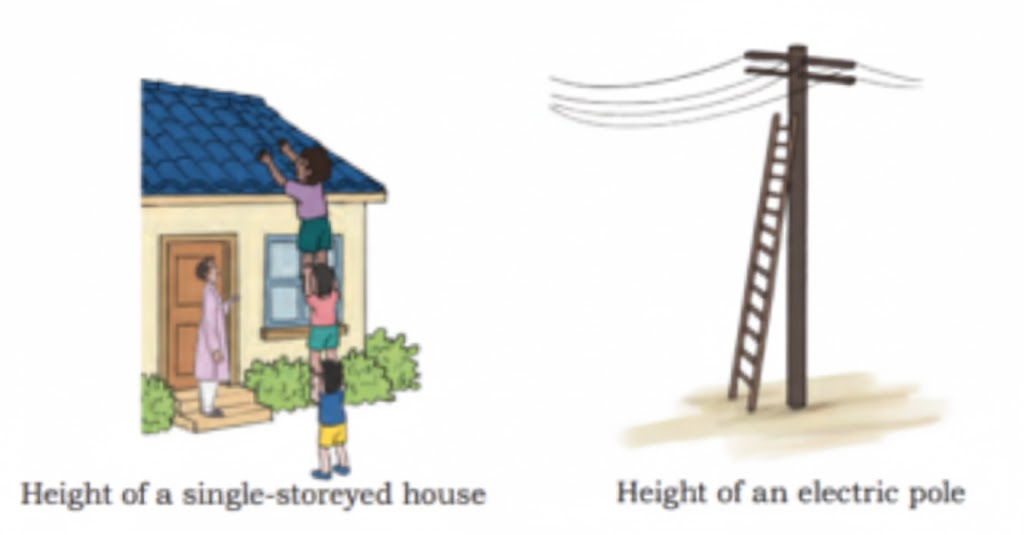
Estimate the following. Share your reasoning in class.
1. The height of the tallest building in your neighbourhood. What did you use as a reference to estimate the height?
2. The height of the tallest tree in your neighbourhood. What did you use as a reference?
3. The depth of a well or swimming pool in your neighbourhood. How did you find out?
Solution:
Students should do it by themselves.
Let Us Explore
In daily life, we use other units of measuring length as well. Height is usually measured in feet and inches. Look at your ruler to see if inches are also marked on it. Find out how many cm and mm equal 1 inch.
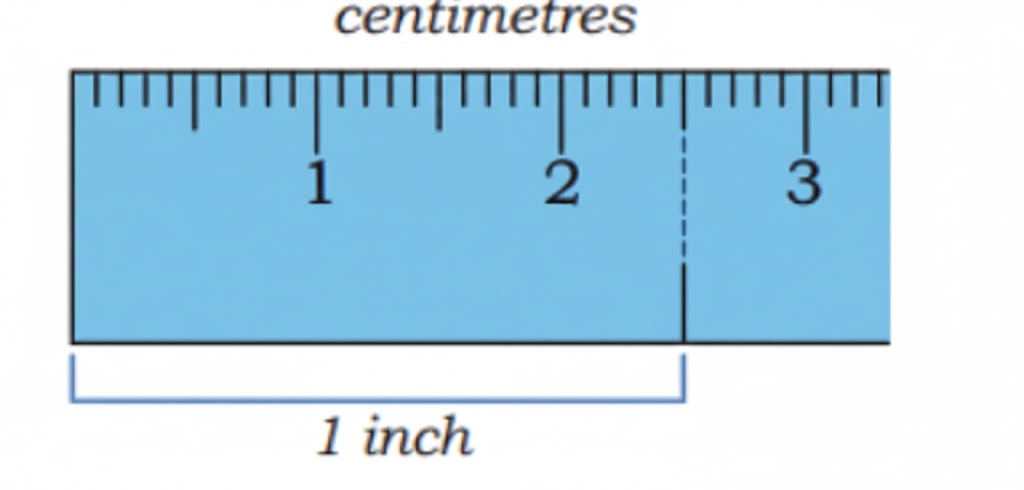
1 inch = 2 cm 5 mm
1 foot = 12 inches or 30 cm.
Solution:
Students should do it by themselves.
NCERT Textbook Page 69
Measure Your Height
Stand against a wall and mark your height. Measure the distance between the floor and the marked point in feet and inches. Similarly, other students in the class can also measure their heights.
Find out who is the tallest student in your class. What is his or her height in feet and inches?
Solution:
Students should do it by themselves.
NCERT Solutions for Class 5 Maths Chapter 5: Far and Near – Key Points
Mastering length measurement units is crucial for Class 5 Maths. This chapter explains metres, centimetres, millimetres, conversions, and comparisons through relatable stories. Practicing NCERT solutions ensures a solid foundation in the concept of “Far and Near.”
Learning about unit conversion techniques and real-life applications helps Class 5 students solve questions about distances, heights, and everyday measurements. Use the exercises in this chapter for quick revision and better exam confidence!
To succeed in exams, regularly practice these NCERT exercise-based solutions. Understand the logic behind each answer, review key examples, and remember to check your calculations. A strong concept of lengths boosts your problem-solving skills and marks.
FAQs on NCERT Solutions For Class 5 Maths Chapter 5 Far And Near - 2026-27 Free PDF Download (Sign-in Required)
1. What topics are covered in NCERT Solutions Class 5 Maths Mela Chapter 5 Far and Near?
The NCERT Solutions for Class 5 Maths Mela Chapter 5 Far and Near include stepwise solutions for every exercise question, clarifications of key concepts, and explanations of diagrams. This chapter focuses on:
- Distance and measurement concepts
- Understanding maps and scales
- Converting units (meters, centimeters, kilometers)
- Reading and labelling diagrams
2. How can I score full marks using NCERT Solutions for Class 5 Maths Chapter 5?
To score full marks in CBSE Class 5 Maths Chapter 5 Far and Near, follow these tips:
- Write stepwise answers using clear working
- Use correct definitions and units
- Include neatly labelled diagrams or maps where asked
- Highlight key points and box your final answer
- Revise with NCERT exercise-wise solutions and practice previous year questions
3. Are diagrams and definitions mandatory in NCERT Class 5 Maths Chapter 5 answers?
Including neat diagrams and exam-ready definitions is important for scoring well in Class 5 Maths Chapter 5. Diagrams are:
- Often required for map and measurement questions
- Required to be labelled accurately
- Help you earn easy step marks per CBSE marking scheme
Definitions are necessary when asked, especially for terms like distance, scale, or unit.
4. Where can I download the free PDF of Class 5 Maths NCERT Solutions Chapter 5?
You can download the free PDF of NCERT Solutions for Class 5 Maths Chapter 5 Far and Near from trusted educational websites. The PDF includes:
- Exercise-wise and stepwise solutions
- Mapped to the latest 2026–27 CBSE syllabus
- Useful for offline study and last-minute revision
5. What is the CBSE marking scheme for Class 5 Maths Chapter 5 solutions?
The CBSE marking scheme for Class 5 Maths Chapter 5 awards marks for:
- Correct steps and method (step marking)
- Accurate final answer with correct unit
- Clear and neat diagrams/maps, if required
- Using keywords and completing all parts of multi-step questions
6. How to revise Class 5 Maths Chapter 5 Far and Near quickly before exams?
To revise NCERT Class 5 Maths Chapter 5 Far and Near efficiently:
- Go through exercise-wise NCERT solutions and key examples
- Revise key formulae and definitions
- Practice important diagrams and map labelling
- Use flash notes and a 1-day or 3-day revision plan
7. What are the most important questions and topics in Class 5 Maths Chapter 5?
The most important topics in Class 5 Maths Chapter 5 Far and Near for exams include:
- Conversion of units (cm, m, km)
- Interpreting maps and scales
- Calculation of distances using given data or diagrams
- Labelling maps and identifying places far and near
- Definitions and exercises with real-life applications
8. Are NCERT Solutions enough for Class 5 Maths exams?
NCERT Solutions for Class 5 Maths cover all essential concepts as per CBSE syllabus and are generally sufficient for exams. For best results:
- Practice all intext and back exercise questions
- Attempt exemplar, MCQs, and previous year questions
- Revise key formulae and definitions regularly
9. How to present long answers in Class 5 Maths according to CBSE marking?
To present long answers for Class 5 Maths Chapter 5 per CBSE marking scheme:
- Write stepwise with clear workings
- Use proper headings (e.g., Given, To Find, Solution)
- Box the final answer with correct units
- Draw neat diagrams if required and label them clearly
10. How do I avoid common mistakes in NCERT Class 5 Maths Chapter 5 solutions?
To avoid common mistakes in Class 5 Maths Chapter 5 Far and Near solutions:
- Always write correct units (cm, m, km) in answers
- Double-check all calculations
- Read map/scales carefully
- Draw and label diagrams neatly
- Follow stepwise solution as per marking scheme to avoid missing steps
11. How to label maps and diagrams in NCERT Solutions for Class 5 Maths Chapter 5?
For map and diagram questions in Class 5 Maths Chapter 5 Far and Near:
- Use a scale when drawing distances
- Label locations and paths clearly and neatly
- Make arrows or legends if required
- Follow textbook conventions and practice with provided examples
12. Do examiners award partial marks for correct steps even if the final answer is wrong?
Yes, CBSE examiners usually award step marks for correct working, even if the final answer is incorrect, especially in Maths solutions. Ensure you:
- Show all steps clearly
- Write each calculation and conversion
- Attempt every part as per the question
