



Stepwise NCERT Answers for Class 5 Maths Chapter 1 with Diagrams and Tips
NCERT Textbook Pages 1-4
Reading and Writing Large Numbers
How do you write numbers to show several thousand objects?
Let us start with 1,000. What numbers do we get when we keep adding a thousand?
Solution:
( 1,000) ( 2,000) ( 3,000) (4,000) (5,000) (6,000) (7,000) (8,000) (9,000)
Let us see how we write number beyond 10,000 and how we name them.
We write them in the same way as numbers below 9,999.
You can use the tokens given in the end of the book.
Solution:
NCERT Textbook Pages 5-7
Let Us Do
Question 1.
Fill in the blanks by continuing the pattern in each of the following sequences. Discuss the patterns in class.
(a)
Solution:
Pattern:
Add 111 to the number to get the next number.
Solution:
Pattern:
Add 1,050 to the previous number to get the next number.
Solution:
Pattern:
Add 900 to the previous number to get the next number.
Solution:
Pattern:
Add 100 to the previous number to get the next number.
Solution:
Pattern:
Add 20 to the previous number to get the next number.
Solution:
Pattern:
Add 1 to the previous number to get the next number.
Solution:
Pattern:
Add 2 to the previous number to get the next number.
Solution:
Pattern:
Subtract 1,001 to the previous number to get the next number.
Solution:
Question 2.
Fill in the blanks appropriately. Use commas as required.
Solution:
Question 3.
Arrange the numbers below in increasing order. You can use the number line below, if required.
Solution:
Question 4.
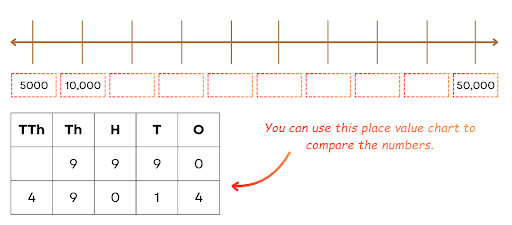
A student said 9,990 is greater than 49,014 because 9 is greater than 4. Is the student correct?
Why or Why Not?
Use the number line below to find the position of the numbers. Fill in the blanks.
Solution:
Even though 9 is greater than 4, the correct way to compare numbers is to first look at the number of digits.
Here, 9,990 has 4 digits, while 49,014 has 5 digits.
A number with more digits is always larger than a number with fewer digits.
Therefore, 49,014 is greater than 9,990.
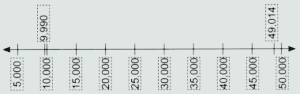
On a number line, any number placed to the right is greater than the number on its left.
Therefore, 9,990 is less than 49,014.
Question 5.
Digit swap
(a) In the number 1,478, interchanging the digits 7 and 4 gives 1,748. Now, interchange any two digits in the number 1,478 to make a number that is larger than 5,500
Solution:
To form a number greater than 5,500 from 1,478, we can rearrange its digits.
For example, swapping 1 and 8 gives 8,471, which is greater than 5,500.
Alternatively, interchanging 1 and 7 results in 7,418, which is also greater than 5,500.
(b) Interchange two digits of 10,593 to make a number
(i) Between 11,000 and 15,000.
(ii) More than 35,000.
Solution:
(i) Interchange the digits 0 and 3 in 10,593 to get 13,590.
So, 13,590 is between 11,000 and 15,000.
(ii) Interchange the digits 1 and 5 in 10,593 to get 50,193.
or
Interchange digits 1 and 9 in 10,593 to get 90,513.
So, 50,193 and 90,513 both the numbers are more than 35,000.
(c) Interchange two digits of 48,247 to make a number
(i) As small as possible.
(ii) As big as possible.
Solution:
(i) Interchange the digits 2 (hundreds place) and 4 (ten thousands place) in 48,247 to get 28,447.
(ii) Interchange the digits 4 and 8 in 48,247 to get 84,247.
NCERT Textbook Pages 7-8
Nearest Tens (10s), Hundreds (100s), and Thousands (1,000)
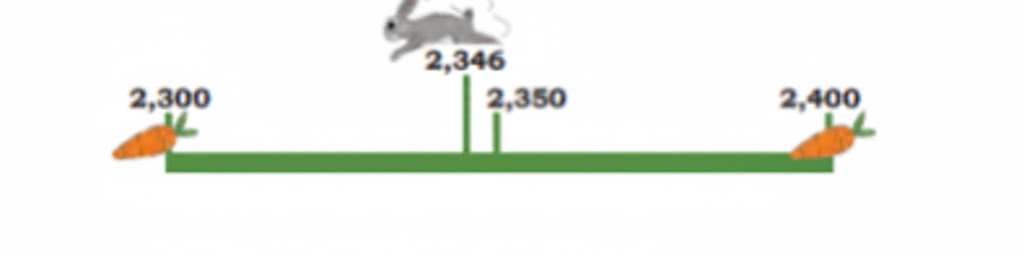
The rabbit is at 2,346. Its food has been kept at its neighbouring hundreds. Which of the two hundreds should the rabbit go to?
_______ is the nearest hundred of 2,346. It will need______ jumps to reach ______.
Solution:
The nearest hundred to 2,346 is 2,300.
To reach 2,300 from 2,346, we need 46 backward jumps.
The rabbit is at 2,346. Its food has been kept at its neighbouring thousands. Which number should the rabbit go to?
_________ is the nearest thousand of 2,346. It will need _______ jumps to reach ______.

Solution:
The nearest thousand to 2,346 is 2,000.
To reach 2,000 from 2,346, we need 346 backward jumps.
Fill in the boxes appropriately.
Solution:
NCERT Textbook Pages 8-9
Let Us Think
Question 1.
Vijay rounded off a number to the nearest hundred. Suma rounded off the same number to the nearest thousand. Both got the same result. Circle the numbers they might have used.
7,126 7,835 7,030 6,999
Solution:
7,126 rounds to 7,100 when rounded to the nearest hundred (since 2 < 5) and to 7,000 when rounded to the nearest thousand (since 1 < 5).
7,835 rounds to 7,800 when rounded to the nearest hundred (since 3 < 5) and to 8,000 when rounded to the nearest thousand (since 8 > 5).
7,030 rounds to 7,000 when rounded to the nearest hundred (since 3 < 5) and also to 7,000 when rounded to the nearest thousand (since 0 < 5).
6,999 rounds to 7,000 when rounded to the nearest hundred (since 9 > 5) and to 7,000 when rounded to the nearest thousand (since 9 > 5).
Since both 7,030 and 6,999 give the same result, 7,000, when rounded to the nearest hundred as well as the nearest thousand, the numbers they might have used are 7,030 and 6,999.
Question 2.
Think and write two numbers that have the same—
(a) Nearest ten.
(b) Nearest hundred.
(c) Nearest thousand.
Solution:
(a) 28 and 31
(b) 78 and 126
(c) 883 and 1263 (Answers might be different)
Question 3.
Think and write the numbers that have the same—
(a) Nearest ten and nearest hundred.
(b) Nearest hundred and nearest thousand.
(c) Nearest ten, hundred and thousand.
Solution:
(a) A number has the same nearest ten and nearest hundred when both rounding processes give the same value.
This occurs when the number is very close to a hundred, either slightly less than or slightly more than it.
For example, any number from 95 to 104, when rounded to the nearest ten or the nearest hundred, becomes 100.
(b) A number has the same nearest hundred and nearest thousand when rounding at both places results in the same value.
This happens when the number lies very close to a thousand, either just below or just above it.
For instance, numbers from 950 to 1049, when rounded to the nearest hundred or the nearest thousand, give 1000.
(c) A number has the same nearest ten, nearest hundred, and nearest thousand when all three rounding methods produce the same result.
This situation occurs when the number is extremely close to a thousand.
For example, any number between 995 and 1004, when rounded to the nearest ten, hundred, or thousand, results in 1000.
NCERT Textbook Page 10
Let Us Do
Question 1.
A cyclist can cover 15 km in one hour. How much distance will she cover in 4 hours, if she maintains the same speed?
Solution:
The cyclist covers 15 km in one hour.
Therefore, in 4 hours, the distance covered is 15 km × 4 = 60 km.
Question 2.
A school has 461 girls and 439 boys. How many vehicles are needed for all of them to go on a trip using the following modes of travel? The numbers in the bracket indicates the number of people that can travel in one vehicle.
(a) Bicycle (2)
(b) Autorickshaw (3)
(c) Car (4)
(d) Big car (6)
(e) Tempo traveller (10)
(f) Boat (20)
(g) Minibus (25)
(h) Aeroplane (180)
Solution:
The total number of students in the school is
461 + 439 = 900.
(a) A bicycle can carry 2 people, so the number of bicycles required is
900÷2=450900 \div 2 = 450900÷2=450.
(b) An auto rickshaw can carry 3 people, so the number of auto rickshaws required is
900÷3=300900 \div 3 = 300900÷3=300.
(c) A car can carry 4 people, so the number of cars required is
900÷4=225900 \div 4 = 225900÷4=225.
(d) A big car can carry 6 people, so the number of big cars required is
900÷6=150900 \div 6 = 150900÷6=150.
(e) A tempo traveller can carry 10 people, so the number of tempo travellers required is
900÷10=90900 \div 10 = 90900÷10=90.
(f) A boat can carry 20 people, so the number of boats required is
900÷20=45900 \div 20 = 45900÷20=45.
(g) A minibus can carry 25 people, so the number of minibuses required is
900÷25=36900 \div 25 = 36900÷25=36.
(h) An aeroplane can carry 180 people, so the number of aeroplanes required is
900÷180=5900 \div 180 = 5900÷180=5.
NCERT Textbook Pages 10-11
Finding Large Numbers Around Us
A book has around 200 pages, and each page has about 50 words. The book therefore has about 10,000 words in all.
Find something in the textbook whose count is a 4-digit
Solution:
A book has around 200 pages each page has about 50 words. We can assume that there are about 10 words in a sentence. There would be 50 ÷ 10 = 5 sentences on each page. So, the number of sentences in the book = 200 × 5 = 1,000 which is 4-digit number.
Now, let us try this with our school.
(a) Our school has ______ classrooms.
(b) There are ______ students in my class.
(c) Our classroom has ______ books in total.
Solution:
Students should do it by themselves.
Find something in the classroom whose count is a—
(i) 4-digit number
(ii) 5-digit number
Solution:
Students should do it by themselves.
List some quantities whose count is a 4-digit or a 5-digit number in the context of—
(i) A tree.
(ii) Your village/town/city, or any other place of your choice.
Solution:
Students should do it by themselves.
NCERT Textbook Pages 11-13
Pastime Mathematics
Question 1.
Mira poses the river crossing puzzle to Sanju. A boatman wants to cross a river in a boat. He has to take a lion, a sheep, and a bundle of grass with him. He can take one of them at a time. If the sheep and grass are left on the shore, the sheep will eat the grass. And, if the sheep and lion are left on the shore, the lion will eat the sheep. How can the boatman take the lion, sheep, and grass across the river? Help him so that he can ferry the lion, sheep, and grass across the river safely, and in the minimum number of trips.
Question 2.
Sanju introduces a game called pile of pebbles to Mira. There are two piles of pebbles. Each pile contains 7 pebbles. Each player can pick as many pebbles they want from either of the piles. The player who picks the last pebble wins. Try this game with your friends. Now, how do you play so that you win?
To find a winning strategy, try playing with 1 pebble in each pile, two in each, three in each, and so on.
Question 3.
Now, it’s Mira’s turn. She gives a fun puzzle to Sanju with the following steps —
(a) Take any two different digits. → 3 and 7
(b) Make two 2-digit numbers using them. → 37 and 73
(c) Subtract the smaller number from the bigger number. → 73 – 37 = 36
Solution:
Students should do it by themselves.
NCERT Textbook Pages 13-15
Let Us Do
Question 1.
Write 5 numbers between the numbers 23,568 and 24,234.
Solution: Answers might be different.
23,569, 23,570, 24,000, 24,100, and 24,200
Question 2.
Write 5 numbers that are more than 38,125 but less than 38,600.
Solution: Answers might be different.
38,130, 38,225, 38,250, 38,275, 38,500
Question 3.
Ravi’s car has been driven for 56,987 km till now. Sheetal’s car has been driven 67,543 km. Whose car has been driven more?
Solution:
Distance covered by Ravi’s car = 56,987 km
Distance covered by Sheetal’s car = 67,543 km
Since 67,543 > 56,987,
Sheetal’s car is driven 67,543 – 56,987 = 10,556 km more than Ravi’s car.
Question 4.
The following are the prices of different electric bikes. Arrange the prices in ascending (increasing) order.
₹ 90,000 ₹ 89,999 ₹ 94,983
₹ 49,900 ₹ 93,743 ₹ 39,999
Solution:
Prices of electric bikes in ascending order are:
₹ 39,999 → ₹ 49,900 → ₹ 89,999 → ₹ 90,000 → ₹ 93,743 → ₹ 94,983
Question 5.
The following table shows the population of some towns. Arrange them in a descending (decreasing) order.
Solution:
The populations of the towns, arranged in descending order, are:
66,540; 65,232; 56,380; 53,231; 51,336; 45,858.
Question 6.
Find numbers between 42,750 and 53,500 such that the ones, tens, and hundreds digits are all 0?
Solution:
The numbers that lie between 42,750 and 53,500 and have 0 in the ones, tens, and hundreds places are:
43,000; 44,000; 45,000; 46,000; 47,000; 48,000; 49,000; 50,000; 51,000; 52,000; and 53,000.
Question 7.
Write the following numbers in the expanded form. One has been done for you.
(a) 783 = 700 + 80 + 3
(b) 8,062 = ______.
(c) 9,980 = ______.
(d) 10,304 = ______.
(e) 23,004 = ______.
(f) 70,405 = ______.
Solution:
(a) 783 = 700 + 80 + 3
(b) 8,062 = 8,000 + 60 + 2
(c) 9,980 = 9,000 + 900 + 80
(d) 10,304 = 10,000 + 300 + 4
(e) 23,004 = 20,000 + 3,000 + 4
(f) 70,405 = 70,000 + 400 + 5
Question 8.
Fill in the blanks with the correct answer. Share your thoughts in class.
Solution:
(a) 983 = 90 Tens + 83 Ones

Since 90 tens make 900, the remaining 83 are counted as ones.
(b) 68 = 5 Tens + 18 Ones
68 Ones – 18 Ones = 50 which is 5 Tens
(c) 607 = 4 Hundred + 207 Ones
4 Hundred is 400, so the remaining 207 will be ones.
(d) 5,621 = 4 Thousands + 16 Hundreds + 2 Tens + 1 One
4 Thousand is 4,000 and 2 Tens means 20, so the remaining 1601 will be divided into Hundreds and Ones 1601 = 16 Hundreds and 1 One
Answers might be different.
(e) 7,069 = 5 Thousands + 20 Hundreds + 69 Ones
20 Hundreds is 2,000, so the remaining 5,069 will be divided into Thousands and Ones
5,069 = 5 Thousands and 69 ones
Answers might be different.
(f) 37,608 = 2 Ten Thousands + 17 Thousands + 6 Hundreds + 8 Ones
17 Thousands is 17,000 and 8 Ones is 8, ‘ so the remaining 20,600 will be divided into Ten Thousands and Hundreds. 20,600 = 2 Ten thousands and 6 Hundreds
Answers might be different.
(g) 43,001 = 3 Ten Thousands + 13 Thousands + 0 Hundreds + 1 One
3 Ten Thousands is 30,000 and 1 One is 1, so the remaining 13,000 will be divided into Thousand and Hundreds.
13,0 = 13 Thousands and 0 Hundreds (Answer may vary)
Question 9.
Fill in the blanks with the correct answers.
(b) How many notes of ₹ 100 are there in ₹ 7,934?
(c) How many thousands are there in ₹ 7,934?
(d) How many ₹ 500 notes are there in ₹ 7,934?
(Hint: Observe the answer of (iii))
(e) How many notes of ₹ 10 are there in ₹ 65,342?
(f) How many notes of ₹ 100 are there in ₹ 65,342?
(g) How many thousands are there in ₹ 65,342?
id) How many ₹ 500 notes are there in ₹ 65,342?
Solution:
(b) Write 7,934 in expanded form:
7,934=7,000+900+30+47,934 = 7,000 + 900 + 30 + 47,934=7,000+900+30+4
The number of hundreds in 900 is 9, and the number of hundreds in 7,000 is 70.
Therefore, the total number of ₹100 notes in ₹7,934 is
70+9=7970 + 9 = 7970+9=79.
(c) Write 7,934 in expanded form:
7,934=7,000+900+30+47,934 = 7,000 + 900 + 30 + 47,934=7,000+900+30+4
The number of thousands in 7,000 is 7.
So, the total number of thousands in ₹7,934 is 7.
(d) Write 7,934 in expanded form:
7,934=7,000+900+30+47,934 = 7,000 + 900 + 30 + 47,934=7,000+900+30+4
The number of ₹500 notes in 900 is 1, and the number of ₹500 notes in 7,000 is 14.
Hence, the total number of ₹500 notes in ₹7,934 is
14+1=1514 + 1 = 1514+1=15.
(e) Write 65,342 in expanded form:
65,342=60,000+5,000+300+40+265,342 = 60,000 + 5,000 + 300 + 40 + 265,342=60,000+5,000+300+40+2
The number of tens in 40 is 4, in 300 is 30, in 5,000 is 500, and in 60,000 is 6,000.
So, the total number of ₹10 notes in ₹65,342 is
6,000+500+30+4=6,5346,000 + 500 + 30 + 4 = 6,5346,000+500+30+4=6,534.
(f) Write 65,342 in expanded form:
65,342=60,000+5,000+300+40+265,342 = 60,000 + 5,000 + 300 + 40 + 265,342=60,000+5,000+300+40+2
The number of hundreds in 300 is 3, in 5,000 is 50, and in 60,000 is 600.
Therefore, the total number of ₹100 notes in ₹65,342 is
600+50+3=653600 + 50 + 3 = 653600+50+3=653.
(g) Write 65,342 in expanded form:
65,342=60,000+5,000+300+40+265,342 = 60,000 + 5,000 + 300 + 40 + 265,342=60,000+5,000+300+40+2
The number of thousands in 5,000 is 5, and in 60,000 is 60.
So, the total number of thousands in ₹65,342 is
60+5=6560 + 5 = 6560+5=65.
(h) Write 65,342 in expanded form:
65,342=60,000+5,000+300+40+265,342 = 60,000 + 5,000 + 300 + 40 + 265,342=60,000+5,000+300+40+2
The number of ₹500 notes in 5,000 is 10, and the number of ₹500 notes in 60,000 is 120.
Hence, the total number of ₹500 notes in ₹65,342 is
120+10=130120 + 10 = 130120+10=130.
NCERT Textbook Pages 15-16
King’s Horses
Once upon a time, there was a king who was very fond of horses. He had 20 horses of the best breed. The horses were kept in the royal stable, and cared for by a caretaker. One night, a thief stole one of the horses. Fearing punishment, the caretaker arranged the horses in the stable as shown in the picture here. The next day, when the king came to check on the horses, the caretaker led him around the square stable. “Please count the number of horses along each side, your majesty,” he said. King’s Horses
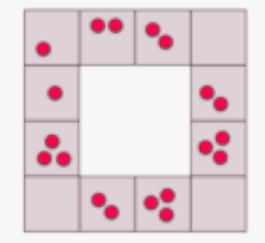
The king counted 5 horses along each side. “We have 5 horses along each side and there are 4 sides. So there are a total of 20 horses, your majesty,” the caretaker explained.
Satisfied with the explanation, the king returned to his palace.
But wait, were there really 20 horses in the stable? Count the horses one by one and check! What was the mistake in the caretaker’s explanation?
Solution:
The caretaker counted the corner horses twice, which made it appear that there were 20 horses, even though the actual number was less.
The next night, a thief stole one more horse, leaving only 18 horses in the stable. Once again, the caretaker cleverly arranged the horses so that there were 5 horses on each side of the square stable. How was this possible?
Solution:
He placed 2 horses along each side, added 2 horses in the middle of each side, and positioned 1 horse at the top-left corner and 1 horse at the bottom-right corner. This arrangement ensured that each side of the square had exactly 5 horses.
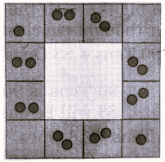
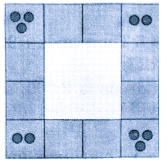
How many more horses can the thief steal before the king notices something is wrong? Try making the arrangements yourself.
Solution:
Thus, the caretaker can arrange 10 horses in such a way that it appears there are 5 horses on each side of the square.
Therefore, the thief can steal up to 10 horses, reducing the total number of horses to 10.
NCERT Solutions for Class 5 Maths Mela Chapter 1 The Travellers—I (2026-27)
Mastering the concept of reading and writing large numbers is made simple with NCERT Solutions for Class 5 Maths Chapter 1. The chapter explores place value, rounding numbers, and mathematical puzzles, helping students build a strong foundation for future maths success.
Practice with chapter-wise solutions will boost your calculation accuracy and speed. Focusing on travel, patterns, and logic, this chapter’s exercises make learning maths fun and easy to remember for exams.
By reviewing the NCERT Solutions Class 5 Maths Mela Chapter 1 The Travellers—I, you’ll improve your understanding of large numbers, rounding techniques, and problem-solving strategies—key skills for scoring high in exams and building maths confidence.
FAQs on NCERT Solutions For Class 5 Maths Chapter 1 We The Travellers-I - 2026-27 Free PDF Download (Login Required)
1. What are stepwise solutions for Maths Mela Chapter 1?
NCERT Solutions for Class 5 Maths Mela Chapter 1 The Travellers—I provide detailed, stepwise answers that follow CBSE guidelines. These solutions include:
- Clear breakdown for each exercise and in-text question
- Definitions and key formulae highlighted for easy recall
- Well-structured answer formats matching the marking scheme
- Neatly labelled diagrams or illustrations where required
2. How to write answers for CBSE Class 5 Maths?
To score full marks in CBSE Class 5 Maths, structure your answers as follows:
- Begin with a clear step-by-step calculation
- Use correct definitions and formulas when needed
- Present diagrams wherever necessary, ensuring they are neat and labelled
- Mention all working steps to secure step-wise marks
- Keep your writing neat and avoid overwriting
3. Are diagrams required in NCERT maths answers?
Diagrams are often required in NCERT maths answers to explain concepts visually and earn full marks. For Chapter 1 The Travellers—I:
- Neatly draw and label maps or shapes as instructed in the question
- Follow standard conventions for diagrams
- Use a ruler and pencil for straight lines
- Label key points and figures clearly
4. Where can I download the chapter’s solutions PDF?
You can download NCERT Solutions Class 5 Maths Chapter 1 The Travellers—I PDF from reliable educational websites offering free study material, such as official CBSE resources or trusted platforms like Vedantu, ensuring you access the correct 2026-27 syllabus version.
5. What is included in NCERT Solutions Class 5 Maths Mela Chapter 1 The Travellers—I?
NCERT Solutions for Chapter 1 include:
- Stepwise answers to all textbook questions
- Key definitions and important formulae
- Neat diagrams and illustrations as per the CBSE syllabus
- Revision notes and exam pointers for better preparation
6. How do stepwise solutions help in scoring in CBSE Class 5 Maths exams?
Stepwise solutions help you earn marks for every correct step and ensure you do not lose marks if a calculation goes wrong. They also match CBSE's marking scheme and improve answer presentation, making revision faster and clearer before exams.
7. Which questions are likely to be asked from Chapter 1 The Travellers—I in the exam?
The exam may include:
- Direct questions from intext and back exercises
- Definition-based and concept questions
- Diagram or map labelling tasks
- Application of learned formulas to solve given problems
Practicing the NCERT Solutions for Class 5 Maths Chapter 1 ensures you are well prepared for all these types.
8. Are definitions and diagrams mandatory in Class 5 Maths answers?
Yes, including definitions and diagrams where required increases your chances of securing full marks in CBSE Class 5 exams. Always:
- Write definitions in your own words, underlining key terms
- Draw diagrams, tables, or maps neatly as per the question
9. What are some common mistakes to avoid in CBSE Class 5 Maths Chapter 1?
Avoid these common mistakes:
- Skipping steps or not showing complete calculations
- Incorrect or missing labels on diagrams and maps
- Not using correct units in answers
- Overwriting or making the answer sheet untidy
Following stepwise NCERT solutions helps minimise these errors.
10. Are NCERT Solutions sufficient for Class 5 Maths final exam preparation?
NCERT Solutions for Class 5 Maths Chapter 1 are comprehensive and follow the CBSE 2026–27 syllabus. For best results:
- Practice all solved questions from the textbook
- Revise using key formulae and revision notes
- Attempt sample papers and MCQs for extra confidence
11. How can practice with NCERT Solutions boost my CBSE 2026-27 scores?
Practicing with NCERT stepwise answers provides exam-ready solutions, improves conceptual clarity, and matches the latest CBSE exam pattern. Regular revision with these solutions ensures accuracy, time management, and better understanding of The Travellers—I chapter.
