



Stepwise Answers & PDF Download for NCERT Class 4 Nature Trail
Write (Page 37)
Question.
Can you think of rules that should be followed while you are in a zoo or a forest?
For example,
(a) We should not feed birds.
(b) ——————–
(c) ——————–
(d) ——————–
Answer:
While visiting a zoo or a forest, we should follow these important rules:
(a) We must not give food to birds or animals.
(b) We should never trouble or tease animals.
(c) We must avoid harming trees, plants, or flowers.
(d) We should not damage public property.
(e) We should stay alert and careful in unfamiliar surroundings.
(f) We should not carry pets, firearms, or any type of weapon.
(g) We should always keep the place clean and avoid throwing litter.
Discuss (Page 37)
Question.
Why are these rules important to be followed?
Answer:
These rules are important because they help ensure our safety when we visit a forest or a zoo. They also protect animals, birds, and plants from harm. By following these rules, we help conserve nature and keep these places clean, safe, and beautiful.
Activity 1 (Page 39)
Animals in the Forest
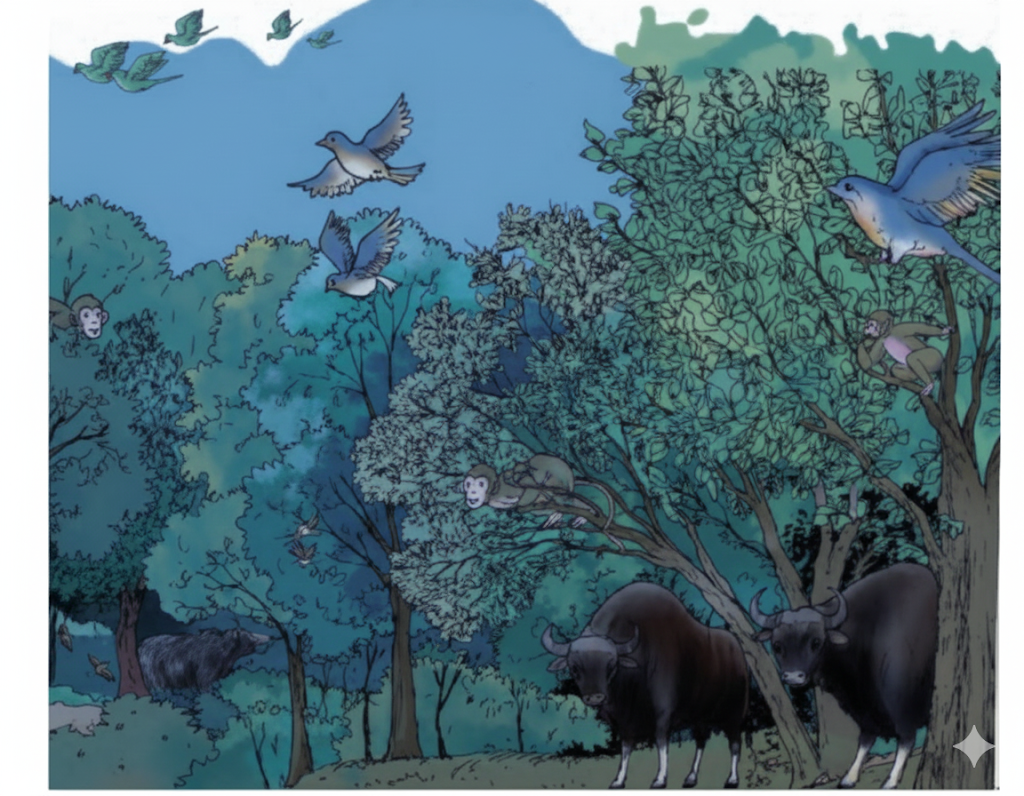
Look closely at the picture and identify the animals. You may take help from your teacher.
Divide them into two categories:
1. Animals on land:
…………………………………..
2. Birds in the sky:
……………………………………
Answer:
Land Animals: Indian bison, spotted deer, sambar deer, monkeys, and bears.
Birds in the Air: Indian roller, parrots, and sparrows.
Write (Page 40)
Question.
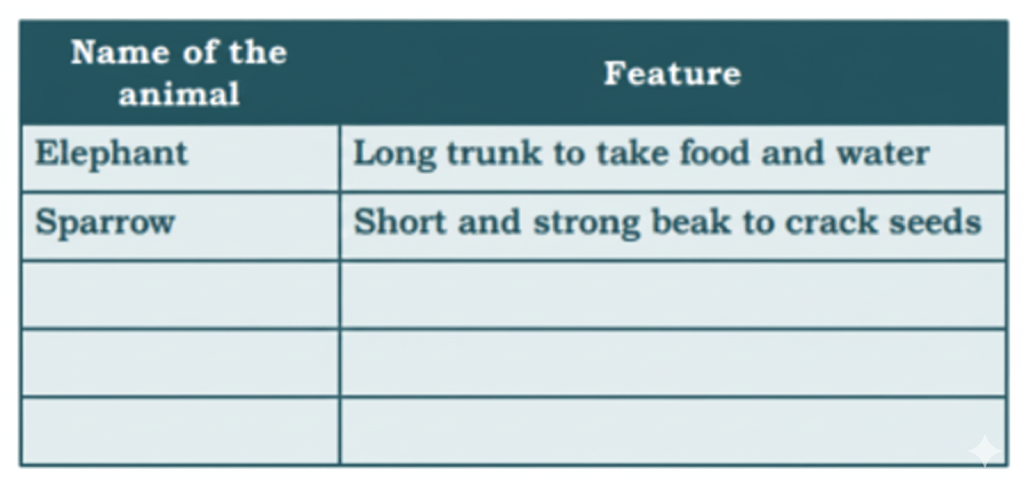
Name some animals including the birds that you have seen. Write any one feature of each of them.
Answer:
(Page 40)
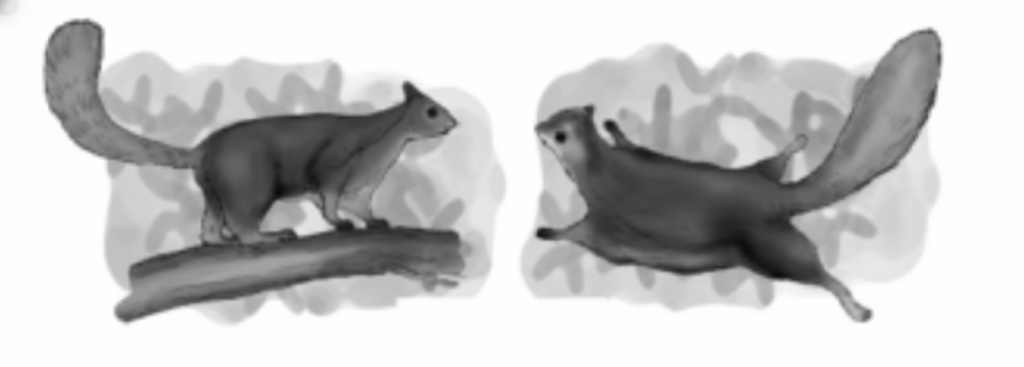
Indian Giant Squirrel is a big, red-coloured squirrel found in Pachmarhi and some other places.
Write
Compare its features with the squirrels you see in your area.
Answer:
The Indian Giant Squirrels are much larger in size compared to the squirrels found in my neighbourhood. They have a reddish-brown colour, whereas the local squirrels are grey with white stripes along their backs. Although both types have long tails, the tails of Indian Giant Squirrels are thicker and more bushy. Indian Giant Squirrels are skilled at jumping between tall trees, while the squirrels in my area move quickly on the ground and enjoy eating nuts and fruits.
Activity 2 (Page 43)
Question 1.
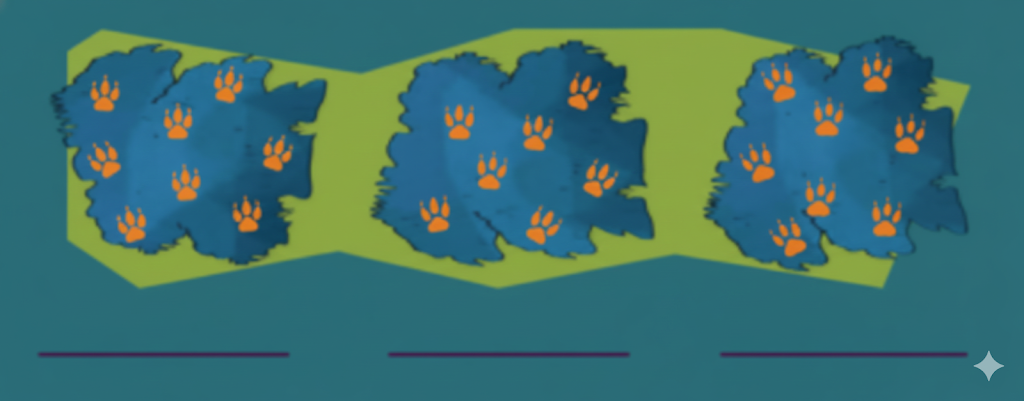
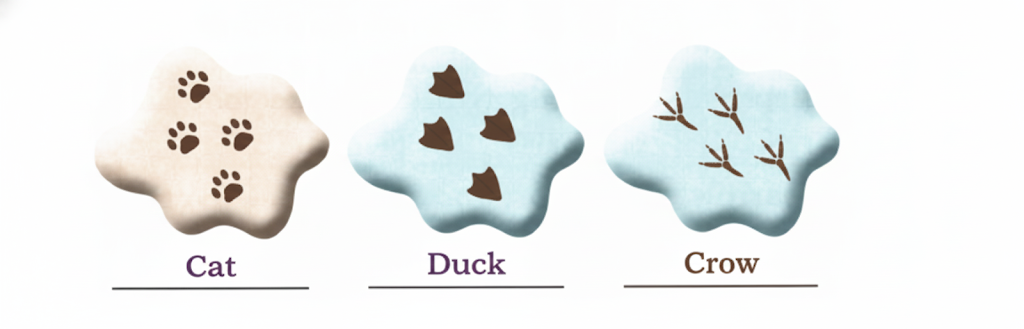
Look at the footprints and guess the name of the animals that you think must have come to the pond to drink water.
Answer:
Question 2.
Observe and draw the footprint of any animal in the space given here.

Answer:
Students should do it by themselves.
Write (Page 44)
Question.
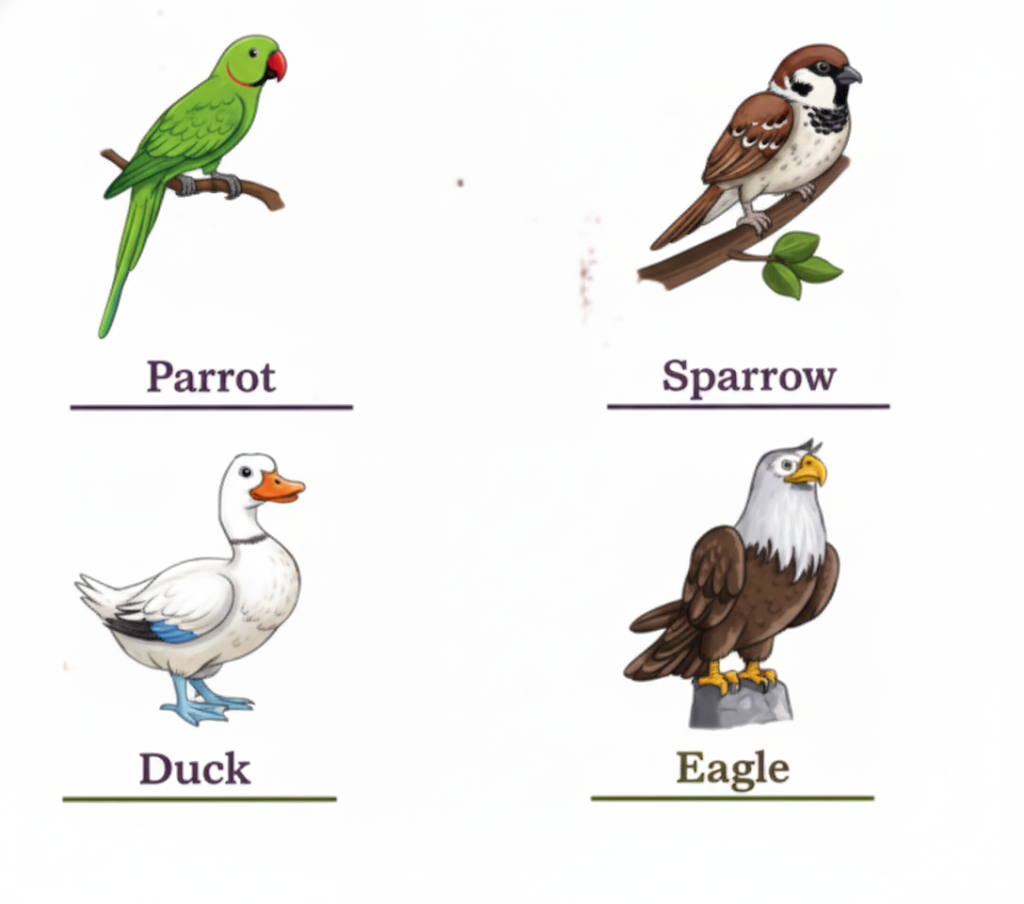
Name the birds shown below.
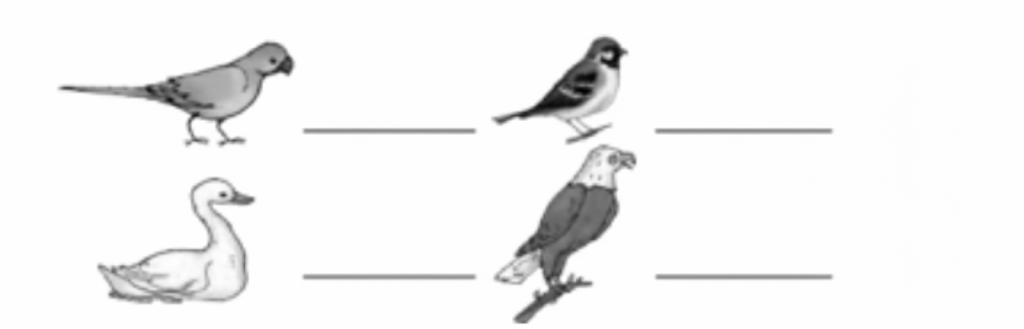
Answer:
Activity 3 (Page 45)
Question.
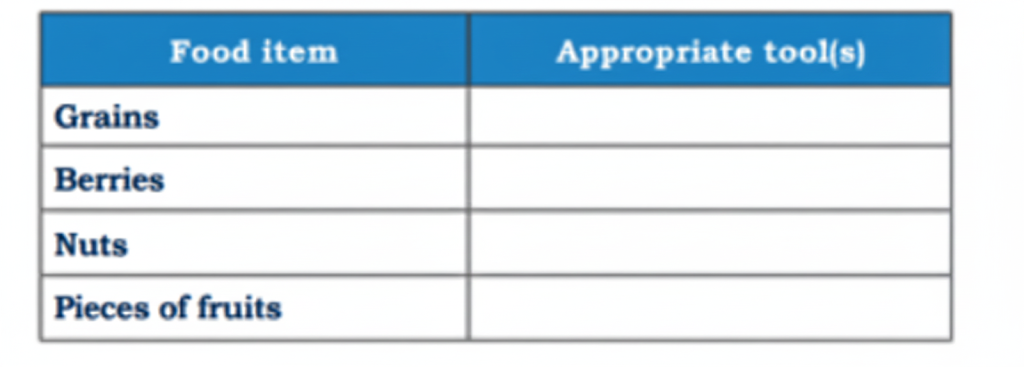
Take different food items like grains, berries, fruits, nuts, etc, in a plate.
Try to pick these food items using a spoon, a toothpick or a pair of sticks. Fill the table below with appropriate tool(s) for picking each of these food items.
Answer:
Activity 4 (page 47)
Question 1.
Bird Diary
(a) Go near a tree.
(b) Close your eyes and listen to the sounds of different birds.
(c) Now open your eyes and focus on one bird at a time.
(d) Observe how it moves, what it eats, and where it sits.
(e) Write your observations in a Bird Diary!
For each bird, note the following:
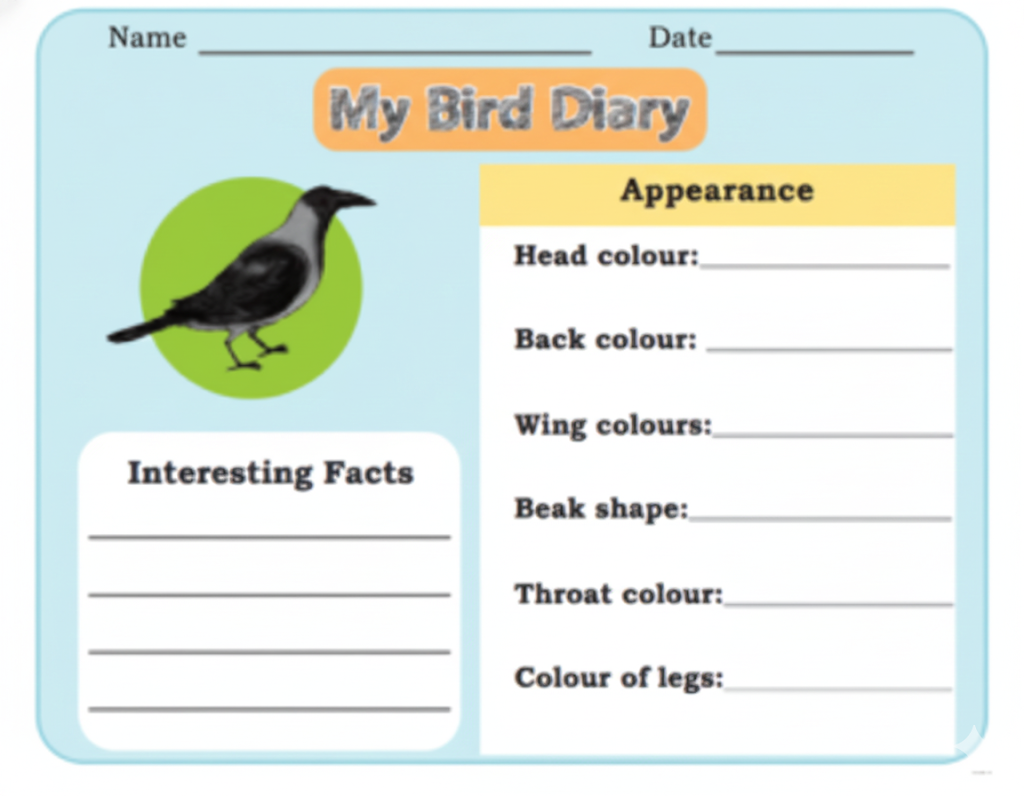
Answer:
Students should do it by themselves.
Question 2.
List the animals which live in and around water bodies. Fill in the table given below.
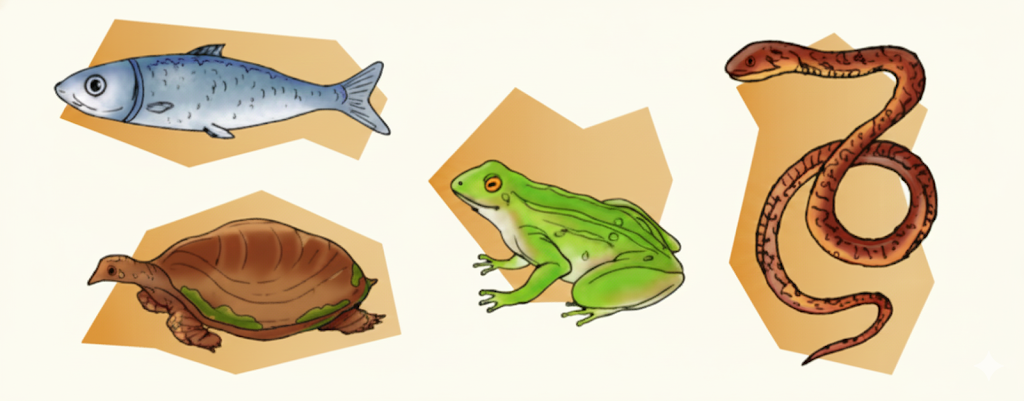
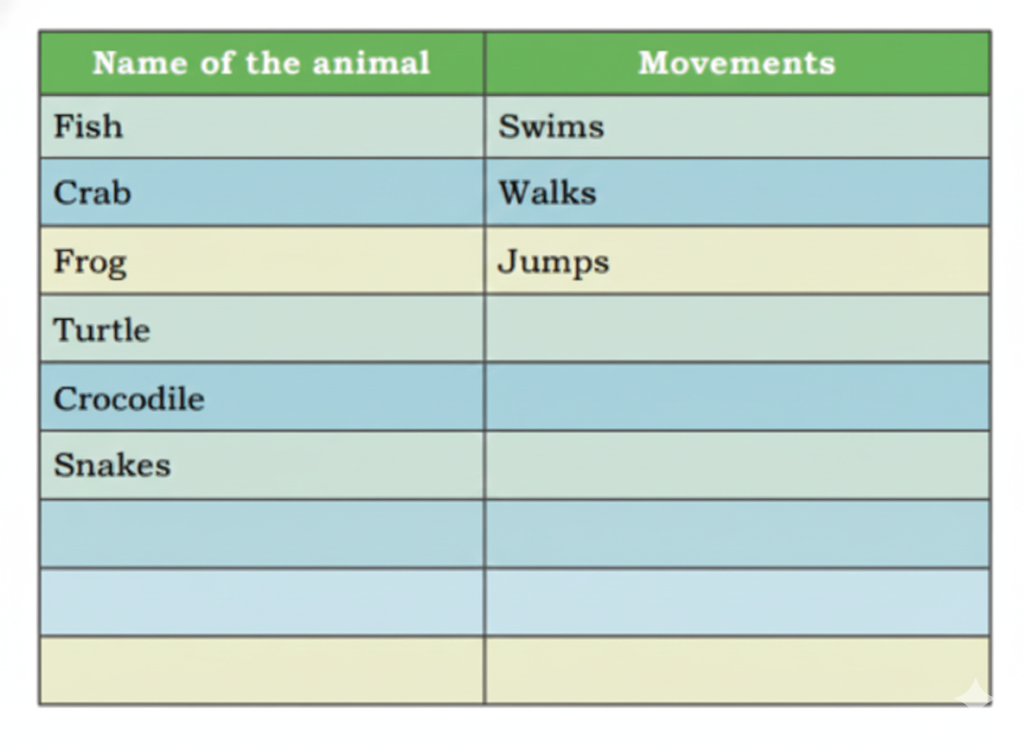
Answer:
Write (Page 49)
Question 1.
What are the insects that you find at your home and in your surroundings?
Answer:
I notice many different insects in and around my home, such as ants, houseflies, mosquitoes, bees, butterflies, cockroaches, and grasshoppers.
Question 2.
Name the insects shown below.
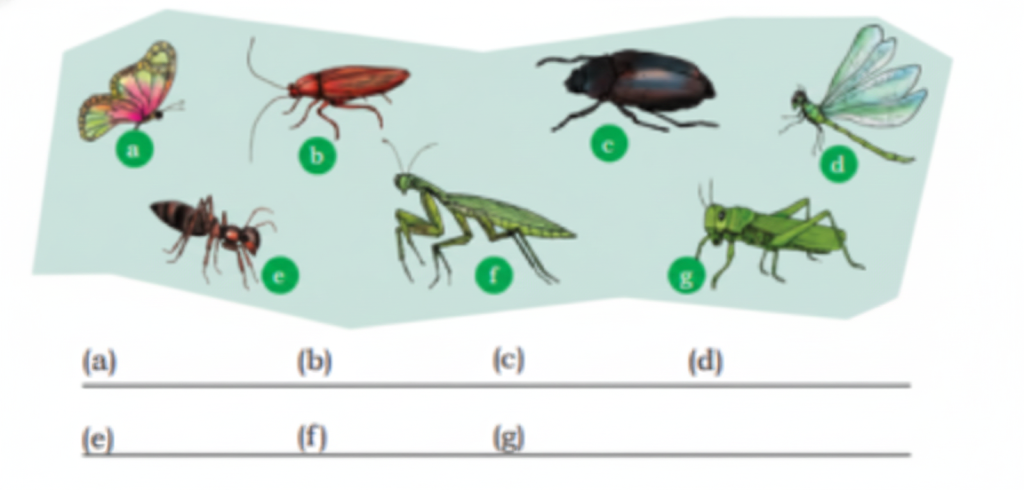
Answer:
(a) Butterfly
(b) Cockroach
(c) Beetle
(d) Dragonfly
(e) Ant
(f) Praying mantis
(g) Grasshopper
Activity 5 (Pages 50-51)
Question 1.
During the visit to the nature trail, students collected leaves from different plants. Help them identify the plants based on the pictures of the leaves given below.
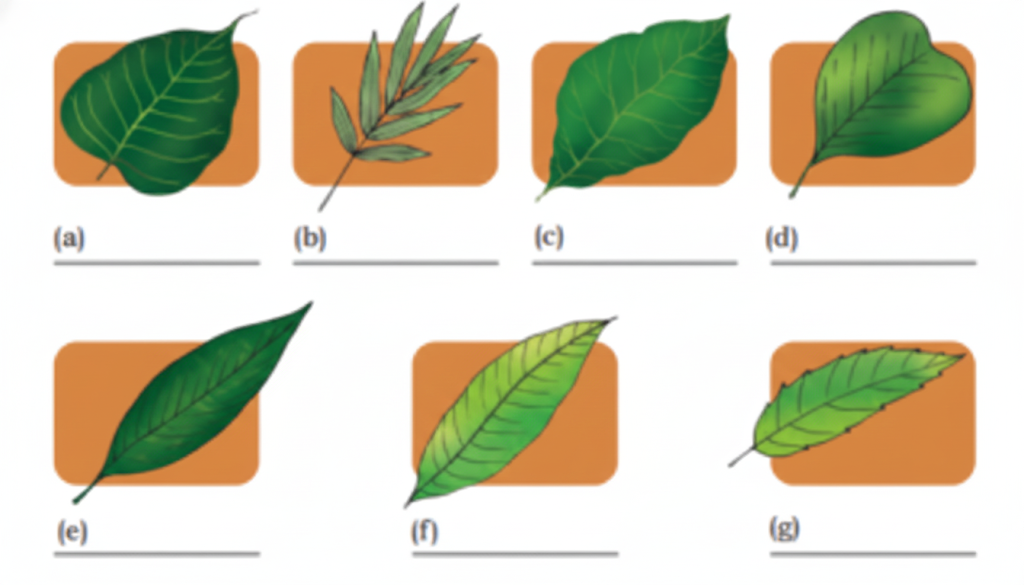
Answer:
(a) Peepal leaf.
(b) Bamboo leaf
(c) Guava leaf
(d) Banyan leaf
(e) Eucalyptus leaf/ gum leaf
(f) Mango leaf
(g) Neem leaf
Question 2.
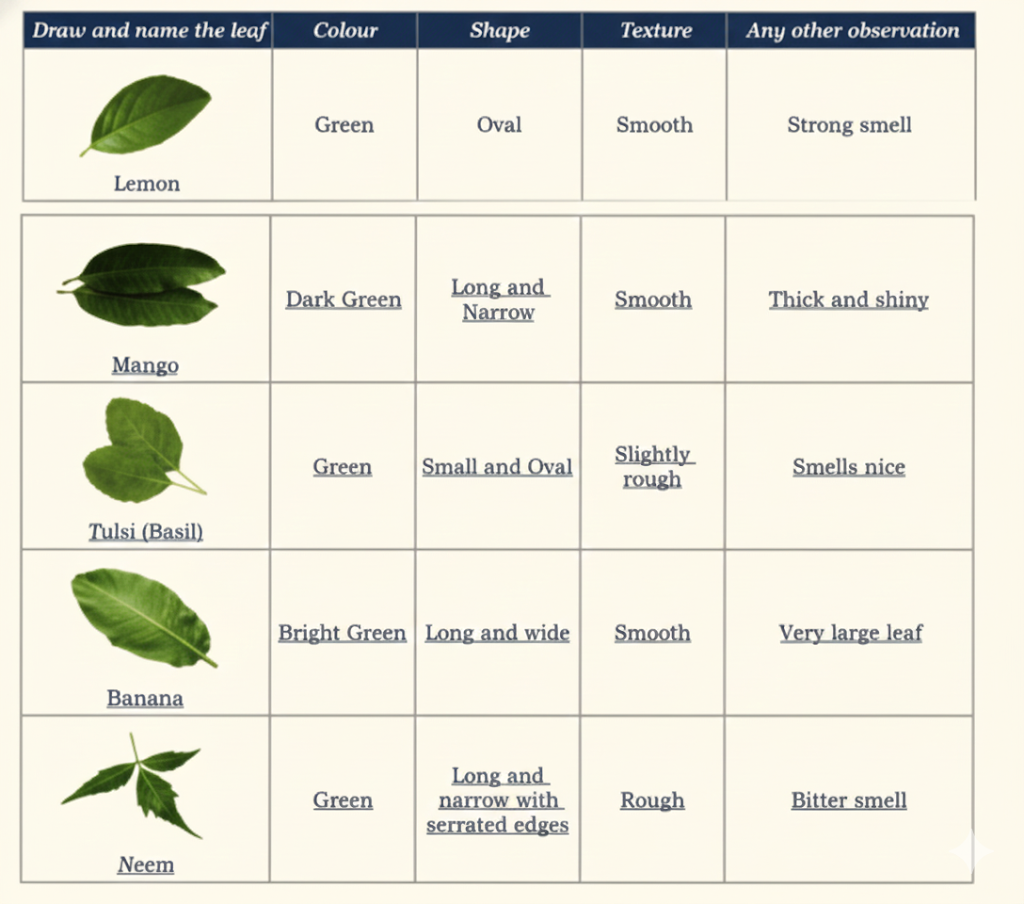
Observe the leaves of different plants in your neighbourhood and fill the table.
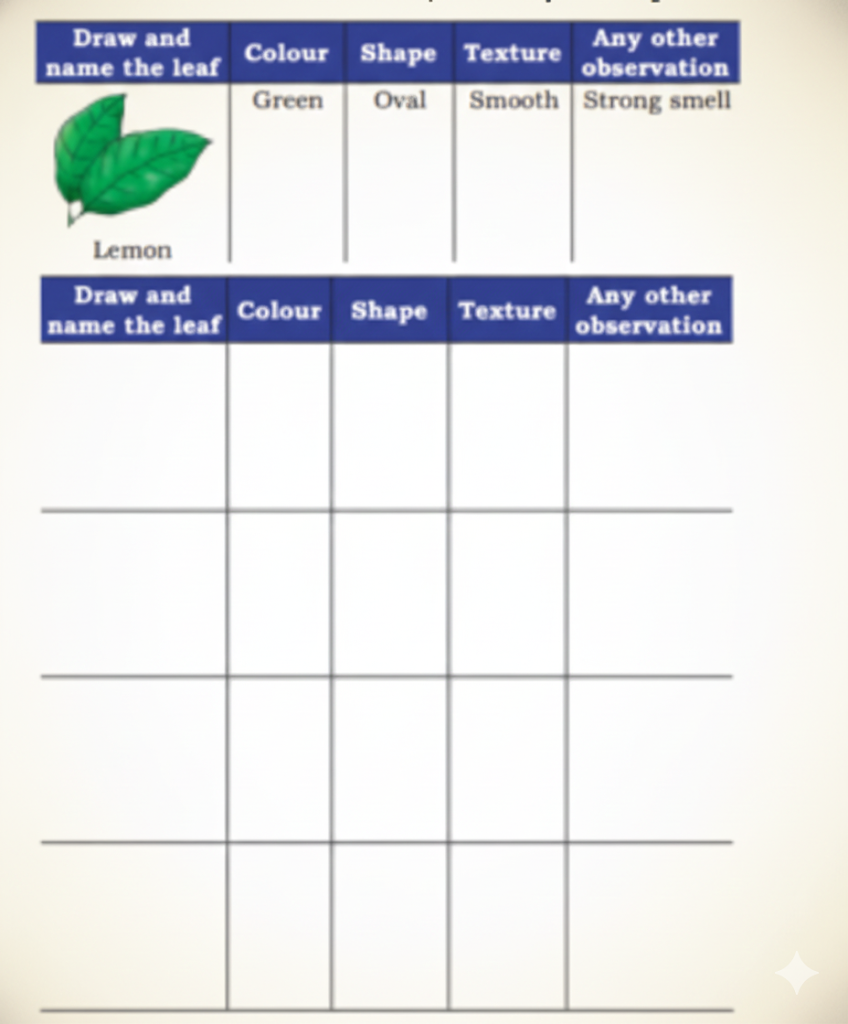
Answer:
Activity 6 (Page 52)
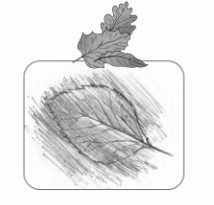
Leaf Autograph
Question.
Place a leaf on a notebook with the rough, vein-side facing up. Cover it with a plain sheet of paper. Rub a crayon over the paper, and watch the leafs shape appear like magic! Try this with different leaves and see how each one has its own unique pattern. Name the plant or tree to which the leaf belongs.
Let Us Reflect (Pages 55-56)
Question 1.
Which animal would you love to be? What special abilities would it give you?
Answer:
I would like to be an eagle because it can soar high in the sky and view the world below with keen eyesight. Being an eagle would allow me to fly over mountains, forests, and rivers and explore nature from above.
Question 2.
How do you think different plants and animals are dependent on each other?
Answer:
Animals and plants rely on each other to survive. Animals need plants for food and oxygen, while plants depend on animals for carbon dioxide and for helping spread their seeds. Some animals feed on plants, while others eat other animals—for example, deer eat grass and tigers feed on deer. If any one part is removed, it disturbs the balance of the whole system. This shows that all living beings are linked together and depend on one another to grow and live.
Question 3.
What is the role of a nature scientist?
Answer:
A nature scientist observes plants, animals, and the surroundings to learn how nature functions. They study how living organisms grow, survive, and interact with one another. They also advise people on ways to conserve nature and protect forests, wildlife, and plants from harm.
Question 4.
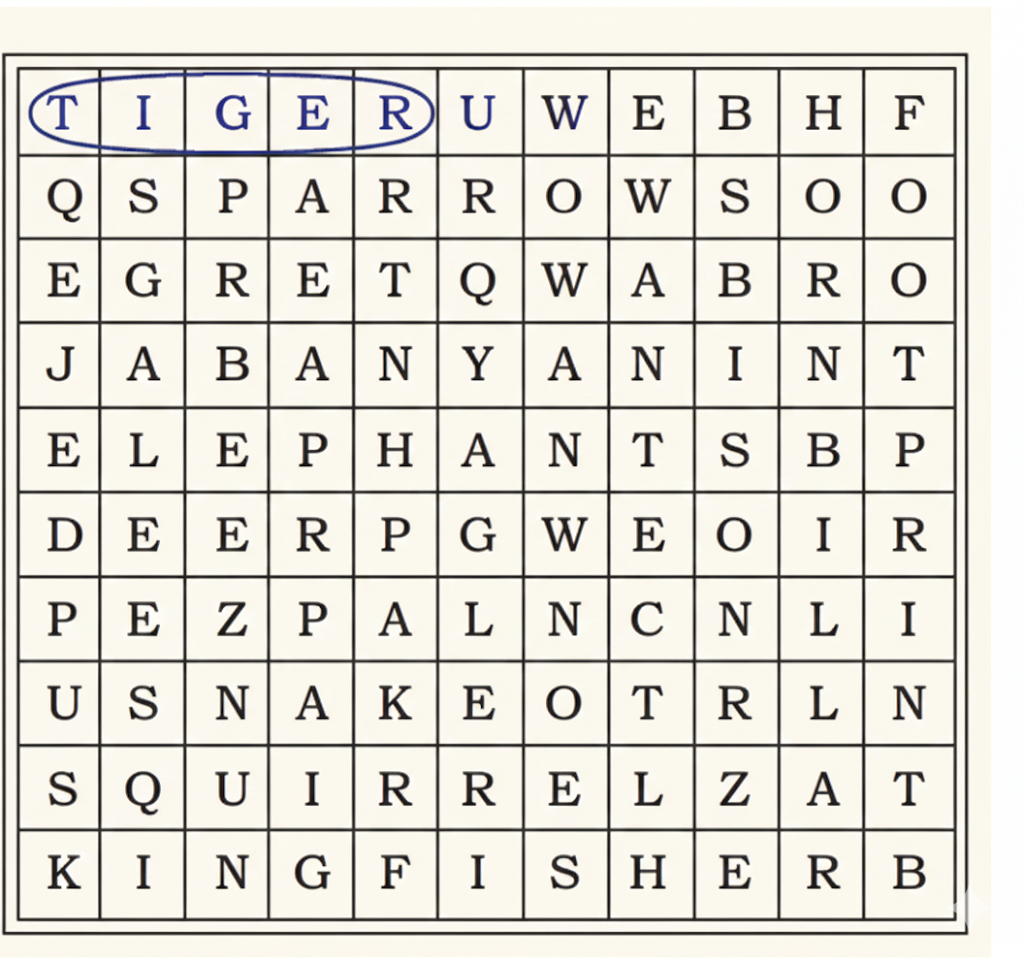
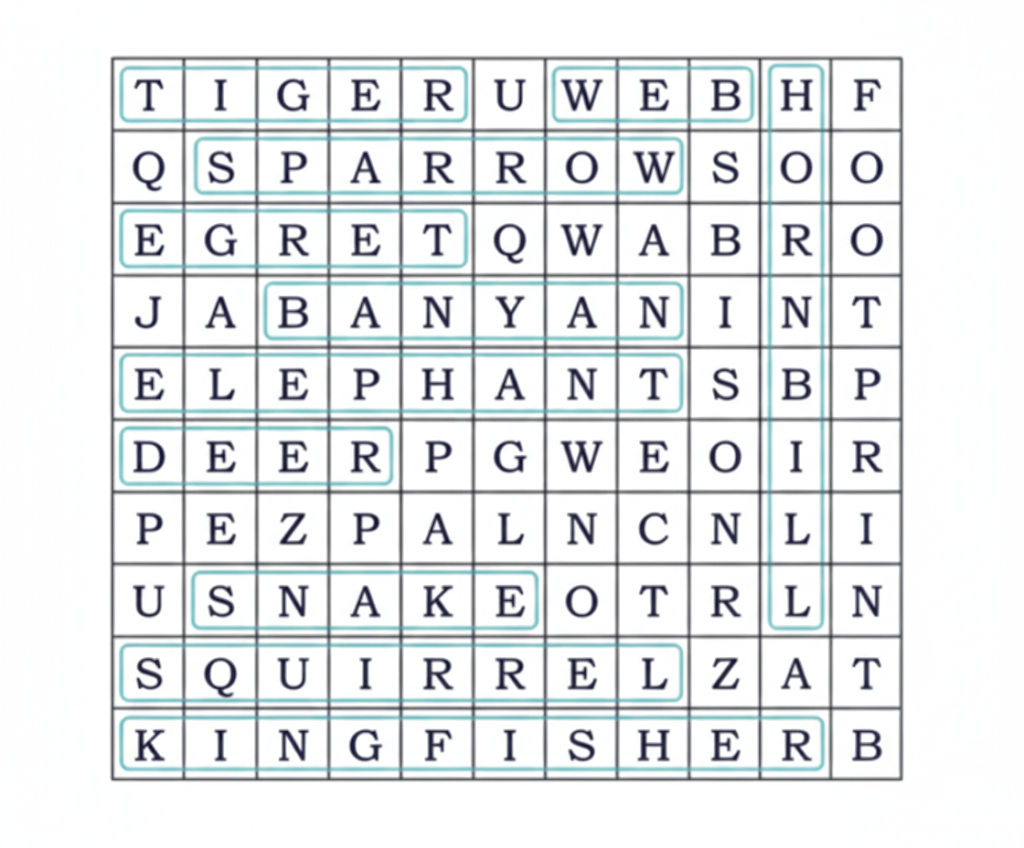
Solve the puzzle.
Find the treasures of the forest.
Answer:
Question 5.
Take on the challenge Plan a nature walk with your family or friends in a nearby park. To prepare yourself as a guide, identify few plants and animals, and study their features and interesting facts which you can explain during the walk.
Answer:
Students should do it by themselves.
Question 6.
Do an art activity
Role-play: Create a scene of a forest in your classroom where students can perform roles of plants and animals, and of visitors. While enacting the play, focus on our role to protect animals and plants.
Answer:
Students should do it by themselves.
Question 7.
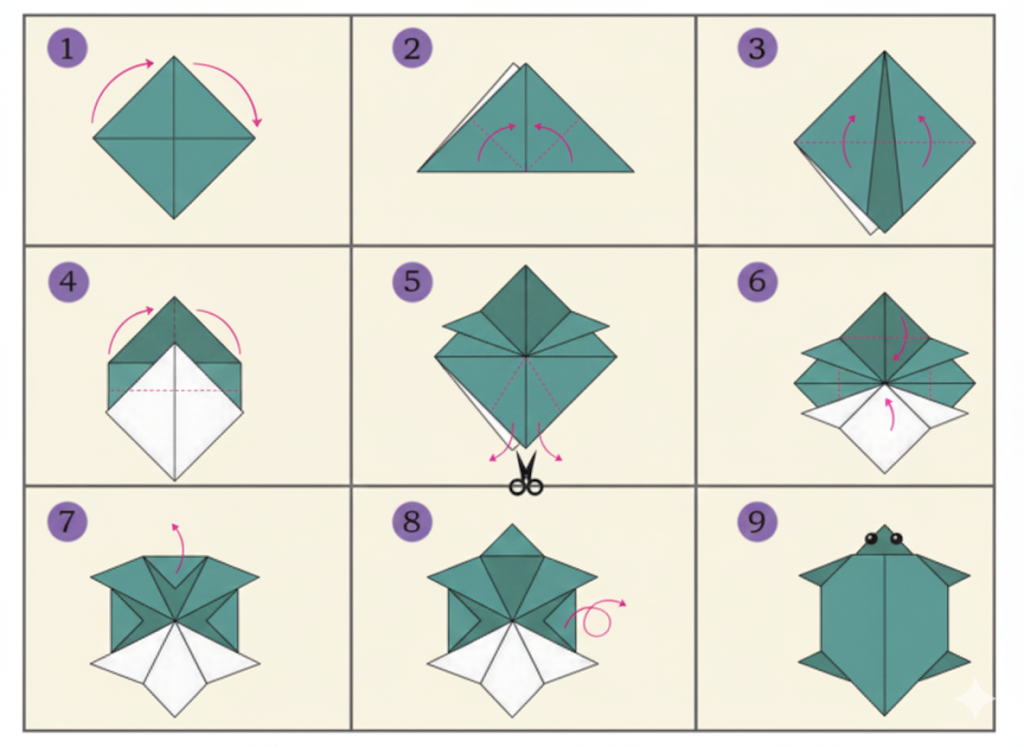
Let us make a paper turtle! Try using an old newspaper or used paper.
Answer:
Students should do it by themselves.
Question 8.
Find out
Write the name of your state animal bird, and plant.
Answer:
Students should do it by themselves.
Discovering Nature's Wonders – Class 4 EVS Chapter 3 Key Points
Class 4 Our Wondrous World Chapter 3, Nature Trail, introduces students to the amazing diversity of plants and animals around us. Exploring these NCERT-based concepts will help you understand the interconnected web of life and why we should respect our environment.
Regularly practicing NCERT questions and exercises can boost your exam confidence. Pay attention to examples like animal features and safety rules during nature walks—they often come in class tests and quizzes. Observing real-life nature trails makes the chapter more engaging and memorable.
Focus on the unique characteristics of plants, animals, birds, and insects as described in this NCERT Chapter 3 Nature Trail. Making your own bird diary and leaf collection can help reinforce learning and make revision fun ahead of exams.
FAQs on NCERT Solutions For Class 4 Our Wonderous World Chapter 3 Nature Trail - 2026-27 Free PDF Download (Login Required)
1. What are NCERT Solutions for Class 4 EVS Chapter 3: Nature Trail?
NCERT Solutions for Class 4 EVS Chapter 3: Nature Trail are stepwise, exam-focused answers to all textbook exercises.
Key features include:
- Easy-to-understand answers for intext and back exercise questions
- CBSE marking scheme alignment for Class 4 EVS
- Helpful tips for diagrams, definitions, and key concepts
- Available as free downloadable PDF for offline revision
2. How do I write answers for Class 4 EVS Chapter 3 to get full marks?
To score full marks in Class 4 EVS Chapter 3, write clear, stepwise answers that cover all points from the NCERT solutions.
Follow these steps:
- Read the question carefully and underline keywords
- Answer in simple, complete sentences as shown in model answers
- Use correct terms and definitions from the chapter
- Neatly draw and label diagrams if required
- Revise marked points from the textbook and sample papers
3. Are diagrams or definitions compulsory in Class 4 EVS Chapter 3 answers?
Yes, including neat diagrams and correct definitions can help secure easy marks in Class 4 EVS answers.
Tips:
- Always label diagrams clearly following CBSE conventions
- Write short, precise definitions for important terms
- Check the exam question: diagrams are often asked for 'flow,' 'trail' or 'nature' concepts in Nature Trail
4. Where can I download the NCERT Solutions PDF for Class 4 EVS Chapter 3?
You can download the Class 4 EVS Chapter 3 Solutions PDF for free from trusted educational websites.
Benefits:
- Offline access to all exercise-wise answers
- Printable format for quick revision
- Contains stepwise solutions, key definitions, and diagrams for Nature Trail
5. What is covered in Class 4 Our Wonderous World Chapter 3: Nature Trail?
Chapter 3: Nature Trail introduces students to observing nature, identifying plants and animals, and understanding our environment.
Main learning outcomes:
- How to observe different forms of nature during a nature trail
- Importance of plants, trees, birds, and insects
- Simple environmental terms like ecosystem, habitat, and trail
- Encourages curiosity and respect for the natural world
6. Which questions are important for exams from Class 4 EVS Chapter 3?
The most important questions from Nature Trail include key definitions, map/diagram labelling, and short/long answers about nature observation.
Focus on:
- Definitions: 'habitat,' 'ecosystem,' 'trail,' 'observe'
- Describing a nature trail experience
- Identifying common plants and animals seen on a walk
- Labelling diagrams or pictures from the chapter
7. How should I revise Class 4 EVS Chapter 3 before exams?
Revise Class 4 EVS Chapter 3 by reading NCERT solutions, going through key definitions, and practising diagrams.
Quick revision plan:
- 1-day: Cover all stepwise solutions once
- 3-day: Review important questions, definitions, and diagrams
- 7-day: Attempt sample papers and MCQs on Nature Trail
8. How do stepwise answers help in getting maximum marks in Class 4 EVS Chapter 3?
Stepwise answers make it easier for the examiner to award marks as per CBSE guidelines.
Benefits:
- Each correct step receives a mark, even if one part is wrong
- Answers are more organised and easy to understand
- Improves the chances of securing full marks in written exams
9. What mistakes should I avoid in Class 4 EVS Chapter 3 exam answers?
To avoid losing marks, do not skip definitions, miss diagram labels, or write incomplete answers.
Common mistakes:
- Forgetting to label diagrams
- Writing one-word answers when explanation is needed
- Missing important points or steps from the marking scheme
- Not following the question format (short/long answer)
10. Are NCERT Solutions enough for Class 4 EVS exams?
NCERT Solutions provide a strong foundation for Class 4 EVS exams.
To prepare thoroughly:
- Start with detailed NCERT solutions for each exercise
- Practise additional MCQs and exemplar questions
- Review diagrams, definitions, and key concepts from Nature Trail
- Check previous year and sample papers for more question types
11. How can I present long answers to match CBSE marking in Class 4 EVS?
To meet CBSE marking standards, format long answers with introduction, main points, neat diagrams, and conclusion.
Recommended structure:
- Begin with a clear introduction using keywords (e.g., 'A nature trail means...')
- List main points using bullets or short paragraphs
- Include diagrams or labelled sketches if required
- Conclude with a summary or key learning point
12. How to learn diagrams and maps for Class 4 EVS Chapter 3?
Practise drawing diagrams and maps from the chapter regularly and label all essential parts as per the NCERT textbook.
Strategies:
- Copy diagrams from the book into your notebook
- Use colour pencils for better understanding and neatness
- Revise labels and terms before exams
- Attempt labelling exercises in sample papers
13. What are the most important topics from Class 4 Chapter 3: Nature Trail?
The most important topics include observation skills, local nature features, key definitions, and sample diagrams.
Key points to focus:
- What to observe during a nature trail
- Names and features of commonly seen plants, trees, and animals
- Definitions: 'nature trail', 'ecosystem', 'habitat'
- Short experiment-based or observation questions
14. Do examiners award partial marks for correct steps even if the final answer is wrong?
Yes, CBSE examiners may give partial marks for correct steps or parts of an answer, even if the final answer is incomplete or contains small errors.
Tip:
- Show all steps clearly and label them to increase chances of earning step marks
15. Are references to textbook page numbers useful during revision?
Referencing textbook page numbers during revision helps locate key diagrams, definitions, and solved NCERT examples quickly.
Benefits:
- Saves time when revising multiple topics
- Makes it easier to cross-check answers with the original NCERT explanations
