



Stepwise Answers and Important Questions for Exploring Our Neighbourhood
Activity 1 (Page 18)
Question 1.
Write a letter to a friend and post it.
Answer:
Dear Shreya,
I hope this letter finds you happy and healthy. Everything is going well at my school, and I was excited to share some news with you. Our class recently went on a school trip, and it was a wonderful experience. I am eager to tell you all about it when we meet.
I really miss spending time with you during our breaks and playing together. I hope you are also having a great time wherever you are. Let’s make plans to meet soon and enjoy ourselves.
Take care, and do write back to me.
Your loving friend,
Sunny
Question 2.
Teacher can take students on a field trip to a post office, to explore various activities that take place there.
Answer:
Students should do it by themselves.
Write (Page 19)
Question 1.
Have you or your family members ever sent, or received a letter or a parcel?
Answer:
Students should do it by themselves.
Question 2.
How does the post office help people stay connected with each other?
Answer:
The postman gathers all the letters from the postbox and delivers them to the post office. At the post office, the letters are organised based on the addresses written on them and then sent to the correct places. Through this process, the post office plays an important role in helping people stay in touch with one another. Apart from delivering letters, post offices also provide many other useful services.
Interview with Elders
Discuss with the elders in your neighbourhood and find out how they communicated with each other when they were of your age. Compare their answers to how you and your friends communicate today, and fill in the table below:
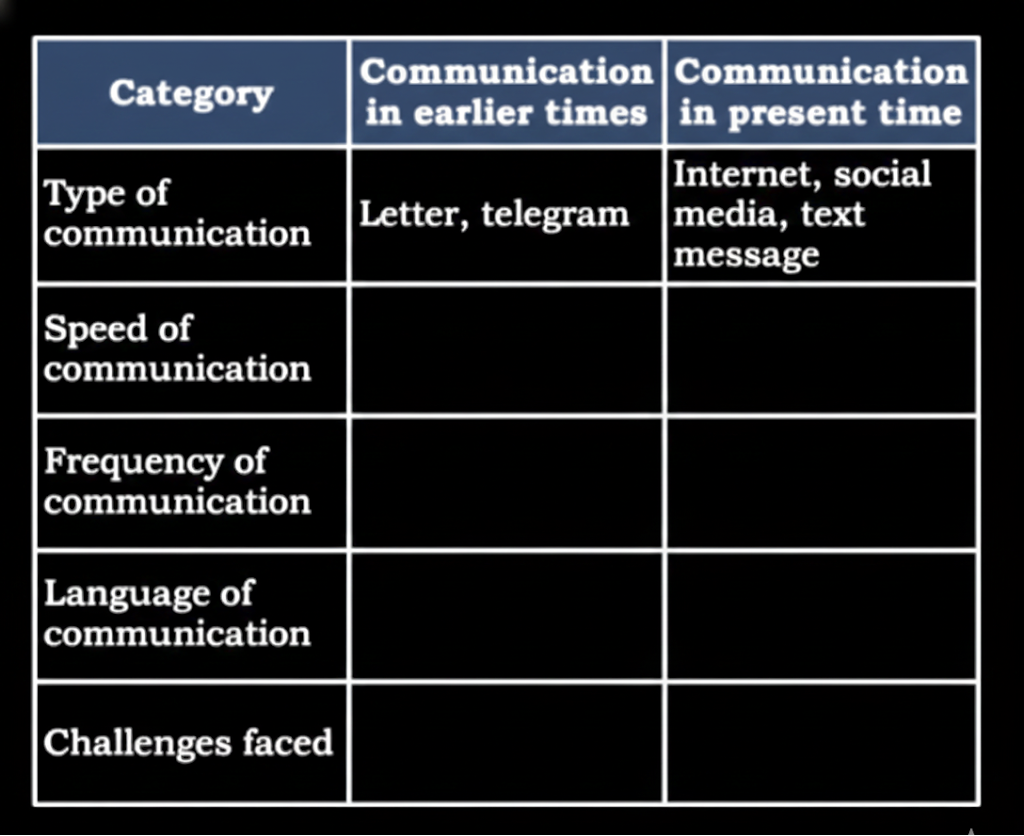
Answer:
Discuss (Page 21)
Question 1.
Letters took a long time to reach other persons. How do you think it affected communication between people in the past?
Answer:
Earlier, sending messages took a lot of time because modern communication tools like mobile phones and the internet did not exist. As a result, people had to wait many days or even weeks to receive a reply from someone living far away.
Communication was slow, and sharing urgent information was difficult. In emergency situations, getting help or passing on important news was not quick. Often, people had to remain unaware of what was happening in the lives of their friends and family for a long time.
Question 2.
How is it different from the way people communicate now?
Answer:
Earlier, sharing information through letters took a long time, as messages often reached after many days or even weeks. Nowadays, modern tools like mobile phones, computers, and the internet allow us to send messages instantly. We can now stay in touch with our friends and family at any time and from any place.
Question 3.
Today quick messages make sharing the news easier, but sometimes wrong information spreads very quick too. How can we ensure the news we share is true?
Answer:
To be confident that the information we share is correct, we should follow a few easy steps. First, check where the news comes from and see if it is shared by a trustworthy website or organisation. Next, look for proof such as facts, data, or statements from experts. It is also important to check the date to make sure the information is not old.
Then, compare the news with reports from other reliable sources to see if they match. If you are still unsure, ask a parent, teacher, or another responsible adult for guidance. By doing this, we can make sure the news we share is true and reliable.
Write (Page 22)
Question 1.
Which mode of transportation do you use the most?
Answer:
Land transport
Question 2.
Can you identify the structures in the pictures, and explain how they have made travel faster and connectivity better?
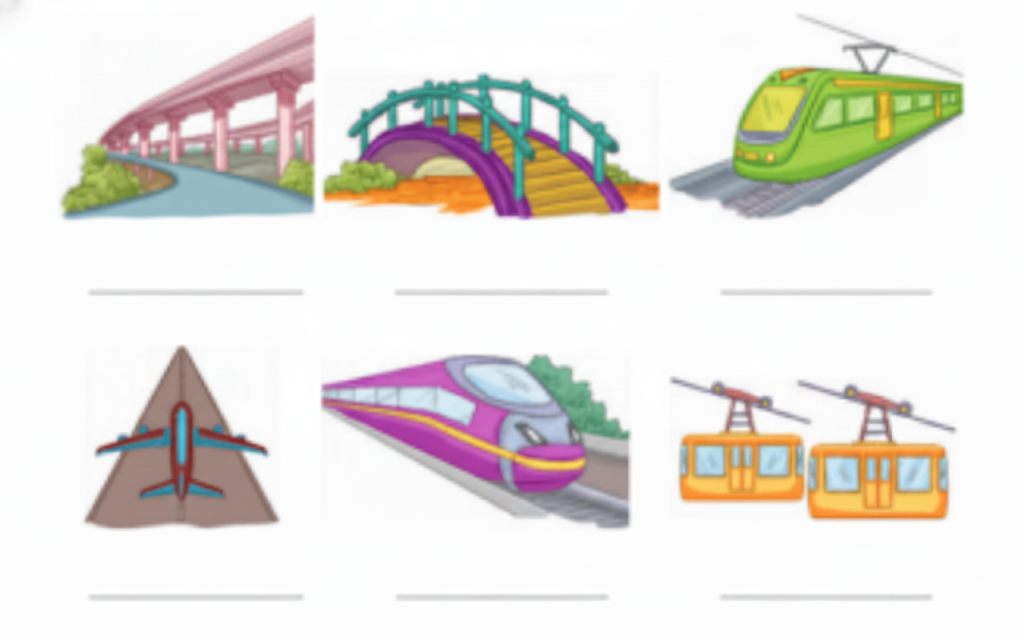
Answer:
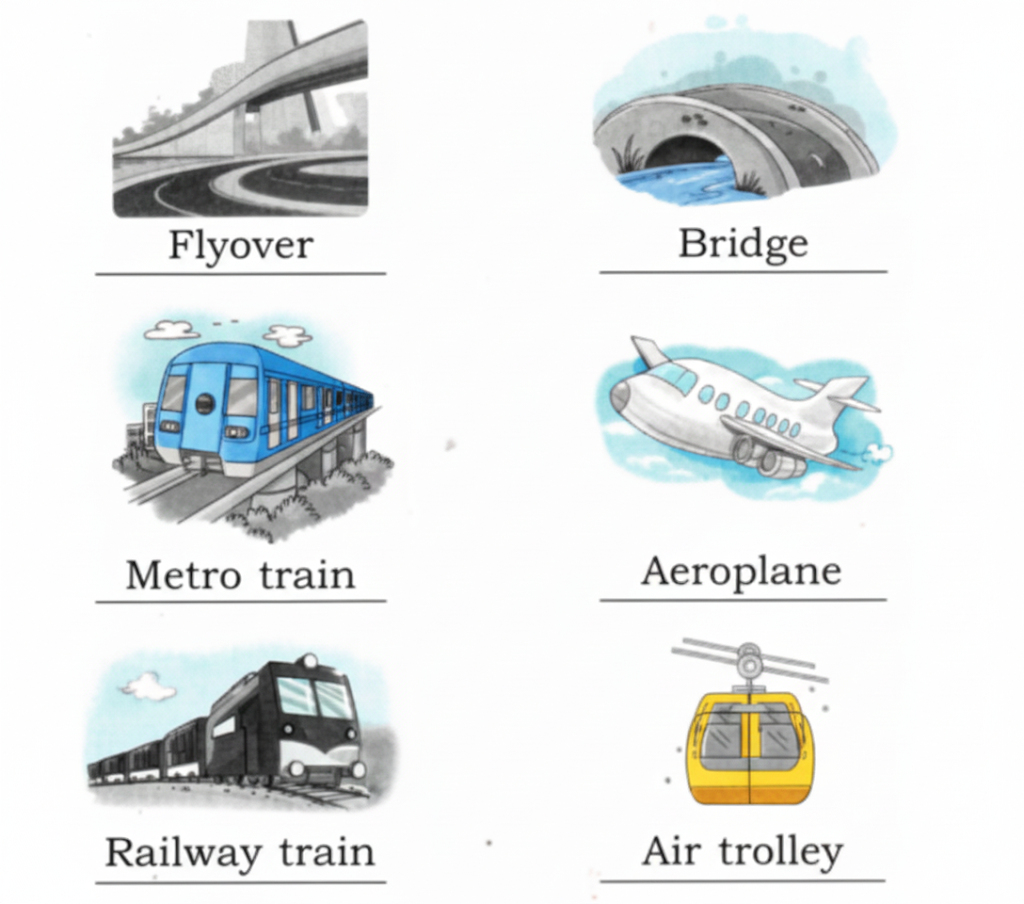
Flyovers are raised roads built above the ground that allow vehicles to pass over crowded roads and intersections, helping to reduce traffic and save time. Bridges are structures that join two sides of a river or gap, making it easier for people and vehicles to cross safely and quickly.
Metro trains operate on dedicated tracks either above or below the ground and provide fast travel within cities. Railway trains run on separate rail lines and are mainly used for travelling long distances in a shorter time.
Aeroplanes and air trolleys are types of air transport. Aeroplanes make it possible to travel between cities or countries within a few hours. Air trolleys move along cables in the air and are especially useful for travelling in hilly regions or crossing rivers.
Find Out (Page 23)
How did your parents and grandparents go to school or other places, when they were of your, age? Is it different from how you travel today? Note it down below.
Answer:
Students should do it by themselves.
Write (Page 23)
List the people who works at a hospital or a health centre, and write down their role in the following table. One example has been given in the table.
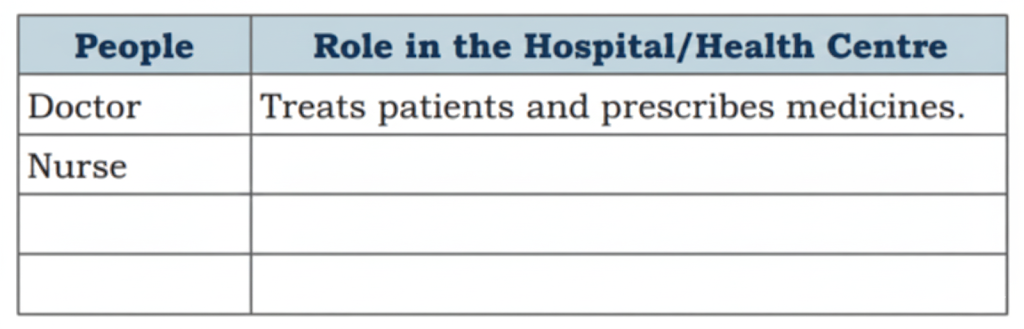
Answer:
Discuss (Page 25)
Q. If you had to send money to someone, which method would you choose using a phone, Money Order or some other mode? Why?
Answer:
I would choose to use a mobile phone for making payments because it is quick and secure. It also sends an instant confirmation message as soon as the money is transferred.
Write (Page 25)
Question 1.
If you get pocket money, do you save it? If yes, where do you put your savings?
Answer:
Yes, I will keep my savings in a piggy bank (gullak).

Question 2.
Why do you think it is important to save money?
Answer:
Saving money is important for future needs. When we require money later, we can make use of the amount we have saved.
Question 3.
What are some things you could do to save more money?
Answer:
We can open a bank account to keep our money safe and also invest it in options such as fixed deposits, mutual funds, or the stock market, which help our savings increase over time.
Question 4.
Request one of your family members to show you their bank passbook. Note the important elements given on the first page of the passbook.
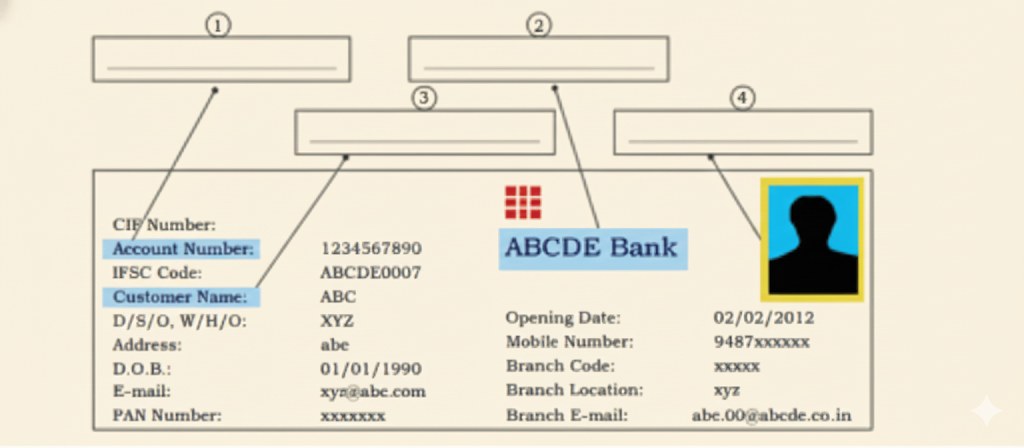
Answer:
Students should do it by themselves.
Account Number
ABCDE Bank
Customer Name
Photograph of an account holder
Activity 3 (Page 26)
Question 1.
Visit a bank in your locality or find out from your elders about how it works. After that, answer the following questions:
(a) Other than saving money, what else do people use banks for?
(b) What is an ATM and how does it help people?
Answer
(a) A bank is used for many purposes such as sending money from one place to another, borrowing money as loans, keeping valuable items like gold, silver, and diamonds safely in lockers, and investing money in options like fixed deposits, mutual funds, or the stock market.
(b) ATM stands for Automated Teller Machine. It allows us to withdraw cash whenever required, and some ATMs also provide the facility to deposit money directly into our bank account instantly.
Question 2.
Take an Indian currency note. Look at it closely and answer the following questions:
(a) What is the value of the note?
(b) How many languages do you see on the note?
(c) What pictures or symbols are there on the note?
Answer:
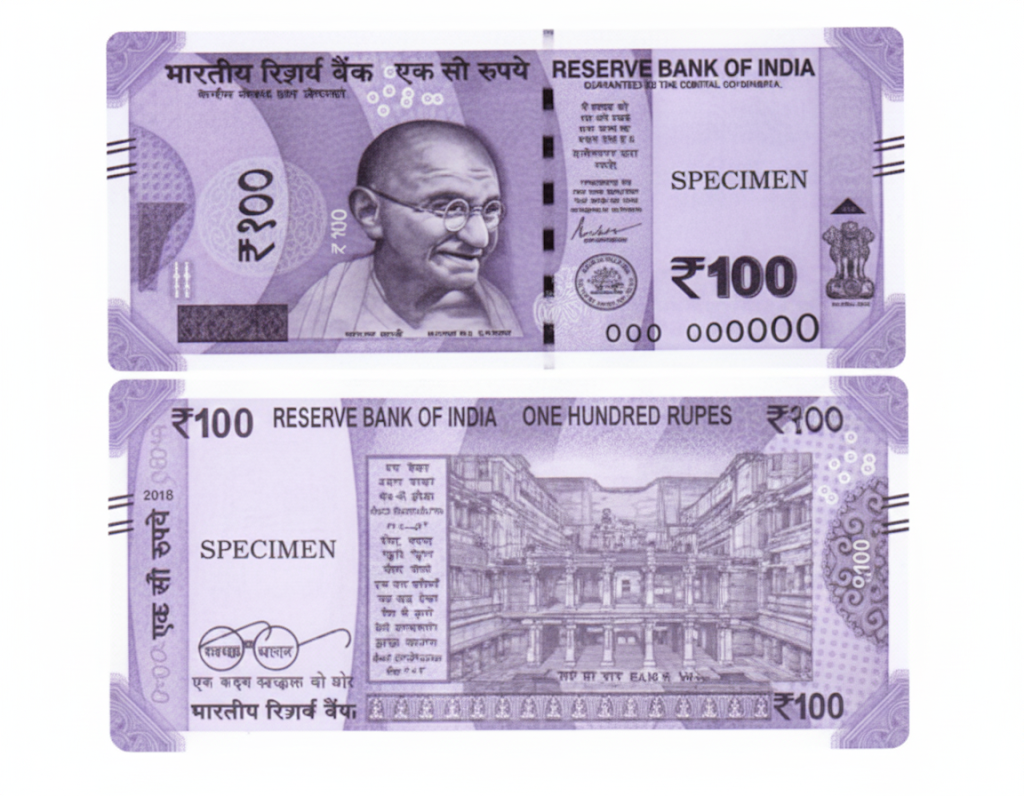
(a) ₹100
The Indian currency note displays text in 17 languages. Hindi and English are printed on the front and back of the note, along with the following languages:
Assamese, Bengali, Gujarati, Kannada, Kashmiri, Konkani, Malayalam, Marathi, Nepali, Odia, Punjabi, Sanskrit, Tamil, Telugu, Urdu, English, and Hindi.
(c) Images or symbols shown on the note include:
A picture of Mahatma Gandhi placed at the centre
The Ashoka Pillar symbol on the right side
The Swachh Bharat logo along with its slogan
A design featuring the Rani Ki Vav motif
Write (Pages 28-29)
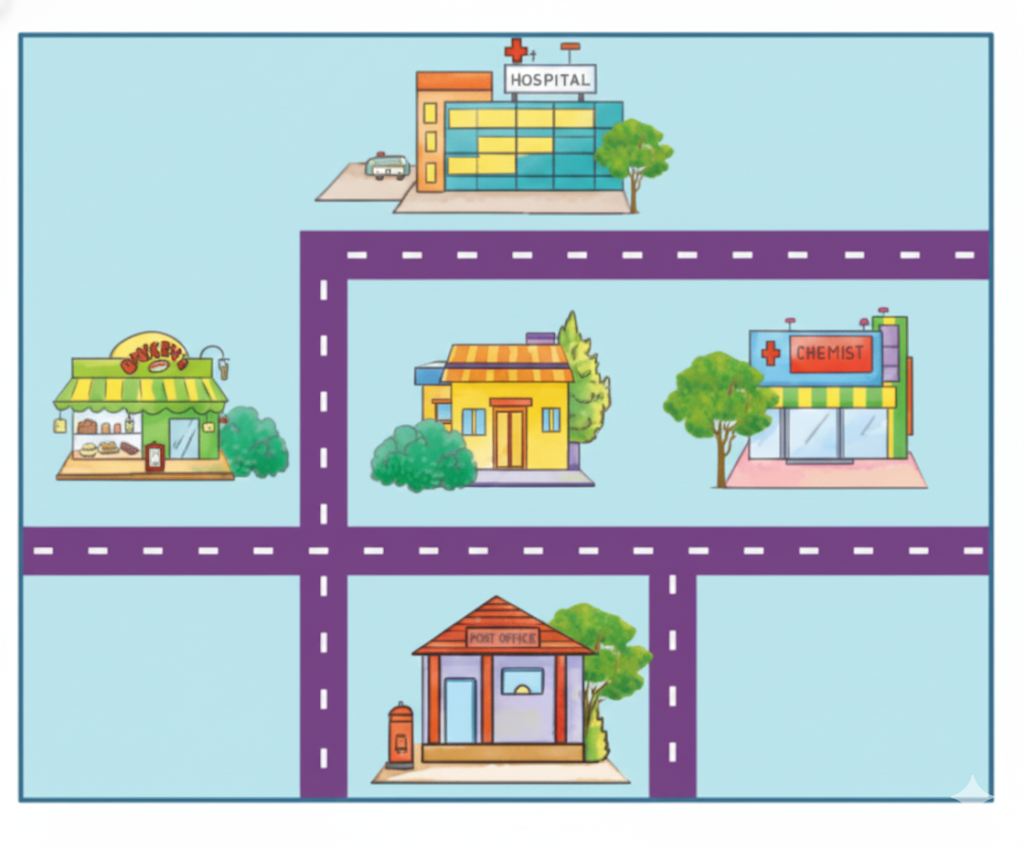
Question 1.
Look at the picture above, and write down the places located in the North, East, West, and South of Navya’s home.
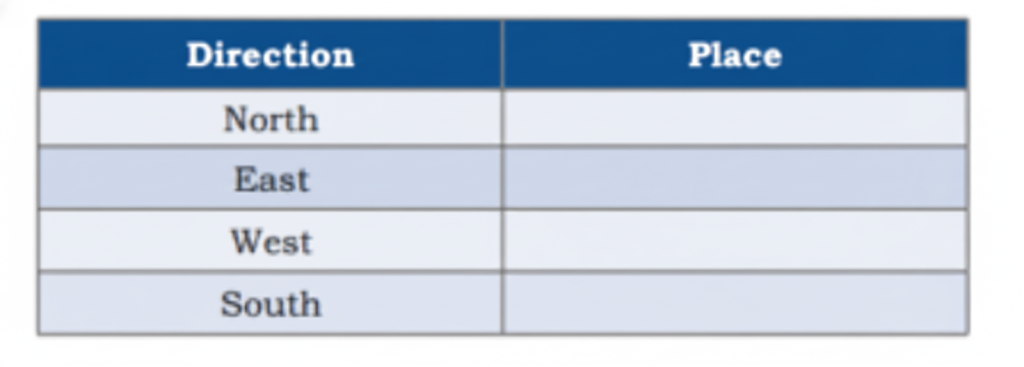
Answer:
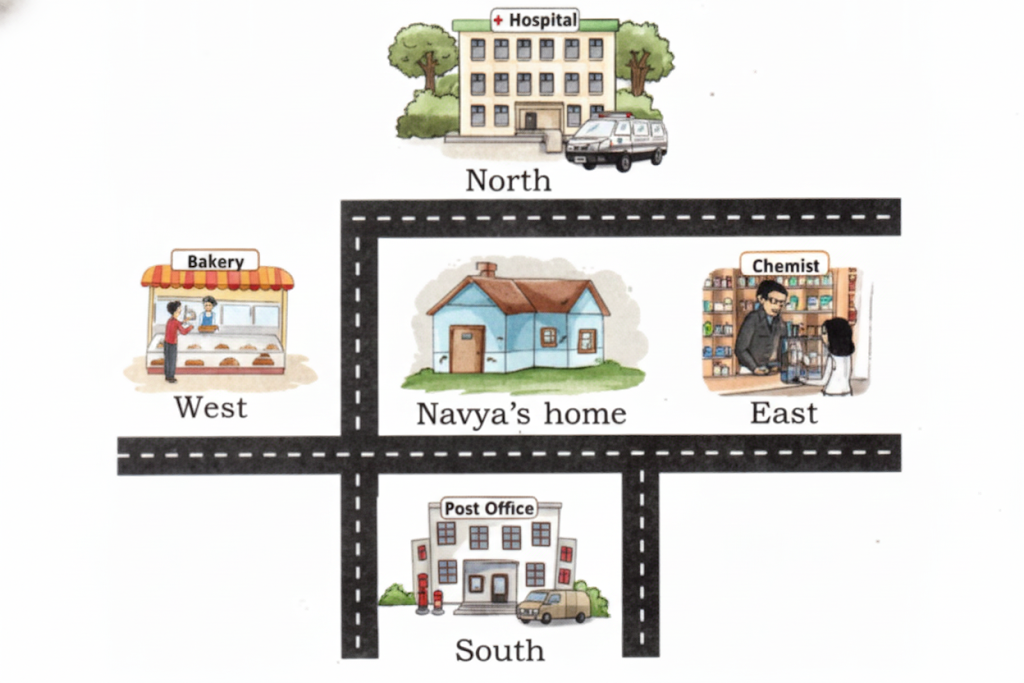
Question 2.
Look at the picture and imagine your school at the centre. Name the buildings or areas near your school and write the direction they are situated in the given spaces.
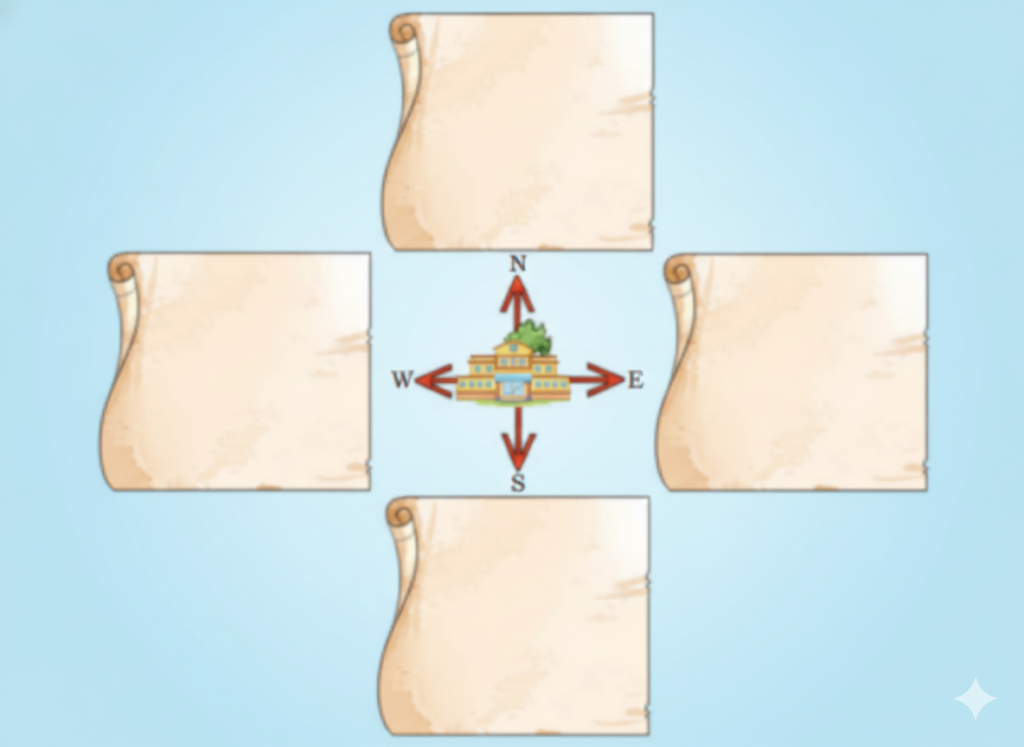
Answer:
Students should do it by themselves.
Question 3.
Imagine you are giving directions to a friend to visit your favourite place near your school. How would you explain it using directions (left, right, forward, backward, etc.) and landmarks?
Place: _________
Instruction: ______
Answer:
Hints: Choose a nearby landmark and ask your friend to stand facing it. The direction she is facing will be the front direction, and the side behind her will be the back direction. Her right hand will point to the right side, while her left hand will indicate the left side. You can try this activity on your own with guidance from your parents or teachers.
Activity 4 (Page 30)
Draw a map showing the route from your school to the public library or any such place near your school. Identify landmarks like parks, shops, hospitals, bus stops. etc on the map.

Answer:
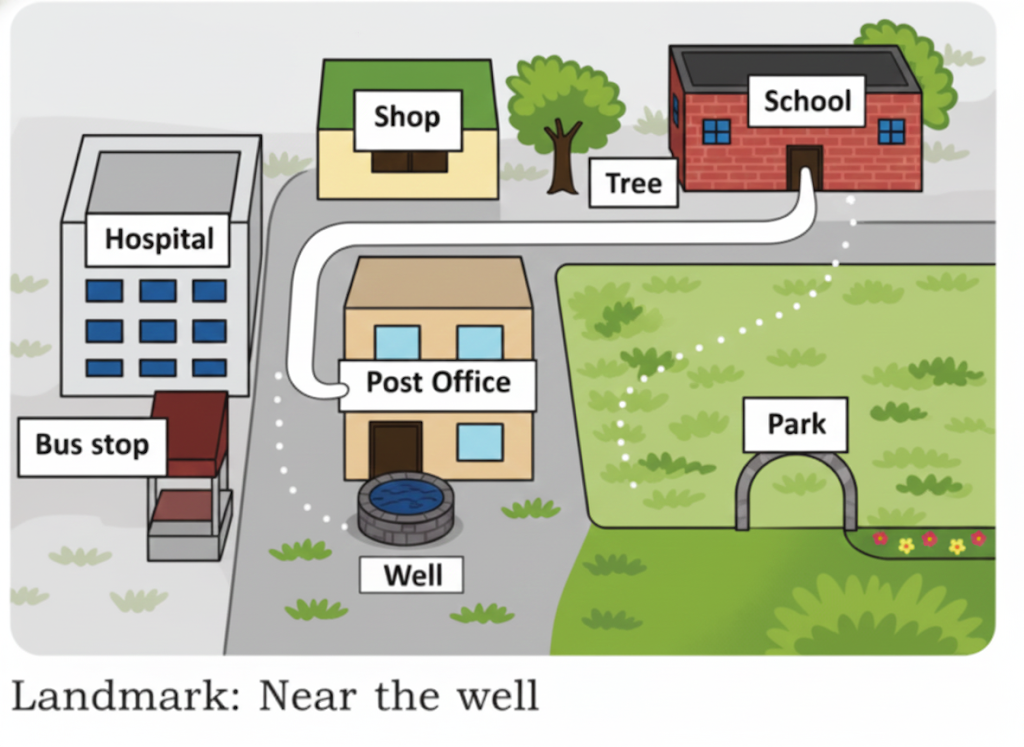
Let Us Reflect (Pages 31-32)
Question 1.
Imagine you have ₹ 100 to utilise in a month. Your task is to plan how to spend and save wisely. Think about your expenses for stationery, snacks, toys, etc. Decide how much you will save in your piggy bank and how much you will use for your expenses. After making this plan, think about how saving money could help you in the future.
Use the table below to create your budget:
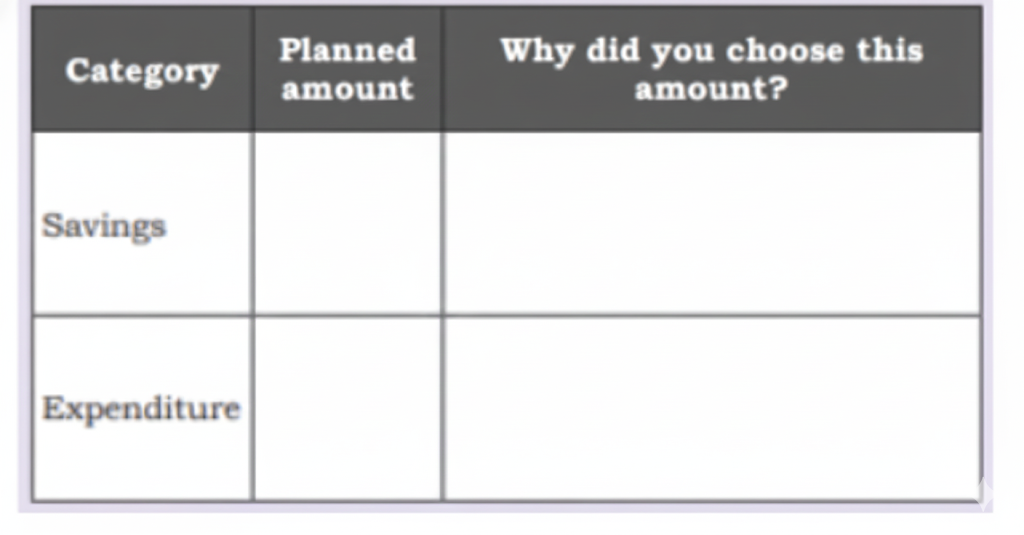
Answer:
Future Benefit:
By saving money on a regular basis, I will be able to afford bigger items later or keep money aside for important things such as a gift or a special trip. Saving also helps me feel ready to handle unexpected situations.
Question 2.
Imagine that your group is in charge of making your neighbourhood better. Discuss what new services or facilities you would add or improve. Present how these changes would help everyone in the community.
Answer:
A child can contribute to the community in many ways:
Keeping the Park Clean: Children can help by picking up waste and ensuring the park remains neat. They can also gently remind others to use dustbins.
Planting in the Community Garden: Kids can take part in planting flowers or vegetables and watering them. This helps make the surroundings greener and healthier.
Setting Up a Book Stall: Children can gather old books from home and donate them to children in need, encouraging reading and learning.
Joining Clean-Up Drives: Kids can participate in neighbourhood clean-up activities by collecting litter and helping keep the area clean.
Creating Awareness: Children can spread awareness among friends and family about protecting the environment, such as recycling waste and avoiding food wastage.
By taking part in these activities, children learn teamwork and responsibility while helping to improve their neighbourhood.
Question 3.
As a class, take help of the elders around you to list people in your neighbourhood who helped the community during COVID-19. These could include doctors, nurses, garbage collectors, shopkeepers, teachers and others. Discuss how they made the community safer and why it is important to thank them.
Answer:
During the COVID-19 pandemic, many people in our neighbourhood played an important role in protecting us. Some of them are mentioned below:
Doctors and Nurses: They cared for patients, treated those who were unwell, and guided everyone on how to stay safe and healthy.
Garbage Collectors: They ensured regular waste collection, which helped maintain cleanliness and prevent the spread of infections.
Shopkeepers: They supplied essential food items so that families could remain at home and stay safe.
Teachers: They continued teaching students by finding new ways to help us learn during challenging times.
Delivery Workers: They delivered essential items to our homes, reducing the need for people to step outside.
It is important to appreciate these people because they worked selflessly during difficult times to keep the community safe and healthy. Their efforts helped everyone stay calm and supported one another. By thanking them, we acknowledge their dedication and hard work. They truly are heroes of our community.
Question 4.
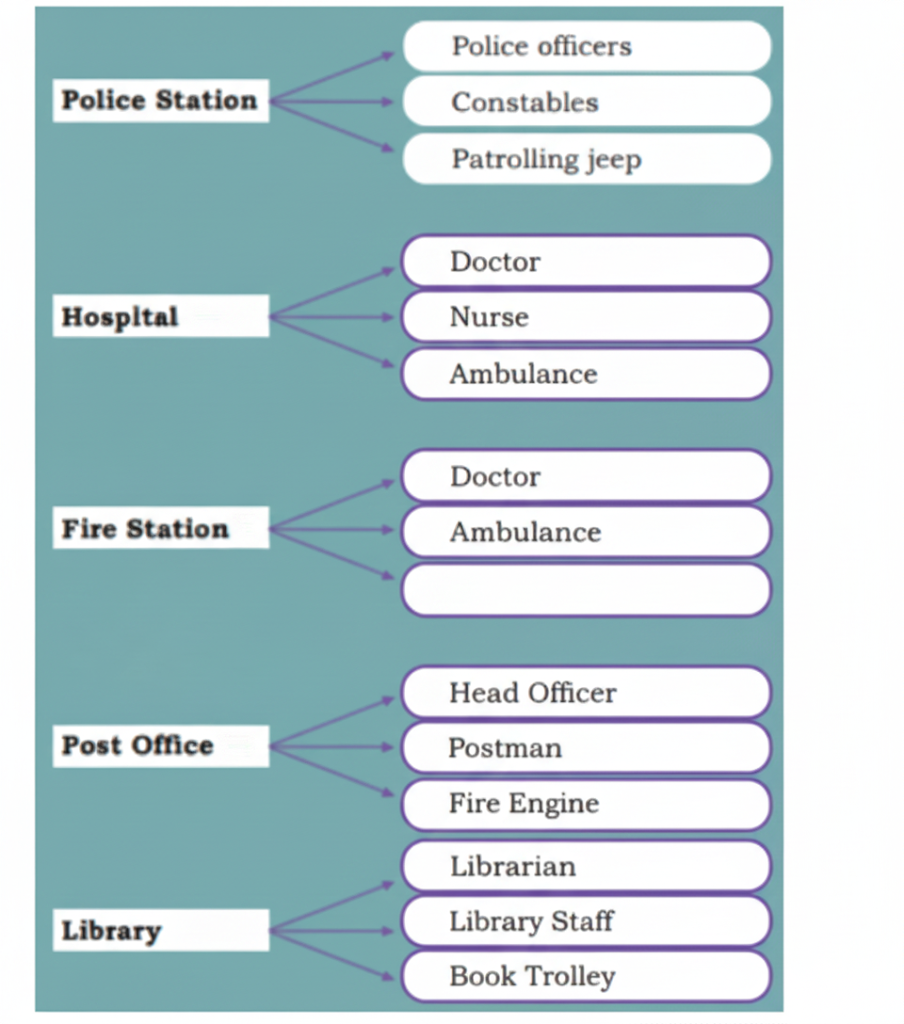
Can you list out the people involved and vehicles used in each of these services in the boxes given below? An example has been given.
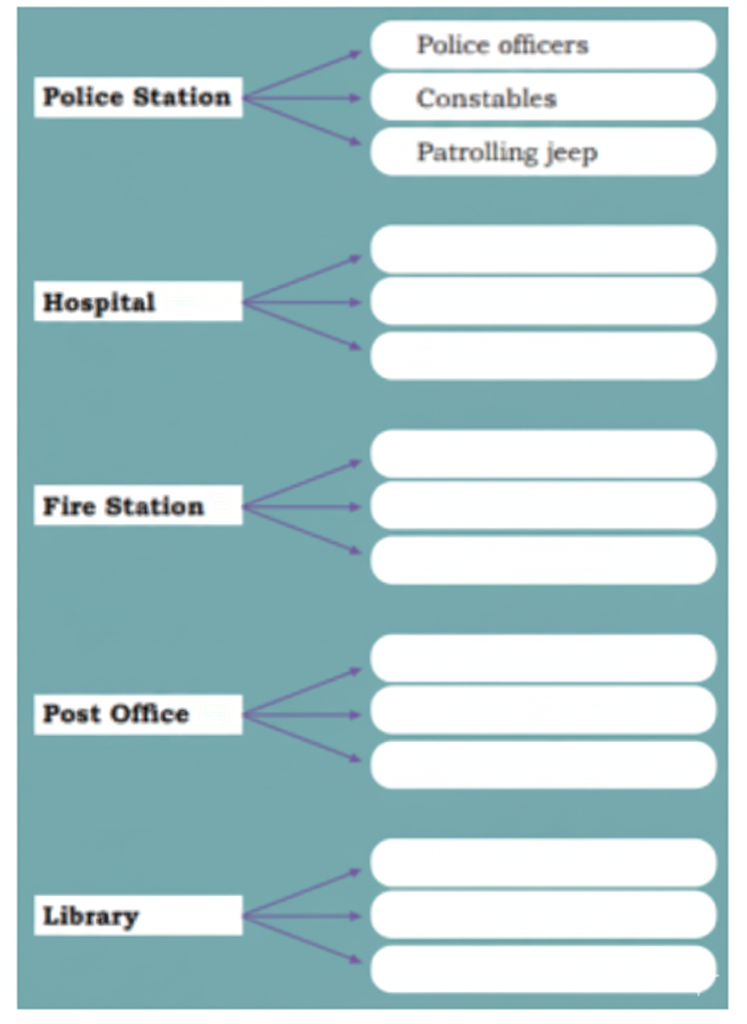
Answer:
NCERT Solutions for Class 4 EVS Chapter 2 Exploring Our Neighbourhood – Key Concepts
The chapter Exploring Our Neighbourhood in Class 4 EVS introduces students to their surroundings, public services, and modern communication. Understanding these key topics is vital for a strong foundation in environmental studies and daily life awareness.
Practicing NCERT Class 4 EVS solutions for Chapter 2 helps students develop observation and critical thinking skills. Focus on the roles of community helpers and the importance of public places for daily needs and safety.
Stay updated with the latest Class 4 NCERT curriculum (2026-27) and review question-answers regularly. This will build your confidence for exams while also helping you appreciate the value of a caring neighbourhood.
FAQs on NCERT Solutions For Class 4 Our Wonderous World Chapter 2 Exploring Our Neighbourhood - 2026-27 Free PDF Download (Sign-in Required)
1. What are the answers for Class 4 EVS Chapter 2?
The answers for Class 4 EVS Chapter 2: Exploring Our Neighbourhood include detailed explanations for all exercise, intext, and activity questions from the chapter, aligned with the latest CBSE 2026–27 syllabus. To score full marks, follow these guidelines:
- Write step-by-step answers using important keywords.
- Include neat diagrams for map/feature-based questions as needed.
- Cite correct definitions and examples from the textbook.
- Structure long answers with headings, bullet points, and clear explanations.
2. How to write full marks answers in EVS?
To write full marks answers in EVS, follow these steps:
- Read the question carefully and identify keywords.
- Start your answer with a short introduction or definition.
- Use bullet points or numbered lists for clarity.
- Include diagrams or maps wherever required, labelled neatly.
- Keep your answers neat and avoid overwriting.
- End with a short conclusion or summary, if appropriate.
3. What is covered in Class 4 Our Wonderous Wrold Chapter 2: Exploring Our Neighbourhood?
Chapter 2 covers exploring neighbourhoods and learning about key places, people, services, and importance of community. Key topics include:
- Understanding your local area or neighbourhood
- Important places like parks, schools, hospitals, and markets
- People who help us in our neighbourhood
- Role of cleanliness and safety in the community
4. Is diagram needed in Chapter 2?
Including diagrams or simple maps in Chapter 2 answers is recommended when:
- The question asks you to show or label neighbourhood places.
- You need to explain locations or directions.
- It helps to clarify your answer or fetches additional marks as per the CBSE marking scheme.
Neat diagrams help you score better and make your answers clearer.
5. Where can I download the chapter’s solutions PDF?
You can easily download the free PDF of Class 4 EVS Chapter 2 Solutions from trusted study portals that align with the CBSE 2026–27 syllabus. These PDFs are exam-ready, easy to print, and help with both quick revision and in-depth study.
6. How should I structure long answers in Class 4 EVS for higher marks?
To get better marks for long answers in Class 4 EVS, use the following structure:
- Begin with a clear introduction or definition.
- Add main points using bullets or numbering.
- Include relevant examples and diagrams where needed.
- End with a short conclusion or summary, if asked.
- Always use chapter keywords and highlight important terms.
7. What are the most important topics from this chapter?
The most important topics from Class 4 Our Wonderous Wrold Chapter 2 include:
- Definition and features of a neighbourhood
- Common places and their uses (parks, hospitals, schools)
- Roles of community helpers (doctors, teachers, police, etc.)
- How to keep the neighbourhood clean and safe
Focus on these topics for your revision and exam preparation.
8. Are NCERT Solutions enough for Class 4 EVS exams?
NCERT Solutions for Class 4 EVS cover all important questions and concepts from the prescribed syllabus. For most school exams and tests:
- These solutions are sufficient to score full marks, if studied well.
- They follow the exact CBSE pattern and marking scheme.
- For extra practice, refer to exemplar and practice worksheets.
9. Do examiners award partial marks for correct steps even if the final answer is wrong?
Yes, CBSE examiners often award partial marks if you follow correct steps and show understanding, even if the final answer is not fully accurate. To maximise marks:
- Always write all steps clearly.
- Label diagrams and highlight main points.
- Use correct terminology from the chapter.
10. How to revise Class 4 EVS Chapter 2 quickly before an exam?
To revise Chapter 2 quickly, follow these steps:
- Read the summary and flash notes.
- Go through stepwise solutions and memorise key definitions.
- Practice labelling a simple neighbourhood diagram or map.
- Revise exam tips, common mistakes, and go over a sample paper or previous year question set for EVS Class 4.
11. How to learn diagrams/maps for this chapter?
To master diagrams and maps in Class 4 EVS Chapter 2:
- Practice drawing common neighbourhood layouts on plain paper.
- Label all places clearly (e.g., school, park, hospital).
- Use a pencil for neatness and erase extra lines.
- Check textbook examples and follow map conventions (such as arrows and labels).
12. Are diagrams or definitions mandatory in answers?
Including definitions and diagrams is very helpful in Class 4 EVS Chapter 2 answers.
- Definitions are mandatory when the question asks you to define a term.
- Diagrams add value for location-based or neighbourhood questions.
- Use both to enhance clarity and score higher as per CBSE marking criteria.
