



Stepwise NCERT Answers for Class 4 Our Wonderous World Chapter 1
Write (Page 4)
Question.
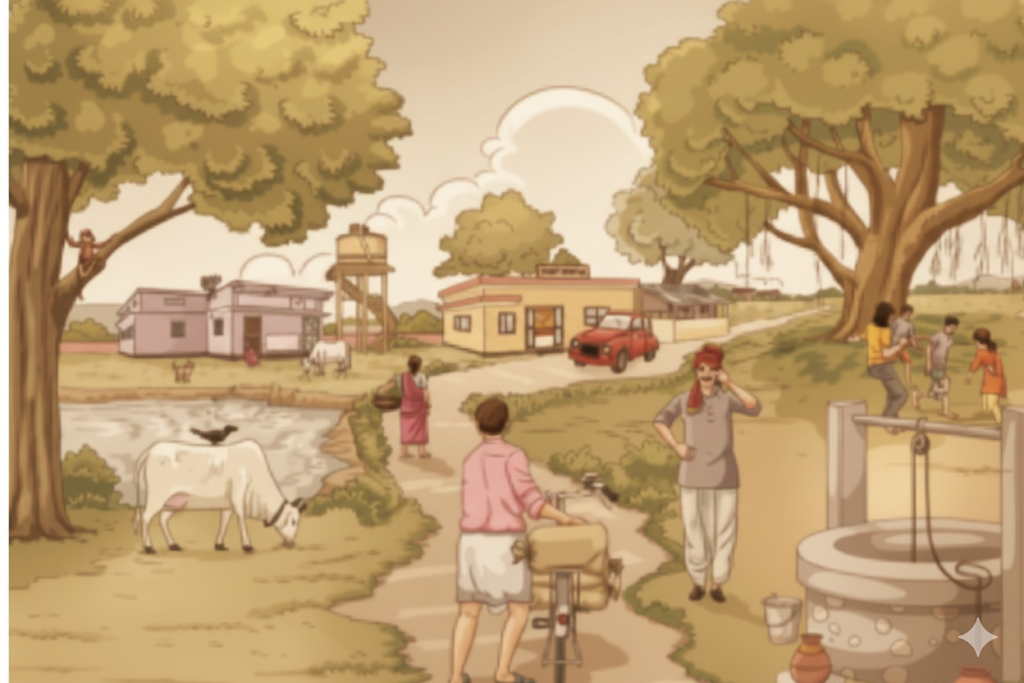
Look at the picture of Chandan’s village. What do you see in the picture? Describe below.
Answer:
The picture of Chandan’s village shows a large open field with a banyan tree at one corner, where elders sit and have conversations. Children can be seen playing football nearby. The village has houses, a post office, a pond, a shop, and an overhead water tank. There is also a well with a bucket, earthen pots, a car, and a man riding a bicycle. A woman, a few animals, and many trees add to the scene. A road links all the places together, and the village appears neat, green, and cheerful.
Activity 1 (page 4)
Question.
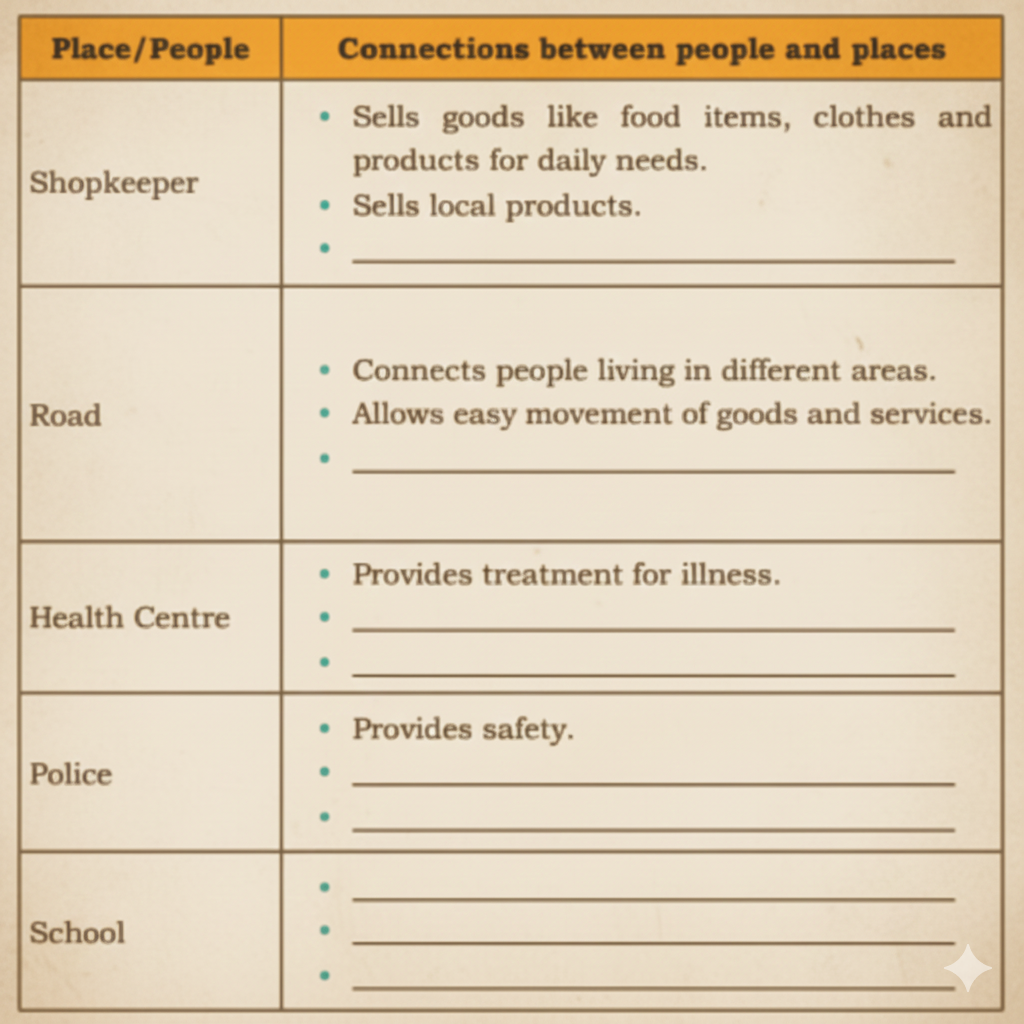
Explore your locality; observe the people and places around you. Write your observations about how the people and places you see are connected to each other in the table given below.
Answer:
Discuss (Page 5)
Question 1.
Why do you think it is important to have places like parks, schools, hospitals and bus stops in your locality?
Answer:
Having facilities such as parks, schools, hospitals, and bus stops close to where we live is very important, as each one serves a useful purpose in our daily life.
Parks give us space to play, exercise, and enjoy fresh air.
Schools help children gain knowledge and develop skills.
Hospitals provide medical care and support when we fall ill.
Bus stops make it convenient for people to move from one place to another.
Question 2.
How would life be different if one or more of these places in your locality did not exist?
Answer:
Life would become challenging if any important place in our neighbourhood was missing.
If there were no parks, people would not have space to play, exercise, or relax.
In the absence of schools, children would miss out on learning, education, and spending time with friends.
Without hospitals, proper medical care would not be available when people fall ill.
If bus stops did not exist, travelling from one place to another would be difficult.
Question 3.
What can you do to keep these places clean and safe?
Answer:
We can follow certain habits to keep places like parks, schools, hospitals, and bus stops neat and secure.
Always throw waste in dustbins and avoid littering.
Do not scribble or write on the walls of schools or bus stops.
Grow trees in parks and look after them regularly.
Maintain silence and behave calmly in hospitals; avoid running or playing inside.
Activity 2 (Page 6)
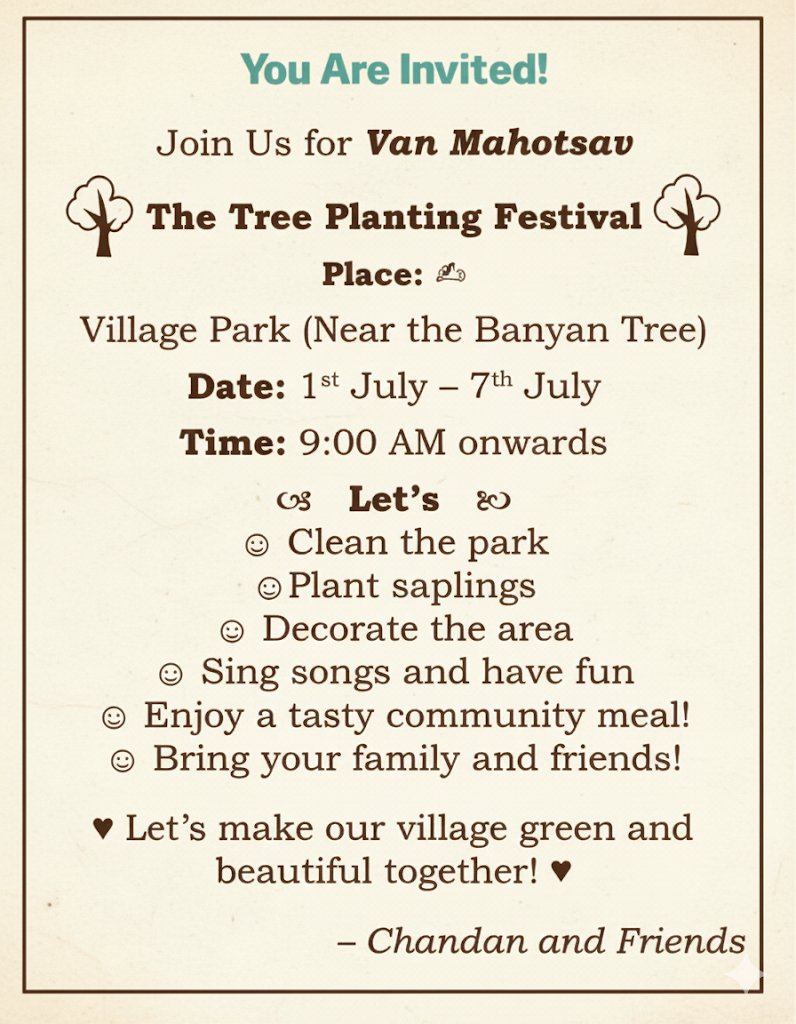
Let us create a colourful poster to help Chandan and his friends invite people from their neighbourhood to participate in the Van Mahotsav.
Answer:
Activity 3 (Pages 7-8)
Question 1.
Identify the people who help in maintaining your locality. What are their occupations?
Answer:
The following people play an important role in keeping our locality well-managed and functioning smoothly:
Shopkeeper: Provides daily-use items such as groceries, clothes, and other essentials.
Teacher: Educates and guides students in schools.
Doctor/Nurse: Gives medical care to people who are unwell at health centres or hospitals.
Police Officer: Ensures safety and maintains peace and order in the area.
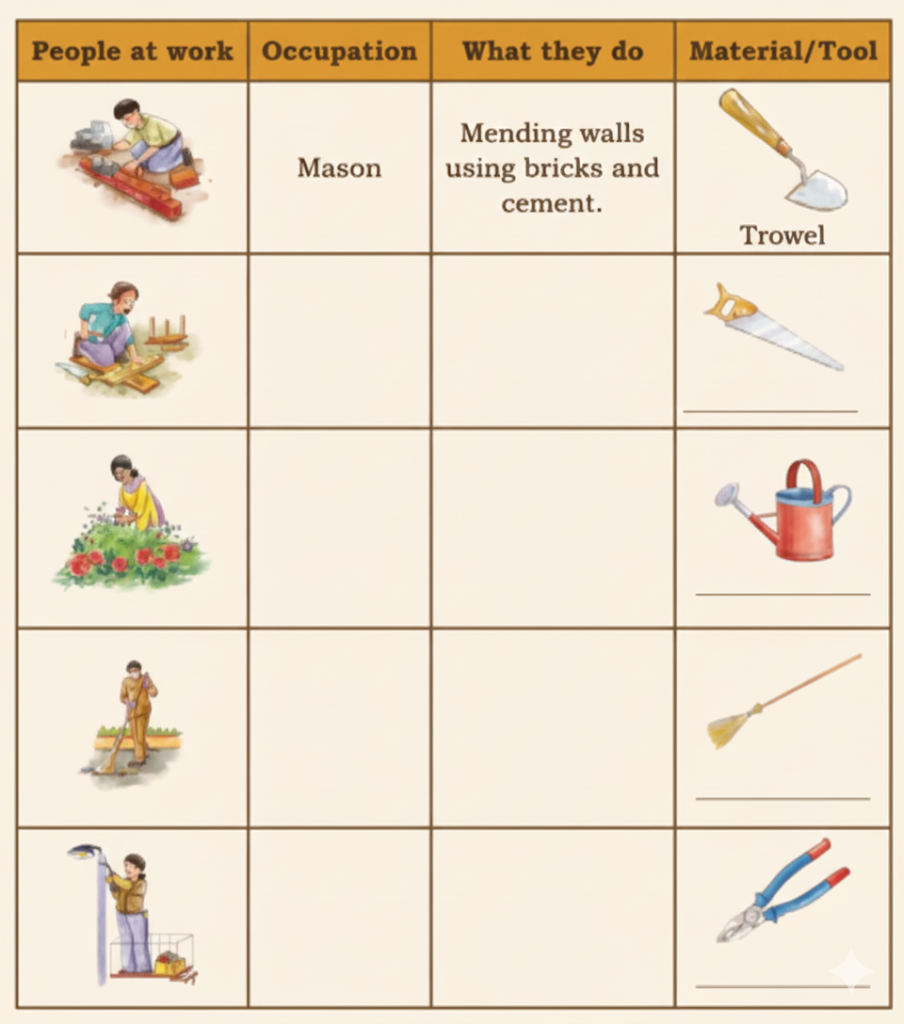
Sweeper: Keeps streets and public spaces clean.
Electrician: Repairs electrical fittings, lights, and wiring.
Gardener: Looks after plants, lawns, and trees in parks and gardens.
Carpenter: Fixes and maintains wooden furniture like benches and doors.
Mason: Constructs and repairs buildings, walls, and other structures.
Plumber: Fixes water pipes, taps, and drainage problems.
Security Guard: Protects buildings, parks, and entry points.
Mechanic: Repairs and services vehicles such as bicycles, autos, and cars.
Question 2.
Look at the table below. List different kinds of work required for developing and maintaining the park. Also, mention the material, tools and skills
Answer:
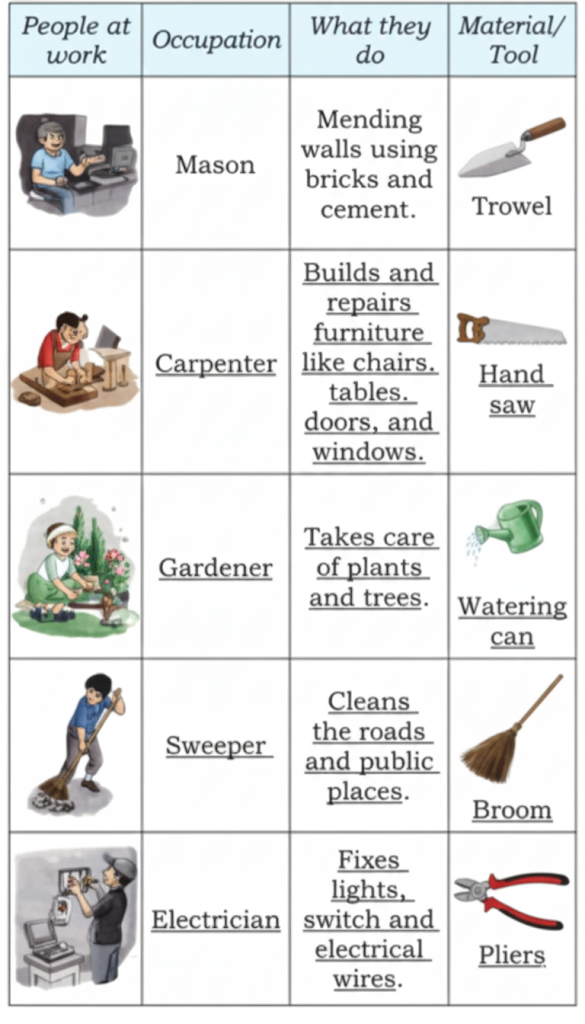
Question 3.
Find out from your family members or neighbours about their work. What questions would you ask them? Here are some examples:
(a) What do you like the most about your work?
(b) What types of tools or things do you use?
(c) What challenges do you face?
Answer:
Hint: I would ask my family members or neighbours the following questions about their jobs:
(a) Which part of your work do you enjoy the most?
(b) What tools or equipment do you use while doing your work?
(c) What difficulties or problems do you face in your job?
(d) Why did you choose this profession?
(e) In what ways does your work help other people?
Discuss (Page 10)
Question 1.
It is important for communities to come together in times of need. What do you think about this statement?
Answer:
Yes, I agree with the statement. When people support one another in difficult situations, problems are easier to handle. It also helps everyone feel secure, happy, and valued, and encourages trust and kindness within the community.
Question 2.
Do people in your locality come together and support each other? Can you remember one such occasion?
Answer:
Yes, people in my neighbourhood help and support one another. I remember an incident when there was heavy rainfall and water flooded a few houses. Everyone came together to remove the water and provide food to those who needed it. It was heart-warming to see people working together like one big family.
Write (Page -11)
Question.
Think about your family or community. How do you work together to help each other while preparing for a festival or any other occasion?
Answer:
In my family, everyone joins in during festivals like Diwali. My parents prepare delicious food, and my father decorates the house with lights. I help by cleaning and organising the house, while my sister creates lovely rangoli designs. We also invite our neighbours and share sweets with them. Since everyone takes part, the celebration becomes joyful and enjoyable for all.
Discuss (Page 13)
Question 1.
What are some of the ways by which we can take care of nature and our neighbourhood? List a few.
Answer:
We can protect nature and keep our neighbourhood clean by following these practices:
Plant more trees and ensure they are watered regularly.
Avoid spitting or throwing waste on roads and public places.
Always use dustbins to dispose of garbage properly.
Conserve water and electricity whenever possible.
Look after the plants and animals living around us.
Question 2.
How does helping others and working together make our community better?
Answer:
We can help preserve nature and maintain a clean neighbourhood by adopting these good habits:
Grow more trees and take care of them by watering regularly.
Do not spit or litter on streets or in public areas.
Throw waste only in dustbins to keep the surroundings tidy.
Use water and electricity wisely and avoid wastage.
Care for the plants and animals around us.
Let Us Reflect (Pages 13-16)
Our School, Our Team!
Question 1.
Write the different roles people play in your school — teachers, students, caretakers, bus drivers, etc.
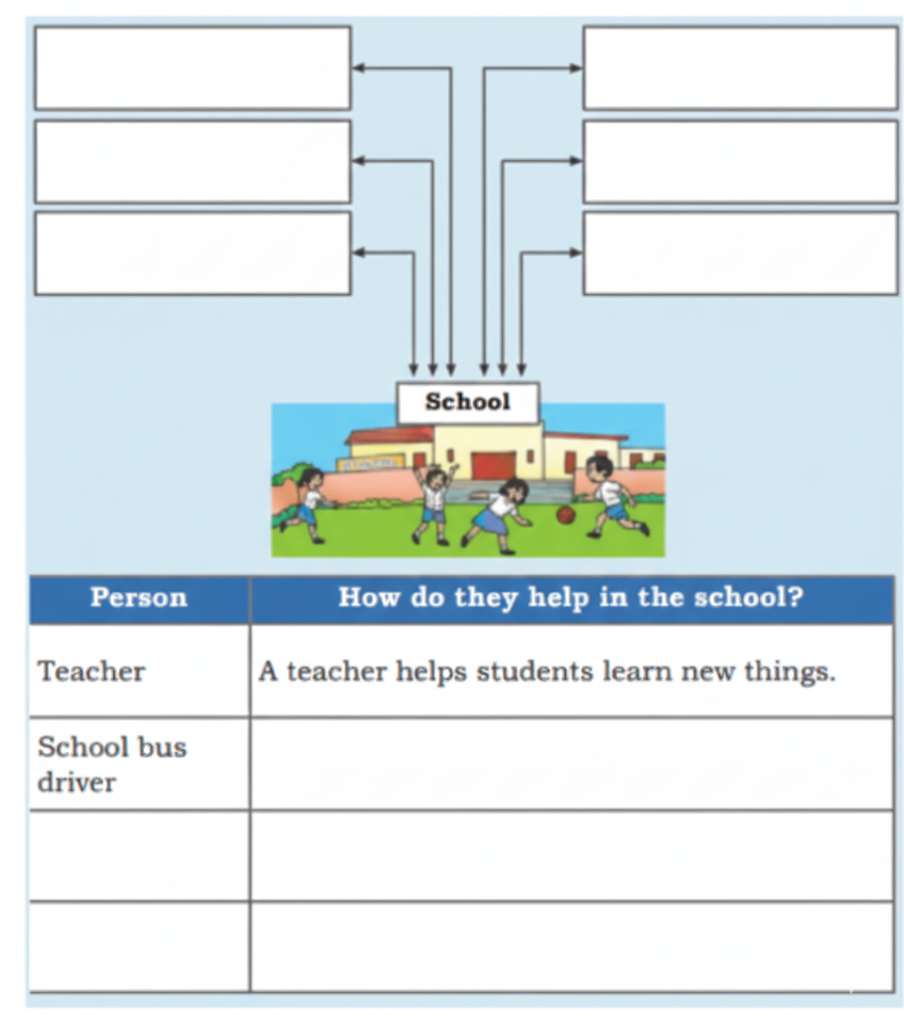
(a) Why is it important for everyone to work as a team in a school?
(b) What is your role as a member of your school community?
Answer:
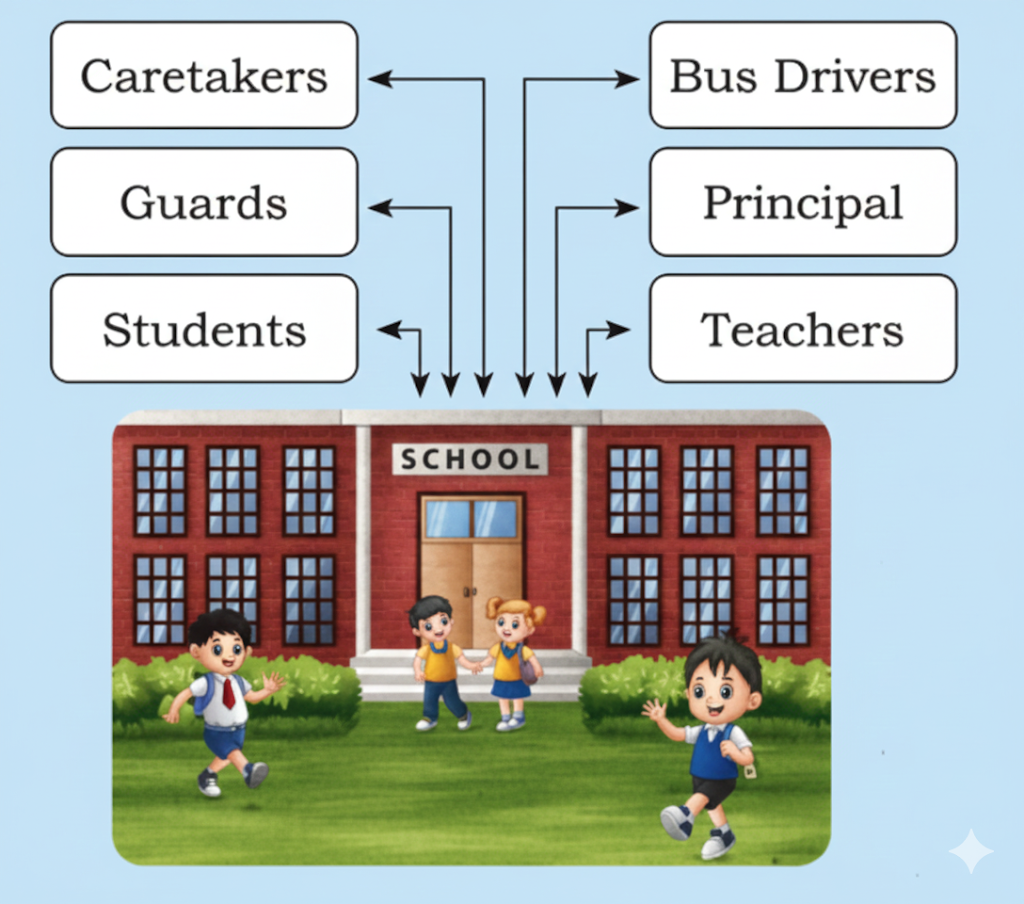
(a) When teachers, students, and staff cooperate with one another, the school turns into a joyful and secure place for learning and development. It also helps us learn values like respect, teamwork, and sharing responsibilities.
(b) As a student, my duties include paying attention in class, completing my work on time, helping classmates, keeping the school neat, and treating everyone with kindness.
Question 2.
Form small groups of 4 – 5 students.
Choose one fun activity to perform from the list below:
(a) Tree plantation
(b) Cleanliness drive
(c) Making artefacts with materials from nature (something useful like a leaf-plate or a decorative item like a garland). After the activity, fill out this table:
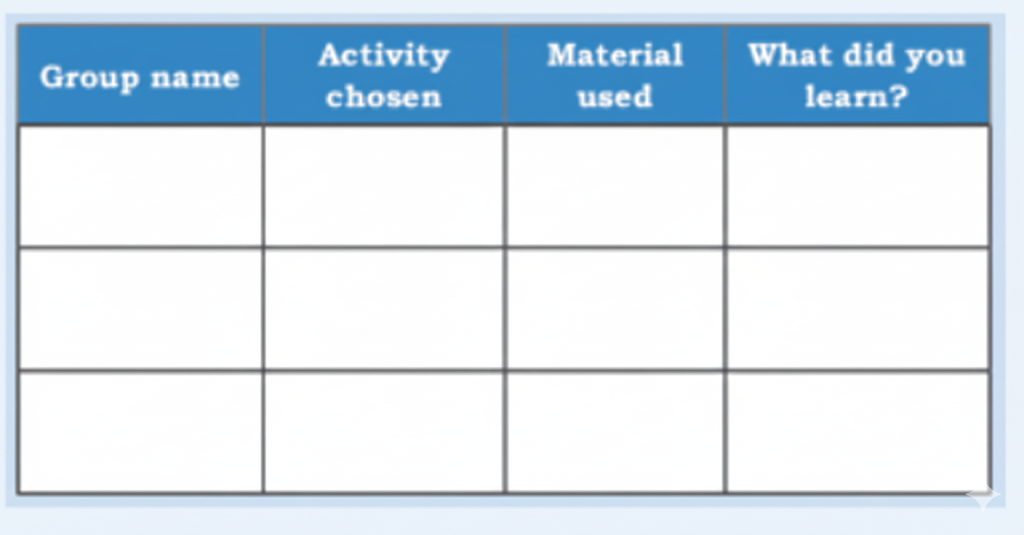
Answer:
Question 3.
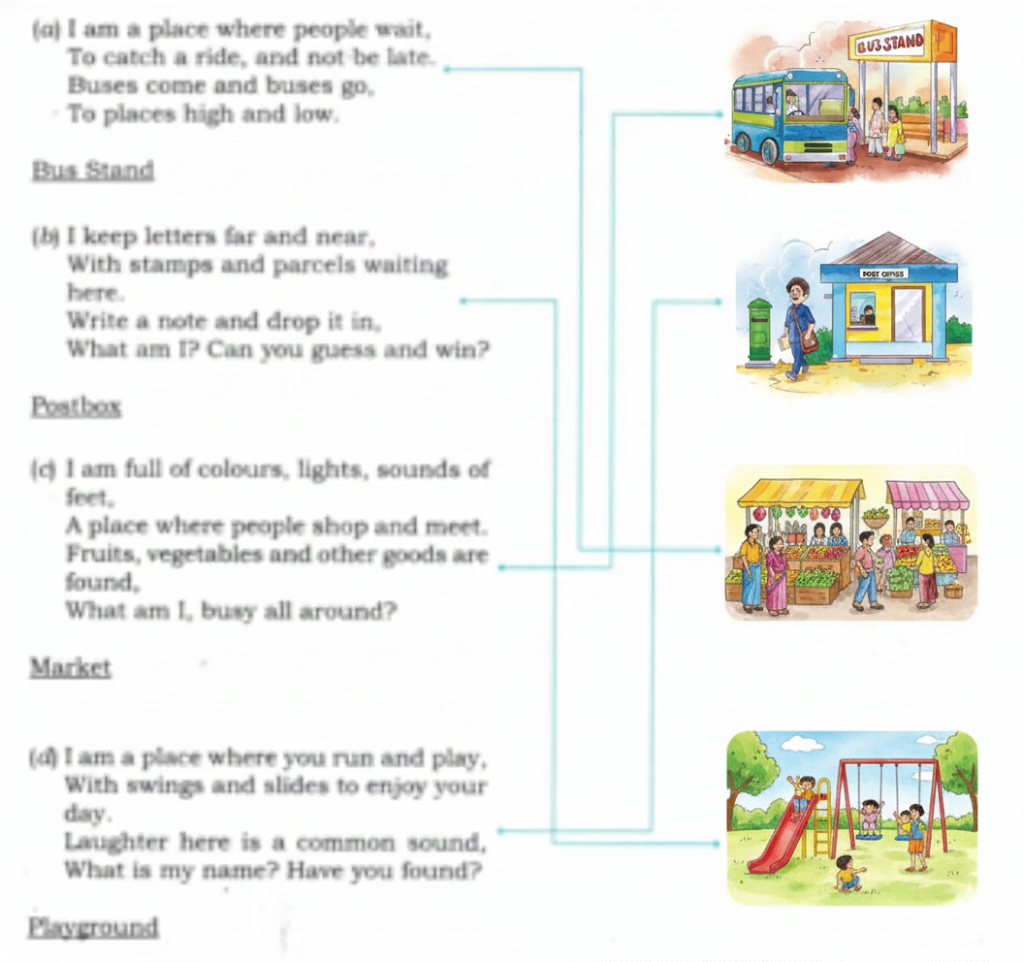
Match the riddles with their solutions hidden in the pictures.
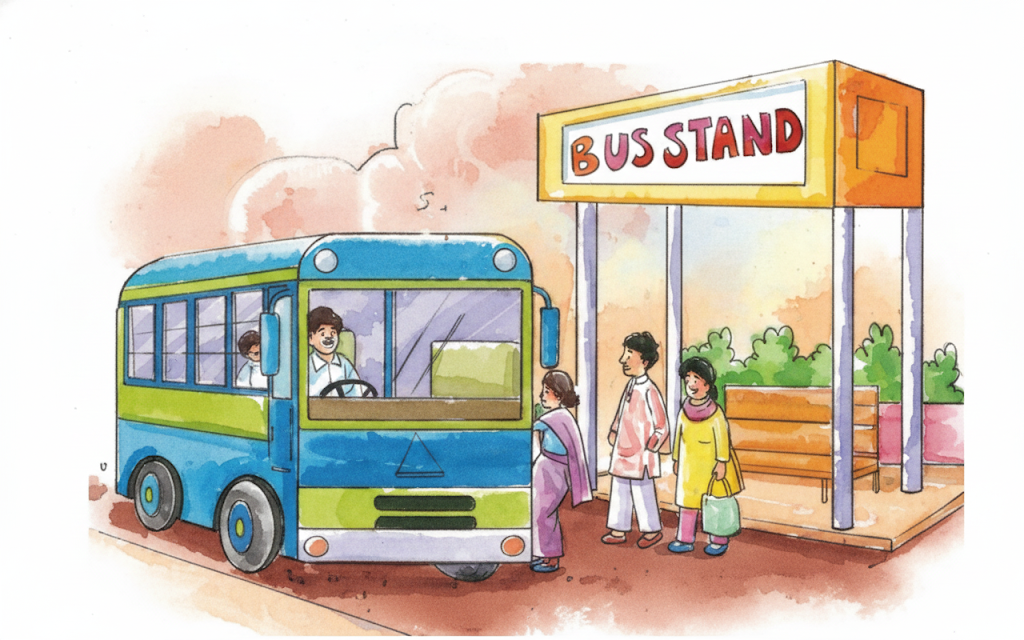
(a) I am a place where people wait,
To catch a ride and not be late.
Buses come and buses go,
To places high and low.
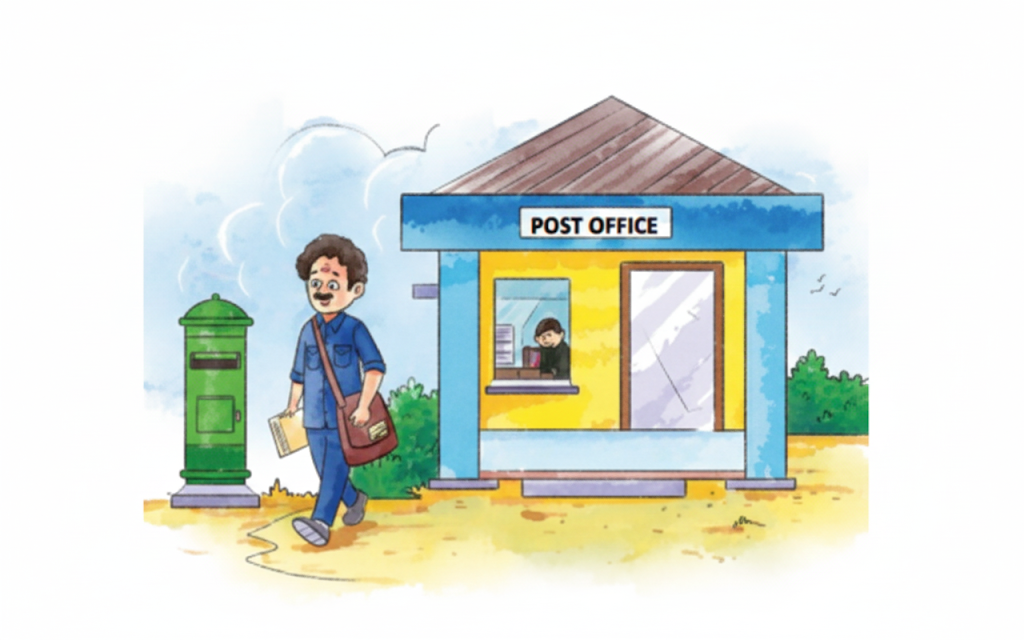
(b) I keep letters far and near,
With stamps and parcels waiting here.
Write a note and drop it in,
What am I? Can you guess and win?
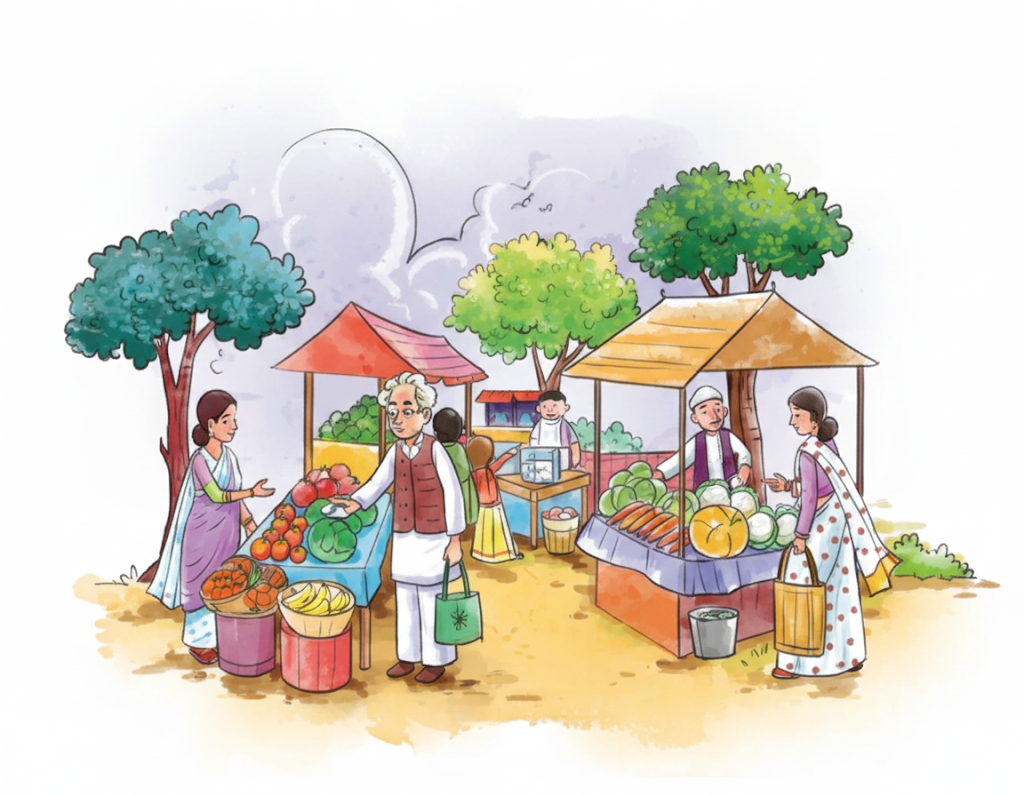
(c) I am full of colours, lights, sounds of feet,
A place where people shop and meet.
Fruits, vegetables and other goods are found,
What am I, busy all around?
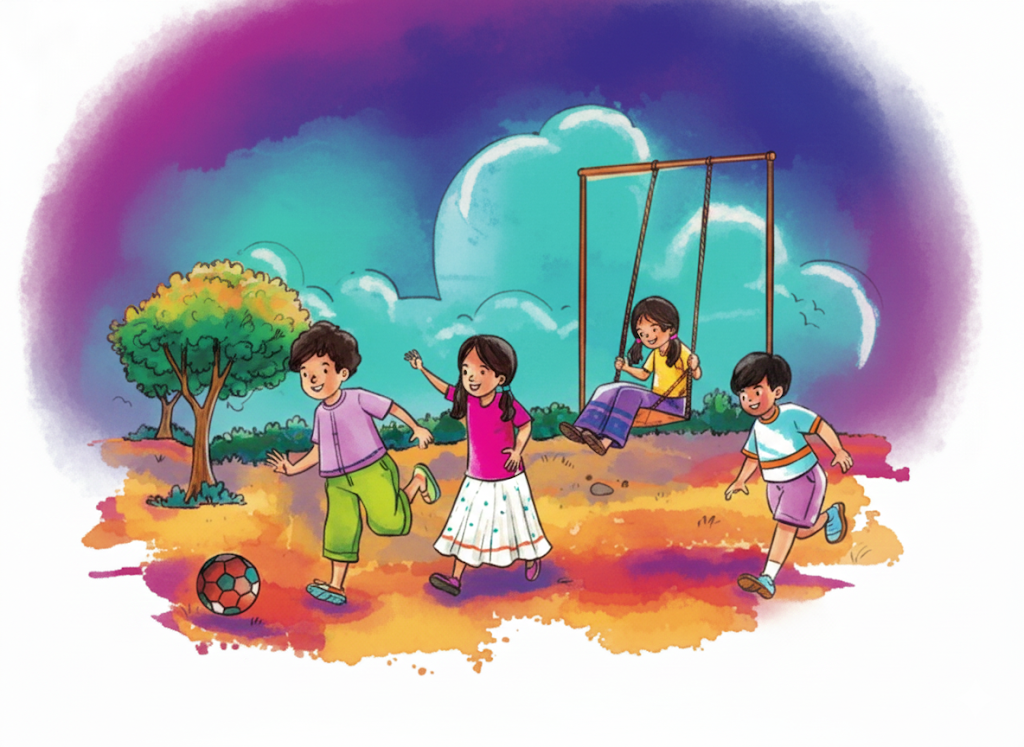
(d) I am a place where you run and play,
With swings and slides to enjoy your day.
Laughter here is a common sound,
Choose a public place of your interest, and create a similar riddle about it for your friends to solve.
Answer:
Riddle:
It’s where we go to learn and grow,
With books, blackboards, and minds that glow.
Teachers guide us every day,
What is this place? Can you say?
Answer: School
Question 4.
Create three groups in the class. Each group would think about a situation in their locality that needs to be improved. Identify activities that can make a difference to the situation.
This could be related to cleaning, helping others, organising an event, etc. Complete the table below.
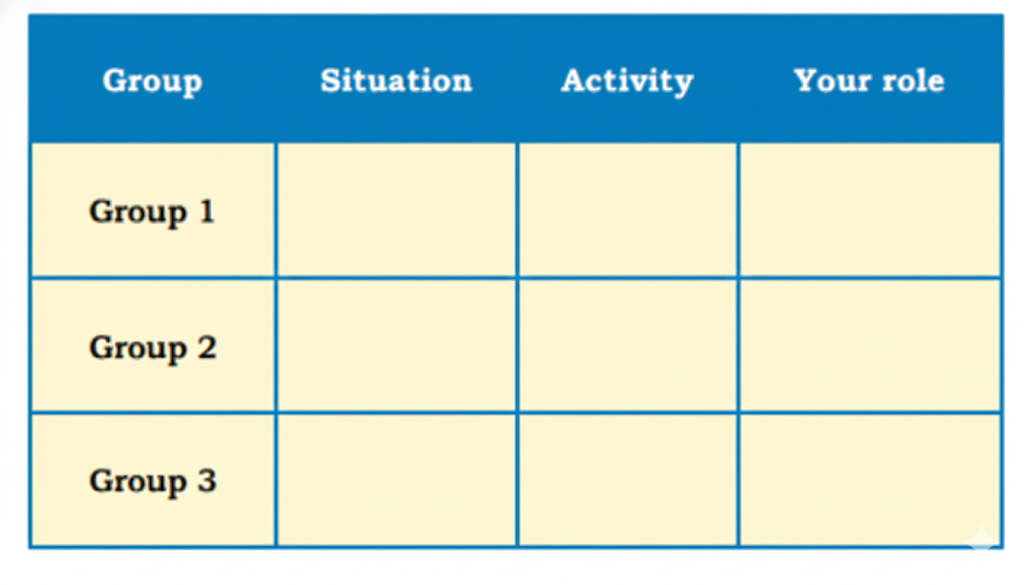
After completing the table, discuss and answer the following questions:
(a) Do you think working together can make your activities more useful? Give reasons.
(b) How will your involvement in these activities help the community?
Answer:
(a) Yes, working together makes any task quicker, simpler, and more enjoyable. Teamwork allows us to share ideas, divide responsibilities, and complete work efficiently. Since everyone contributes different skills, the outcome is often better. It also helps us learn cooperation, patience, and respect for others’ opinions.
(b) By taking part in these activities, I can help make the community cleaner, safer, and more welcoming. Helping others, sharing ideas, and working as a team motivates more people to participate and helps create a caring and united community.
Question 5.
Ask your family about any one special skill or craft (for example — basket making, wall painting, pottery) that is famous in your region.
Answer:
Students should do it by themselves.
All About Living Together | Class 4 Our Wonderous World Chapter 1
Understanding the importance of community living is the main focus of Class 4 Our Wonderous World Chapter 1. By exploring how people work together and share responsibilities, students develop a strong sense of togetherness and inclusion in their environment.
With real-life stories like Van Mahotsav and teamwork examples, this chapter shows how cooperation leads to growth in every neighbourhood. Practicing the chapter questions builds exam confidence and helps you remember important community activities.
Make sure to revise NCERT solutions for Class 4 EVS regularly. Key concepts and interesting activities will boost your learning and help you score well in the 2026-27 exams. Regular practice and examples from your own locality will make revision easier.
FAQs on NCERT Solutions For Class 4 Our Wonderous World Chapter 1 Living Together - 2026-27 Free PDF Download (Login Required)
1. What are NCERT Solutions for Class 4 EVS Chapter 1 Living Together?
NCERT Solutions for Class 4 EVS Chapter 1 Living Together provide detailed answers and stepwise explanations for all chapter exercises.
Key features include:
- Exercise-wise solutions for both intext and back questions
- Precise definitions and diagrams as per CBSE 2026–27 syllabus
- Answers tailored to help score maximum marks
- Suitable for revision and concept clarity
2. How can I write stepwise answers to score full marks in Class 4 EVS Chapter 1?
Writing stepwise answers ensures you get full marks in Class 4 EVS Chapter 1.
Follow these steps:
- Start with a clear introduction based on the question
- Use bullets or numbering for each key point
- Include definitions or short explanations where needed
- Draw and label diagrams or maps if asked
- Summarise with a brief conclusion where applicable
This approach matches the CBSE evaluation pattern and improves answer clarity.
3. Which topics are most important in Class 4 Our Wonderous World Chapter 1: Living Together for exams?
The most important topics from Chapter 1 Living Together for Class 4 EVS exams are:
- Definition of community and living together
- Examples of cooperation in daily life
- Role of family, friends, and neighbours
- Importance of unity and sharing
- Relevant diagrams or scenarios about living together
Focusing on these ensures strong exam preparation and clear concept understanding.
4. Are diagrams or definitions mandatory in answers for Class 4 EVS Chapter 1?
Diagrams and definitions are strongly recommended in answers as per the CBSE marking scheme.
- Definitions make your answers precise and exam-ready
- Diagrams or map labelling enhance marks and understanding
- Always use neat, well-labelled diagrams when required in questions
These elements help you score full marks and present your answers well.
5. How do I structure long answers in Class 4 EVS Chapter 1 for better marks?
To structure long answers in Class 4 EVS Chapter 1 for maximum marks:
Follow this format:
- Begin with a brief introduction (one sentence on the topic)
- Use separate bullet points for each important fact or step
- Include examples, definitions, or diagrams if relevant
- Conclude with a short summary or key point
This format ensures clarity and includes all keywords assessed by examiners.
6. Where can I download free PDF NCERT Solutions for Class 4 Our Wonderous World Chapter 1?
You can download free PDF NCERT Solutions for Class 4 Our Wonderous World Chapter 1: Living Together from trusted educational websites.
Benefits of PDF download:
- Offline access anytime
- Well-structured, stepwise answers
- Useful for quick revision and exam prep
Look for PDFs that match the latest CBSE 2026–27 syllabus for the best results.
7. Why are NCERT Solutions for Class 4 EVS Chapter 1 important for CBSE exams?
NCERT Solutions for Class 4 EVS Chapter 1 are essential as they:
- Cover all CBSE board exam patterns
- Provide step-by-step model answers
- Improve concept clarity and confidence
- Boost scores with correct format and keywords
Using these solutions helps you prepare thoroughly for Class 4 EVS assessments.
8. How can I quickly revise Class 4 EVS Chapter 1: Living Together before my exams?
To revise Class 4 EVS Chapter 1 quickly and efficiently:
- Review key definitions and diagrams
- Go through stepwise NCERT Solutions for intext and back questions
- Practice important questions and sample papers
- Use revision notes and 1-day or 3-day revision planners
This systematic approach ensures you cover all important points before the exam.
9. Do examiners give partial marks if steps are correct in EVS answers but the final solution is wrong?
Yes, CBSE examiners often award partial marks for correct steps or definitions in EVS answers, even if the final answer has a minor error.
- Always show all necessary steps and relevant points
- Even if unsure about the complete answer, writing accurate steps can help you score partial marks
This strategy boosts your chances of getting marks for partial correctness in Class 4 EVS.
10. Are references to textbook page numbers useful during revision for Class 4 EVS?
Referencing textbook page numbers during revision is very helpful in Class 4 EVS.
- Speeds up location of answers in the book
- Ensures alignment with CBSE-approved content
- Useful for quick cross-checking while revising
Including page numbers in your notes makes your exam preparation more efficient.
