



How to Solve Data Handling Questions in Class 4 Maths for Full Marks
NCERT Textbook Pages 203-205
Look at the questions asked by Rohan and Anjali.
Tick the question that is the most appropriate for finding the ‘most liked subject’. Why do you think so? Discuss with your friends and teacher.
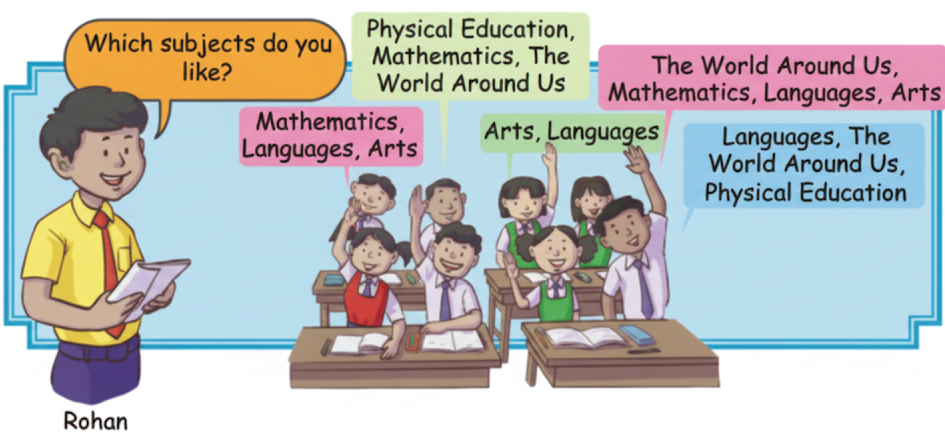
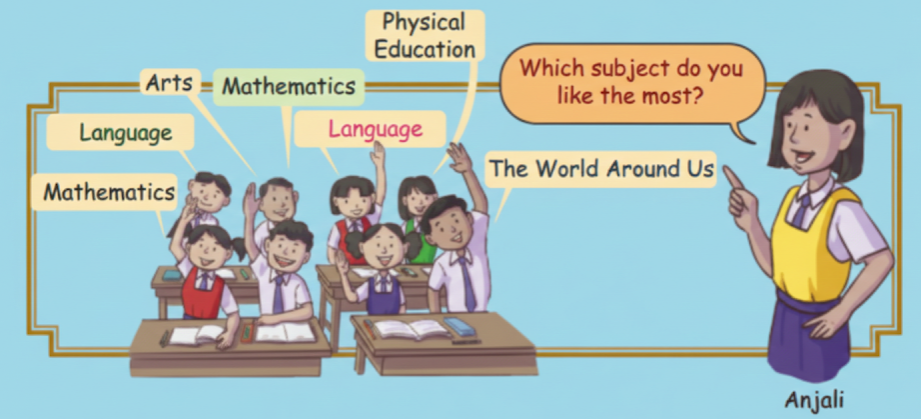
Solution: Students should do it by themselves.
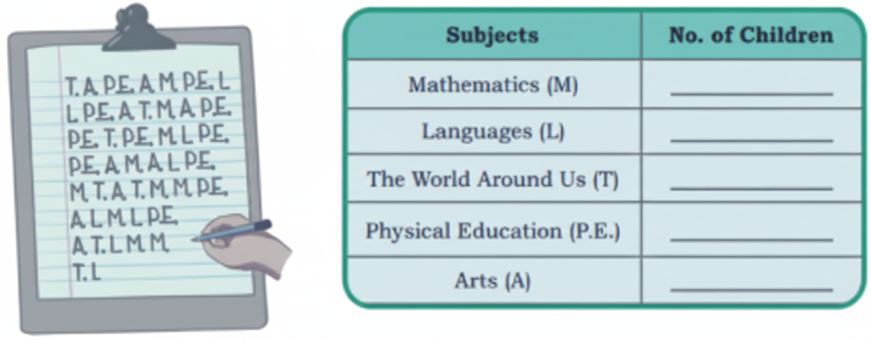
Anjali and Rohan recorded the children’s answers (responses) to the above question as follows:
They wrote M for Mathematics, L for Languages, T for the World Around Us, A for Arts and P.E. for Physical Education.
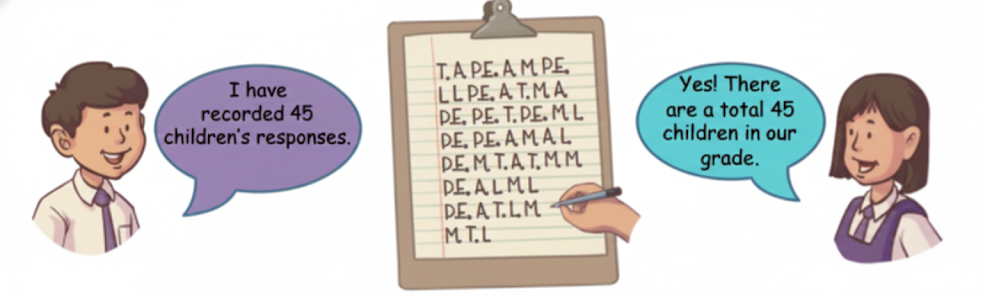
Look at the children’s responses above and answer the following questions:
The number of children who like Mathematics the most is ________ .
The number of children who like Language the most is ________ .
The number of children who like The World Around Us the most is ________ .
The number of children who like Physical Eduation the most is ________ .
The number of children who like Arts the most is ________ .
Solution:
The number of children who like Mathematics the most is 10.
The number of children who like Language the most is 8.
The number of children who like The World Around Us the most is 7.
The number of children who like Physical Education the most is 11.
The number of children who like the arts the most is 9.
Let’s fill in the above information in this table.
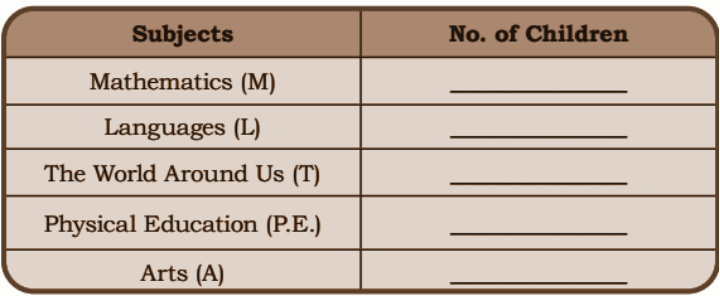
Solution:
Now, look at the above table and answer the following questions:
What is the most common favourite subject among the children?
Solution: Physical Education
What is the least common favourite subject among the children?
Solution: Languages
There are the following two ways to display information.
Which way of displaying information is easier to understand and why? __________
Solution: The second method, presented in a tabular form, is more effective for understanding as it is better organized and allows for quicker comparison of numbers.
NCERT Textbook Pages 206-207
Colourful Golas
During school lunch break children rush to eat gola of their favourite colour.
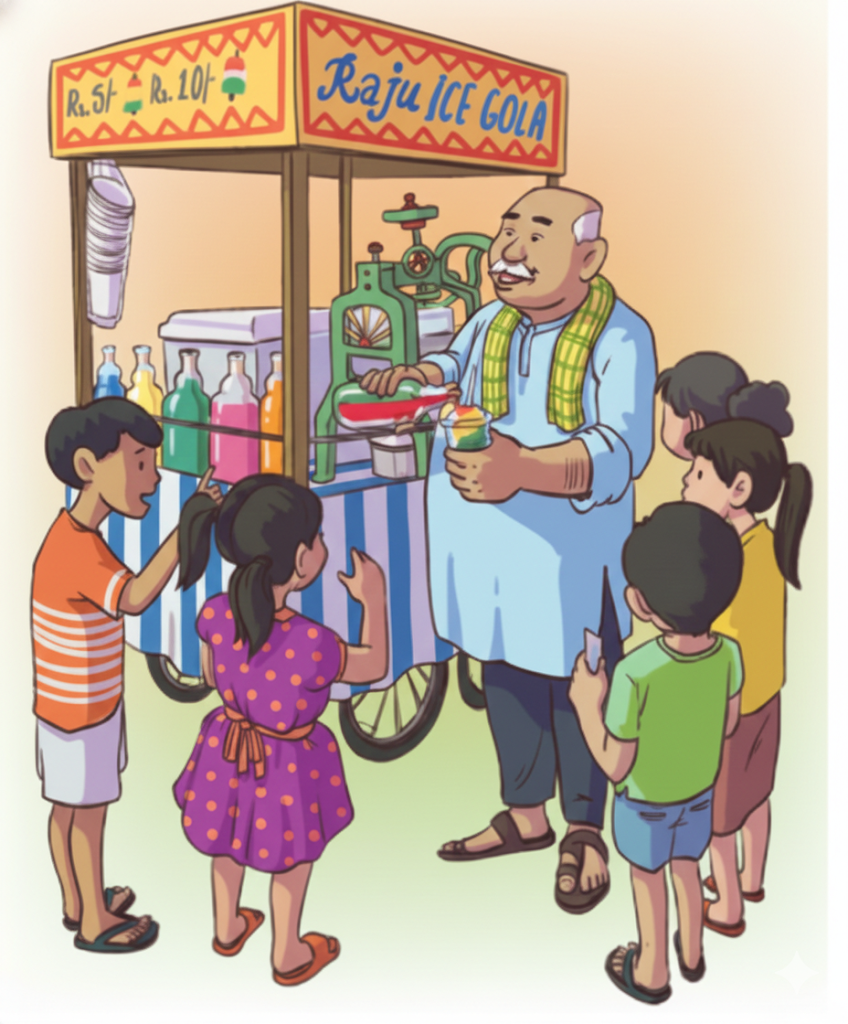
Rohan and Anjali record the golas eaten by different children. They want to eat the one that is most eaten by others.
They both start recording the golas eaten by the children.
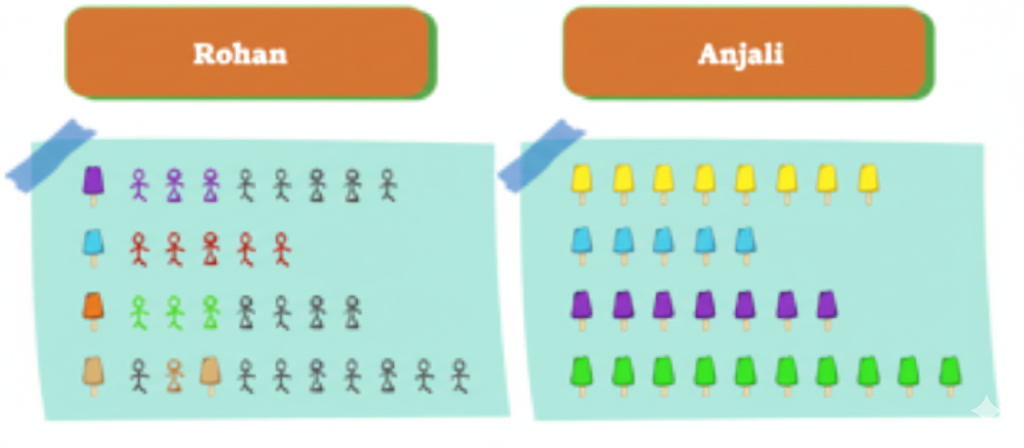
Look at the information given above. Colour the line drawing of the gola appropriately.
Question 1. Which colour ice gola do the children eat:
a) the most
b) the least
How do you know?
Solution: (a) Yellow
By counting, we find that there are 9 red golas, 5 blue golas, 7 orange golas, and 10 yellow golas.
Question 2. Which colour gola would Anjali and Rohan have bought?
Solution: They would prefer to buy the yellow gola, as it is the most popular.
Question 3. Which colour golas did boys eat the most?
Solution: Yellow
Question 4. Which colour golas did girls eat the most?
Solution: Red, Orange and Yellow
Question 5. Which of the ways of representing data did you use to answer these questions and why?
Solution: By using a pictograph and counting the numbers, we can quickly and easily find the answer.
NCERT Textbook Page 208 Bal Mela
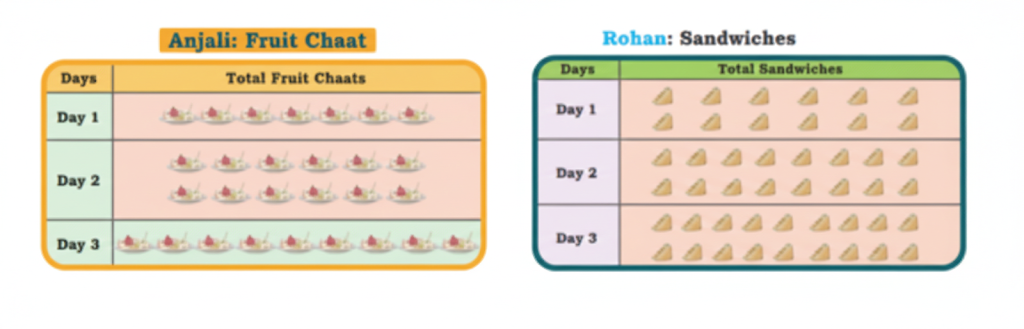
Anjali and Rohan have recorded the number of people who ate fruit chaats and sandwiches in the Bal Mela over three days, using a Pictograph.

Let Us Do
Question 1. Complete the table.

Solution:
Question 2. On which day was the most sandwiches sold?
Solution: Day 3
Question 3. Which item had the highest sale on Day 2?
Solution: On day 2, the sales of fruit chaats were 12, and the sales of sandwiches were 16. The difference in sales between the two items is 16 – 12 = 4. Therefore, sandwiches had the highest sales on day 2.
Question 4. Complete the table given below. Circle the day that had the highest sales.
Solution:
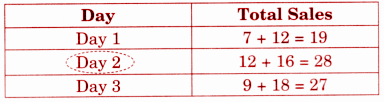
Day 2 had the highest sale.
NCERT Solutions Class 4 Maths Chapter 14 Data Handling (2026-27)
In NCERT Solutions Class 4 Maths Chapter 14 Data Handling, students learn how to collect, count, and arrange information in tables and pictographs. These simple activities make it easy to understand **data handling** and build confidence for school exams.
This chapter on Data Handling Class 4 includes questions on favourite subjects, colourful golas, and Bal Mela sales. By practicing regularly, students understand how to read tables and pictographs, and use this **chapter-wise solution** to revise quickly.
To score well in the 2026-27 exams, go through each solved question of Class 4 Maths Chapter 14, then try similar questions on your own. Focus on how data is organised; this **smart practice** will improve both accuracy and speed.
FAQs on NCERT Solutions For Class 4 Maths Chapter 14 Data Handling - 2026-27 Free PDF Download (Login Required)
1. What is Data Handling in Class 4 Maths?
Data Handling in Class 4 Maths refers to the process of collecting, organizing, and interpreting information for solving mathematical problems.
- It includes activities like making tables, tally charts, and drawing simple bar graphs.
- Helps students analyse, compare, and answer questions using real-life situations.
- Forms the foundation for understanding statistics in higher classes.
2. How do NCERT Solutions for Class 4 Maths Chapter 14 help students score better?
NCERT Solutions for Class 4 Maths Chapter 14 provide step-by-step answers based on the CBSE 2026–27 syllabus, making concepts easy to understand.
- Solutions match textbook exercises and marking schemes.
- They offer clear explanations, diagrams, and practice questions.
- Practising these helps students gain confidence and accuracy in exams.
3. What type of questions are important in Chapter 14 Data Handling?
Important questions in Data Handling for Class 4 Maths include:
- Drawing and interpreting tables, tally charts, and pictograms.
- Reading data from diagrams and answering direct questions.
- Definitions of key terms like ‘data’, ‘tally mark’, and ‘bar graph’.
- Simple problem-solving based on given sets of data.
4. Are diagrams or definitions needed in Data Handling answers?
Including diagrams and clear definitions in your answers is highly recommended for scoring full marks.
- Neat diagrams (tables, tally marks, pictograms) show understanding and fetch step marks.
- Definitions help answer conceptual questions correctly.
- CBSE marking scheme rewards answers following textbook format with neat presentation.
5. How should I present long answers in Class 4 Maths Chapter 14 for full marks?
Present long answers in Class 4 Maths Chapter 14 stepwise, integrating definitions, diagrams, and explanations.
- Start with a brief definition or heading.
- Draw the required table or diagram neatly.
- Write each step of calculation with reasons, wherever applicable.
- Highlight the final answer and ensure all data is clearly labelled.
6. Where can I download the solutions PDF for Class 4 Maths Chapter 14 Data Handling?
You can download the free solutions PDF for Class 4 Maths Chapter 14 Data Handling from trusted educational websites that provide NCERT solutions.
- Look for a clearly labelled download button for the year 2026–27.
- Ensure the file covers all exercises and follows updated CBSE syllabus.
7. What are the key definitions and formulae in Chapter 14 Data Handling?
Key definitions and terms in Chapter 14 Data Handling include:
- Data: Collection of information or facts.
- Tally Marks: Marks used for counting frequency.
- Pictogram: Pictures or symbols to represent data.
- Bar Graph: Visual representation of data using bars.
8. How to avoid common mistakes in Class 4 Maths Data Handling questions?
Avoiding mistakes ensures full marks in Data Handling questions:
- Always label diagrams and axes clearly.
- Count tally marks accurately and double-check numbers.
- Write units or labels wherever required.
- Read questions carefully to answer as asked.
9. Are NCERT Solutions enough for Class 4 Maths exams?
NCERT Solutions for Class 4 Maths are generally enough for school exams as they cover the entire syllabus and follow CBSE guidelines.
- They offer stepwise answers, explanations, and solved examples for practice.
- For better performance, also solve extra questions and do regular revision.
10. Do examiners award partial marks for correct steps even if the final answer is wrong?
Yes, CBSE examiners often award partial marks for correct steps even if the final answer is wrong in Data Handling questions.
- Write every calculation step clearly.
- Include diagrams and intermediate steps for step marking.
- This approach can help secure marks even in case of minor errors in the last step.
11. How do diagrams help in scoring better in Data Handling from Class 4 Maths?
Diagrams like tables, tally charts, and pictograms are essential in Data Handling for clear data representation.
- They help visualize data, making answers easier to understand and check.
- CBSE marking scheme gives specific marks for correctly labelled and neat diagrams.
- Proper use of diagrams often leads to higher scores in exams.
12. What is the CBSE 2026–27 marking scheme for Class 4 Maths Chapter 14 Data Handling?
The CBSE 2026–27 marking scheme for Chapter 14 Data Handling awards marks for the following:
- Writing correct definitions and explanations (1 mark).
- Neatly labelled diagrams and tables (1–2 marks).
- Stepwise calculation and interpretation (1–2 marks).
- Final correct answer (1 mark).
