



Stepwise Answers and Important Questions for NCERT Maths Chapter 12 Class 4
NCERT Textbook Pages 175-177 – Let Us Do
Question 1.
Notice the number of days in February in the years 2024 and 2025.
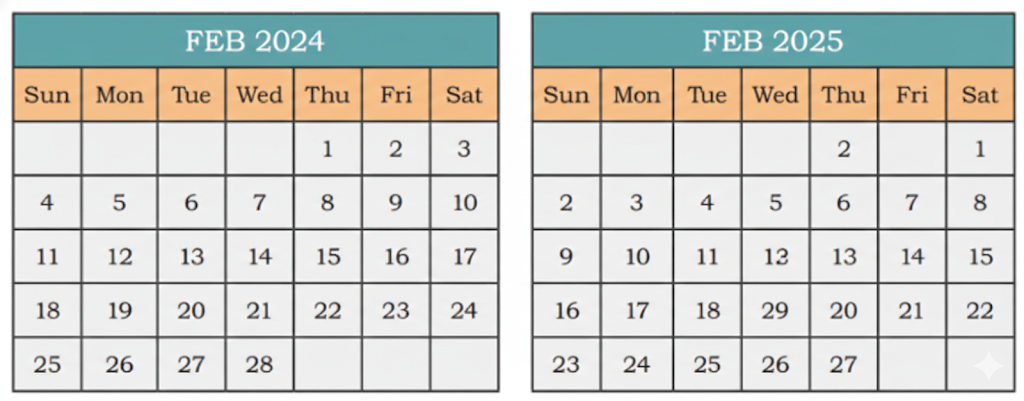
Number of days in Feb 2024 = _____________
Number of days in Feb 2025 = _____________
Solution:
Number of days in Feb 2024 = 29
Number of days in Feb 2025 = 28
Question 2.
Fill in the blanks with consecutive leap years before and after 2024.
________, ________, 2024, ________, ________, ________
Solution:
A leap year happens once every four years.
Examples include 2016, 2020, 2024, 2028, 2032, and 2036.
Question 3.
We know that most years have 365 days. How many days would a leap year have?
Solution: A leap year is a year with 366 days, as opposed to the typical 365 days.
Question 4.
Write the names of the months when you celebrate your favourite festivals.
Solution:
Students should do it by themselves.
Question 5.
Answer the following questions by writing the appropriate days of the week:
(a) Today: _____________
(b) Yesterday: _____________
(c) Tomorrow: _____________
(d) Day after tomorrow: _____________
(e) Day before yesterday: _____________
Solution:
Students should do it by themselves.
Question 6.
July 1 is a Monday. Write the dates for the next two Mondays.
Solution:
Every day of the week repeats exactly 7 days after its previous occurrence. Therefore, the next two Mondays will fall on July 8 and July 15.
Question 7.
Laali is born on 04/07/2014 and Chotu is born on 04/12/2019. Who is older among the two and how much?
Solution: Since Laali was born in 2014, which is earlier than Chotu's birth year of 2019, Laali is older. To calculate the age difference, we will consider Laali's age on 04/12/2019 (Chotu's birthdate).
Year difference: From 04/07/2014 to 04/07/2019 = 5 years
Months difference: From 04/07/2019 to 04/12/2019 = 5 months
Thus, Laali is 5 years and 5 months older than Chotu.
Laali will turn 5 years old on ______________.
Solution: Adding 5 years to 2014 gives 2019, meaning Laali will turn 5 years old on 04/07/2019.
Chotu’s 10th birthday will be celebrated on ________________.
Solution: Adding 10 years to 2019 gives 2029, so Chotu will celebrate their 10th birthday on 04/12/2029.
Question 8.
Check the manufacturing and expiry dates on the wrapper of any biscuit packet.
(a) How old is the packet of biscuits?
Answer: ____ months ____ days.
(b) How many more days are the biscuits safe to eat?
____ months ____ days.
Solution:
Students should do it by themselves.
Question 9.
Notice the day on which July 15 falls in your calendar. Now find out what day is August 15? September 15? October 15? What pattern do you notice? Share in grade.
Solution:
Students should do it by themselves.
Now choose a date and look up the day on which it falls. Challenge your friends to guess what day will the same date fall in the following month.
Solution:
Students should do it by themselves.
NCERT Textbook Page 177 – Let Us Explore
With the help of your parents and teachers, explore the names of the months in the Hindu/Islamic/Sikh or any other calendar of your community.
1. Find out when the year begins in each of these calendars.
2. Check how the names of the months in these calenders
correspond to the months in the English calendar.
3. Identify the months from the Hindu/Islamic/Sikh or any other
calendar in which some of the important festivals of the community fall.
4. Identify the dates of the new moon and full moon in your community’s calendar every month. Do you notice any pattern?
5. How are the full moon or new moon days named in your community’s calendar?
Solution:
Students should do it by themselves.
NCERT Textbook Pages 178-180
How many hours in a day?
Look at the picture below. It shows the time spent on different activities by a doctor. Write the number of hours spent on each activity in the space provided. Then, find the total number of hours between 6 o’clock morning to 6 o’clock evening and 6 o’clock morning of the next day.
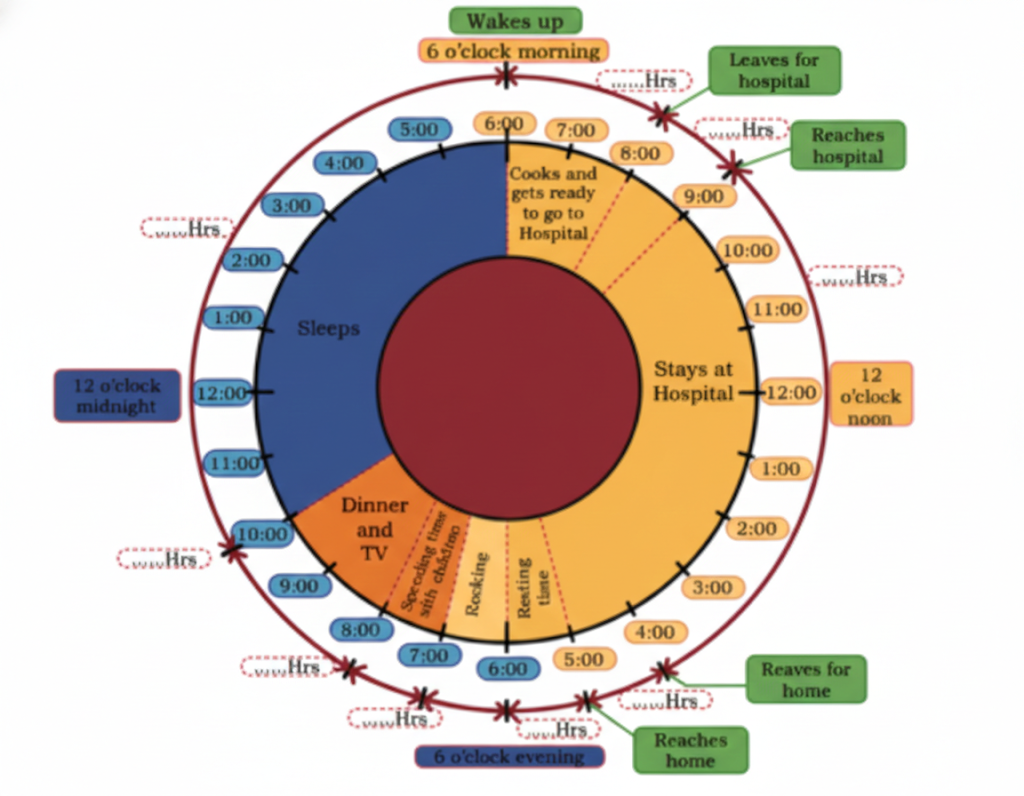
The total number of hours is ________ .
Solution:
Based on the provided image, the total number of hours is calculated as 2 + 1 + 7 + 1 + 1 + 1 + 1 + 2 + 8, which equals 24 hours. Thus, the total number of hours is 24.
NCERT Textbook Pages 179-180
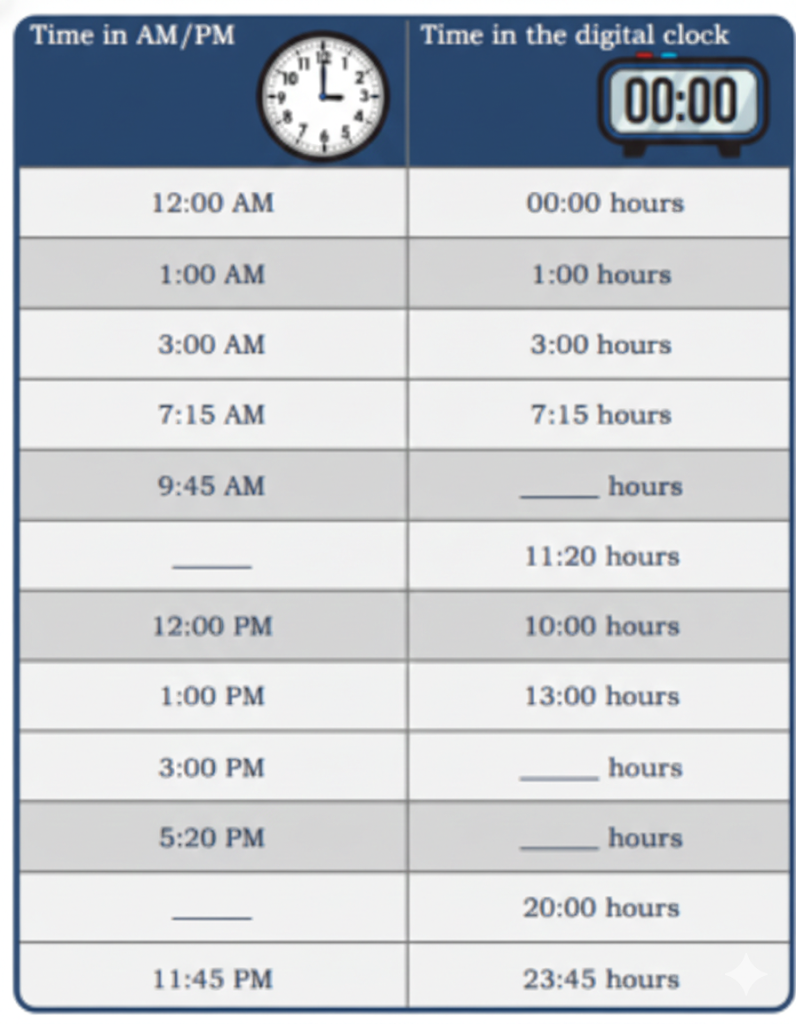
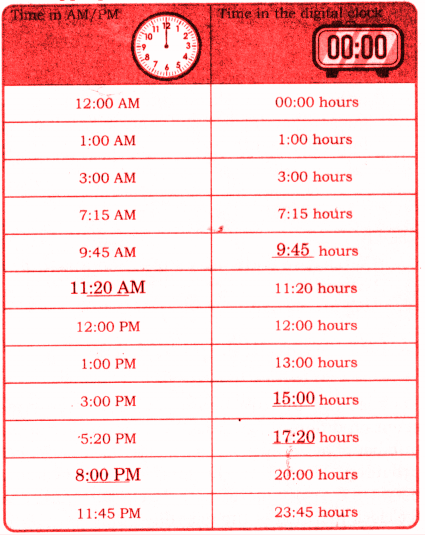
Read the following table and see how we read and write time using AM/PM and the digital clock. Discuss what you notice about the two different ways.
Fill in the blanks by writing time in the appropriate format.
Solution:
NCERT Textbook Page 181 – Hours and minutes
Raghav brings milk from the market every morning.
Raghav leaves home at 8:20 AM and returns back at 8:35 AM.
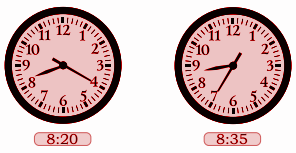
How much time has he taken? ________
Solution: 8:35 hours minus 8:20 hours equals 15 minutes. Therefore, Raghav has taken 15 minutes.
NCERT Textbook Pages 181-183 – Let us Do
Question 1.
Show appropriate time’on the clock as per instructions.
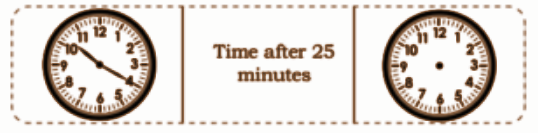
(a) Raghav started doing his homework at 10:20 AM. He took 25 minutes to finish it. Show the time that he finished his homework.
Solution:
10:20 hours plus 25 minutes equals 10:45 hours, or 10:45 AM.
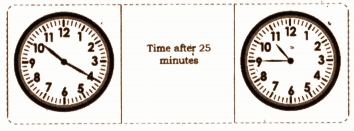
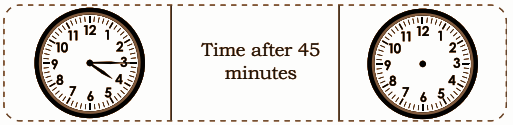
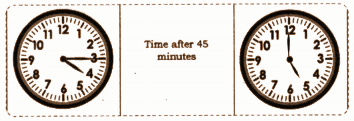
(b) Muneera begins reading a story at 4:15 PM and finishes it after 45 minutes. Indicate the time she completed reading the story.
Solution:
4:15 PM is equivalent to 16:15 hours. Adding 45 minutes to 16:15 hours gives 16:60 hours, which is 17:00 hours or 5:00 PM.
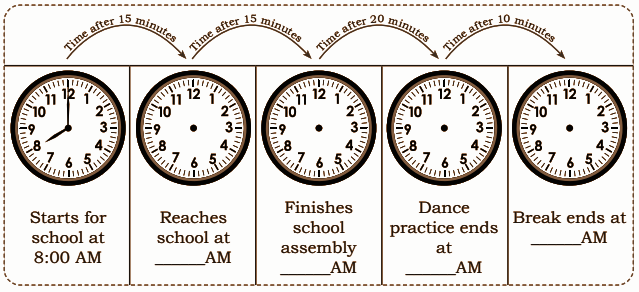
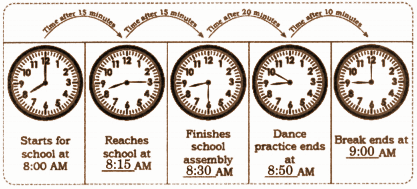
(c) Akira leaves for school at 8:00 AM She reaches school in 15 minutes.
Solution:
Akira arrives at school at:
8:00 AM + 15 minutes = 8:15 AM
She finishes the school assembly at:
8:15 AM + 15 minutes = 8:30 AM
The dance competition ends at:
8:30 AM + 20 minutes = 8:50 AM
The break ends at:
8:50 AM + 10 minutes = 9:00 AM
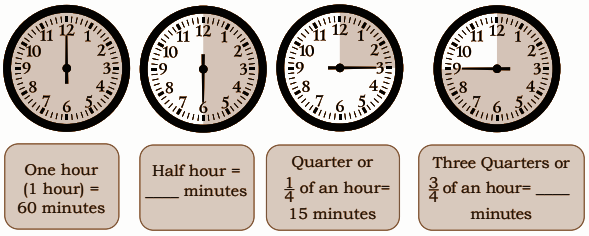
Who do you think is correct? Is there any relation between 1 hour and 60 minutes?
Solution:
Both are accurate, as 1 hour is equivalent to 60 minutes.
Pay attention to the shaded areas.
Find out how much time you take to
(а) boil milk
(b) fill water from tap in a bucket
What activities can you do in 5 minutes?
Solution:
Students should do it by themselves.
NCERT Textbook Page 183 – Let Us Check
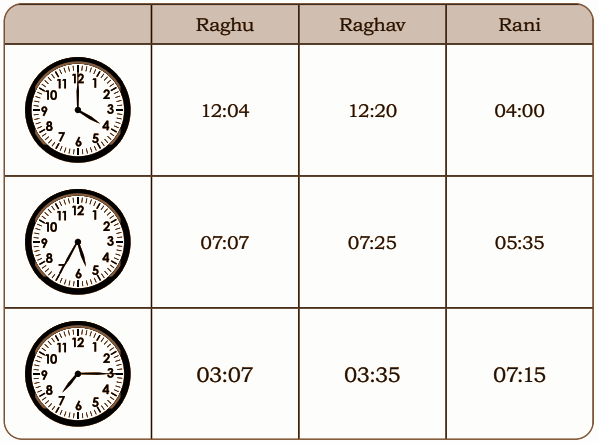
Three friends read time from a clock. Who is right? Discuss the error and explain how one reads the clock correctly.
Solution:
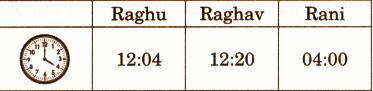
The minute hand is pointing at 12, and the hour hand is pointing at 4. Therefore, the correct time is 04:00, and Rani is right.

The hour hand is between 5 and 6, and the minute hand is pointing at 7. Therefore, the correct time is 05:35, and Rani is correct.
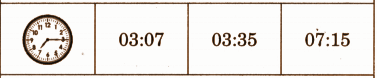
The hour hand is between 7 and 8, while the minute hand is pointing at 3. Therefore, the correct time is 07:15, and Rani is correct.
NCERT Solutions Class 4 Maths Chapter 12 Ticking Clocks And Turning Calendar
In Class 4 Maths Chapter 12, students learn to read ticking clocks, understand AM and PM, and use calendars. These NCERT Solutions for the 2026-27 session make concepts like leap year, months, days and digital time simple and fun.
Practising NCERT Solutions Class 4 Maths Chapter 12 Ticking Clocks And Turning Calendar helps children calculate durations, find dates and interpret 24-hour clock format. Regular revision of these time and calendar problems builds strong basics for higher classes and everyday life planning.
To score well, students should solve all textbook questions, observe real calendars and practise reading both analogue and digital clocks. Using these NCERT Solutions 2026-27 regularly will boost confidence, improve speed with time calculations and make exam preparation easier.
FAQs on NCERT Solutions For Class 4 Maths Chapter 12 Ticking Clocks And Turning Calendar - 2026-27 Free PDF Download (Sign-in Required)
1. What is Ticking Clocks And Turning Calendar in NCERT Solutions for Class 4 Maths Chapter 12?
Ticking Clocks And Turning Calendar in NCERT Solutions for Class 4 Maths Chapter 12 focuses on understanding time, reading clocks, and using calendars for dates and planning.
Key topics include:
- Reading analogue and digital clocks
- Identifying time intervals
- Understanding days, weeks, months, and years using the calendar
- Solving problems about time management
2. How can I score full marks in Class 4 Maths Chapter 12 Ticking Clocks And Turning Calendar?
You can score full marks in Class 4 Maths Chapter 12 by writing clear, stepwise solutions and following CBSE exam patterns.
Tips for full marks:
- Show all calculation steps and units (hours, minutes, days)
- Use neat diagrams when drawing clocks
- Write accurate definitions and label diagrams/maps properly
- Revise formulas and definitions from the chapter
3. Are diagrams or definitions required in NCERT Solutions Class 4 Maths Chapter 12 answers?
Yes, diagrams and definitions are important for Class 4 Maths Chapter 12 answers.
Earn extra marks by:
- Drawing neat clock faces for time-based questions
- Labeling all parts of a diagram
- Writing clear definitions for terms like 'o'clock', 'half past', 'calendar', etc.
4. Which topics from Ticking Clocks And Turning Calendar are most important for CBSE exams?
The most important topics in Ticking Clocks And Turning Calendar for CBSE exams are:
- Reading and drawing time on clocks
- Calculating elapsed time
- Using calendars to find days, dates, and months
- Relationship between time units (minutes, hours, days, weeks)
5. Where can I download Class 4 Maths Chapter 12 NCERT Solutions PDF?
You can download the free PDF of NCERT Solutions for Class 4 Maths Chapter 12 from trusted educational websites.
To access the PDF, look for:
- Download links on the chapter's solution page
- Official NCERT solution platforms
- CBSE-approved educational portals
6. How should long answers be structured for full marks in Class 4 Maths Chapter 12?
To score full marks for long answers in Class 4 Maths Chapter 12, follow a stepwise, well-organised structure:
- Start with a clear introduction or definition if required
- List all calculation steps one below the other
- Show diagrams or drawings with proper labels
- Write the final answer in a box or highlight it
7. Are NCERT Solutions enough for preparing Class 4 Maths Chapter 12 for school exams?
NCERT Solutions provide a strong foundation for CBSE Class 4 Maths Chapter 12 exam prep.
For best results:
- Practice all solved NCERT problems
- Attempt extra worksheet and exemplar questions if possible
- Revise with sample papers and mock tests
8. How can I learn to label diagrams or draw clocks neatly for this chapter?
Learn to label diagrams and draw clocks by:
- Practising stepwise drawing of clock faces during revision
- Using a sharp pencil and ruler for neatness
- Labeling hours, minutes, and hands clearly
- Following sample diagrams from NCERT Solutions
9. What are some common mistakes to avoid in Class 4 Maths Chapter 12?
Avoid these common mistakes in NCERT Solutions Class 4 Maths Chapter 12:
- Not labeling clock hands properly
- Writing incorrect units (minutes vs. hours)
- Skipping stepwise calculations
- Ignoring definitions or diagrams when required
10. Do examiners award partial marks for correct steps even if the final answer is wrong in Class 4 Maths?
Yes, CBSE examiners usually give partial marks for correct steps even if the final answer is incorrect in Class 4 Maths.
To maximise marks:
- Show all intermediate steps clearly
- Use proper units (minutes, hours, days)
- Box or highlight each step for clarity
11. Is referencing textbook page numbers useful during revision for Class 4 Maths?
Referencing textbook page numbers during revision helps you quickly locate important NCERT solutions, definitions, and solved examples for Class 4 Maths.
Benefits include:
- Easy access for last-minute exam revision
- Helps you cross-check answers with the textbook
- Makes it simpler to clarify doubts
