



Stepwise Answers for Elephants, Tigers and Leopards (Class 4 Maths)
NCERT Textbook Pages 149-150 NIM Game (2 Player Game)
You have played a version of this game in the chapter ‘Vacation with my Nani Maa’ in Grade 3. We will add either 1 or 2 each time to reach the target number 10.

Can you win the game if
(а) the other player has reached the total of 6 and it is your turn?
(b) the other player has reached the total of 7 and it is your turn?
(c) the other player has reached the total of 8 and it is your turn?
Solution:
(a) Yes, we can win. Add 1 to bring the total to 7. On the opponent's turn, they can add either 1 or 2. If they add 1, the total becomes 8, and on our turn, we can add 2 to reach 10 and win. If they add 2, the total becomes 9, and on our turn, we can add 1 to reach 10 and win.
(b) No, we cannot win. We can add either 1 or 2. If we add 1, the total becomes 8, and the opponent can add 2 to reach 10 and win. If we add 2, the total becomes 9, and the opponent can add 1 to reach 10 and win.
(c) Yes, we can win. Add 2 to bring the total to 10, and we win.
Play the game to reach target numbers like 10, 11, or 12 by adding 1 or 2 each time.
Can you find a number in each case when you are sure that you can win?
Solution:
Suppose the other player has reached a total of 9, and it’s our turn. We can add 1 to reach 10 and win. Similarly, we can identify certain numbers in each case where we are guaranteed to win if the target number is 11 or 12. For example, if the target number is 11 and the other player has reached 7, and it’s our turn, we can add 1 to reach 8. The opponent can either add 1 or 2. If they add 1, the total becomes 9, and on our turn, we can add 2 to win.
If they add 2, the total becomes 10, and on our turn, we can add 1 to reach 11 and win.
Likewise, if the target number is 12 and the other player has reached 8, and it’s our turn, we are guaranteed to win.
NCERT Textbook Pages 150-151 Addition Chart
Look at the table given below and discuss how the table is made.

Question 1.
Identify some patterns in the table.
Solution:
Here are some patterns observed in the table:
Adding 0 to any number keeps it the same.
The sum increases by 2 when moving diagonally.
Each row and column increases by 1 as we move to the right or downward.
The table is symmetrical across the main diagonal.
Question 2.
Observe the cells where the number 9 appears in the table. How many times do you see number 9?
What about other numbers?
Solution: There are ten 9's in the table. The patterns for the appearance of the numbers are as follows:
0 appears once, 1 appears twice, 2 appears three times, and so on, up to 12, which appears thirteen times. After that, the appearances decrease symmetrically: 13 appears twelve times, 14 appears eleven times, 15 appears ten times, and so on, with 24 appearing once.
Each number appears one more time than its value up to 12, after which the frequency of numbers starts to decrease symmetrically.
Question 3.
Are there any rows or columns that contain only even numbers or only odd numbers? Explain your observation.
Solution: Every row and column in the table contains both odd and even numbers. This occurs because the sum of two even numbers or two odd numbers results in an even number, while the sum of one odd and one even number results in an odd number.
Question 4.
Look at the window frame highlighted in red colour in the table.
(a) Find the sum of the two numbers in each row.
(b) Find the sum of the two numbers in each column. What do you notice?
(c) Now, find the sum of the numbers in each of the two diagonals marked by arrows. What do you notice?
(d) Now, put the red window frame in other places and find the sums as above. What do you notice?
Solution: (a) The sum of 10 and 11 is 10 + 11 = 21, and the sum of 11 and 12 is 11 + 12 = 23.
(b) In the column, the sum of 10 and 11 is 21, and the sum of 11 and 12 is 23. We again get the numbers 21 and 23 as the result.
(c) The sum of 10 and 12 is 22, and the sum of 11 and 11 is also 22. The sum of the numbers in both diagonals is the same.
(d) If we place a window frame around any two consecutive numbers in a row and column, the sum of the rows and columns will change, but the difference between the sums of any two rows, columns, and diagonals will remain constant.
Question 5.
Identify some patterns and relationships among the numbers in the blue window frame.
Solution: In the blue window frame, the numbers in each row and column are identical, and the difference between the sum of the numbers in each row and column is 3.
NCERT Textbook Page 151 – Reverse and Add
(a) Take a 2-digit number say, 27. Reverse its digits (72). Add them (99). Repeat for different 2-digit numbers.
Solution:
Some other such examples are as follows:
10 + 01 = 11
13 + 31 = 44
35 + 53 = 88
37 + 73 = 110, etc.
(b) What sums can we get when we add a 2-digit number with its reverse?
Solution:
Let’s add some 2-digit numbers and their reverse to identify any pattern.
10 + 01 = 11 = 1 × 11
11 + 11 = 22 = 2 × 11
12 + 21 = 33 = 3 × 11
13 + 31 = 44 = 4 × 11
18 + 81 = 99 = 9 × 11
99 + 99 = 198 = 18 × 11
It can be observed that when we add a two-digit number to its reverse, the result is a number that appears in the 11 times table.
(c) List down all numbers which when added to their reverse gives
(i) 55
(ii) 88
Solution:
(i) 14 + 41 = 55, 32 + 23 = 55, 50 + 05 = 55. Therefore, the numbers that, when added to their reverse, result in 55 are 14, 23, 32, 41, and 50.
(ii) 17 + 71 = 88, 26 + 62 = 88, 35 + 53 = 88, 44 + 44 = 88, 80 + 08 = 88. Therefore, the numbers that, when added to their reverse, result in 88 are 17, 26, 35, 44, 53, 62, 71, and 80.
(d) Can we get a 3-digit sum? What is the smallest 3-digit sum that we can get?
Solution: Yes, we can obtain a 3-digit sum by adding a two-digit number and its reverse. The smallest such 3-digit number is 110, as 19 + 91 equals 110.
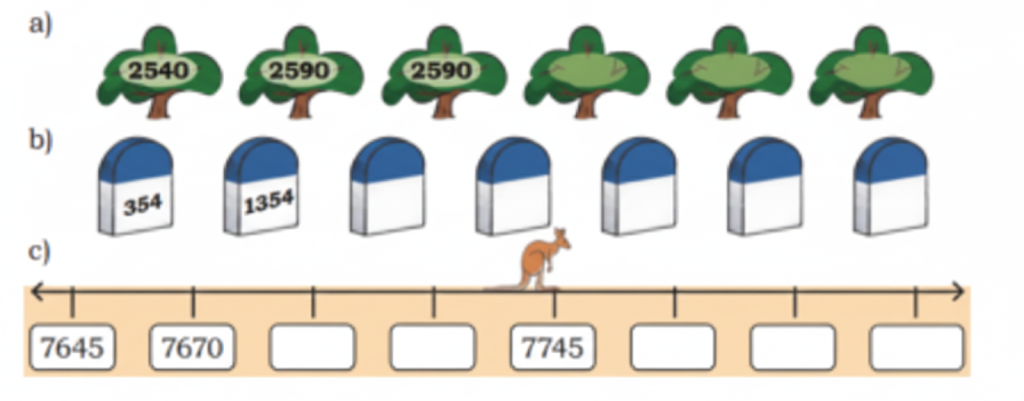
Fill the blanks with appropriate numbers.
Solution:
(a) Since 2590 – 2540 = 50, each number is obtained by adding 50 to the previous one.

(b) Since 1354 – 354 = 1000, each number is derived by adding 1000 to the previous one.

(c) Since 7670 – 7645 = 25, each number is formed by adding 25 to the previous one.

NCERT Textbook Pages 152-154 – How Many Animals?
India is rich in biodiversity. It is home to some of the endangered wildlife, like elephants, tigers and leopards.
\(\frac{3}{4}\) of the world’s tiger population and \(\frac{3}{5}\) of the Asiatic elephant population is in India.

Question 1.
The population of elephants in Karnataka is 6049 and in Kerala is 3054. How many total elephants are there in these two states? Estimate the answer.

Solution:
6000 + 3000 = 9000.
Therefore, there are approximately 9000 elephants in these two states.
Question 2.
The highest number of leopards are found in three states. Gujarat has 1355, Karnataka has 1131 and Madhya Pradesh has 1817.

How many total leopards are there in these states? Estimate the answer.
Solution:
1000 + 1000 + 2000 = 4000.
Question 3.
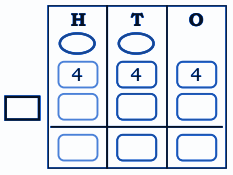
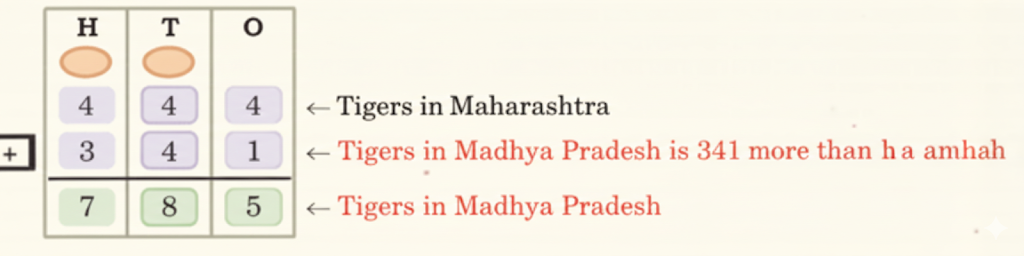
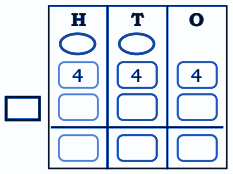
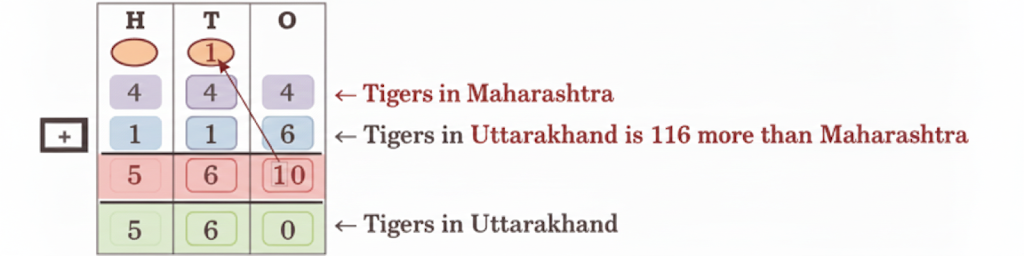
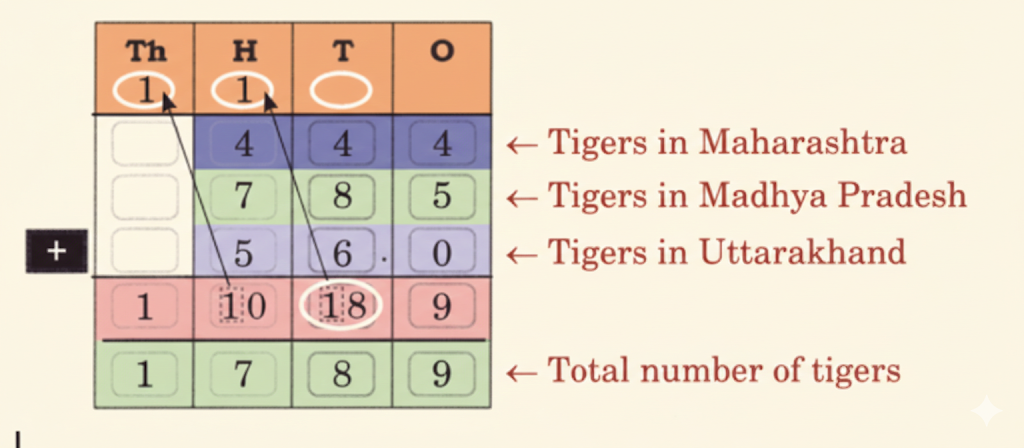
Maharashtra has 444 tigers. Madhya Pradesh has 341 more tigers than Maharashtra. Uttarakhand has 116 tigers more than Maharashtra.
(a) How many tigers does Madhya Pradesh have?
Solution: Madhya Pradesh
(b) How many tigers does Uttarakhand have?
Solution: Uttarakhand
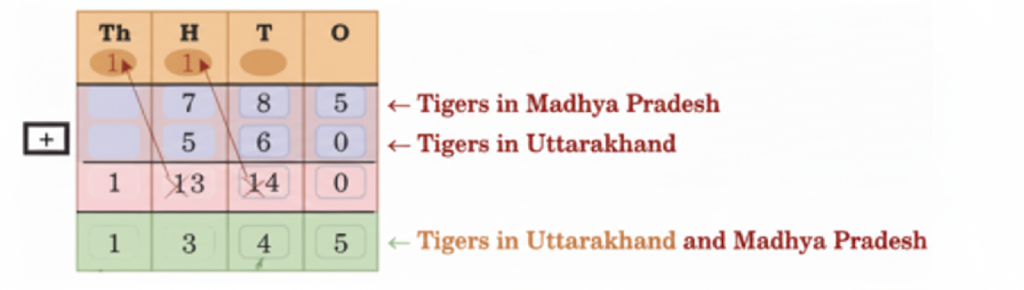
(c) How many tigers does Madhya Pradesh and Uttrakhand have?
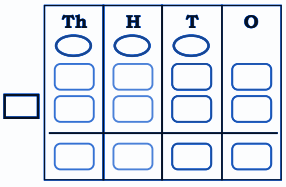
Solution: Madhya Pradesh
(d) How many tigers are there in total across the three states?
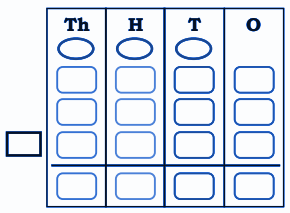
Solution:
3 States
NCERT Textbook Pages 155-156 – More or Less?
Question 1.
Assam has 5719 elephants. It has 3965 more elephants than Meghalaya. How many elephants are there in Meghalaya? Estimate the answer.

Solution:
6000 – 4000 = 2000
Thus, there are approximately 2000 elephants in Meghalaya.
Question 2.
The population of leopards as per the 2022 census was 8820 in the Central India and the Eastern Ghats. It had increased by 749 in comparison to the number of leopards in 2018 in the same region. How many leopards were there in 2018? Estimate the answer.

__________ leopards were there in 2018.
Solution:

There were about 8100 leopards in 2018.
Therefore, the exact number of leopards in 2018 was 8071.
Write the number of animals on this map based on the data from the problems in the previous pages.

Solution:

NCERT Textbook Pages 157-160 – Let Us Do
Question 1.
The board in the ticket office in the Kaziranga National Park shows the following:

(a) How many more visitors came in December than in November?
(b) The number of visitors in November is 1587 more than October. How many visitors were there in October?
Solution:
(a) The number of visitors in December was 8591, and in November it was 6415.
The difference between the number of visitors in these two months is 8591 – 6415 = 2176.
Therefore, December saw 2176 more visitors than November.
(b) The number of visitors in November was 6415.
Since the number of visitors in November was 1587 more than in October,
the number of visitors in October was 6415 – 1587 = 4828.
Thus, there were 4828 visitors in October.
Question 2.
In a juice making factory, women make different types of juices as given below:


(a) The number of bottles of guava juice is 759 more than the number of bottles of pineapple juice. Find the number of bottles of guava juice.
(b) The number of bottles of orange juice is 1257 more than the number of bottles of guava juice and 1417 less than the number of bottles of passion fruit juice. How many bottles of orange juice are made in a month?
(c) Is the total number of bottles of guava juice and orange juice more or less than the number of bottles of passion fruit juice? How much more or less?
Solution:
(a) The number of bottles of pineapple juice is 1348.
The number of bottles of guava juice is 759 more than the number of pineapple juice bottles.
Thus, the number of bottles of guava juice is 1348 + 759 = 2107.
Therefore, there are 2107 bottles of guava juice.
(b) The number of bottles of guava juice is 2107.
The number of bottles of orange juice is 1257 more than the number of bottles of guava juice.
Thus, the number of bottles of orange juice is 2107 + 1257 = 3364.
Therefore, 3364 bottles of orange juice are packed in a month.
(c) The total number of bottles of guava juice and orange juice is 2107 + 3364 = 5471.
The number of bottles of passion fruit juice is 4781.
Since 5471 - 4781 = 690,
the number of bottles of guava juice and orange juice is 690 more than passion fruit juice.
Question 3.
In a small town, the following vehicles were registered in the year 2022. Find the number of vehicles as per the conditions given below.
(a) The number of buses are 253 more than the number of jeeps. How many buses are there in the town?
(b) The number of tractors are 5247 less than the number of buses. How many tractors are in the town?
(c) The number of taxis is 1579 more than the number of tractors? How many taxis are there?
(d) Arrange the number of each type of vehicle from lowest to highest.

Solution:
(a) The number of jeeps is 6304.
The number of buses is 253 more than 6304, so 253 + 6304 = 6557.
Therefore, there are 6557 buses in the town.
(b) The number of buses is 6557.
The number of tractors is 5247 less than 6557, so 6557 – 5247 = 1310.
Therefore, there are 1310 tractors.
(c) The number of tractors is 1310.
The number of taxis is 1579 more than 1310, so 1579 + 1310 = 2889.
Therefore, there are 2889 taxis.
(d) The numbers are: Jeeps: 6304, Buses: 6557, Tractors: 1310, Taxis: 2889.
Arranged from lowest to highest, the order is: 1310, 2889, 6304, 6557.
Question 4.
Solve
a) 1459 + 476
b) 3863 + 4188
c) 5017 + 899
d) 4285 + 2132
e) 3158 + 1052
f) 7293 – 2819
g) 3105 – 1223
h) 8006 – 5567
i) 5000 – 4124
j) 9018 – 487
Solution:
(a) 1459 + 476 = 1935
(b) 3863 + 4188 = 8051
(c) 5017 + 899 = 5916
(d) 4285 + 2132 = 6417
(e) 3158 + 1052 = 4210
(f) 7293-2819 = 4474
(g) 3105 – 1223 = 1882
(h) 8006-5567 = 2439
(i) 5000-4124 = 876
(j) 9018-487 = 8531
Question 5.
The children in a school in Chittoor are planning to organise a Baal Mela in their school.
Raju, Rani and Roja decided to raise some money to make arrangements for the mela. The money is availabe in notes of 500, 100, 50, 10 and coins of 5, 2 and 1. They decide to put the money in the School Panchayat Bank.

Help each of the children fill the deposit slip given below.
Different combinations of notes can give the same amount. Can you guess a possible combination of notes they might have? Fill in the amounts appropriately.

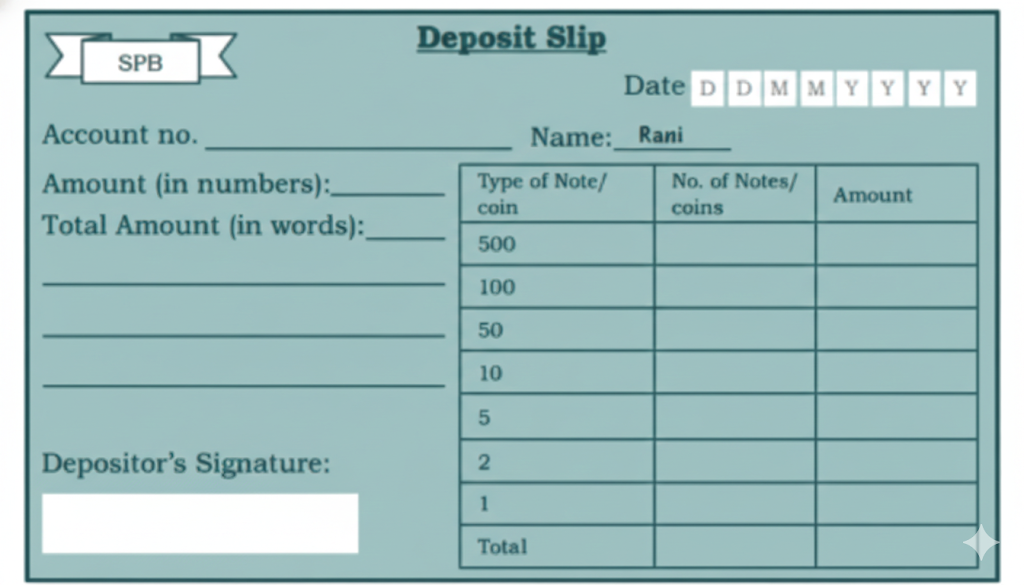
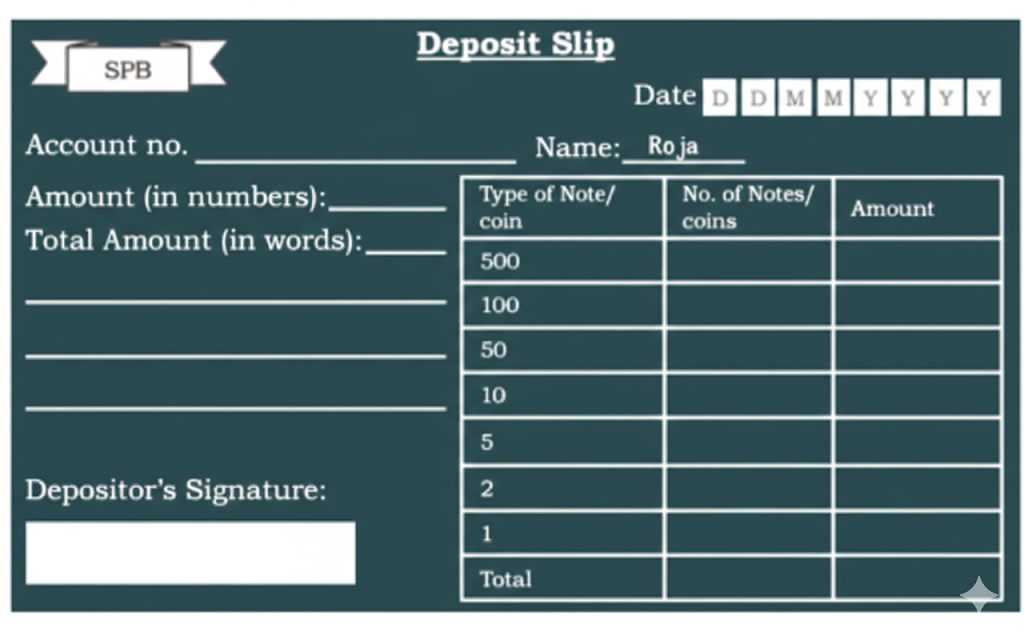
Solution:
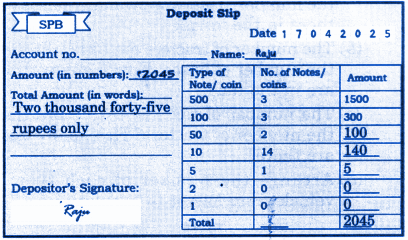
Another way to make the same amount is by using four 500-rupee notes, four 10-rupee notes, and one 5-rupee coin.

Another possible combination to make the same amount is: five 500-rupee notes, nine 100-rupee notes, three 50-rupee notes, five 5-rupee coins, and three 1-rupee coins.

Another possible combination is: one 500-rupee note, two 100-rupee notes, ten 50-rupee notes, and four 10-rupee notes. (The answer may vary for other possible combinations.)
NCERT Textbook Page 161 – Let Us Solve
Question 1. Solve
Solution:
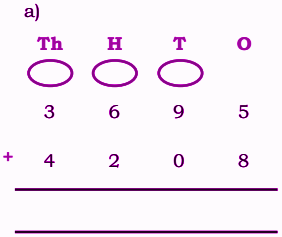
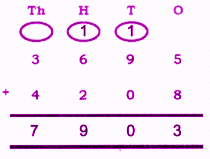
Solution:
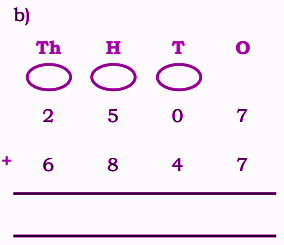
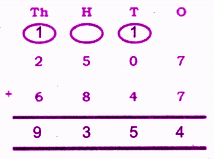
Solution:
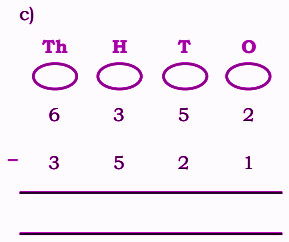
Solution:
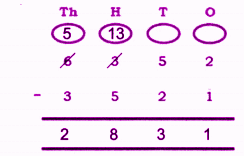
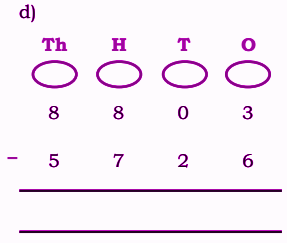
Solution:
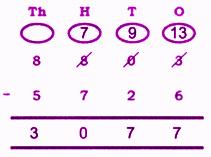
Question 2.
Arrange the following in columns and solve in your notebook.
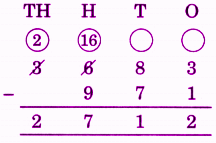
a) 3683 – 971
Solution:
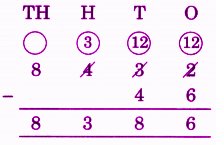
b) 8432-46
Solution:
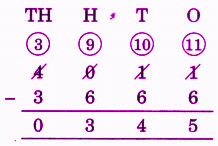
c) 4011 -3666
Solution:
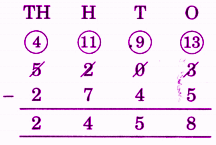
d) 5203 – 2745
Solution:
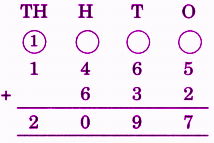
e) 1465 + 632
Solution:
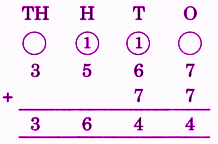
f) 3567 + 77
Solution:
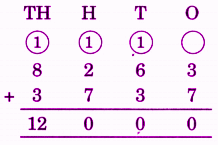
g) 8263 + 3737
Solution:
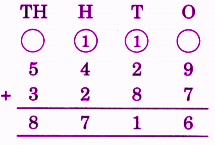
h) 5429 + 3287
Solution:
NCERT Textbook Page 162 – Let Us Solve
Question 1.
Find easy ways to solve the following problems. Write the answers in the given space. Share your thinking with the grade.
a) 8787 – 99 =__________
Solution:
8787 – 99 (Subtract 100, then add 1)
8787 – 100 = 8687
8687 + 1 = 8688
Therefore, 8787 – 99 = 8688
b) 4596 + 104=__________
Solution:
4596 + 104 (Add 100, then add 4)
4596 + 100 = 4696
4696 + 4 = 4700
Therefore, 4596 + 104 = 4700
c) 3459 + 21 =__________
Solution:
3459 + 21 (Add 1, then add 20)
3459 + 1 = 3460
3460 + 20 = 3480
Therefore, 3459 + 21 = 3480
d) 5010 + 95 =__________
Solution:
5010 + 95 (Add 100, then subtract 5)
5010 + 100 = 5110 5110-5 = 5105
Therefore, 5010 + 95 = 5105
e) 4990 + 310 =__________
Solution:
4990 + 310 (Add 10, then add 300)
4990 + 10 = 5000 5000 + 300 = 5300
Therefore, 4990 + 310 = 5300
f) 7844 – 15 =__________
Solution:
7844 – 15 (Subtract 20, then add 5)
7844 – 20 = 7824 7824 + 5 = 7829
Therefore, 7844 — 15 = 7829
g) 260 + 240 =__________
Solution:
260 + 240 (Add 200, then add 40)
260 + 200 = 460 460 + 40 = 500
Therefore, 260 + 240 = 500
h) 1575 – 125 =__________
Solution:
1575 – 125 (Subtract 100, then subtract 25)
1575 – 100 = 1475
1475 – 25 = 1450
Therefore, 1575 – 125 = 1450
i) 3999 + 290 =__________
Solution:
3999 + 290 (Add 1, then add 289)
3999 + 1 = 4000
4000 + 289 = 4289
Therefore, 3999 + 290 = 4289
Question 2.
Use the signs <, =, > as appropriate to compare the following without actually calculating. Try to reason them out and share in grade.

Solution:

The larger the number added to the same number, the greater the sum.

The result is larger when the same number is subtracted from a bigger number.
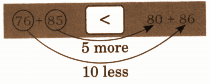

The larger the number subtracted from the same number, the smaller the difference.
Question 3.
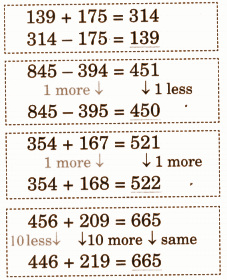
Use the given information to find the values. Share your reasoning with the grade.

Solution:
NCERT Textbook Page 163
Question 1.
Add
a) 2783 + 378
Solution:
\[\begin{array}{c@{}c@{}c@{}c@{}c} & 1 & 1 & 1 \\+ & 2 & 7 & 8 & 3 \\+ & 3 & 7 & 7 & 8 \\\hline & 3 & 1 & 6 & 1 \\\end{array}\]
b) 8948 + 97
Solution:
\[\begin{array}{c@{}c@{}c@{}c@{}c} & 1 & 1 & 1 \\+ & 8 & 9 & 4 & 8 \\+ & 9 & 7 \\\hline & 9 & 0 & 4 & 5 \\\end{array}\]
c) 7006 + 367
Solution:
\begin{array}{c@{}c@{}c@{}c@{}c} & 1 \\+ & 7 & 0 & 0 & 6 \\+ & 3 & 6 & 7 \\\hline & 7 & 3 & 7 & 3 \\\end{array}
d) 8009 + 485
Solution:
\begin{array}{c@{}c@{}c@{}c@{}c} & 1 \\+ & 8 & 0 & 0 & 9 \\+ & 4 & 8 & 5 \\\hline & 8 & 4 & 9 & 4 \\\end{array}
e) 6062 + 3809
Solution:
\begin{array}{c@{}c@{}c@{}c@{}c} & 1 \\+ & 6 & 0 & 6 & 2 \\+ & 3 & 8 & 0 & 9 \\\hline & 9 & 8 & 7 & 1 \\\end{array}
f) 3792 + 2688
Solution:
\begin{array}{c@{}c@{}c@{}c@{}c} & 1 & 1 & 1 \\+ & 3 & 7 & 9 & 2 \\+ & 2 & 6 & 8 & 8 \\\hline & 6 & 4 & 8 & 0 \\\end{array}
g) 4999 + 3888
Solution:
\begin{array}{c@{}c@{}c@{}c@{}c} & 1 & 1 & 1 \\+ & 4 & 9 & 9 & 9 \\+ & 3 & 8 & 8 & 8 \\\hline & 8 & 8 & 8 & 7 \\\end{array}
h) 5005 + 4895
Solution:
\begin{array}{c@{}c@{}c@{}c@{}c} & 1 & 1 \\+ & 5 & 0 & 0 & 5 \\+ & 4 & 8 & 9 & 5 \\\hline & 9 & 9 & 0 & 0 \\\end{array}
i) 5768 + 4053
Solution:
\begin{array}{c@{}c@{}c@{}c@{}c} & 1 & 1 \\+ & 5 & 7 & 6 & 8 \\+ & 4 & 0 & 5 & 3 \\\hline & 9 & 8 & 2 & 1 \\\end{array}
j) 3480 + 479
Solution:
\begin{array}{c@{}c@{}c@{}c@{}c}& 1 \\+ & 3 & 4 & 8 & 0 \\+ & 4 & 7 & 7 & 9 \\\hline & 3 & 9 & 5 & 9 \\\end{array}
Question 2.
Subtract.
a) 4456 – 2768
Solution:
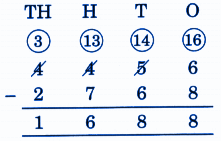
b) 5300 – 467
Solution:
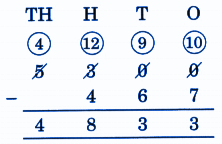
c) 8067 – 4546
Solution:
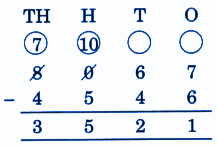
d) 5302 – 1034
Solution:
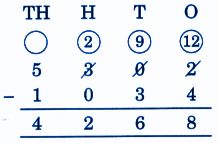
e) 8004 – 3107
Solution:
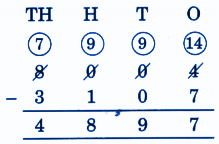
f) 3400 – 897
Solution:
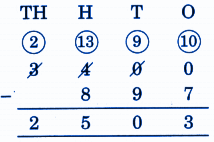
g) 9382 – 4857
Solution:
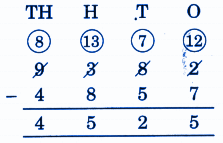
h) 7561 – 2933
Solution:
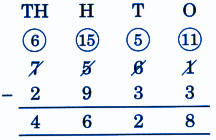
i) 6478 – 5986
Solution:
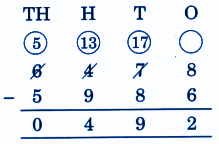
j) 3444 – 2555
Solution:
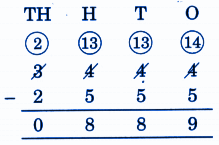
Question 3.
Fill the squares with the numbers 1-9. The difference between any two neighbouring squares (connected by a line) must be odd.

Can you find other ways to fill the squares? Solution:Yes, we can fill the squares in many ways.
For example, –
Solution:
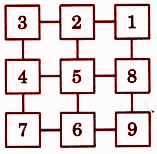
Can you do the same thing such that the difference between any two neighbouring squares is even?
Solution: No, it is not possible to fill the squares such that the difference between any two neighboring squares is even. This is because the difference between two odd numbers or two even numbers is always even. Therefore, it is not possible to place an even number next to an odd number, or vice versa, in the given connected squares.
NCERT Solutions for Class 4 Maths Chapter 10 Elephants Tigers And Leopards (2026-27)
With NCERT Solutions Class 4 Maths Chapter 10 Elephants Tigers And Leopards, children practice big-number addition and subtraction using real data about animals. These step-by-step solutions make place value and regrouping easy to understand.
This chapter links wildlife facts with maths. By revising the 2026-27 NCERT exercises, students learn to read tables, compare numbers and solve word problems about elephants, tigers and leopards confidently for school exams.
Practice every question from Class 4 Maths Chapter 10 and recheck answers using written steps, not mental maths alone. Focus on keywords like “more than”, “together” and “total” to avoid mistakes and improve your overall maths accuracy.
FAQs on NCERT Solutions For Class 4 Maths Chapter 10 Elephants Tigers And Leopards - 2026-27 Free PDF Download (Login Required)
1. What are the solutions for Class 4 Maths Chapter 10?
NCERT Solutions for Class 4 Maths Chapter 10 provide stepwise answers for each question based on the syllabus.
Key highlights:
- Complete solutions for all exercises in Elephants Tigers And Leopards
- Exam-ready explanations with simple steps
- Includes diagrams and definitions where necessary
- Useful for CBSE 2026–27 exam preparation
- Free PDF download for offline study
2. How to score full marks in Elephants, Tigers And Leopards?
To score full marks in Class 4 Maths Chapter 10, follow these simple tips:
- Write stepwise answers using the NCERT Solutions for Class 4 Maths Chapter 10
- Use proper mathematical words and clear diagrams
- Label all diagrams neatly
- Mention definitions and formulae where needed
- Revise using practice PDFs and sample papers
3. Is diagram important in Class 4 Chapter 10?
Yes, diagrams are important in NCERT Solutions Class 4 Maths Chapter 10 Elephants Tigers And Leopards as they help explain concepts clearly and help you earn extra marks.
- Label diagrams properly for full marks
- Neatness and correct representation are key
4. Are NCERT Solutions enough for Class 4 Maths exams?
NCERT Solutions for Class 4 Maths Chapter 10 are generally sufficient for most school exams because they match the syllabus and CBSE marking scheme.
- Practice NCERT questions thoroughly
- Revise definitions, diagrams, and solved examples
- Attempt sample papers for extra practice
5. Where to get chapterwise solutions PDF for offline study?
You can download the Class 4 Maths Chapter 10 PDF solutions for offline study from trusted educational websites.
- Free single-click PDF downloads are available
- Contains stepwise answers for every exercise
- Accessible for quick revision anytime
6. How to present long answers to match CBSE marking?
Presenting long answers for NCERT Class 4 Maths Chapter 10 should follow CBSE guidelines:
- Start with a brief introduction/definition
- Show all calculation steps neatly
- Include proper diagrams or tables where asked
- Highlight key terms and formulae
- Keep the answer structured and avoid skipping steps
7. What are the most important topics from this chapter?
The most important topics in Chapter 10 Elephants Tigers And Leopards are:
- Animal classification and counting
- Understanding bar graphs or data representation
- Simple addition and subtraction with examples
- Identification of key mathematical terms and diagrams
- Word problems based on the chapter
8. How to learn diagrams/maps for this chapter?
To learn and draw diagrams for Class 4 Maths Chapter 10:
- Practice drawing all important diagrams from the textbook and solutions
- Label every part clearly
- Use a ruler and pencil for neatness
- Study sample labelled diagrams from the PDF
9. Do examiners award partial marks for correct steps even if the final answer is wrong?
Yes, CBSE examiners often give partial marks for correct steps shown in NCERT Solutions Class 4 Maths Chapter 10—even if the final answer is incorrect.
- Always write complete working steps
- Follow the standard stepwise marking scheme
10. Are references to textbook page numbers useful during revision?
Referencing NCERT textbook page numbers during revision helps you quickly locate important topics and practice questions for Class 4 Maths Chapter 10.
- Makes self-study and targeted revision easier
- Improves exam preparation and recall
11. Which questions are likely from this chapter in school exams?
For CBSE Class 4 Chapter 10, questions are usually based on:
- Counting and grouping of animals
- Bar graphs/diagrams interpretation
- Short word problems and definitions
- Direct questions from NCERT intext and back exercises
12. How do I structure long answers for better marks?
To structure long answers in NCERT Solutions Class 4 Maths Chapter 10:
- Start with an introduction or statement of concept
- Include each calculation step clearly
- Add required diagrams, formulas, or definitions in between steps
- End with a conclusion or final answer
