






Paper Boats Questions and Answers - Free PDF Download
This chapter tells the story of Meena, who loves making and sailing paper boats in a stream. When a mischievous boy disrupts her fun, she confronts him and teaches him how to make his boats. They learn the value of sharing, cooperation, and enjoying activities together through their interaction.
 Table of Content
The complete NCERT Class 3 English Chapter 6 Question Answer is updated for the latest CBSE Class 3 English syllabus. Our FREE PDF download includes detailed question answers, making it easy for students to understand and learn. This resource is designed to enhance comprehension and increase the confidence in English.
Glance on Class 3 English Chapter 6 - Paper Boats
Meena enjoys putting paper boats in the stream near a bamboo bridge and feels delighted watching them sail swiftly.
Meena notices a boy overturning her boat and gets angry. Despite her protests, the boy continues his mischief, finding it fun.
Meena confronts the boy, who admits he finds overturning the boats fun. She firmly tells him to stop since the boats are hers.
The boy asks for Meena's help, expressing his desire to play but not knowing how to make paper boats. Meena agrees to teach him.
Meena shows the boy how to fold paper to make boats using coloured paper of different sizes. The boy learns quickly and starts making his boats.
Meena and the boy put their boats in the stream and enjoy watching them sail together, illustrating cooperation and shared fun.
A. Answer the following.
1. What was Meena playing with?
Ans. Meena was playing with paper boats.
2. Meena was angry. Why?
Ans. Meena was angry as there was a boy who was overturning all the boats she had left sailing on the water.
3. How did Meena help the boy?
Meena helped by making paper boats for the boy.
B. Think and answer.
1. Meena made paper boats. What else can you make with paper? Discuss in small groups.
Ans. We can make airplanes, and origami with paper.
2. What games do you play with your friends? Which one do you like the most? Why?
Ans. We play lock and tag, hide and seek, basketball and running-and-catching together as friends. Hide and seek is my favourite due to the thrill of hiding from the catcher.
C. Say whether True or False.
1. The boy thought it was fun to overturn paper boats.
Ans. True
2. Meena ran home to complain about the boy.
Ans. False
3. The boy did not know how to make paper boats.
Ans. True
4. Meena had only white paper.
Ans. False
A. Fill in the blanks using ‘he’ or ‘she’.
1. Rani likes playing outside.
Ans. She likes flying kites.
2. Sahil has a top.
Ans. She plays with it every day.
3. Durga is five years old.
Ans. She is going to school.
4. Ranjit goes to school, regularly.
Ans. He likes reading stories.
B. Look at the picture.
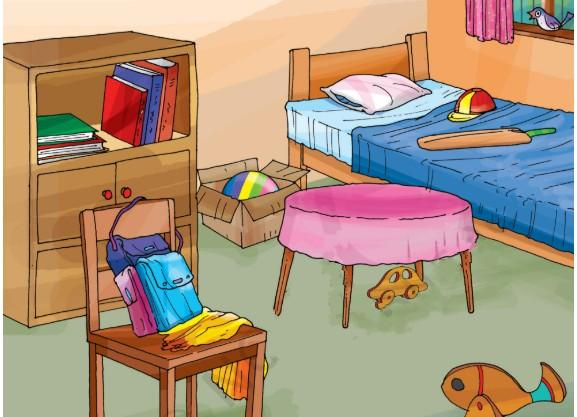
Write where each thing is. Choose the correct word from the brackets.
1. The bat is (on/under) the bed.
Ans. On
2. The bag is (in/on) the chair.
Ans. On
3. The ball is (in/under) the box.
Ans. In
4. The car is (in/under) the table.
Ans. Under
5. The books are (in/on) the shelves.
Ans. On
Benefits of Class 3 English Chapter 6 Question Answers
Class 3 English Lesson 6 Question Answers provide detailed explanations of the story, helping students grasp the moral lessons about sharing and cooperation.
The solutions Break down the text and vocabulary, making it easier for students to understand the context and characters' actions.
Offers clear answers to textbook questions, aiding students in completing their assignments accurately and efficiently.
Class 3 English Lesson 6 Question Answers encourage critical thinking and discussion about empathy, cooperation, and problem-solving in real-life situations.
NCERT Solutions include engaging exercises and activities related to the story, making learning fun and interactive for students.
It helps students feel more prepared and confident in understanding the chapter's themes and content.
The Class 3 English Chapter 6 Question Answer PDF is available for FREE download so that students can easily access it as and when they need it.
Conclusion
In this chapter, Meena and a mischievous boy learn the importance of cooperation and empathy. Initially upset by the boy's actions, Meena teaches him how to make paper boats, leading to a shared enjoyment of the activity. Their interaction highlights the value of understanding and working together, making the story a heartwarming lesson in friendship and kindness. You can easily access and download the FREE Class 3 English Chapter 6 PDF from Vedantu updated for the 2026-27 syllabus. Students can refer to these solutions to perform better in their examinations.
Chapter-wise NCERT Solutions Class 3 English - Santoor
After familiarising yourself with the Class 3 English Unit 6 Question Answers, you can access comprehensive NCERT Solutions from all English Class 3 Santoor textbook chapters.
FAQs on NCERT Solutions For Class 3 English Santoor Chapter 6 Paper Boats - 2026-27 Free PDF Download (Login Required)
1. How can I find the correct solutions for all questions in NCERT Class 3 English Chapter 6, 'Paper Boats'?
You can find comprehensive, step-by-step NCERT Solutions for Class 3 English Chapter 6, 'Paper Boats', on Vedantu. These solutions are prepared by expert teachers and are fully aligned with the latest CBSE 2026-27 syllabus, providing clear answers for all in-text questions to help you understand the chapter thoroughly.
2. What did Meena enjoy doing by the stream in the story 'Paper Boats'?
In the story 'Paper Boats', Meena enjoyed making and floating colourful paper boats in the stream. She felt happy and accomplished as she watched them sail swiftly down the water near a bamboo bridge.
3. How is the conflict between Meena and the boy introduced in the chapter?
The conflict begins when a boy suddenly appears and starts overturning Meena’s paper boats one by one. His actions ruin Meena's fun and make her very angry and frustrated, setting up the main problem in the story.
4. Why did the boy keep overturning Meena’s paper boats, and what does this show about him at first?
The boy overturned the boats simply because he found it to be a fun and mischievous game. Initially, he did not consider Meena's feelings or the effort she put into making them. This shows that at first, he was thoughtless and a bit selfish, but not necessarily mean, as he was willing to learn and play together later.
5. What was Meena's step-by-step method for resolving the conflict with the boy?
Meena used a very mature, step-by-step method to solve the problem. Here is how she did it:
- First, she firmly told the boy to stop his disruptive behaviour.
- Next, she realised he also wanted to play, so she showed empathy instead of staying angry.
- Finally, she offered to teach him how to make his own boats, turning a conflict into a cooperative activity.
6. How does Meena’s character show growth from being angry to becoming a helpful teacher?
Meena’s character shows significant growth. She starts off feeling angry and frustrated when her boats are ruined. However, she quickly moves past her anger and shows patience and empathy by choosing to teach the boy instead of continuing to argue. This demonstrates her ability to solve problems constructively and her understanding of sharing and friendship.
7. What is the main lesson about cooperation that 'Paper Boats' teaches students?
The main lesson in 'Paper Boats' is that cooperation and sharing are much more rewarding than conflict. The story teaches that by working together and understanding each other's feelings, you can turn a negative situation into a positive one and find greater happiness in shared activities.
8. What does it mean when the story says the boats 'sailed swiftly'?
When the story says the boats 'sailed swiftly', it means they moved very quickly and smoothly through the water. The word 'swiftly' helps us imagine the boats gliding effortlessly down the stream, which was a sight that brought Meena great joy and a sense of accomplishment.
9. Besides making more boats, how else could Meena and the boy have cooperated?
After making boats together, Meena and the boy could have cooperated in other fun ways. For instance, they could have:
- Held friendly races to see whose paper boat was the fastest.
- Decorated their boats with small flowers or leaves to make them unique.
- Worked together to clear small twigs from the stream's path to help their boats sail even further.
10. What moral values are most important in this chapter for a Class 3 student?
The most important moral values highlighted in this chapter are empathy (understanding others' feelings), forgiveness (not staying angry), and cooperation (working together). It shows that being kind and sharing can help you make new friends and have more fun.
