



Maths Class 11 Chapter 10 Questions and Answers - Free PDF Download
Get the FREE PDF of NCERT Solutions for Class 11 Maths Chapter 10 - Conic Sections: Exercise 10.1. This exercise covers important topics of circles including how to derive the equation, locate the centre, diameter, and radius of a circle which are key parts of the Class 11 Maths Syllabus. The Class 11 Maths NCERT Solutions will help you understand the concepts step by step and solve problems with ease, making your preparation smoother.
 Table of Content
To access these solutions, click on the link below. This PDF will not only help you with your homework but also serve as a quick revision guide before exams. Make sure to download it and keep it handy!
Formulas Used in Class 11 Maths Exercise 10.1
Exercise 10.1 focuses on circles as part of the conic sections, and the following key formulas are used:
1. Standard Equation of a Circle:
- $(x - h)^2 + (y - k)^2 = r^2$, where $(h, k)$ is the centre of the circle and $r$ is the radius.
2. Equation of a Circle with centre at the Origin:
- $x^2 + y^2 = r^2$, where the centre is at $(0, 0)$ and $r$ is the radius.
3. Distance Formula (to find radius if centre and a point on the circle are given):
- $d = \sqrt{(x_2 - x_1)^2 + (y_2 - y_1)^2}$, where $(x_1, y_1)$ is the centre and $(x_2, y_2)$ is a point on the circle.
4. General Equation of a Circle:
$x^2 + y^2 + 2gx + 2fy + c = 0$, where $(-g, -f)$ is the centre, and the radius is $\sqrt{g^2 + f^2 - c}$.


Exercise 10.1
1. Find the equation of the circle with centre (0,2) and radius 2
Ans: The equation of a circle with centre (h,k) and radius (r) is given as
${{(x-h)}^{2}}+{{(y-k)}^{2}}={{r}^{2}}$
It is given that centre $(h,k)=(0,2)$ and radius $(r)=2.$
Therefore, the equation of the circle is
${{(x-0)}^{2}}+{{(y-2)}^{2}}={{2}^{2}}$
$\begin{align} & {{x}^{2}}+{{y}^{2}}+4-4y=4 \\ & {{x}^{2}}+{{y}^{2}}-4y=0 \\ \end{align}$
2. Find the equation of the circle with centre (-2,3) and radius 4
Ans: The equation of a circle with centre (h,k) and radius (r) is given as
${{(x-h)}^{2}}+{{(y-k)}^{2}}={{r}^{2}}$
It is given that centre (h,k)=(-2,3) and radius (r)=4.
Therefore, the equation of the circle is
${{(x+2)}^{2}}+{{(y-3)}^{2}}={{(4)}^{2}}$
$\begin{align} & {{x}^{2}}+4x+4+{{y}^{2}}-6y+9=16 \\ & {{x}^{2}}+{{y}^{2}}+4x-6y-3=0 \\ \end{align}$
3. Find the equation of the circle with centre $\left( \dfrac{1}{2},\dfrac{1}{4} \right)$ and radius $\left( \dfrac{1}{12} \right)$
Ans: The equation of a circle with centre (h,k) and radius (r) is given as
${{(x-h)}^{2}}+{{(y-k)}^{2}}={{r}^{2}}$
It is given that centre $(h,k)=\left( \dfrac{1}{2},\dfrac{1}{4} \right)$ and radius $(r)=\left( \dfrac{1}{12} \right).$
Therefore, the equation of the circle is
${{\left( x-\dfrac{1}{2} \right)}^{2}}+{{\left( y-\dfrac{1}{4} \right)}^{2}}={{\left( \dfrac{1}{12} \right)}^{2}}$
${{x}^{2}}-x+\dfrac{1}{4}+{{y}^{2}}-\dfrac{y}{2}+\dfrac{1}{16}=\dfrac{1}{144}$
${{x}^{2}}-x+\dfrac{1}{4}+{{y}^{2}}-\dfrac{y}{2}+\dfrac{1}{16}-\dfrac{1}{144}=0$
$144{{x}^{2}}-144x+36+144{{y}^{2}}-72y+9-1=0$ (Solve by taking LCM)
$144{{x}^{2}}-144x+144{{y}^{2}}-72y+44=0$
$36{{x}^{2}}-36x+36{{y}^{2}}-18y+11=0$
$36{{x}^{2}}+36{{y}^{2}}-36x-18y+11=0$
4. Find the equation of the circle with centre (1,1) and radius $\sqrt{2}$
Ans: The equation of a circle with centre (h,k) and radius (r) is given as
${{(x-h)}^{2}}+{{(y-k)}^{2}}={{r}^{2}}$
It is given that centre (h,k)=(1,1) and radius $(r)=\sqrt{2}.$
Therefore, the equation of the circle is
${{(x-1)}^{2}}+{{(y-1)}^{2}}={{(\sqrt{2})}^{2}}$
$\begin{align} & {{x}^{2}}-2x+1+{{y}^{2}}-2y+1=2 \\ & {{x}^{2}}+{{y}^{2}}-2x-2y=0 \\ \end{align}$
5. Find the equation of the circle with centre (-a,-b) and radius $\sqrt{{{a}^{2}}-{{b}^{2}}}$
Ans: The equation of a circle with centre (h,k) and radius (r) is given as
${{(x-h)}^{2}}+{{(y-k)}^{2}}={{r}^{2}}$
It is given that centre (h,k)=(-a,-b) and radius $(r)=\sqrt{{{a}^{2}}-{{b}^{2}}}.$
Therefore, the equation of the circle is
${{(x+a)}^{2}}+{{(y+b)}^{2}}={{(\sqrt{{{a}^{2}}-{{b}^{2}}})}^{2}}$
$\begin{align} & {{x}^{2}}+2ax+{{a}^{2}}+{{y}^{2}}+2by+{{b}^{2}}={{a}^{2}}-{{b}^{2}} \\ & {{x}^{2}}+{{y}^{2}}+2ax+2by+2{{b}^{2}}=0 \\ \end{align}$
6. Find the centre and radius of the circle ${{(x+5)}^{2}}+{{(y-3)}^{2}}=36$
Ans: The equation of the given circle is ${{(x+5)}^{2}}+{{(y-3)}^{2}}=36$
${{(x+5)}^{2}}+{{(y-3)}^{2}}=36$
$\Rightarrow {{\{x-(-5)\}}^{2}}+{{(y-3)}^{2}}={{(6)}^{2}}$, which is the form of ${{(x-h)}^{2}}+{{(y-k)}^{2}}={{r}^{2}}$, where $h=-5,k=3,and\; r=6$.
Thus, the centre of the given circle is $(-5,3),$ while its radius is 6.
7. Find the centre and radius of the circle ${{x}^{2}}+{{y}^{2}}-4x-8y-45=0$
Ans: The equation of the given circle is ${{x}^{2}}+{{y}^{2}}-4x-8y-45=0$
$\Rightarrow {{x}^{2}}+{{y}^{2}}-4x-8y-45=0$
$\Rightarrow ({{x}^{2}}-4x)+({{y}^{2}}-8y)=45$
$\Rightarrow \{{{x}^{2}}-2(x)(2)+{{(2)}^{2}}\}+\{{{y}^{2}}-2(y)(4)+{{(4)}^{2}}\}-4-16=45$
$\Rightarrow {{(x-2)}^{2}}+{{(y-4)}^{2}}=65$
$\Rightarrow {{(x-2)}^{2}}+{{(y-4)}^{2}}={{\left( \sqrt{65} \right)}^{2}},$ which is of the form ${{(x-h)}^{2}}+{{(y-k)}^{2}}={{r}^{2}}$, where $h=2,k=4,and\; r=\sqrt{65}$
Thus, the centre of the given circle is $(2,4),$while its radius is $\sqrt{65}$.
8. Find the centre and radius of the circle ${{x}^{2}}+{{y}^{2}}-8x+10y-12=0$
Ans: The equation of the given circle is ${{x}^{2}}+{{y}^{2}}-8x+10y-12=0$
$\Rightarrow {{x}^{2}}+{{y}^{2}}-8x+10y-12=0$
$\Rightarrow ({{x}^{2}}-8x)+({{y}^{2}}+10y)=12$
$\Rightarrow \{{{x}^{2}}-2(x)(4)+{{(4)}^{2}}\}+\{{{y}^{2}}+2(y)(5)+{{(5)}^{2}}-16-25=12$
$\Rightarrow {{(x-4)}^{2}}+{{(y+5)}^{2}}=53$
$\Rightarrow {{(x-4)}^{2}}+{{\{y-(-5)\}}^{2}}={{\left( \sqrt{53} \right)}^{2}},$ which is of the form ${{(x-h)}^{2}}+{{(y-k)}^{2}}={{r}^{2}}$, where $h=4,k=-5,and\; r=\sqrt{53}$
Thus, the centre of the given circle is $(4,-5),$ while its radius is $\sqrt{53}$.
9. Find the centre and radius of the circle $2{{x}^{2}}+2{{y}^{2}}-x=0$
Ans: The equation of the given circle is $2{{x}^{2}}+2{{y}^{2}}-x=0$
$\Rightarrow 2{{x}^{2}}+2{{y}^{2}}-x=0$
$\Rightarrow (2{{x}^{2}}-x)+2{{y}^{2}}=0$
$\Rightarrow 2\left[ \left( {{x}^{2}}-\dfrac{x}{2} \right)+{{y}^{2}} \right]=0$
$\Rightarrow \left\{ {{x}^{2}}-2.x\left( \dfrac{1}{4} \right)+{{\left( \dfrac{1}{4} \right)}^{2}} \right\}+{{y}^{2}}-{{\left( \dfrac{1}{4} \right)}^{2}}=0$
$\Rightarrow {{\left( x-\dfrac{1}{4} \right)}^{2}}+{{\left( y-0 \right)}^{2}}={{\left( \dfrac{1}{4} \right)}^{2}},$ which is of the form ${{(x-h)}^{2}}+{{(y-k)}^{2}}={{r}^{2}}$, where $h=\dfrac{1}{4},k=0,$ and $r = \dfrac{1}{4}$
Thus, the centre of the given circle is $\left( \dfrac{1}{4},0 \right),$ while its radius is $\dfrac{1}{4}$.
10. Find the equation of the circle passing through the points $(4,1)$ and $(6,5)$ and whose centre is on the line $4x+y=16$
Ans: Let the equation of the required circle be ${{(x-h)}^{2}}+{{(y-k)}^{2}}={{r}^{2}}$
Since the circle passes through points $(4,1)$ and $(6,5)$,
${{(4-h)}^{2}}+{{(1-k)}^{2}}={{r}^{2}}$ ………(i)
${{(6-h)}^{2}}+{{(5-k)}^{2}}={{r}^{2}}$ ………(ii)
Since the centre (h,k) of the circle lies on line $4x+y=16,$
$4h+k=16$ ………(iii)
From equations (i) and (ii), we get
$\Rightarrow {{(4-h)}^{2}}+{{(1-k)}^{2}}={{(6-h)}^{2}}+{{(5-k)}^{2}}$
$\Rightarrow 16-8h+{{h}^{2}}+1-2k+{{k}^{2}}=36-12h+{{h}^{2}}+25-10k+{{k}^{2}}$
$\begin{align} & \Rightarrow 16-8h+1-2k=36-12h+25-10k \\ & \Rightarrow 4h+8k=44 \\ \end{align}$
$\Rightarrow h+2k=11$ ………(iv)
On solving equations (iii) and (iv), we obtain $h=3$ and $k=4$
On substituting the values of h and k in equation (i), we obtain
${{(4-3)}^{2}}+{{(1-4)}^{2}}={{r}^{2}}$
$\Rightarrow {{(1)}^{2}}+{{(-3)}^{2}}={{r}^{2}}$
$\Rightarrow 1+9={{r}^{2}}$
$\begin{align} & \Rightarrow {{r}^{2}}=10 \\ & \Rightarrow r=\sqrt{10} \\ \end{align}$
Thus, the equation of the required circle is
${{(x-3)}^{2}}+{{(y-4)}^{2}}={{\left( \sqrt{10} \right)}^{2}}$
$\begin{align} & {{x}^{2}}-6x+9+{{y}^{2}}-8y+16=10 \\ & {{x}^{2}}+{{y}^{2}}-6x-8y+15=0 \\ \end{align}$
11. Find the equation of the circle passing through the points (2,3) and (-1,1) and whose centre is on the line $x-3y-11=0$
Ans: Let the equation of the required circle be ${{(x-h)}^{2}}+{{(y-k)}^{2}}={{r}^{2}}$
Since the circle passes through points $(2,3)$ and $(-1,1)$,
${{(2-h)}^{2}}+{{(3-k)}^{2}}={{r}^{2}}$ ………(i)
${{(-1-h)}^{2}}+{{(1-k)}^{2}}={{r}^{2}}$ ………(ii)
Since the centre (h,k) of the circle lies on line $x-3y-11=0$
$h-3k=11$ ………(iii)
From equations (i) and (ii), we get
$\Rightarrow {{(2-h)}^{2}}+{{(3-k)}^{2}}={{(-1-h)}^{2}}+{{(1-k)}^{2}}$
$\Rightarrow 4-4h+{{h}^{2}}+9-6k+{{k}^{2}}=1+2h+{{h}^{2}}+1-2k+{{k}^{2}}$
$\Rightarrow 4-4h+9-6k=1+2h+1-2k$
$\Rightarrow 6h+4k=11$ ………(iv)
On solving equations (iii) and (iv), we obtain $h=\dfrac{7}{2}$ and $k=\dfrac{-5}{2}$
On substituting the values of h and k in equation (i), we obtain
$\Rightarrow {{\left( 2-\dfrac{7}{2} \right)}^{2}}+{{\left( 3+\dfrac{5}{2} \right)}^{2}}={{r}^{2}}$
$\Rightarrow {{\left( \dfrac{4-7}{2} \right)}^{2}}+{{\left( \dfrac{6+5}{2} \right)}^{2}}={{r}^{2}}$
$\Rightarrow {{\left( \dfrac{-3}{2} \right)}^{2}}+{{\left( \dfrac{11}{2} \right)}^{2}}={{r}^{2}}$
$\begin{align} & \Rightarrow \dfrac{9}{4}+\dfrac{121}{4}={{r}^{2}} \\ & \Rightarrow \dfrac{130}{4}={{r}^{2}} \\ \end{align}$
Thus, the equation of the required circle is
${{\left( x-\dfrac{7}{2} \right)}^{2}}+{{\left( y+\dfrac{5}{2} \right)}^{2}}=\dfrac{130}{4}$
$\begin{align} & {{\left( \dfrac{2x-7}{2} \right)}^{2}}+{{\left( \dfrac{2y+5}{2} \right)}^{2}}=\dfrac{130}{4} \\ & 4{{x}^{2}}-28x+49+4{{y}^{2}}+20y+25=130 \\ \end{align}$
$\begin{align} & 4{{x}^{2}}+4{{y}^{2}}-28x+20y-56=0 \\ & 4({{x}^{2}}+y{}^{2}-7x+5y-14)=0 \\ \end{align}$
${{x}^{2}}+{{y}^{2}}-7x+5y-14=0$
12. Find the equation of the circle with radius 5 whose centre lies on x-axis and passes through the point (2,3).
Ans: Let the equation of the required circle be ${{(x-h)}^{2}}+{{(y-k)}^{2}}={{r}^{2}}$
Since the radius of the circle is 5 and its centre lies on the x-axis, k=0 and r=5.
Now, the equation of the circle passes through point $(2,3).$
$\begin{align} & \therefore {{\left( 2-h \right)}^{2}}+{{3}^{2}}=25 \\ & \Rightarrow {{\left( 2-h \right)}^{2}}=25-9 \\ & \Rightarrow {{\left( 2-h \right)}^{2}}=16 \\ \end{align}$
$\begin{align} & \Rightarrow \left( 2-h \right)=\pm \sqrt{16} \\ & =\pm 4 \\ \end{align}$
If $2-h=4,$ then $h=-2$
If $2-h=-4,$ then $h=6$
When $h=-2$, the equation of the circle becomes
$\begin{align} & {{\left( x+2 \right)}^{2}}+{{y}^{2}}=25 \\ & {{x}^{2}}+4x+4+{{y}^{2}}=25 \\ & {{x}^{2}}+{{y}^{2}}+4x-21=0 \\ \end{align}$
When $h=6$, the equation of the circle becomes
$\begin{align} & {{\left( x-6 \right)}^{2}}+{{y}^{2}}=25 \\ & {{x}^{2}}-12x+36+{{y}^{2}}=25 \\ & {{x}^{2}}+{{y}^{2}}-12x+11=0 \\ \end{align}$
So, the equation of the circle can be ${{x}^{2}}+{{y}^{2}}+4x-21=0 $ or ${{x}^{2}}+{{y}^{2}}-12x+11=0 $
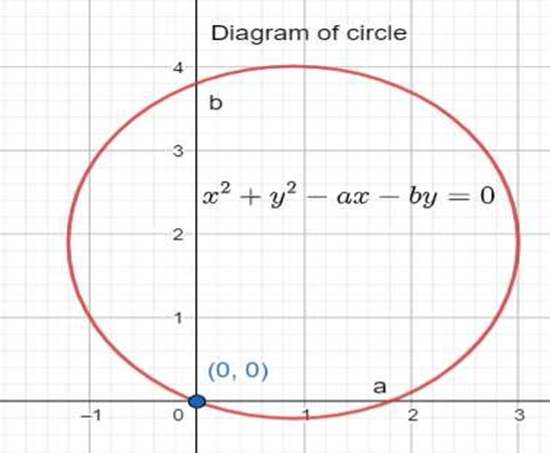
13. Find the equation of the circle passing through (0,0) and making intercepts a and b on the coordinate axes.
Ans: Let the equation of the required circle be ${{(x-h)}^{2}}+{{(y-k)}^{2}}={{r}^{2}}$
Since the circle passes through (0,0).
$\begin{align} & {{(0-h)}^{2}}+{{(0-k)}^{2}}={{r}^{2}} \\ & \Rightarrow {{h}^{2}}+{{k}^{2}}={{r}^{2}} \\ \end{align}$
The equation of the circle now becomes ${{(x-h)}^{2}}+{{(y-k)}^{2}}={{h}^{2}}+{{k}^{2}}$
It is given that the circle makes intercepts a and b on the coordinate axes. This means that the circle passes through points $(a,0)$ and $(0,b)$. Therefore,
${{(a-h)}^{2}}+{{(0-k)}^{2}}={{h}^{2}}+{{k}^{2}}$ …….(1)
${{(0-h)}^{2}}+{{(b-k)}^{2}}={{h}^{2}}+{{k}^{2}}$ …….(2)
From equation (1), we’ll get
$\begin{align} & {{a}^{2}}-2ah+{{h}^{2}}+{{k}^{2}}={{h}^{2}}+{{k}^{2}} \\ & \Rightarrow {{a}^{2}}-2ah=0 \\ & \Rightarrow a(a-2h)=0 \\ \end{align}$
$\Rightarrow a=0$ or $(a-2h)=0$
However, $a\ne 0;$ hence, $(a-2h)=0\Rightarrow h=\dfrac{a}{2}$
From equation (2), we’ll get
$\begin{align} & {{h}^{2}}+{{b}^{2}}-2bk+{{k}^{2}}={{h}^{2}}+{{k}^{2}} \\ & \Rightarrow {{b}^{2}}-2bk=0 \\ & \Rightarrow b(b-2k)=0 \\ \end{align}$
$\Rightarrow b=0$ or $(b-2k)=0$
However, $b\ne 0;$ hence, $(b-2k)=0\Rightarrow k=\dfrac{b}{2}$
Thus, the equation of the required circle is
${{\left( x-\dfrac{a}{2} \right)}^{2}}+{{\left( y-\dfrac{b}{2} \right)}^{2}}={{\left( \dfrac{a}{2} \right)}^{2}}+{{\left( \dfrac{b}{2} \right)}^{2}}$
${{\left( \dfrac{2x-a}{2} \right)}^{2}}+{{\left( \dfrac{2y-b}{2} \right)}^{2}}=\dfrac{{{a}^{2}}+{{b}^{2}}}{4}$
$\begin{align} & \Rightarrow 4{{x}^{2}}-4ax+{{a}^{2}}+4{{y}^{2}}-4by+{{b}^{2}}={{a}^{2}}+{{b}^{2}} \\ & \Rightarrow 4{{x}^{2}}+4{{y}^{2}}-4ax-4by=0 \\ & \Rightarrow {{x}^{2}}+{{y}^{2}}-ax-by=0 \\ \end{align}$
14. Find the equation of a circle with centre (2,2) and passes through the point (4,5).
Ans: The centre of the circle is given as (h,k)=(2,2)
Since the circle passes through point (4,5), the radius (r) of the circle is the distance between the points (2,2) and (4,5).
$\begin{align} & \therefore r=\sqrt{{{(2-4)}^{2}}+{{(2-5)}^{2}}} \\ & =\sqrt{{{(-2)}^{2}}+{{(-3)}^{2}}} \\ & =\sqrt{4+9} \\ & =\sqrt{13} \\ \end{align}$
Thus, the equation of the circle is
${{(x-h)}^{2}}+{{(y-k)}^{2}}={{r}^{2}}$
$\begin{align} & {{(x-2)}^{2}}+{{(y-2)}^{2}}={{\left( \sqrt{13} \right)}^{2}} \\ & {{x}^{2}}-4x+4+{{y}^{2}}-4y+4=13 \\ & {{x}^{2}}+{{y}^{2}}-4x-4y-5=0 \\ \end{align}$

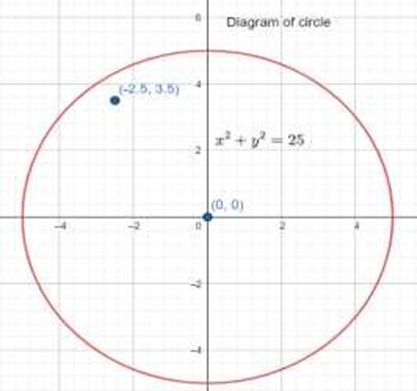
15. Does the point (-2.5, 3.5) lie inside, outside or on the circle ${{x}^{2}}+{{y}^{2}}=25$?
Ans: The equation of the given circle is ${{x}^{2}}+{{y}^{2}}=25$.
${{x}^{2}}+{{y}^{2}}=25$
$\Rightarrow {{(x-0)}^{2}}+{{(y-0)}^{2}}={{5}^{2}},$ which is of the form of ${{(x-h)}^{2}}+{{(y-k)}^{2}}={{r}^{2}}$, where $h = 0, k = 0 \; and\; r=5$
$\therefore $ Centre =(0,0) and radius =5
Distance between point (-2.5, 3.5) and centre (0,0)
$=\sqrt{{{(-2.5-0)}^{2}}+{{(3.5-0)}^{2}}}$
$\begin{align} & =\sqrt{6.25+12.25} \\ & =\sqrt{18.25} \\ \end{align}$
$=4.3$ (approx.) $<5$
Since the distance between point (-2.5, 3.5) and centre (0,0) of the circle is less than the radius of the circle, point (-2.5, 3.5) lies inside the circle.
Class 11 Maths Chapter 10: Exercises Breakdown
Conclusion
NCERT Solutions for Class 11 Maths Chapter 10 - Conic Sections: Exercise 10.1 provide a comprehensive and clear explanation of the fundamental concepts of conic sections. By utilising these step-by-step solutions, students can easily understand the properties and equations of circles, parabolas, ellipses, and hyperbolas. This resource not only helps in solving textbook problems but also strengthens the foundation for future mathematical concepts. Downloading the FREE PDF ensures that students have a reliable tool for homework, revisions, and exam preparations.
CBSE Class 11 Maths Chapter 10 - Conic Sections Other Study Materials
Chapter-Specific NCERT Solutions for Class 11 Maths
Given below are the chapter-wise NCERT Solutions for Class 11 Maths. Go through these chapter-wise solutions to be thoroughly familiar with the concepts.
Additional Study Materials for Class 11 Maths

FAQs on NCERT Solutions For Class 11 Maths Chapter 10 Conic Sections Exercise 10.1 - 2026-27 Free PDF Download (Sign-in Required)
1. What are conic sections and how are they formed geometrically?
Conic sections are curves formed when a plane intersects a right circular cone at different angles. The four main types are circle, ellipse, parabola, and hyperbola, each created by varying the angle and position of the intersecting plane relative to the cone's axis.
2. How does the NCERT Solutions for exercise 10.1 class 11 conic sections help students understand these curves?
NCERT Solutions for exercise 10.1 provide step-by-step solutions to problems involving circles, parabolas, ellipses, and hyperbolas. Each solution demonstrates the application of standard equations and geometric properties with detailed working.
3. What is the general equation of a circle in coordinate geometry?
The general equation of a circle is (x-h)² + (y-k)² = r², where (h,k) represents the center coordinates and r is the radius. This can also be written in expanded form as x² + y² + 2gx + 2fy + c = 0.
4. Can students download the class 11 maths ex 10.1 conic sections solutions as a Free PDF?
Yes, students can access Free PDF downloads of ex 10.1 class 11 maths solutions through educational platforms like Vedantu. These PDFs contain complete worked solutions for all exercise problems with proper formatting and mathematical notation.
5. How do students identify different types of conic sections from their equations?
Students identify conic sections by examining the general second-degree equation Ax² + Bxy + Cy² + Dx + Ey + F = 0. The discriminant B² - 4AC determines the type: circle/ellipse (B² - 4AC < 0), parabola (B² - 4AC = 0), or hyperbola (B² - 4AC > 0).
6. What topics are covered in the 10.1 class 11 conic sections exercise?
Exercise 10.1 focuses primarily on circles as the introductory conic section. Problems involve finding equations of circles given different conditions like center-radius, diameter endpoints, or points on the circumference.
Mastering circle problems builds the foundation for understanding more complex conics like ellipses, parabolas, and hyperbolas in subsequent exercises.
7. Why is the standard form of a parabola important in coordinate geometry?
The standard form y² = 4ax represents a parabola opening rightward with vertex at origin and focus at (a,0). This form simplifies calculations for finding focus, directrix, and solving problems involving parabolic curves in coordinate geometry applications.
8. How do exercise 10.1 class 11 conic sections answers help with exam preparation?
The exercise 10.1 answers provide detailed solutions with complete working steps, helping students understand problem-solving techniques for circle-related questions that frequently appear in board exams.
9. What is the relationship between the focus and directrix of a parabola?
For any point on a parabola, the distance to the focus equals the distance to the directrix. This constant ratio property defines the parabola and helps derive its equation in coordinate geometry applications.
10. How does the ex 10.1 class 11 conic section solutions PDF support different learning styles?
The PDF format presents solutions through multiple representations including algebraic steps, geometric diagrams, and coordinate plotting, catering to visual, analytical, and kinesthetic learning preferences.
