








Definition Properties and Examples of the Number 1
The concept of numbers is one of the preliminary concepts that is first taught to kids. Counting numbers is the very aspect of introducing kids to the subject of Mathematics. Only after mastering this, a child is introduced to mathematical operations like addition, subtraction, and so on. Let us look into the introduction to numbers for kids. In this article, we focus our discussion on answering what is 1? The article also mentions common rhymes that can be used to familiarise the number.
What is 1?
The number 1 is the very first number in Mathematics. The counting of numbers begins with the number 1. One is a number in Mathematics that represents the quantity or the value of 1. While counting, the number 1 is succeeded by 2 which is then succeeded by 3 and so on. Before learning some interesting facts about the number 1, let us look into what a number is.
Number is defined as the mathematical term that is used to describe the quantity or value of objects. The number is generally used to quantify things.
Counting the Number 1
We have learnt that numbers are primarily used for quantification, which includes counting things. Now let us look into examples where we can count the number of things and develop a better understanding of what is 1.
Example 1
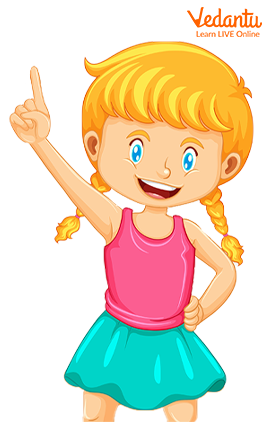
Image: Girl showing 1 finger
In the above-given image, the girl is holding up a single finger, which can also be said that the girl is showing 1 finger.
Example 2

Image: A single or 1 butterfly
In the above-given image, there is a butterfly, if we were told to count the number of butterflies, we would answer that there is 1 butterfly.
Example 3

Image: The image illustrates a balloon, a moon and a lion
In this image, there is one of everything; there is 1 balloon, 1 lion and 1 moon.
How to Write Number 1 in Words?
As we have learnt what is 1, we can now answer the question of how to write 1 in words. 1 is written as “one” in words.
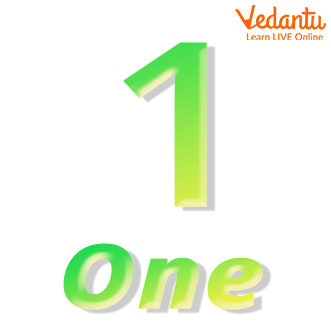
Image: Number 1 in words
Song to Learn the Number One
Planning an activity or memorising the facts through song or poem can help kids in developing a better understanding of the concept. Let us look into a song that can help kids to memorise number one.
One little funny clown,
Wears one shiny crown.
He dances around one town,
One skip, one hop and a turnaround.
Conclusion
This was the complete discussion on what is 1. We have learnt about 1, the number; we have also learnt how to count to 1 and write 1 in words. As kids grow, they are introduced to various concepts. Teaching kids with the help of images and fun activities as mentioned in the article can help kids understand better. We hope that the article helps kids develop curiosity about numbers and Maths. If you enjoyed learning about the number 1 and would like to study the other numbers in a similar way, head to our website today!
FAQs on What Is 1 in Mathematics
1. What is 1 in mathematics?
The number 1 is the first positive integer and represents a single unit or one quantity. It is the counting number that comes after 0 and before 2. In mathematics, 1 is used as the basic building block for counting, arithmetic operations, and number systems. It represents unity, meaning a single object, value, or entity.
2. Is 1 a prime number?
No, 1 is not a prime number because a prime number must have exactly two distinct positive factors. The number 1 has only one factor: 1 itself. Prime numbers such as 2, 3, and 5 have exactly two factors (1 and the number itself), which is why 1 does not qualify as a prime number.
3. Is 1 an even or odd number?
The number 1 is an odd number because it is not divisible by 2. An even number can be written in the form 2n, where n is an integer. Since 1 cannot be expressed as 2 × any whole number, it is classified as odd.
4. What is the value of 1 in multiplication?
In multiplication, 1 is the multiplicative identity, meaning any number multiplied by 1 remains unchanged. This property can be written as:
- a × 1 = a
- 1 × a = a
5. What is the value of 1 in division?
When a number is divided by 1, the result is the number itself, so a ÷ 1 = a. For example:
- 10 ÷ 1 = 10
- 56 ÷ 1 = 56
6. What is 1 factorial (1!)?
The value of 1! (1 factorial) is 1. Factorial means multiplying all positive integers up to that number. Since 1 has only one positive integer up to itself, we calculate:
- 1! = 1
7. Is 1 a natural number and a whole number?
Yes, 1 is both a natural number and a whole number. Natural numbers typically start from 1 and continue as 2, 3, 4, and so on. Whole numbers include 0 and all natural numbers, so the set is:
- Whole numbers: 0, 1, 2, 3, …
8. What is the square and cube of 1?
The square and cube of 1 are both equal to 1. This is because:
- 1² = 1 × 1 = 1
- 1³ = 1 × 1 × 1 = 1
9. What is 1 raised to any power?
The value of 1 raised to any exponent is always 1. This follows the exponent rule:
- 1ⁿ = 1 for any integer n
10. Why is 1 called the multiplicative identity?
The number 1 is called the multiplicative identity because multiplying any number by 1 leaves it unchanged. The identity property of multiplication states:
- a × 1 = a
