









Definition examples and how to identify terms and factors of an expression
Have you ever thought, about what the terms with the same algebraic factors are called? The term 'factor' is used to express a number as the produt of any two numbers. Factorization is a method for determining factors for any mathematical object, such as a number, a polynomial, or an algebraic expression. Thus, factorization of an algebraic expression refers to the process of identifying the factors of a given algebraic expression. In the given article, children would gain knowledge about the factors of the terms of an expression and the way how to write the factors. Reading this article, students will be able to identify the factors of the terms of the expression. This is the most common topic of algebra, thus should be on the tips of every child to excel in advanced mathematics.
What are the Factors of a Term of an Expression?
The numbers and variables that are multiplied together to form a term are called the factors of the term. For example, 5xyz is a term, whose factors are 5, x, y, and z. Factors can either be positive or negative, but not zero. One cannot further factorize the factors. Generally, factors have a wide application in daily life.
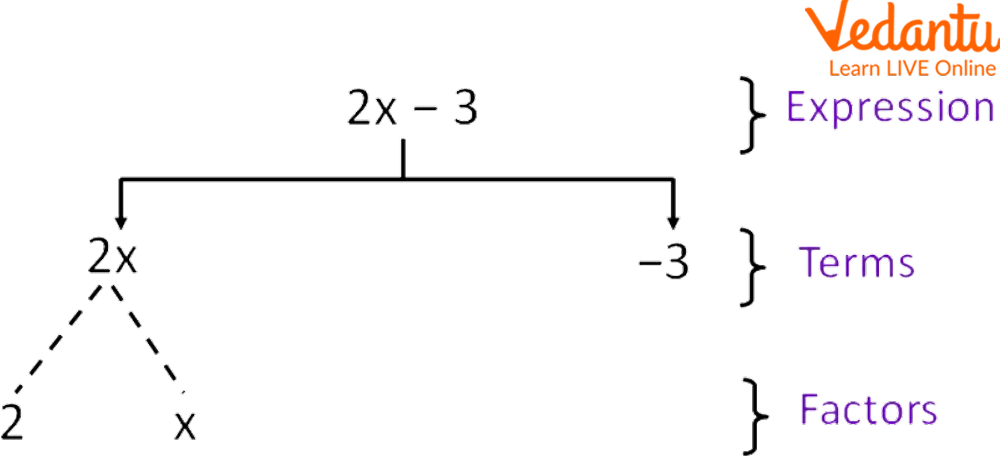
Terms and Factors of an Expression
Factors can be used to divide the entire term by leaving the remainder zero. The factor of the expression is also called the coefficient. The terms with the same algebraic factors are called like terms. For eg: 8y + 3y. While the terms with varied algebraic factors are called, unlike terms. For eg: 2x + 6y.
How to Find Factors?
Steps to find the factors of the term of the expression using the tree diagram are discussed below:
Write the given expression
Separate each term by removing the arithmetical operations and write just below the given expression
Then, factorize the term i.e. writing all the numbers and variables separately
How to Write Factors?
Before we proceed with the topic; of how to write factors, one should be aware of the way to identify the factors of the terms of the expression. The way of writing factors is very simple. Students just need to write all the numbers or variables being written in terms separately by putting commas in between.
Solved Examples
Q 1. Find the factors of the algebraic expression $2+x+x^2$.
Ans: Using a tree diagram,
Write the given expression
$2+x+x^2$
Separate the terms of the given expression, as
$2, x, x^2$
Write corresponding factors to each term of the expression
$2, x, x, x$

Factors of the Given Expression
Q 2. What are the terms and factors in the expression?
15xy – 25y + 18
Ans: Using a tree diagram,
Write the given expression
15xy – 25y + 18
Separate the terms of the given expression, as
15xy, -25y, 18
Write corresponding factors to each term of the expression
15, x, y, -25, y, 18
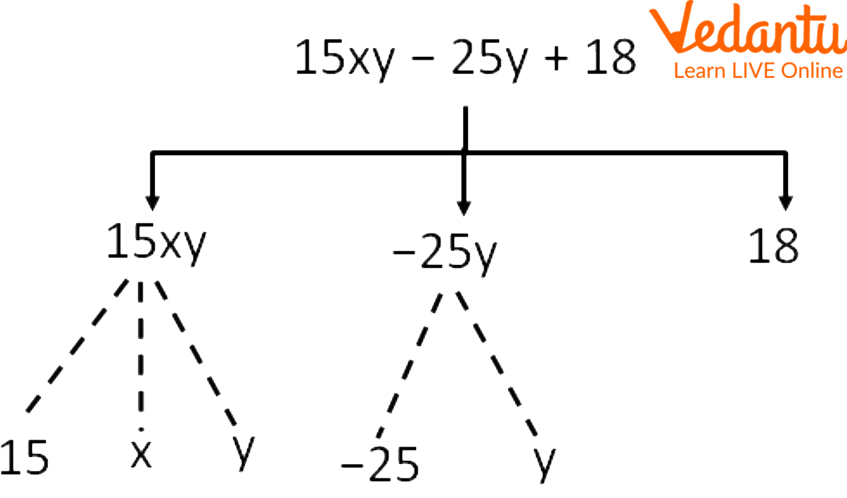
Showing Factors of the Expression, 15xy – 25y + 18
Practice Problems
Q 1. Discover the factors of the number 108.
Ans: 1, 2, 3, 4, 6, 9, 12, 18, 27, 36, 54, and 108
Q 2. Identify the factors of the given expression
3x2 - 2
Ans: 3, x, x, -2
Q 3. Identify the terms of the algebraic expression 7x – 9.
Ans: 7x and 9
Q 4. Write the terms in the expression: 9x – 7y + 5 and write the corresponding factors to each term.
Ans: Terms are 9x, -7y, and 5.
Factors are 9, x, -7, y, 5.
Summary
Summing up here with the concept of factors of an expression and the way to find these factors. Every topic in this article has been discussed in a simple language and attractive format for a better understanding of the concepts. Some solved examples are also discussed to make students master the given topics. Practice problems are given above that need to be solved by the students themselves. Hoping you enjoyed reading it. Feel free to ask your doubts by writing in the comments section given below.
FAQs on Understanding Terms and Factors in Algebraic Expressions
1. What are terms in an algebraic expression?
Terms in an algebraic expression are the individual parts separated by addition or subtraction signs. In an expression like 3x + 5y − 7, the terms are:
- 3x
- 5y
- −7
2. What are factors of a term in an expression?
Factors of a term are the numbers or variables that are multiplied together to form that term. For example, in 6xy, the factors are:
- 6
- x
- y
3. How do you identify terms and factors in an expression?
You identify terms by splitting the expression at addition or subtraction signs and identify factors by breaking each term into multiplied parts. For example, in 4x² − 3x + 8:
- Terms: 4x², −3x, 8
- Factors of 4x²: 4, x, x
4. What is the difference between terms and factors?
Terms are separated by addition or subtraction, while factors are multiplied within a single term. For example, in 5x + 10:
- Terms: 5x and 10
- Factors of 5x: 5 and x
5. What are like and unlike terms in an expression?
Like terms are terms with the same variables raised to the same powers, while unlike terms have different variables or exponents. For example:
- 3x and 7x are like terms.
- 3x and 3x² are unlike terms.
6. Can you give an example of terms and factors in a polynomial?
In a polynomial, terms are separated by plus or minus signs and each term has its own factors. Consider 2x² + 5x − 3:
- Terms: 2x², 5x, −3
- Factors of 2x²: 2, x, x
7. What is a constant term in an expression?
A constant term is a term that has no variable and remains fixed. In the expression 7x + 4, the constant term is 4. Constant terms are important when arranging polynomials in standard form.
8. How many terms can an algebraic expression have?
An algebraic expression can have one or more terms depending on how many parts are separated by addition or subtraction. For example:
- 5x → 1 term (monomial)
- 3x + 2 → 2 terms (binomial)
- x² + 3x + 1 → 3 terms (trinomial)
9. Why is it important to understand terms and factors?
Understanding terms and factors is essential for simplifying, expanding, and factoring algebraic expressions. It helps in:
- Combining like terms
- Finding the greatest common factor (GCF)
- Solving equations
- Factoring polynomials
10. What is the greatest common factor (GCF) of terms?
The greatest common factor (GCF) is the largest factor common to all terms in an expression. For example, in 6x² + 9x:
- Factors of 6x²: 6, x, x
- Factors of 9x: 9, x
