








Simple Nursery Math Activities for Counting Numbers and Shapes
Maths is an interesting subject. The first step is to understand numbers. For example, you write two numbers 3 and 4 on the blackboard and ask your kids to add these numbers. Here, the kids as beginners firstly learn to write 3 and 4 on the paper with your aid. Now, you help them with counting the steps to take after ‘3’ to get the answer ‘7’.
Understanding numbers and mathematical operations are new for young kids. So, we follow a fundamental method to teach nursery kids.
Steps to Teach Maths to Nursery Kids
Teaching Maths begins with learning numbers. You can help kids learn to count the numbers with various strategies that we will be discussing now. Below are the best 4 strategies to teach nursery Maths to kids of age 3-4 years.
Start with Counting
Kids can memorise numbers faster when they develop a habit of counting or picking objects from one to ten. Once your kid begins counting, you can start with some basic Maths operations like addition and subtraction.
Use Everyday Objects
You can use everyday objects to teach Maths to your child. For example, you can ask your kid to count the number of books, fruits, trees, or cars. You can count a few objects first, and ask your kid to count the remaining objects. Maths is easy to teach when you provide your child with real-life objects. It leaves an everlasting impression on the child.
So, counting various real-life objects instead of reading out the numbers 1, 2, 3, and so on helps your child understand numbers better.
Play Maths Games
There are various Maths games that you can make your child play offline as well online. For example, you throw 5 balls on the floor and ask your child to count those. The next time, you may throw six balls one by one and ask your child to count them as you throw. These physical activities motivate kids to become a pro at counting numbers.
Pattern in Maths
You can write numbers like 3, 4, __, __, and ask your child to fill the next two blanks, and practising similar series and patterns will help your kid remember the numbers better.
Now, let us have a look at the nursery Maths worksheet to understand how you can teach Maths to your kids through sample questions.
Nursery Maths Worksheet
Worksheet 1:
In the below worksheet, you need to find the number of items in each of the four boxes, respectively. Choose the correct answer.
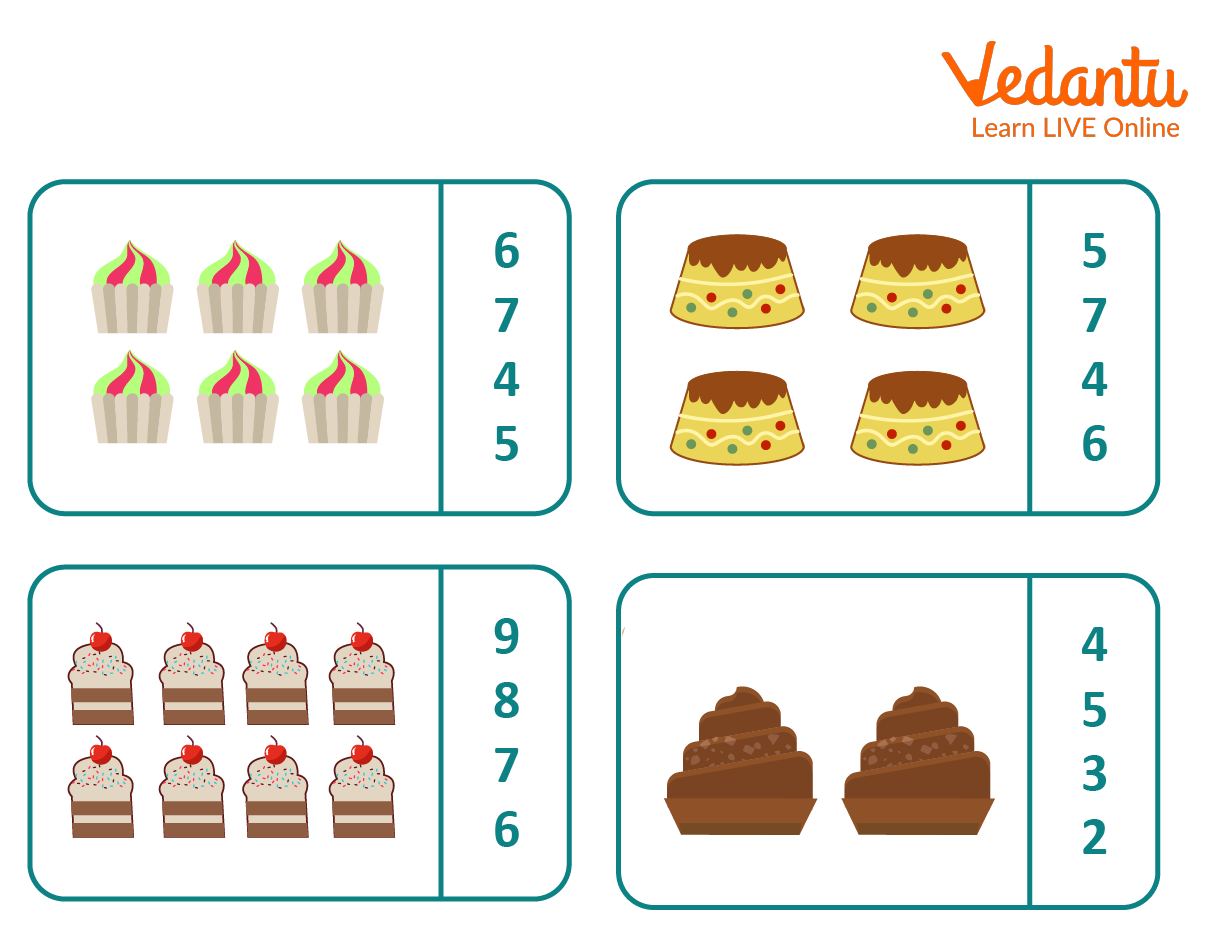
Counting number nursery maths worksheet
The number of cupcakes in the first box:
6
7
4
5
The number of items is 6. So, option a is the correct answer.
The number of cakes in the secound box:
5
7
4
6
The number of items is 4. So, option c is the correct answer.
The number of pastries in the third box:
9
8
7
6
The number of items is 8. So, option b is the correct answer.
The number of items in the fourth box is:
4
5
3
2
The number of items is 2. So, option d is the correct answer.
Worksheet 2
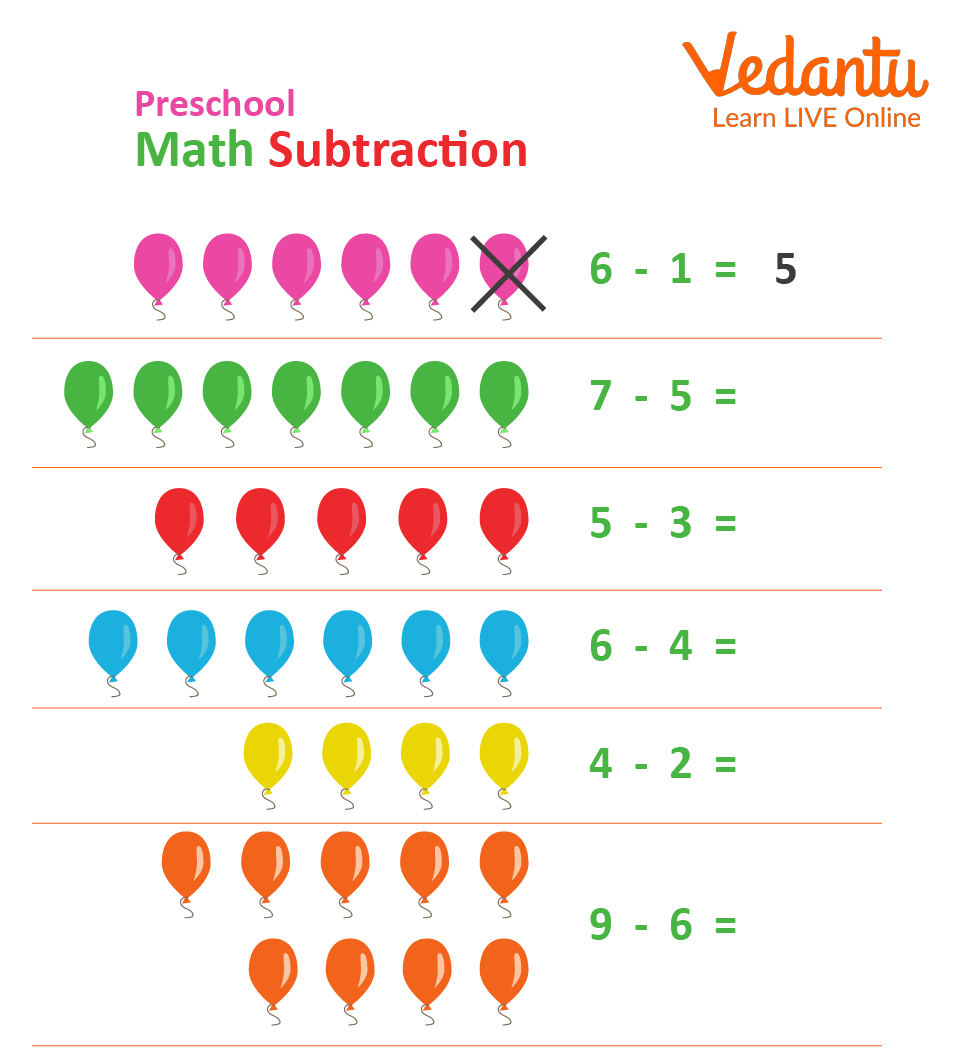
Subtracting numbers nursery Maths worksheet
First: 6 - 1 = 5 (given). Now, let us find the solution for the other questions.
Second: 7 - 5 = 2
Third: 5 - 3 = 2
Fourth: 6 - 4 = 2
Fifth: 4 - 2 = 2
Sixth: 9 - 6 = 3
So, this is how we can teach Maths to nursery kids with the help of real-life objects, playing Maths games, and solving worksheets. Practice makes a man perfect, so practice can help your kid become a pro in Mathematics at an early age.
FAQs on How to Teach Maths to Nursery Children Effectively
1. What is math for nursery kids?
Math for nursery kids is the basic introduction to numbers, counting, shapes, sizes, and patterns. It helps young children develop early numeracy skills through simple and playful activities.
- Learning numbers from 1 to 10
- Counting everyday objects like toys or fruits
- Recognizing basic shapes such as circle, square, and triangle
- Understanding big and small, more and less
2. How do you teach counting to nursery kids?
Counting is taught to nursery kids by helping them match number words with actual objects in a one-to-one manner. This method is called one-to-one correspondence.
- Ask the child to touch and count each object once
- Count toys, fingers, or blocks from 1 to 10
- Use songs and rhymes like counting rhymes
3. What numbers should a nursery child know?
A nursery child should typically recognize and count numbers from 1 to 10. Some children may also begin identifying numbers up to 20.
- Recognize number symbols (1, 2, 3…)
- Say numbers in correct order
- Count small groups of objects accurately
4. How do you explain shapes to nursery kids?
Shapes are explained to nursery kids by showing simple figures and relating them to real-life objects. The most common basic shapes are circle, square, triangle, and rectangle.
- A circle looks like a ball
- A square has 4 equal sides
- A triangle has 3 sides
- A rectangle has 4 sides with opposite sides equal
5. What is number recognition in nursery math?
Number recognition is the ability to identify and name written numbers such as 1, 2, 3, 4, and 5. It is different from counting because the child recognizes the symbol itself.
- Showing flashcards with numbers
- Matching numbers to objects
- Tracing numbers for practice
6. How do you teach addition to nursery kids?
Addition for nursery kids is taught by combining small groups of objects to find the total. The basic idea is that addition means putting together.
- Example: 2 apples + 1 apple
- Count all apples together: 1, 2, 3
- So, 2 + 1 = 3
7. What is the difference between big and small in nursery math?
The difference between big and small is a comparison of size. “Big” means larger in size, while “small” means smaller in size.
- Compare two balls: one large, one tiny
- Ask the child to point to the bigger object
- Repeat with different items
8. Why is learning patterns important for nursery kids?
Learning patterns is important because it helps children recognize repeated sequences and improve logical thinking. A pattern is something that repeats in a rule-based way.
- Example: Red, Blue, Red, Blue
- Clap, Tap, Clap, Tap
- Circle, Square, Circle, Square
9. How can nursery kids learn numbers through play?
Nursery kids learn numbers best through play-based activities that involve counting and number games. Play makes early math fun and engaging.
- Counting blocks while building
- Number puzzles (1–10)
- Hopscotch with numbered boxes
10. What are common mistakes nursery kids make in counting?
Common counting mistakes include skipping numbers, double counting, or not matching one number to one object. These errors happen when one-to-one correspondence is not fully developed.
- Saying 1, 2, 4 (skipping 3)
- Counting one object twice
- Pointing at objects without saying numbers correctly
