









How Radian Measure Connects Real Numbers on the Number Line with Formula and Examples
We usually use the radian and degrees as units to measure an angle. The relation between radians and degrees is the relationship between radians and real numbers because the degree is a real number. Radian is used to measure the arc of a circle and is easy to calculate. The real number of a radian is not a whole number but is easy to visualize on the number line.
What is a radian?
The radian is an S.I. unit used to measure angles and the radian is the angle that an arc whose length is equal to the radius of a circle forms at the center of the circle. One radian, shown directly below, equals approximately 57.296 degrees. Use radians instead of degrees when calculating angles as radii. Since ‘°’ is used to represent degrees, rad or c is used to represent radians. For example, 1.5 radians is written as 1.5 radians or 1.5 c.
The Radian of a Number System
Radian of a number system is known as the number of counting digits in a number system. For example, decimal number system has 10 digits, i.e., 0, 1, 2, …, 9. Thus the radian of decimal system is 10. Similarly Binary number system has a radian 2, octal has 8 and hexadecimal has 16.
Relation between Radian and Real Numbers
The circumference of a circle is \[2\pi r\], where r is the radius of the circle. The arc length of a circle with a radius of 1 unit is \[2\pi \] radian. Again we know that \[2\pi \] radian = 360.
Divide both sides by \[2\pi \]
\[1\,radian = \dfrac{{360}}{{2\pi }}\]
Putting the \[\pi = \dfrac{{22}}{7}\]
\[1\,radian = \dfrac{{360}}{{2 \times \dfrac{{22}}{7}}}\]
Solving the above equation:
\[1\,radian = 57.296\]
By solving the equation we get 1 radian = 57.296. The relationship between radian and real numbers is 1 radian = 57.296(approx.).
What is the relationship between radians and real numbers?
1 radian of a circle with a radius r is equal to the central angle at the center whose arc is equal to r. The radians are at the same distance on the number line.
We know that the length of an arc of a circle is \[\theta r\], where \[\theta \] is in radians.
Again, the length of an arc of a circle is \[\theta \times r \times \dfrac{{180}}{\pi }\] where \[\theta \] is in degree.
Interesting fact
Radian is the S I unit used for measuring angles.
The circumcircle of a circle is \[2\pi \] radian.
Solved examples
1. Visualize 3 radians on a circle.
Solution:
We know that one radian is equal to the central angle which makes an arc that length is equal to the radius of the circle.
Step 1: First we will draw a circle and measure the radius of the circle using a thread.
Step 2: Place the thread three times around the circle.
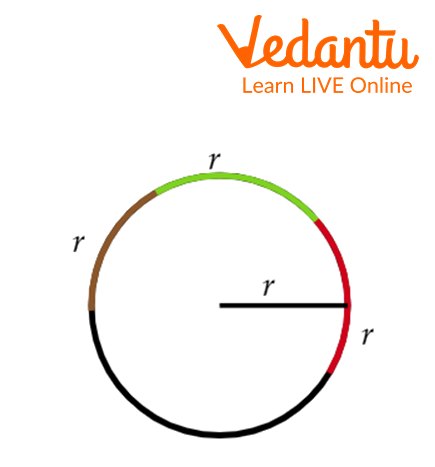
3 radians measuring
2. Convert \[3\pi \] in real number.
Solution: We know that 1 radian =57.296.
Thus multiply 57.296 with \[3\pi \] to get it in real number.
\[3\pi \times 57.296 = 171.88\pi \]
Putting the value of \[\pi \]
\[3\pi \times 57.296 = 171.88 \times \dfrac{{22}}{7}\]
\[3\pi \times 57.296 = 540.219\] (approx.)
3. Convert \[75^{\circ}\] into radian.
Solution: Multiplying \[\dfrac{\pi}{180^{\circ}}\] with \[75^{\circ}\] to convert into radian:
\[75^{\circ}=75^{\circ}\dfrac{\pi}{180^{\circ}}\]
\[\Rightarrow 75^{\circ}=\dfrac{5\pi}{12^{\circ}}\]
Therefore \[75^{\circ}=\dfrac{5\pi}{12^{\circ}}\]
Conclusion
Radian is the SI unit for measuring angles. Another unit for measuring angles is degrees. 1 radian = \[\dfrac{180^{\circ}}{\pi}\] and \[1^{\circ}=\dfrac{\pi}{180^{\circ}}\] radians. Radian measurements and real number measurements are the same.
The real value of one radian is 57.296(approx). The real value of radian is an irritation number.
Practices problem:
1. Convert \[4\pi \] radian into a real number.
Answer: 12.571(approx.)
2. Draw 1.5 radians on a circle.
Answer:
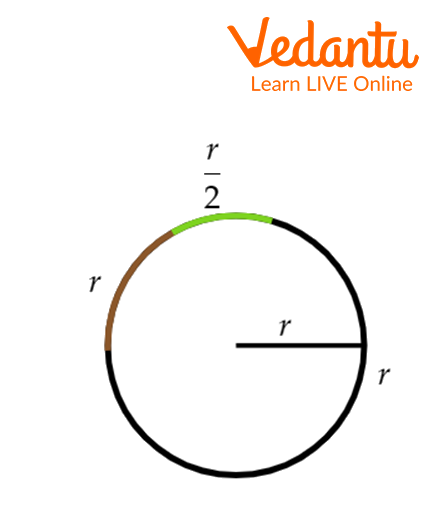
1.5 radians
List of related articles
FAQs on Relation Between Radian and Real Numbers in Trigonometry
1. What is the relation between radian and real numbers?
The measure of an angle in radians is defined as a real number equal to the ratio of arc length to radius of a circle. In mathematics, every radian measure corresponds to a real number because it is calculated as:
θ = s / r
Where:
- s = arc length
- r = radius of the circle
2. Why are radians considered real numbers?
Radians are considered real numbers because they are defined as a ratio of two real quantities—arc length and radius. Since:
- Arc length (s) ∈ Real numbers
- Radius (r) ∈ Real numbers
3. What is the formula for converting radians to real numbers?
There is no special conversion because a radian measure is already a real number. However, when converting from degrees to radians, the formula is:
Radians = (π/180) × Degrees
For example:
- 180° = π radians
- 90° = π/2 radians
4. How is 1 radian defined in terms of real numbers?
One radian is defined as the angle subtended at the center of a circle by an arc equal in length to the radius, giving the real value 1 = s/r. When:
- s = r
- θ = 1 radian
5. Can radian measure be negative or fractional real numbers?
Yes, radian measures can be positive, negative, or fractional real numbers. Since radians are real numbers:
- Clockwise rotation gives negative values (e.g., -π/3)
- Counterclockwise rotation gives positive values (e.g., π/4)
- Fractions like π/6 or decimals like 0.5 are valid radian measures
6. What is the difference between radian and degree in terms of real numbers?
Both degrees and radians are real numbers, but radians are dimensionless real numbers defined using arc length. Key differences include:
- 1 full circle = 2π radians
- 1 full circle = 360°
- Radians are derived from the ratio s/r
- Degrees are based on dividing a circle into 360 equal parts
7. How do you represent angles as real numbers using radians?
Angles are represented as real numbers by measuring them in radians instead of degrees. To represent an angle:
- Use the formula θ = s/r
- Or convert degrees using (π/180) × Degrees
60 × π/180 = π/3
Thus, the angle is represented by the real number π/3.
8. Is π a real number in radian measure?
Yes, π is an irrational real number and commonly appears in radian measures. Since:
- π ≈ 3.14159...
- It is non-terminating and non-repeating
9. Why are radians important in calculus and real analysis?
Radians are important in calculus because trigonometric limits and derivatives work correctly only when angles are measured in radians. A key result is:
lim(x→0) (sin x)/x = 1 (only when x is in radians).
This property connects trigonometric functions directly with real number limits, making radians essential in real analysis and higher mathematics.
10. What is a real number line representation of radian measures?
Radian measures can be plotted directly on the real number line because every radian value is a real number. For example:
- 0 represents no rotation
- π/2 represents a quarter turn
- π represents a half turn
- 2π represents a full rotation
