









What Is the Degree of a Polynomial and an Angle
How far is your school from your home? How much time do you take to reach your home? 10 km, and it will take 15 minutes by bicycle. And, how far is your best friend’s home from yours and how much time do you take to reach his home? Approximately 500 metres, and 2 to 3 minutes by walk. What do km or metre and minutes represent here? These are the units of distance and time, respectively. Do you know what is the unit to measure an angle?
The unit which is used to measure the angle is ‘degree’. In this article, we will dive deep into the definition of ‘degree’, its symbol, and its conversion into another unit. So waiting for what my dear child, let us go!
Definition of Degree
In Geometry, the unit which is used to measure the angle is known as 'degree'. There are other units also used to measure the angle, but the degree is most popular and commonly used amongst all. The other common unit used to measure the angle is ‘radian’. It is the SI unit to measure an angle. We can convert both units into one another using some formulas.
A protractor is used to measure the angles in degrees.
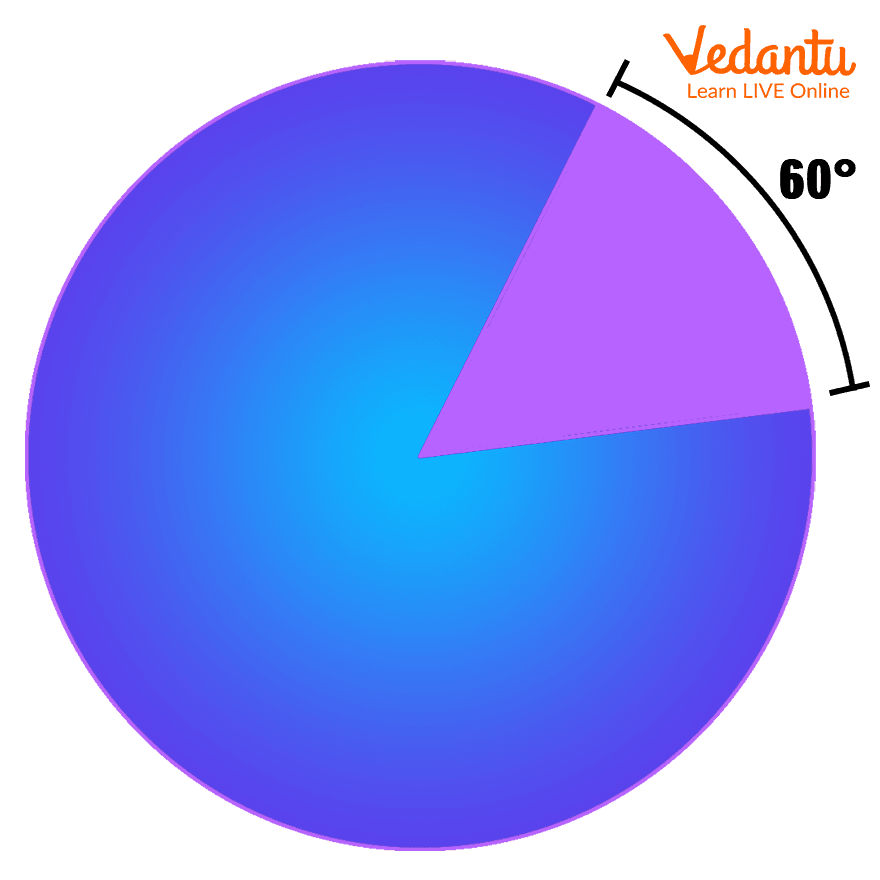
An example of ‘degree’; degree measure 60
Degree Symbol
A degree is represented by the symbol °. It is of the shape of a small circle that would be written after a number and on its top such as 0 degree = 0°, 90 degree = 90°, 180 degree = 180°, etc.
Types of Angles on the Basis of Their Degrees
There are different types of angles based on their measurement. Some of them are listed below:
Acute Angle: The angle which measures more than 0° and less than 90°, is called an acute angle.
Right Angle: The angle which measures 90° is called the right angle.
Obtuse Angle: The angle which measures more than 90° and less than 180°, is called the obtuse angle.
Straight Angle: The angle which measures exactly 180° is called a straight angle.
Reflex Angle: The angle which measures more than 180° and less than 360° is called a reflex angle.
Complete Angle: The angle which measures 360° is called a complete angle. A complete circle measures 360°.
Conversion of Units of Angle
There are mostly two units used to measure the angle, radian and degree. They both are interchangeable. Now let us see how to convert both of them.
Degree to Radian
To convert degree to radian, we use the following formula:
Radian = \[ \frac{angle \, in \, degree\times \Pi }{180^{0}} \]
Radian to Degree
To convert radian to a degree, we use the following formula:
Degree = \[ \frac{angle \, in \, radians \times 180^{0}}{\Pi} \]
Numerical Type Questions
1. Convert 45° into radian.
Solution: To convert degree to radian, we can calculate as:
Angle in radian = \[ \frac{angle \, in \, degree \times π}{180^{0}} \]
= \[ \frac{45^{0} \times \Pi}{180^{0}} \]
= \[ \frac{\Pi}{4} \]
2. A child measures an angle of 2𝜋 radian. Convert it to the degree.
Solution: To convert radian to degree, we can calculate as:
Angle in degree = \[ \frac{angle \, in \, radians \times 180^{0}}{\Pi} \]
= \[ \frac{2\Pi \times 180^{0}}{\Pi} \]
= \[ 180^{0} \]
Points to Remember
1. If θ is the measured angle, then we can remember the names of the angles and their measurement as:
2. A protector can measure the angle in two ways:
Clockwise direction
Anti-clockwise angle
FAQs on Degree in Math Explained for Polynomials and Angles
1. What is a degree in Math?
A degree in Math is an academic program that focuses on the study of numbers, structures, patterns, and logical reasoning using mathematical theories and techniques. It typically includes core subjects such as:
- Calculus
- Linear Algebra
- Algebra
- Probability and Statistics
- Discrete Mathematics
2. What subjects are studied in a mathematics degree?
A mathematics degree typically covers core areas such as pure mathematics, applied mathematics, and statistics. Common subjects include:
- Differential and Integral Calculus
- Linear Algebra and Matrices
- Real and Complex Analysis
- Abstract Algebra
- Probability Theory
- Numerical Methods
3. Is a degree in Math hard?
A degree in Math is considered challenging because it requires strong logical reasoning, abstract thinking, and problem-solving skills. Students often find difficulty in:
- Understanding mathematical proofs
- Working with abstract concepts in abstract algebra or real analysis
- Solving multi-step problems in calculus and linear algebra
4. What can you do with a degree in Math?
A degree in Math can lead to careers in finance, data science, education, engineering, research, and technology. Common job roles include:
- Data Analyst or Data Scientist
- Actuary
- Financial Analyst
- Software Developer
- Statistician
5. What is the difference between pure math and applied math?
The main difference is that pure mathematics focuses on abstract theories, while applied mathematics uses mathematical methods to solve real-world problems. For example:
- Pure math studies structures like groups in abstract algebra.
- Applied math uses differential equations to model physical systems like population growth or motion.
6. How long does it take to complete a math degree?
A bachelor’s degree in Math typically takes 3 to 4 years to complete, depending on the country and institution. Program durations are generally:
- 3 years in many UK and European universities
- 4 years in the United States and some other countries
7. What skills do you gain from a degree in Mathematics?
A degree in Mathematics develops strong analytical, quantitative, and logical reasoning skills. Key skills include:
- Problem-solving and critical thinking
- Mathematical modeling
- Data analysis and interpretation
- Ability to construct and understand formal proofs
- Proficiency in tools like Python, R, or MATLAB (in applied programs)
8. Do you need calculus for a math degree?
Yes, calculus is a foundational subject in any mathematics degree program. Students typically study:
- Differential Calculus (rates of change)
- Integral Calculus (area and accumulation)
- Multivariable Calculus
9. Is a math degree good for data science?
Yes, a math degree is excellent preparation for data science because it provides strong foundations in statistics, probability, and linear algebra. These areas are essential for:
- Machine learning algorithms
- Statistical modeling
- Data visualization and analysis
10. What are the requirements to study a degree in Math?
The typical requirement to study a degree in Math is strong prior knowledge in algebra, calculus, and advanced high school mathematics. Most universities expect:
- High grades in mathematics courses
- Understanding of functions, equations, and trigonometry
- Logical reasoning and problem-solving ability
