








What Is the Less Than Sign with Definition and Solved Examples
The less-than symbol is a fundamental mathematical symbol that denotes the difference between two values. In mathematics, there are several symbols that are used to conduct various arithmetic operations, hold some fixed values, and compare numbers using equality and inequality symbols.
In this topic, we'll go through one of the inequality symbols, the "Less than Symbol," in depth, using multiple examples.
What is a Less than Symbol?
When comparing two values where the first number is less than the second number, such as in ascending order, the less-than symbol is used. The opening angle bracket is represented by the less than symbol, which is an approximation. " " is the symbol used to represent inequality that is less than. The less than sign is a widely used math symbol that consists of two equal-sized strokes that meet at an acute angle on the left.
Remembering the Less than Sign
The "Alligator Method" is the best way to remember the less-than sign. Consider the alligator approach for comparing two values. The alligator's mouth is considered to constantly point to the highest value because it can consume as much as it wants. The alligator's mouth is always open to the right, symbolising inequality. To employ greater than a symbol, we can use the alligator method. The greater than symbol is defined by the alligator mouth pointing to the left.
Examples of Less than
One of the words used to show the relationship between two values is less than. It expresses the fact that one value is less than the other. The symbol for less than is, and we can compare numbers, weights, heights, and values using this metric.
For example, in Bowl A, there are four marbles and in Bowl B, there are seven marbles. When the two are compared, it is evident that Bowl A has less marbles than Bowl B.
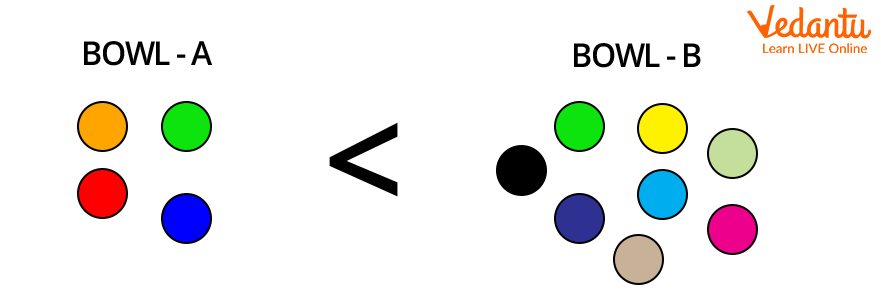
Fig: An example of a less than symbol
Likewise, we can also compare weights. For example:
Ray purchases 4 kg of potatoes and 2 kg of onions and separates them into two bags. His son receives the lighter bag from him. Which one does he cling to?
To do so, you must first determine which bag is lighter. There are two bags, one containing 4 kg of potatoes and the other containing 2 kg of onions. As a result, the onion bag weights less, and Ray gives it to his son while carrying the potato bag.

Fig: Finding the weight of vegetables by using the Less than symbol
Ajay has six chocolate packets. Ram has two chocolate packs while Ansu has three chocolate packs. Is Ajay's chocolate collection bigger than Ram's and Ansu's combined?
With Ram and Ansu, the total amount of packets is 2 + 3 = 5 packets.
Ajay also has 6 chocolate packets.
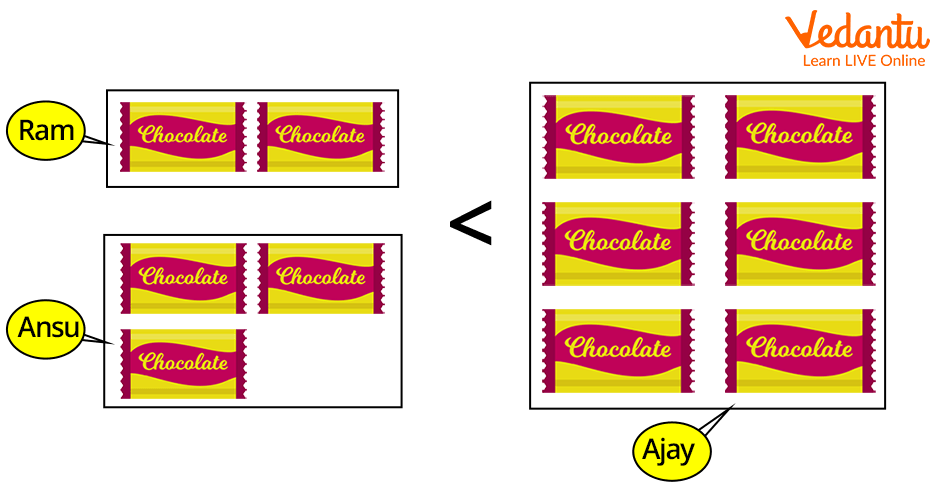
Fig: Finding the chocolate box count using the Less than symbol
Therefore, Ram and Ansu together have only fewer chocolates compared to Ajay.
Some more examples of less than with symbol include:
0.8 < 1.2: 0.8 is less than 1.2
2 < 5: 2 is less than 5
-0.6 < -0. 1: -0.6 is less than -0.1
Summary
To summarise, comparing is an important part of our life. It's impossible to demonstrate the equality or inequality between items we see around us without a comparison.
Fun Fact
Thomas Harriot, a British mathematician, first introduced the symbol for less than () in his book "Artis Analyticae Praxis ad Aequationes Algebraicas Resolvendas" in 1631.
FAQs on Less Than Symbol Explained with Examples
1. What does the less than symbol mean in Maths?
The less than symbol (<) means that one number is smaller in value than another number. It compares two quantities and shows that the number on the left is smaller than the number on the right.
- Example: 3 < 7 means 3 is less than 7.
- Example: -2 < 1 means −2 is less than 1.
2. How do you use the less than symbol with numbers?
You use the less than symbol (<) by placing it between two numbers when the first number is smaller than the second. Follow these steps:
- Compare the two numbers.
- Identify which number is smaller.
- Place < between them.
3. Can you give an example of a less than inequality?
A less than inequality shows that one value is smaller than another using a variable. Example: x < 10 means x can be any number smaller than 10.
- If x = 5, then 5 < 10 ✅
- If x = 9.9, then 9.9 < 10 ✅
- If x = 10, it does not satisfy the inequality ❌
4. What is the difference between less than and less than or equal to?
The difference is that less than (<) excludes the number itself, while less than or equal to (≤) includes the number.
- 4 < 6 means 4 is smaller than 6.
- x < 8 means x is strictly smaller than 8.
- x ≤ 8 means x can be 8 or any number smaller than 8.
5. How do you solve a less than inequality step by step?
To solve a less than inequality, isolate the variable on one side of the inequality sign. Example: Solve x + 3 < 7.
- Step 1: Subtract 3 from both sides.
- x + 3 − 3 < 7 − 3
- Step 2: Simplify → x < 4
6. How is the less than symbol shown on a number line?
On a number line, a less than inequality is shown with an open circle and shading to the left. For example, x < 5 is represented by:
- An open circle at 5 (since 5 is not included).
- A shaded line extending to the left.
7. What are some real-life examples of less than?
A less than comparison is used in real life to compare quantities and limits. Examples include:
- If a speed limit is 60 km/h, driving at 50 km/h means 50 < 60.
- If you have $8 and an item costs $10, then 8 < 10.
- If a child must be under 12 years old, their age must be < 12.
8. How do you remember the less than symbol?
You can remember the less than symbol (<) because it looks like a mouth opening toward the larger number. The wider side always faces the bigger value.
- In 2 < 9, the symbol opens toward 9.
- Think: “The alligator eats the bigger number.”
9. Can less than be used with negative numbers?
Yes, the less than symbol works with negative numbers by comparing their positions on the number line. A number further left is smaller.
- -5 < -2 because −5 is further left.
- -1 < 3 because any negative number is less than a positive number.
10. What is a common mistake when using the less than sign?
A common mistake when using the less than sign is reversing the symbol or forgetting to flip it when multiplying or dividing by a negative number. Example:
- Incorrect: If -2x < 6, dividing by −2 gives x < −3 ❌
- Correct: Dividing by −2 flips the sign → x > -3 ✅
