








Steps to Find the Common Factor with Examples
Common factors are those factors which are common in two numbers. Factor can be a whole number, integer. Any decimal number Cannot be a Factor. We can find a common factor by individually finding the factor of two or more numbers and comparing the same factors which are present in two or more numbers, they are called common factors.
What is a Factor?
A factor is a number that divides the other number leaving the remainder as 0. if we multiply that are factors of the product A number can have multiple numbers of factors. Let us take the example of 12. The factors of 12 are 1,2,3,4,6,12. The given number is the factor of 12 because after dividing 12 by any of these numbers the remainder will be 0. We know the very common formula that is \[{\rm{dividend}} = {\rm{divisor}} \times {\rm{quotient}} + {\rm{remainder}}\]. Let’s take an example of a number 12, 2 is a factor of 12 ,So 2 divide 12 Exactly and give 6 as a quotient and 0 as a reminder. 6 is also a factor of 12. So a number can have multiple number of factors like in case of 12 its factors are 1, 2, 3, 4, 6, 12

Factors
Common Factor
Those factors which are common in two numbers are called common factors. We can find out common factors of two numbers by separately finding the factor of each number and then comparing those factors,which are common to both numbers. These factors are called common factors.
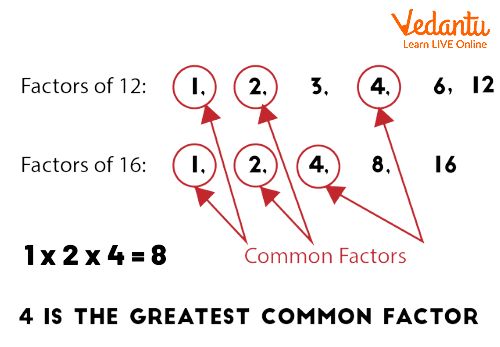
Common Factor of Two Number
Factors and its Properties:
Finite number of factors are present for integers
Only 0 and 1 are two numbers which do not have at least two factors.
For a number its factor is always less than or equal to the number
We can find out factors by multiplication and division.
What is Prime Factorisation:
Prime factorisation of a number can be represented as a product of all the prime factors of the number; numbers involved in prime factorisation are prime numbers.ex – factor of \[8 = 2 \times 2 \times 2\] so here the prime factor is 2.
Now let’s discuss the methods from which we can calculate prime factorisation:
Firstly we have to divide given number to the smallest prime number
Repeat the process again by dividing quotient of the above solution by the smallest prime number
We have to repeat this process again and again until the quotient becomes 1.
Then multiply all the prime factors we get from various steps ,the result of that multiplication is called prime factorisation.
What is HCF
HCF is the highest common factor as its name suggests it is the greatest common factor of two or more numbers. Highest common factor is the largest number which can divide both the numbers. Let’s take an example, let a and b are two numbers so the HCF of two numbers is the largest number which can simultaneously divide both a and b. HCF is also called GCF– Greatest common factor.
Example-let’s take two number 12 and 36
Factors of 12–1,2,3,4,6,12
Factors of 36–1, 2,3,4,6,9,12,18,36
The common factor of 12 and 36 are 1,2,3,4,6,12
And the highest common factor of two numbers is 12.
What is LCM
LCM is the least common multiple as its name suggests it is the lowest number that can be divisible by both numbers. Let’s understand this with the help of an example – take two numbers 3 and 5. Multiples are the number that divided by another number will leave the remainder as 0.
Multiples of 3–3,6,9,12,15,18,21,24,27,30
Multiples of 5–5,10,15,20,25,30
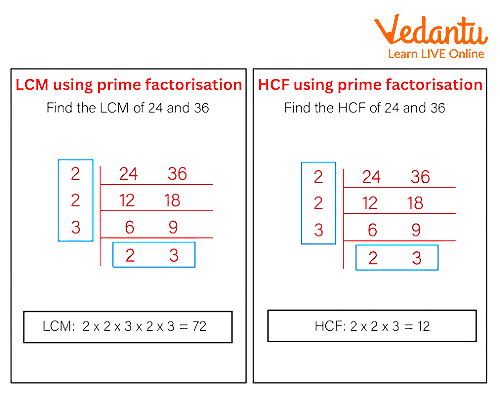
Image Showing Lcm and Hcf of Two Numbers
Some Facts about Factors:
There are finite number of factors of a given number
Every number is a factor of itself
Every number has one common factor that is 1
Factor is exact divisor of a number
Solved Questions:
1.Find the prime factors of 30.
We know prime numbers are those numbers which are either multiple of 1 or the number itself.
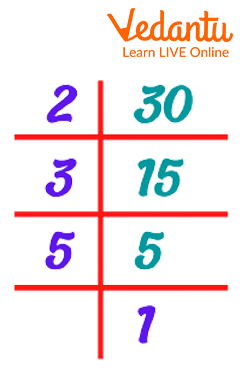
So prime factors of 30 are 2,3,5
2. Find the common factor of 5 and 30.
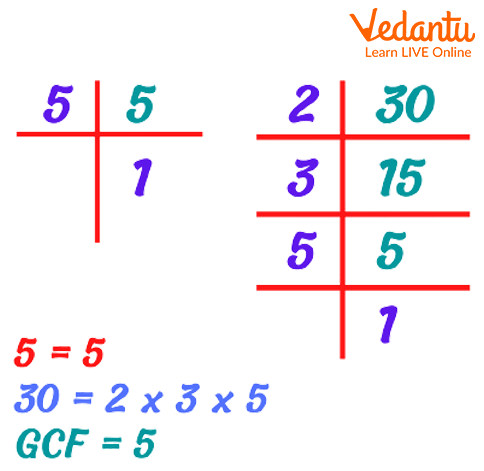
GC of 5 and 30
So from matching factors of both 5 and 30 we get the common factor 5
Conclusion:
Here in this article we learned about common factors and how to find out common factors as The name itself suggests that there is a common number which divides two numbers exactly. In this article we also learned about factors, HCF, LCM, prime factorisation and also learnt some interesting facts about factors.
FAQs on How to Find the Common Factor in Numbers
1. What is a common factor in Maths?
A common factor is a number that divides two or more numbers exactly without leaving a remainder. In other words, it is a shared factor of the given numbers.
- A factor divides a number completely.
- A common factor must divide all the given numbers.
- Example: Factors of 12 are 1, 2, 3, 4, 6, 12 and factors of 18 are 1, 2, 3, 6, 9, 18.
- Common factors of 12 and 18 are 1, 2, 3, 6.
2. How do you find the common factors of two numbers?
To find the common factors of two numbers, list all factors of each number and identify the shared ones. Follow these steps:
- List all factors of the first number.
- List all factors of the second number.
- Circle the numbers that appear in both lists.
- Those shared numbers are the common factors.
3. What is the greatest common factor (GCF)?
The greatest common factor (GCF) is the largest number that divides two or more numbers exactly. It is also called the highest common factor (HCF).
- Find all common factors.
- Select the largest one.
4. How do you find the greatest common factor using prime factorization?
To find the GCF using prime factorization, write each number as a product of prime numbers and multiply the common primes with the smallest powers. Steps:
- Prime factorize each number.
- Identify common prime factors.
- Multiply the lowest powers of those common primes.
5. What is the difference between factors and common factors?
A factor divides one number exactly, while a common factor divides two or more numbers exactly.
- Factors belong to a single number.
- Common factors are shared between numbers.
- Example: 2 is a factor of 10, but it is a common factor of 10 and 14.
6. Can you give an example of finding common factors?
Yes, you can find common factors by listing and comparing factors of each number. Example with 16 and 24:
- Factors of 16: 1, 2, 4, 8, 16
- Factors of 24: 1, 2, 3, 4, 6, 8, 12, 24
- Common factors: 1, 2, 4, 8
7. How do you find common factors of more than two numbers?
To find common factors of more than two numbers, list the factors of each number and find the numbers common to all lists. Steps:
- List factors of each number.
- Identify factors appearing in every list.
- The shared numbers are the common factors.
8. Why is finding common factors important?
Finding common factors is important for simplifying fractions, solving word problems, and factoring algebraic expressions. Common uses include:
- Reducing fractions to simplest form.
- Finding the greatest common factor (GCF).
- Factoring polynomials in algebra.
- Solving grouping and sharing problems.
9. What is the smallest common factor of any two numbers?
The smallest common factor of any two positive integers is always 1. This is because 1 divides every whole number exactly.
- 1 is a universal factor.
- All integers share 1 as a common factor.
- If 1 is the only common factor, the numbers are called co-prime.
10. What are common mistakes when finding common factors?
A common mistake when finding common factors is forgetting to list all factors or confusing factors with multiples. Avoid these errors:
- Missing smaller factors like 1 or 2.
- Including multiples instead of factors.
- Choosing the largest factor of one number instead of the largest common factor.
