









How to Convert Grams to Kg Using Decimals with Examples
Conversion between units of mass involves moving the decimal point to the right or the left. To measure something, you need a system of units. The decimal metric is a system of units in which multiples or partial multiples of a unit of measure are connected by multiples.
What are Mass and Weight?
Mass and weight are closely related. Weight is a measure of how strongly the Earth pulls the object. Therefore, objects in space weigh less than the Earth's surface.
However, the amount of material object remains the same; this is known as the mass of the object. The basic unit of mass in the metric system is the kilogram.
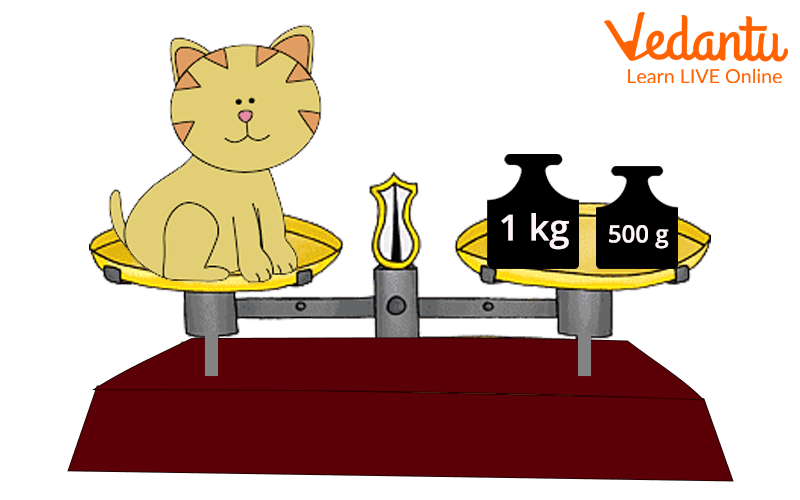
Expressing Weight Using a Example
What Is Decimal?
Decimals are numbers that have an integral part and a fractional part separated by a decimal point. The integral part is those parts whose value can be negative or positive such as 5 and -4. The fractional part is those whose value lies between zero and one such as 0.25. In decimal numbers the fractional part is on the right side of the decimal point and on the left side of the decimal it is the integral part.
Units of Mass
A system of measurement in which the basic units are meters, seconds, and kilograms is called metric units.
Conversion of the unit of mass is given as follows:
Conversion of Unit of Mass
The mass when changed from a smaller to a larger unit needs to be written in a decimal form. This is done by simple division. Let's understand this by an example where you need to change 683g into kg. To express as kg using decimals we need to know the basic conversion which is 1000 g is equal to 1 kg. so, we will divide 683 by 1000 and get 0.683. So, 683 gm is equal to 0.683kg.
To change the mass from a larger unit to smaller unit, we need to multiply by the 10,100 or 1000 depending on the unit of conversion.
For example, if we need to express 75 hectogram into gram then we will multiply 75 by 100 as 1 hectogram is equal to 100gm. This will result in 7500gm.
Conclusion
Unit conversion is a multi-step procedure that requires multiplying or dividing by a numerical number or, more specifically, a conversion factor. The technique could also require selecting the appropriate number of critical digits and rounding. Different conversion units are applied to evaluate different parameters.
Solved Examples
1. Which one is greater, 45kg or 350gm?
a. 45kg
b. 350gm
c. none of the above
d. cannot decide
Ans: 45kg
Explanation: If we change the units of conversion into the same units of both the numbers then it would be easy to determine which one is greater. So 45kg can be written as 45000gm. If we compare 45000gm and 350gm then 45000gm is greater.
2. Which is the smaller unit hectogram or centigram?
a. Hectogram
b. centigram
c. both
d. None of the above
Ans: Centigram
Explanation: Centigram is the smallest unit as 1 centigram is equal to 0.01gm and a hectogram is equal to 100gm.
3. Which is the smallest unit of mass?
a. kilogram
b. centigram
c. gram
d. hectogram
Ans: Gram
The Smallest unit of mass in gram. One kilogram is equal to 1000 grams. Hence, grams are the smallest unit of mass in grams.
FAQs on Expressing Weight in Kilograms Using Decimals
1. What does it mean to express weight as kg using decimals?
Expressing weight as kg using decimals means writing the weight in kilograms (kg) using decimal numbers instead of grams or mixed units. For example:
- 750 g = 0.75 kg
- 2 kg 500 g = 2.5 kg
This method uses the fact that 1 kg = 1000 g, so grams are converted into decimal parts of a kilogram.
2. How do you convert grams to kilograms using decimals?
To convert grams to kilograms using decimals, divide the number of grams by 1000. Follow these steps:
- Step 1: Write the grams value.
- Step 2: Divide by 1000 (or move the decimal point three places left).
- Example: 450 g ÷ 1000 = 0.45 kg
This is because 1 kilogram = 1000 grams.
3. What is 500 grams in kilograms as a decimal?
500 grams in kilograms as a decimal is 0.5 kg. Since 1 kg = 1000 g, divide 500 by 1000:
- 500 ÷ 1000 = 0.5
So, 500 g is equal to half a kilogram, written as 0.5 kg in decimal form.
4. How do you write 2 kg 250 g as a decimal in kilograms?
2 kg 250 g written as a decimal in kilograms is 2.25 kg. Convert grams to kilograms first:
- 250 g ÷ 1000 = 0.25 kg
- Add to 2 kg: 2 + 0.25 = 2.25 kg
This combines whole kilograms and decimal kilograms into one decimal number.
5. Why do we divide by 1000 when converting grams to kilograms?
We divide by 1000 because 1 kilogram equals 1000 grams. In the metric system:
- Grams are smaller units.
- Kilograms are larger units.
To convert from a smaller unit (g) to a larger unit (kg), divide by 1000, which moves the decimal point three places to the left.
6. What is 1250 g expressed in kg using decimals?
1250 g expressed in kilograms using decimals is 1.25 kg. Divide by 1000:
- 1250 ÷ 1000 = 1.25
This means 1250 grams is equal to 1 whole kilogram and 0.25 of a kilogram.
7. How do you add weights in kilograms using decimals?
To add weights in kilograms using decimals, align the decimal points and add as normal decimal numbers. Example:
- 1.5 kg + 0.75 kg
- 1.50 + 0.75 = 2.25 kg
Make sure all weights are written in decimal kilograms before adding.
8. What is the difference between 0.5 kg and 500 g?
There is no difference because 0.5 kg = 500 g. Since 1 kg = 1000 g:
- 0.5 × 1000 = 500 g
The first is written in decimal kilograms, and the second is written in grams, but they represent the same weight.
9. Can you give an example of converting mixed units to decimal kilograms?
Yes, for example, 3 kg 80 g as decimal kilograms is 3.08 kg. Follow these steps:
- Convert grams: 80 ÷ 1000 = 0.08 kg
- Add to 3 kg: 3 + 0.08 = 3.08 kg
This method works for any mixed weight in kilograms and grams.
10. What are common mistakes when expressing weight as kg using decimals?
A common mistake when expressing weight as kg using decimals is placing the decimal point incorrectly. Important points to remember:
- Always divide grams by 1000, not 100.
- Move the decimal point three places left when converting g to kg.
- Example mistake: Writing 250 g as 0.25 kg is correct, but writing it as 2.5 kg is incorrect.
Careful decimal placement ensures accurate weight conversion in kilograms.
