




Which of the following molecules are polar as well as planar?
A) $BFCLBr$
B) ${B_3}{N_3}{H_6}$
C) $Cl{F_3}$
D) ${H_2}C = C = C = C{F_2}$
Answer
 Verified
265.2k+ views
Hint: To determine the shape of molecules, we must be acquainted with the Lewis electron dot structure. Although this theory does not actually determine the shapes of molecules, it is a step applied prior to VSEPR theory which actually determines molecular geometry.
Complete step by step answer:
To determine the molecules that are polar as well as planar.
First of all molecular geometry is 3D arrangement of atoms or molecules around a central atom which is helpful in determining polarity. The Lewis dot structure helps us predict the bond pairs and the lone pairs. After that, we apply the valence-shell-electron-pair-repulsion (VSEPR) theory which states that electron pairs (both lone pair and bond pair) repel each other.
After the 3D representation of the molecule using VSEPR rules, if molecules have symmetry around the central atom, bond dipole cancels each other and molecule is nonpolar. And if the molecule is asymmetric, the dipole moment doesn’t cancel out. Thus, the molecules are polar.
We draw the 3D structure of the molecules given –
A) $BFClBr$
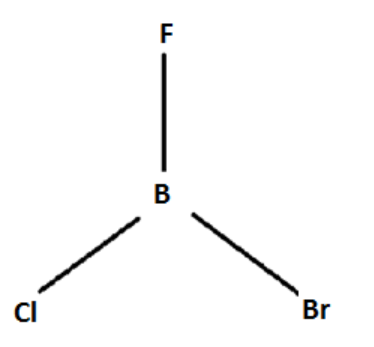
$s{p^2}$ , Trigonal planar polar
B) ${B_3}{N_6}{H_6}$
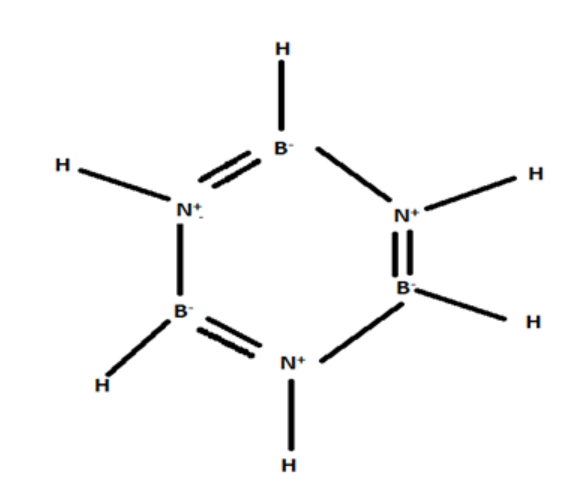
Planar, Non-polar
C) $Cl{F_3}$
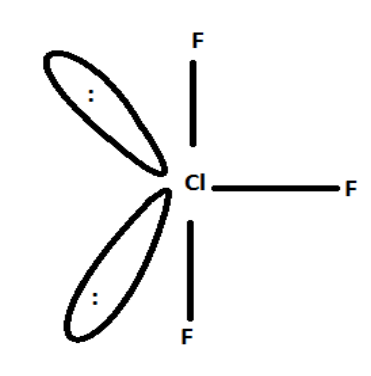
Planar, Polar
D) ${H_2}C = C = C = C{F_2}$

Planar, Polar
Option (A), (C), (D) are correct.
Note:
The general idea of the student that the compound in which the central atom has $sp/s{p^2}$ hybridization is planar might not work in analyzing allenes (in option (D)). So, a general simple rule that students should follow is – The molecule will not be planar if there is an $s{p^3}$ hybridized carbon or two $s{p^2}/sp$ hybridized atoms separated by odd number of double bonds while others are planar.
Complete step by step answer:
To determine the molecules that are polar as well as planar.
First of all molecular geometry is 3D arrangement of atoms or molecules around a central atom which is helpful in determining polarity. The Lewis dot structure helps us predict the bond pairs and the lone pairs. After that, we apply the valence-shell-electron-pair-repulsion (VSEPR) theory which states that electron pairs (both lone pair and bond pair) repel each other.
After the 3D representation of the molecule using VSEPR rules, if molecules have symmetry around the central atom, bond dipole cancels each other and molecule is nonpolar. And if the molecule is asymmetric, the dipole moment doesn’t cancel out. Thus, the molecules are polar.
We draw the 3D structure of the molecules given –
A) $BFClBr$
$s{p^2}$ , Trigonal planar polar
B) ${B_3}{N_6}{H_6}$
Planar, Non-polar
C) $Cl{F_3}$
Planar, Polar
D) ${H_2}C = C = C = C{F_2}$
Planar, Polar
Option (A), (C), (D) are correct.
Note:
The general idea of the student that the compound in which the central atom has $sp/s{p^2}$ hybridization is planar might not work in analyzing allenes (in option (D)). So, a general simple rule that students should follow is – The molecule will not be planar if there is an $s{p^3}$ hybridized carbon or two $s{p^2}/sp$ hybridized atoms separated by odd number of double bonds while others are planar.
Recently Updated Pages
JEE Main Mock Test 2025-26: Principles Related To Practical

JEE Main 2025-26 Experimental Skills Mock Test – Free Practice
JEE Main 2025-26 Electronic Devices Mock Test: Free Practice Online
JEE Main 2025-26 Mock Tests: Free Practice Papers & Solutions
JEE Main 2025-26: Magnetic Effects of Current & Magnetism Mock Test
JEE Main Statistics and Probability Mock Test 2025-26
Trending doubts
JEE Main 2026: Exam Dates, Session 2 Updates, City Slip, Admit Card & Latest News
JEE Main Participating Colleges 2026 - A Complete List of Top Colleges
Hybridisation in Chemistry – Concept, Types & Applications
Understanding the Electric Field of a Uniformly Charged Ring
Derivation of Equation of Trajectory Explained for Students
How to Convert a Galvanometer into an Ammeter or Voltmeter
Other Pages
JEE Advanced 2026 Notification Out with Exam Date, Registration (Extended), Syllabus and More
JEE Advanced Percentile vs Marks 2026: JEE Main Cutoff, AIR & IIT Admission Guide
JEE Advanced Weightage Chapter Wise 2026 for Physics, Chemistry, and Mathematics
JEE Advanced Marks vs Rank 2025 - Predict Your IIT Rank Based on Score
NCERT Solutions For Class 11 Chemistry In Hindi Chapter 1 Some Basic Concepts Of Chemistry - 2025-26
Understanding Electromagnetic Waves and Their Importance