




Which of the following compounds has an isopropyl group?
A.2 – methyl pentane
B.2, 2, 3 – trimethylpentane
C.2, 2, 3, 3 – tetramethyl pentane
D.All of these
Answer
 Verified
279.6k+ views
Hint: While considering the propyl group, the carbon atoms at the position 1 and 2 have the capacity to form a carbocation. If the carbocation is formed at position 1, then the propyl group is named as n – propyl. On the other hand, if the carbocation is formed at position 2, then the propyl group is known as isopropyl.
Complete Step-by-Step Answer:
Before we move towards the solution of this question, let us first understand some important basic concepts.
Alkanes are aliphatic organic compounds which have a minimum of 1 and maximum ‘n’ number of carbon atoms. Also, only sigma bonds are present in alkanes. This means that alkanes are formed only with single bonds, and not double or triple bonds. When we make an alkane with 3 carbon atoms, then the organic compound is known as propane. The chemical formula for propane can be given as \[{C_3}{H_8}\] . Propane loses one hydrogen atom to form the propyl group. This propyl group takes place in various reactions and acts as a site for substitution, addition, or elimination. It can be basically explained as a three-carbon alkane with a carbocation.
Now, this propyl group may have one terminal or one internal carbocation site. In simpler terms, the carbon atoms at the position 1 and 2 have the capacity to form a carbocation. If the carbocation is formed at position 1, then the propyl group is named as n – propyl. On the other hand, if the carbocation is formed at position 2, then the propyl group is known as isopropyl. The molecular structure of isopropyl group can be shown as follows:

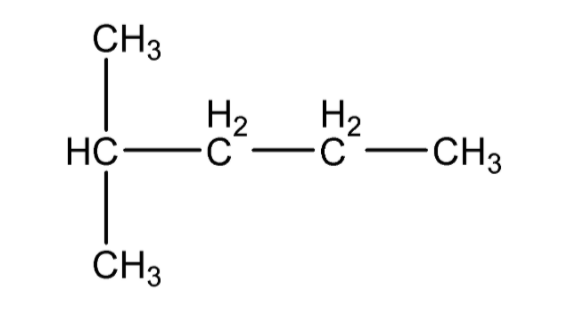
Now, moving back to the question, we can identify the presence of isopropyl groups by observing the molecular structures of the given compounds.
A.2 – methyl pentane
B.2, 2, 3 – trimethylpentane

C.2, 2, 3, 3 – tetramethyl pentane
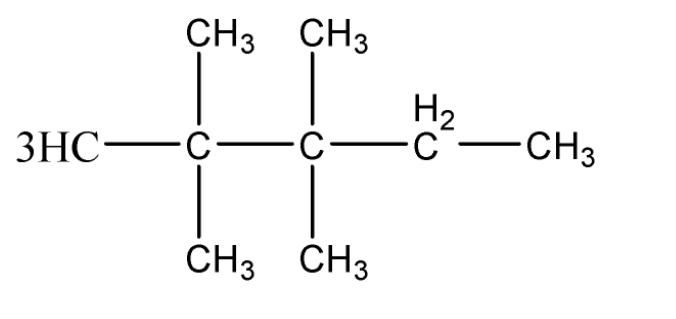
Hence, we can observe that 2 – methyl pentane is the only compound that has an isopropyl group present.
Hence, Option A is the correct option
Note: We know that higher the degree of the carbocation, higher is the stability of the compound. Hence \[2^\circ \] carbocation is more stable than \[1^\circ \] carbocation. This means that the isopropyl group is more stable than n – propyl group.
Complete Step-by-Step Answer:
Before we move towards the solution of this question, let us first understand some important basic concepts.
Alkanes are aliphatic organic compounds which have a minimum of 1 and maximum ‘n’ number of carbon atoms. Also, only sigma bonds are present in alkanes. This means that alkanes are formed only with single bonds, and not double or triple bonds. When we make an alkane with 3 carbon atoms, then the organic compound is known as propane. The chemical formula for propane can be given as \[{C_3}{H_8}\] . Propane loses one hydrogen atom to form the propyl group. This propyl group takes place in various reactions and acts as a site for substitution, addition, or elimination. It can be basically explained as a three-carbon alkane with a carbocation.
Now, this propyl group may have one terminal or one internal carbocation site. In simpler terms, the carbon atoms at the position 1 and 2 have the capacity to form a carbocation. If the carbocation is formed at position 1, then the propyl group is named as n – propyl. On the other hand, if the carbocation is formed at position 2, then the propyl group is known as isopropyl. The molecular structure of isopropyl group can be shown as follows:
Now, moving back to the question, we can identify the presence of isopropyl groups by observing the molecular structures of the given compounds.
A.2 – methyl pentane
B.2, 2, 3 – trimethylpentane
C.2, 2, 3, 3 – tetramethyl pentane
Hence, we can observe that 2 – methyl pentane is the only compound that has an isopropyl group present.
Hence, Option A is the correct option
Note: We know that higher the degree of the carbocation, higher is the stability of the compound. Hence \[2^\circ \] carbocation is more stable than \[1^\circ \] carbocation. This means that the isopropyl group is more stable than n – propyl group.
Recently Updated Pages
With which part the mRNA should be bound to initiate class 12 biology JEE_Main

Which one of the following is an example of a biofertiliser class 12 biology JEE_Main
A straight line goes through the points pq and rs -class-11-mathematics-JEE_Main
Which of the following protein destroys the antigen class 12 biology JEE_Main
Which of the following scientists discovered the Pasteurization class 11 biology JEE_Main
Explain the experiment of Julius von Sachs class 11 biology JEE_Main
Trending doubts
JEE Main 2026: Exam Dates, Session 2 Updates, City Slip, Admit Card & Latest News
Understanding the Electric Field of a Uniformly Charged Ring
Understanding Atomic Structure for Beginners
Derivation of Equation of Trajectory Explained for Students
Understanding the Different Types of Solutions in Chemistry
How to Convert a Galvanometer into an Ammeter or Voltmeter
Other Pages
JEE Advanced 2026 Notification Out with Exam Date, Registration (Extended), Syllabus and More
JEE Advanced Percentile vs Marks 2026: JEE Main Cutoff, AIR & IIT Admission Guide
JEE Advanced Weightage Chapter Wise 2026 for Physics, Chemistry, and Mathematics
NCERT Solutions For Class 11 Chemistry In Hindi Chapter 1 Some Basic Concepts Of Chemistry - 2026-27
Electron Gain Enthalpy and Electron Affinity Explained
Understanding Instantaneous Velocity