




What is conformation in alkanes?
Answer
 Verified
292.8k+ views
Hint: Alkanes contain C-C sigma bonds. The charge distribution of the sigma molecular orbital is symmetrical near the internuclear axis of the C–C bond. This charge distribution will remain undisturbed for any rotation about its axis. This allows unrestricted rotation of the C–C single bond.
Complete Step by Step Solution:
The rotation of the C-C single bond yields various spatial arrangements of atoms in space that are interchangeable.
The spatial arrangements of atoms that can be modified into one another by rotation around a C-C single bond are called conformations.
Alkanes can therefore have an infinite number of conformations by rotating around C-C single bonds.
Conformations of ethane
Ethane comprises a carbon-carbon single bond with each carbon atom attached to three hydrogen atoms.
Suppose we retain one carbon atom stationary and rotate the other carbon atom around the C-C axis. In that case, this rotation yields a vast no.of spatial arrangements of hydrogen atoms connected to one carbon atom for the hydrogen atoms bonded to the other carbon atom.
These are known as conformational isomers (conformers).
I) Eclipsed conformation - Here hydrogen atoms connected to two carbons are close to each other.
ii) Staggered conformation - Here hydrogens are far apart from each other.
These two conformations can be represented by many projections one of them is Sawhorse projections.
Sawhorse projections
In this, front carbon is demonstrated at the lower end of the line, whereas the rear carbon is exhibited at the upper end.
Each carbon has three lines connecting it to three hydrogen atoms.
The lines are inclined at an angle of 120° to each other.
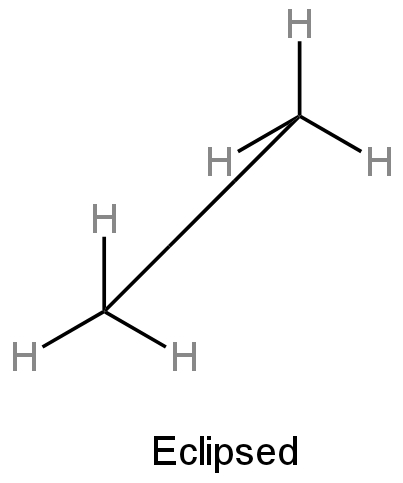
Image: Eclipsed conformation of ethane
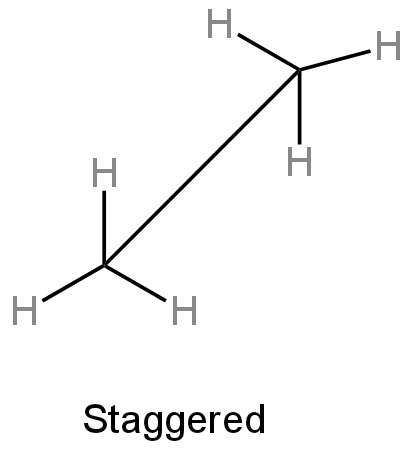
Image: Staggered conformation of ethane
Note: The rotation around a C-C single bond is not entirely free.
It is hindered by a small energy barrier of 1-20 kJ/mol due to weak repulsion between the adjacent bonds. This category of repulsive interaction is called torsional strain.
Complete Step by Step Solution:
The rotation of the C-C single bond yields various spatial arrangements of atoms in space that are interchangeable.
The spatial arrangements of atoms that can be modified into one another by rotation around a C-C single bond are called conformations.
Alkanes can therefore have an infinite number of conformations by rotating around C-C single bonds.
Conformations of ethane
Ethane comprises a carbon-carbon single bond with each carbon atom attached to three hydrogen atoms.
Suppose we retain one carbon atom stationary and rotate the other carbon atom around the C-C axis. In that case, this rotation yields a vast no.of spatial arrangements of hydrogen atoms connected to one carbon atom for the hydrogen atoms bonded to the other carbon atom.
These are known as conformational isomers (conformers).
I) Eclipsed conformation - Here hydrogen atoms connected to two carbons are close to each other.
ii) Staggered conformation - Here hydrogens are far apart from each other.
These two conformations can be represented by many projections one of them is Sawhorse projections.
Sawhorse projections
In this, front carbon is demonstrated at the lower end of the line, whereas the rear carbon is exhibited at the upper end.
Each carbon has three lines connecting it to three hydrogen atoms.
The lines are inclined at an angle of 120° to each other.
Image: Eclipsed conformation of ethane
Image: Staggered conformation of ethane
Note: The rotation around a C-C single bond is not entirely free.
It is hindered by a small energy barrier of 1-20 kJ/mol due to weak repulsion between the adjacent bonds. This category of repulsive interaction is called torsional strain.
Recently Updated Pages
JEE Main 2023 (February 1st Shift 2) Physics Question Paper with Answer Key

JEE Main 2023 (February 1st Shift 1) Maths Question Paper with Answer Key
JEE Main 2023 (February 1st Shift 2) Chemistry Question Paper with Answer Key
Hydrogen and Its Type Important Concepts and Tips for JEE Exam Preparation
JEE Main 2023 (February 1st Shift 2) Maths Question Paper with Answer Key
JEE Main 2023 (February 1st Shift 1) Physics Question Paper with Answer Key
Trending doubts
JEE Main 2026: Exam Dates, Session 2 Updates, City Slip, Admit Card & Latest News
Understanding the Electric Field of a Uniformly Charged Ring
Understanding Atomic Structure for Beginners
Electron Gain Enthalpy and Electron Affinity Explained
Derivation of Equation of Trajectory Explained for Students
Understanding the Different Types of Solutions in Chemistry
Other Pages
JEE Advanced Percentile vs Marks 2026: JEE Main Cutoff, AIR & IIT Admission Guide
JEE Advanced 2026 Notification Out with Exam Date, Registration (Extended), Syllabus and More
NCERT Solutions For Class 11 Chemistry In Hindi Chapter 1 Some Basic Concepts Of Chemistry - 2026-27 Free PDF Download (Sign-in Required)
How to Convert a Galvanometer into an Ammeter or Voltmeter
JEE Advanced Weightage Chapter Wise 2026 for Physics, Chemistry, and Mathematics
What Are Current and Potential Difference in Electricity?
JEE Advanced Percentile vs Marks 2026: JEE Main Cutoff, AIR & IIT Admission Guide
JEE Advanced 2026 Notification Out with Exam Date, Registration (Extended), Syllabus and More
NCERT Solutions For Class 11 Chemistry In Hindi Chapter 1 Some Basic Concepts Of Chemistry - 2026-27 Free PDF Download (Sign-in Required)