




What is an orthogonal vector?
Answer
 Verified
264.9k+ views
Hint: In this question, we need to define the concept of an orthogonal vector and its significance. The word “orthogonal” means “perpendicular”. In simple words, it means right angle.
Also, the vector is a quantity that has both magnitude and direction.
Complete step by step answer:
Consider two vectors \[m\] and \[n\] are any two vectors.
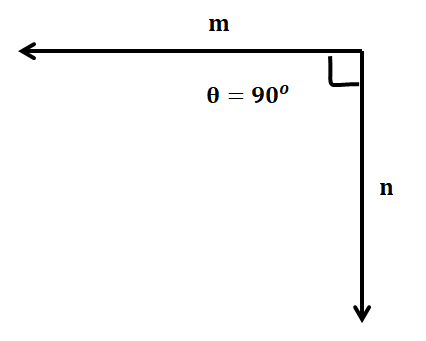
Image: Orthogonal Vector
The vectors \[m\]and \[n\] are said to be orthogonal if and only if the angle between them is \[{90^o}\]. That means they are perpendicular to each other. Also, it is denoted by \[m \bot n\].
Therefore, the two vectors are orthogonal means they are perpendicular.
Note: The vectors \[m\] and \[n\] are said to be orthogonal if and only if the angle between them is \[{90^o}\]. That means they are perpendicular to each other. Also, it is denoted by \[m \bot n\].
Therefore, the two vectors are orthogonal means they are perpendicular.
Additional Information: Vectors are geometrical structures with magnitude and direction. A vector can be visualised as a line with an arrow pointing toward its direction and its length showing the vector's magnitude. As a result, vectors are depicted by arrows and have starting and end points. If we look at the characteristics of orthogonal vectors, we can see that the zero vectors, which are effectively zero, are virtually orthogonal to each and every vector.
Also, the vector is a quantity that has both magnitude and direction.
Complete step by step answer:
Consider two vectors \[m\] and \[n\] are any two vectors.
Image: Orthogonal Vector
The vectors \[m\]and \[n\] are said to be orthogonal if and only if the angle between them is \[{90^o}\]. That means they are perpendicular to each other. Also, it is denoted by \[m \bot n\].
Therefore, the two vectors are orthogonal means they are perpendicular.
Note: The vectors \[m\] and \[n\] are said to be orthogonal if and only if the angle between them is \[{90^o}\]. That means they are perpendicular to each other. Also, it is denoted by \[m \bot n\].
Therefore, the two vectors are orthogonal means they are perpendicular.
Additional Information: Vectors are geometrical structures with magnitude and direction. A vector can be visualised as a line with an arrow pointing toward its direction and its length showing the vector's magnitude. As a result, vectors are depicted by arrows and have starting and end points. If we look at the characteristics of orthogonal vectors, we can see that the zero vectors, which are effectively zero, are virtually orthogonal to each and every vector.
Recently Updated Pages
JEE Main Mock Test 2025-26: Principles Related To Practical

JEE Main 2025-26 Experimental Skills Mock Test – Free Practice
JEE Main 2025-26 Electronic Devices Mock Test: Free Practice Online
JEE Main 2025-26 Mock Tests: Free Practice Papers & Solutions
JEE Main 2025-26: Magnetic Effects of Current & Magnetism Mock Test
JEE Main Statistics and Probability Mock Test 2025-26
Trending doubts
JEE Main 2026: Exam Dates, Session 2 Updates, City Slip, Admit Card & Latest News
JEE Main Participating Colleges 2026 - A Complete List of Top Colleges
Hybridisation in Chemistry – Concept, Types & Applications
Understanding the Electric Field of a Uniformly Charged Ring
Derivation of Equation of Trajectory Explained for Students
How to Convert a Galvanometer into an Ammeter or Voltmeter
Other Pages
JEE Advanced 2026 Notification Out with Exam Date, Registration (Extended), Syllabus and More
JEE Advanced Percentile vs Marks 2026: JEE Main Cutoff, AIR & IIT Admission Guide
JEE Advanced Weightage Chapter Wise 2026 for Physics, Chemistry, and Mathematics
JEE Advanced Marks vs Rank 2025 - Predict Your IIT Rank Based on Score
Understanding Electromagnetic Waves and Their Importance
JEE Main Marking Scheme 2026- Paper-Wise Marks Distribution and Negative Marking Details