




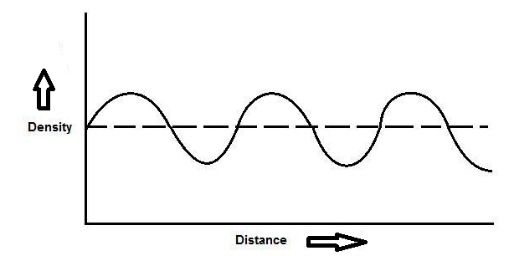
What type of wave is represented by a density-distance graph?
A. Transverse wave
B. Longitudinal wave
C. Water wave
D. Light wave
Answer
 Verified
264.9k+ views
Hint: To solve this question, we need to know the basic theory related to the Longitudinal wave, Transverse wave, Water wave and Light wave. As we know the density-distance graph for a longitudinal wave at any point of time is drawn by plotting the particle density of the medium on the y -axis against distance on the x-axis as discussed below.
Complete step by step answer:
Mechanical waves are classified by their type of motion and fall into any of two categories: longitudinal or transverse.
Remember that both waves (transverse and longitudinal waves) can be periodic. A transverse wave propagates in such a way that the disturbance is always perpendicular to the direction of motion.
Light can be modeled as an electromagnetic wave. In this system, a varying electric field creates a changing magnetic field. This varying magnetic field then creates a change in the electric field.
Water waves involve a combination of both waves (longitudinal and transverse motions) and As a results water waves travel through the water. The radius of the water wave circles decreases as the depth into the water increases.
Therefore, we concluded that the Longitudinal wave is always represented by a density-distance graph. Longitudinal waves consist of compression and rarefaction in the medium.
Always remember that In the compression area air density is extremely higher than the normal air density while in case of rarefaction zone the air density is lower than the normal air density.
Therefore the correct option is B
Note: Always remember that in a density-distance graph, Compression refers to the region of high density or concentration or pressure and Rarefaction refers to the region of low density or concentration or pressure.
Complete step by step answer:
Mechanical waves are classified by their type of motion and fall into any of two categories: longitudinal or transverse.
Remember that both waves (transverse and longitudinal waves) can be periodic. A transverse wave propagates in such a way that the disturbance is always perpendicular to the direction of motion.
Light can be modeled as an electromagnetic wave. In this system, a varying electric field creates a changing magnetic field. This varying magnetic field then creates a change in the electric field.
Water waves involve a combination of both waves (longitudinal and transverse motions) and As a results water waves travel through the water. The radius of the water wave circles decreases as the depth into the water increases.
Therefore, we concluded that the Longitudinal wave is always represented by a density-distance graph. Longitudinal waves consist of compression and rarefaction in the medium.
Always remember that In the compression area air density is extremely higher than the normal air density while in case of rarefaction zone the air density is lower than the normal air density.
Therefore the correct option is B
Note: Always remember that in a density-distance graph, Compression refers to the region of high density or concentration or pressure and Rarefaction refers to the region of low density or concentration or pressure.
Recently Updated Pages
JEE Main Mock Test 2025-26: Principles Related To Practical

JEE Main 2025-26 Experimental Skills Mock Test – Free Practice
JEE Main 2025-26 Electronic Devices Mock Test: Free Practice Online
JEE Main 2025-26 Mock Tests: Free Practice Papers & Solutions
JEE Main 2025-26: Magnetic Effects of Current & Magnetism Mock Test
JEE Main Statistics and Probability Mock Test 2025-26
Trending doubts
JEE Main 2026: Exam Dates, Session 2 Updates, City Slip, Admit Card & Latest News
JEE Main Participating Colleges 2026 - A Complete List of Top Colleges
Hybridisation in Chemistry – Concept, Types & Applications
Understanding the Electric Field of a Uniformly Charged Ring
Derivation of Equation of Trajectory Explained for Students
How to Convert a Galvanometer into an Ammeter or Voltmeter
Other Pages
JEE Advanced 2026 Notification Out with Exam Date, Registration (Extended), Syllabus and More
JEE Advanced Percentile vs Marks 2026: JEE Main Cutoff, AIR & IIT Admission Guide
CBSE Notes Class 11 Physics Chapter 1 - Units And Measurements - 2025-26
NCERT Solutions For Class 11 Physics Chapter 1 Units And Measurements - 2025-26
Important Questions For Class 11 Physics Chapter 1 Units and Measurement - 2025-26
JEE Advanced Weightage Chapter Wise 2026 for Physics, Chemistry, and Mathematics