




Two normal uniform magnetic field contain a magnetic needle making an angle ${60^ \circ }$ with F. Then the ratio of $\dfrac{F}{H}$ is ?
A. $1:2$
B. $2:1$
C. $\sqrt 3 :1$
D. $1:\sqrt 3 $
Answer
 Verified
232.8k+ views
Hint: We are aware that the Earth's magnetosphere is made up of the geomagnetic field, also known as the Earth's magnetic field, which effectively reaches into space for thousands of kilometres. Near the equator, when the field is horizontal, its strength is at its lowest. Gauss units are used to express the magnetic field's intensity.
Formula used:
$H = F\tan \theta $
where $\theta $ defines the angle through which the needle deflects.
Complete step by step solution:
We are aware that the portion of a material's magnetic field that results from an external current and is not intrinsic to the material itself is known as magnetic field strength, also known as magnetic intensity or magnetic field intensity.
We can also draw the conclusion that an angle is a measurement of how far an object is moving from its intended course. Measured between the line of sight to the target and the line of sight to the aiming point, the angle of a deflection shot in gunnery.
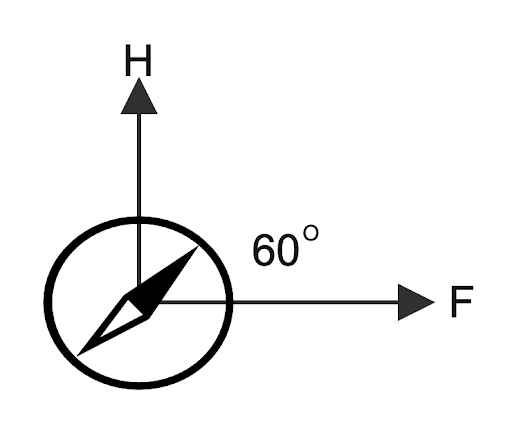
We know that $H = F\tan \theta $ where $\theta $ defines the angle through which the needle deflects.
So, at the equilibrium of needle we can say that putting$\theta = {60^ \circ }$
$\tan {60^ \circ } = \dfrac{H}{F}$
$ \Rightarrow \sqrt 3 = \dfrac{H}{F}$
$\therefore \dfrac{F}{H} = \dfrac{1}{{\sqrt 3 }}$
Hence the correct option is D.
Note: It is important to keep in mind the following facts about the magnetic field:
- There are two different types of magnetic fields: the B-field and the H-field.
- Teslas are used to measure B-field (T). A/m units are used to express the H-field.
- The earth's magnetic field is oriented so that it extends from its magnetic north pole to its magnetic south pole. The inclined bar magnet is merely a fictitious magnet; it does not exist.
Formula used:
$H = F\tan \theta $
where $\theta $ defines the angle through which the needle deflects.
Complete step by step solution:
We are aware that the portion of a material's magnetic field that results from an external current and is not intrinsic to the material itself is known as magnetic field strength, also known as magnetic intensity or magnetic field intensity.
We can also draw the conclusion that an angle is a measurement of how far an object is moving from its intended course. Measured between the line of sight to the target and the line of sight to the aiming point, the angle of a deflection shot in gunnery.
We know that $H = F\tan \theta $ where $\theta $ defines the angle through which the needle deflects.
So, at the equilibrium of needle we can say that putting$\theta = {60^ \circ }$
$\tan {60^ \circ } = \dfrac{H}{F}$
$ \Rightarrow \sqrt 3 = \dfrac{H}{F}$
$\therefore \dfrac{F}{H} = \dfrac{1}{{\sqrt 3 }}$
Hence the correct option is D.
Note: It is important to keep in mind the following facts about the magnetic field:
- There are two different types of magnetic fields: the B-field and the H-field.
- Teslas are used to measure B-field (T). A/m units are used to express the H-field.
- The earth's magnetic field is oriented so that it extends from its magnetic north pole to its magnetic south pole. The inclined bar magnet is merely a fictitious magnet; it does not exist.
Recently Updated Pages
JEE Main 2023 April 6 Shift 1 Question Paper with Answer Key

JEE Main 2023 April 6 Shift 2 Question Paper with Answer Key
JEE Main 2023 (January 31 Evening Shift) Question Paper with Solutions [PDF]
JEE Main 2023 January 30 Shift 2 Question Paper with Answer Key
JEE Main 2023 January 25 Shift 1 Question Paper with Answer Key
JEE Main 2023 January 24 Shift 2 Question Paper with Answer Key
Trending doubts
JEE Main 2026: Session 2 Registration Open, City Intimation Slip, Exam Dates, Syllabus & Eligibility
JEE Main 2026 Application Login: Direct Link, Registration, Form Fill, and Steps
Understanding the Angle of Deviation in a Prism
Hybridisation in Chemistry – Concept, Types & Applications
How to Convert a Galvanometer into an Ammeter or Voltmeter
Understanding Uniform Acceleration in Physics
Other Pages
JEE Advanced Marks vs Ranks 2025: Understanding Category-wise Qualifying Marks and Previous Year Cut-offs
Dual Nature of Radiation and Matter Class 12 Physics Chapter 11 CBSE Notes - 2025-26
Understanding the Electric Field of a Uniformly Charged Ring
JEE Advanced Weightage 2025 Chapter-Wise for Physics, Maths and Chemistry
Derivation of Equation of Trajectory Explained for Students
Understanding Electromagnetic Waves and Their Importance